


Dual MAFs with EU


Registered User
Joined: Jun 2003
Posts: 112
Likes: 0
From: GARDEN GROVE, CA

Gurgen:
In '91 I made a MAF converter box for George Spears, of Spearco. It was for a prototype twin turbo Mustang he built for an Australian company called DDMI. David Inall was the engineer he was working with. I believe he now works at APS.
George wanted to draw through the MAF, but if you did that, you would only get half the airflow reading. Note that since the MAF signal is non linear, you can't just multiply the number by two.
Ford provided the airflow specs for the meter, and I programmed a uP to convert the half airflow signal into a pseudo full flow value. It was basically a lookup table of values. It worked, but the engine would sometimes die when coming to a stop. I think it was a reversion problem. I don't know what they did to fix that.
We also installed a J&S knock controller before the car was shipped to Australia. They deleted it in the production version of the kit, in favor of turning the distributor back four degrees. Arg.
I googled and found this: Whoosh! Radical twin-turbo 5.0 power from down under, via Los Angeles. Super Ford Magazine, January 1993 pg. 16, by Tom Wilson - details the technical specifications and parts for the Design, Development, and Manufacture International (DDMI) and Spearco twin turbo EFI Mustang kit.
In '91 I made a MAF converter box for George Spears, of Spearco. It was for a prototype twin turbo Mustang he built for an Australian company called DDMI. David Inall was the engineer he was working with. I believe he now works at APS.
George wanted to draw through the MAF, but if you did that, you would only get half the airflow reading. Note that since the MAF signal is non linear, you can't just multiply the number by two.
Ford provided the airflow specs for the meter, and I programmed a uP to convert the half airflow signal into a pseudo full flow value. It was basically a lookup table of values. It worked, but the engine would sometimes die when coming to a stop. I think it was a reversion problem. I don't know what they did to fix that.
We also installed a J&S knock controller before the car was shipped to Australia. They deleted it in the production version of the kit, in favor of turning the distributor back four degrees. Arg.
I googled and found this: Whoosh! Radical twin-turbo 5.0 power from down under, via Los Angeles. Super Ford Magazine, January 1993 pg. 16, by Tom Wilson - details the technical specifications and parts for the Design, Development, and Manufacture International (DDMI) and Spearco twin turbo EFI Mustang kit.
Thread Starter

Joined: Aug 2003
Posts: 1,211
Likes: 1
From: Los Angeles, CA
Wow good info John, thanks. I'll look this up.
I understand the fact that AMF is not a linear voltage output (in ref to the airflow). A look up table is exactly what I am working with, this is available in the eManage ultiamte. I will first run the stock MAF in the stock location, with the pre-turbo maf in place as well. This will allow me to build a fairly comprehensive table, with the pre-turbo MAF voltage as the Y-axis, rpm as the x-axis, and stock MAF voltage as it's values, with a 4.9x V as the "clamped" voltage, the maximum it can reach, This will become the Airflow output table in the EU, which in theory should allow me to remove the stock MAF sensor. The benefit of course is that now I will have much greater range on the pre-turbo MAF, as it's only measuring half the airflow. All theory at this point, but we'll see.
Please tell me what you think. Thanks
P.S. I have been trying to get a hold of you for a long time, please PM me your new contact info, I have got that barebone displat circuit board to return to you. Thanks
I understand the fact that AMF is not a linear voltage output (in ref to the airflow). A look up table is exactly what I am working with, this is available in the eManage ultiamte. I will first run the stock MAF in the stock location, with the pre-turbo maf in place as well. This will allow me to build a fairly comprehensive table, with the pre-turbo MAF voltage as the Y-axis, rpm as the x-axis, and stock MAF voltage as it's values, with a 4.9x V as the "clamped" voltage, the maximum it can reach, This will become the Airflow output table in the EU, which in theory should allow me to remove the stock MAF sensor. The benefit of course is that now I will have much greater range on the pre-turbo MAF, as it's only measuring half the airflow. All theory at this point, but we'll see.
Please tell me what you think. Thanks
P.S. I have been trying to get a hold of you for a long time, please PM me your new contact info, I have got that barebone displat circuit board to return to you. Thanks

Registered User
Joined: Jan 2004
Posts: 1,337
Likes: 0
From: ATL-What U Know About That???
Hey GurgenPB, here's a post I replied to back '01 on the Supra boards when a lot of us were considering dual maf set-ups. I believe the theory should still be the same 4 years later  Hope it helps..
Hope it helps..
Originally Posted by ATLSUPDAWG#2
This is a ops scenario that I came up with based on what I read about the MAF's operation.
"A"=Thermistor
"B"=Platinum Hot Wire
The stock MAF can only meter so much air based on its operating principle of trying to maintain a common resistance between "A" and "B" by adjusting the voltage to the platinum hot wire. The more airflow you have = cooler hot wire = less resistance = more voltage to keep the resistance equal to "A". The system can only provide so much voltage to keep "B" at the desired temp./resistance before it maxes out and there is not enough voltage left. This would be the scenario when upgrading to a large single turbo that flows more air than the stockers.
Running a dual MAF set-up would divide the load, so to speak, thus utilizing less voltage to keep the platinum wires hot. The voltage used to maintain the wires temp. is also what's measured by the ECU, which in turns adjusts the fuel accordingly. This can also lead to a false signal. If dual MAF's are requiring less voltage to keep the wires hot, the ECU will read this and assume that the airflow is less than what it actually is.
There was a previous post on here about the idea of fabricating a non-inverting amplifier to boost the voltage signal when using dual MAF's. It's an op amp circuit which you can find the schematic for on the National Semiconductor web page, just use a search engine to find the site. As far as the signal not being linear to airflow, the op amp circuits output is determined by its input. It's only job is to boost the voltage/signal.
Sorry for the long post and if there are any discrepencies please correct me as this is only my analysis of how a dual MAF set-up would be successful.
--B--
"A"=Thermistor
"B"=Platinum Hot Wire
The stock MAF can only meter so much air based on its operating principle of trying to maintain a common resistance between "A" and "B" by adjusting the voltage to the platinum hot wire. The more airflow you have = cooler hot wire = less resistance = more voltage to keep the resistance equal to "A". The system can only provide so much voltage to keep "B" at the desired temp./resistance before it maxes out and there is not enough voltage left. This would be the scenario when upgrading to a large single turbo that flows more air than the stockers.
Running a dual MAF set-up would divide the load, so to speak, thus utilizing less voltage to keep the platinum wires hot. The voltage used to maintain the wires temp. is also what's measured by the ECU, which in turns adjusts the fuel accordingly. This can also lead to a false signal. If dual MAF's are requiring less voltage to keep the wires hot, the ECU will read this and assume that the airflow is less than what it actually is.
There was a previous post on here about the idea of fabricating a non-inverting amplifier to boost the voltage signal when using dual MAF's. It's an op amp circuit which you can find the schematic for on the National Semiconductor web page, just use a search engine to find the site. As far as the signal not being linear to airflow, the op amp circuits output is determined by its input. It's only job is to boost the voltage/signal.
Sorry for the long post and if there are any discrepencies please correct me as this is only my analysis of how a dual MAF set-up would be successful.
--B--
Registered User
Joined: Jan 2004
Posts: 1,337
Likes: 0
From: ATL-What U Know About That???
Originally Posted by John at J&S
atlsupdawg#2
That approach is not accurate. I'll dig up my notes later.
That approach is not accurate. I'll dig up my notes later.
Now there's too many supporting mods available for anyone to even consider dual mafs (on the Supra end). Would be pretty interesting to see the outcome of this on twin turbo'd Z's.

Registered User
Joined: Jun 2003
Posts: 112
Likes: 0
From: GARDEN GROVE, CA
atlsupdawg#2:
Here's a plot of the data from the Ford 55mm MAF meter that we were working with:
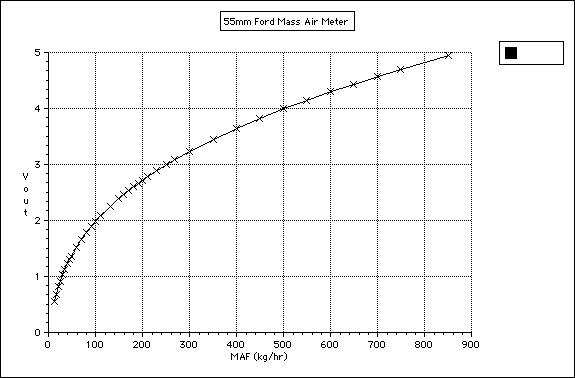
At 4.943v, the airflow is 850.76 kg/hr
Maximum half airflow is 850/2, or about 425 kg/hr, producing an output voltage of 3.74v
If you simply amplify that by two, then you get 7.48v, which is 51% too high.
At the lower end of the scale, for example, where the whole flow is 49 kg/hr, Vout=1.365v. Half airflow is 24.5 kg/hr, producing 0.93v. Doubling with an amplifier gives 1.86v, which is 36% too high.
This is why you can't simply multiply the half airflow reading by a fixed amount. It will only be correct at one point.
The easiest solution is to create a lookup table in a uP. I took the data and entered it into a program called "TK Solver", and it gave me a third order equation for that graph.
The equation is y = 6.7095 + 4.3116x + 13.3612xx + 4.1233xxx
Once you have that, you can use it to create your table.
Here's how it works: The uP reads the "half airflow" voltage, looks up the corresponding calculated value for the "whole airflow" voltage, and outputs it to a D/A converter.
Here's a plot of the data from the Ford 55mm MAF meter that we were working with:
At 4.943v, the airflow is 850.76 kg/hr
Maximum half airflow is 850/2, or about 425 kg/hr, producing an output voltage of 3.74v
If you simply amplify that by two, then you get 7.48v, which is 51% too high.
At the lower end of the scale, for example, where the whole flow is 49 kg/hr, Vout=1.365v. Half airflow is 24.5 kg/hr, producing 0.93v. Doubling with an amplifier gives 1.86v, which is 36% too high.
This is why you can't simply multiply the half airflow reading by a fixed amount. It will only be correct at one point.
The easiest solution is to create a lookup table in a uP. I took the data and entered it into a program called "TK Solver", and it gave me a third order equation for that graph.
The equation is y = 6.7095 + 4.3116x + 13.3612xx + 4.1233xxx
Once you have that, you can use it to create your table.
Here's how it works: The uP reads the "half airflow" voltage, looks up the corresponding calculated value for the "whole airflow" voltage, and outputs it to a D/A converter.
Thread Starter
Joined: Aug 2003
Posts: 1,211
Likes: 1
From: Los Angeles, CA
Great informaton.
As per our phone conversation, I will try to find a flowbench and do some experiments wth OUR MAFs. Anyone know one in NorCal? (or SoCal?)
As per our phone conversation, I will try to find a flowbench and do some experiments wth OUR MAFs. Anyone know one in NorCal? (or SoCal?)

Thread
Thread Starter
Forum
Replies
Last Post
350Z_Al
Exterior & Interior
133
Oct 29, 2020 07:44 PM
