


Stoptech Brake Test on Z


Registered User
Joined: Dec 2002
Posts: 1,223
Likes: 0
From: sactown, cali

hi jran76, thanx for the comopliment.
i was in the same situation as you were in. couldn't decide whether cross-drilled ot slotted.
i went the cross-drilled route because i'm into the looks of the car and that i only take my car to the track about 1-2 times a year. maybe autocross 1-2 times a year also.
but if i was doing track or autocros events more often, i would of chose slotted.
hope this helps.
john
i was in the same situation as you were in. couldn't decide whether cross-drilled ot slotted.
i went the cross-drilled route because i'm into the looks of the car and that i only take my car to the track about 1-2 times a year. maybe autocross 1-2 times a year also.
but if i was doing track or autocros events more often, i would of chose slotted.
hope this helps.
john

Thanks for the info....
I do plan to track it maybe 4-6 times a year, so I will probably go slotted. I agree the drilled look great, I got comments on my Maxima daily with drilled rotors, and that was on stock rotor sizes.
I do plan to track it maybe 4-6 times a year, so I will probably go slotted. I agree the drilled look great, I got comments on my Maxima daily with drilled rotors, and that was on stock rotor sizes.
Registered User
Joined: Jun 2002
Posts: 830
Likes: 0
From: Frisco, TX
Originally posted by jran76
Michael, I by no means an expert, so help me out here, what exactly is "scrubbing the pads" and assuming I am going Stoptech (which I plan to order tomorrow), which is better. I was set on slotted (because I have to agree, I don't think drilled add anything more than looks), but now....
Michael, I by no means an expert, so help me out here, what exactly is "scrubbing the pads" and assuming I am going Stoptech (which I plan to order tomorrow), which is better. I was set on slotted (because I have to agree, I don't think drilled add anything more than looks), but now....
Michael.
Michael
Thanks for the explanation, that make perfect sense. If I had to guess wear will not be too much worse (not half the life anyway), so this sounds like the way to go. I don't mind changing pads every 15,000 miles, or so (obviously if I go to the track I may get WAY less than that, but that is what the track is for).
Would you say a 10-20% decrease on brake pad life for slotted vs. drilled rotors?
Thanks for the explanation, that make perfect sense. If I had to guess wear will not be too much worse (not half the life anyway), so this sounds like the way to go. I don't mind changing pads every 15,000 miles, or so (obviously if I go to the track I may get WAY less than that, but that is what the track is for).
Would you say a 10-20% decrease on brake pad life for slotted vs. drilled rotors?

Registered User
Joined: Feb 2003
Posts: 109
Likes: 0
From: The distant Desert
Brakes are generally the last upgrade needed on a car.
The gains from cross drilled rotors are near nothing. They do look cool though.
I would never ever put cross drilled rotors on my car if the holes were "drilled" rather than "cast" during the manufacturing process.
There are some clubs out there that will nto allow people to run their cars with drilled rotors.
Plus, you can't have them turned like normal rotors.
The gains from cross drilled rotors are near nothing. They do look cool though.
I would never ever put cross drilled rotors on my car if the holes were "drilled" rather than "cast" during the manufacturing process.
There are some clubs out there that will nto allow people to run their cars with drilled rotors.
Plus, you can't have them turned like normal rotors.

Brakes are generally the last upgrade needed on a car.

Thread Starter
Registered User
Joined: Nov 2002
Posts: 28
Likes: 0
From: Los Altos, CA
Slotted rotors are there to release gases created by the pads getting hot, not scrub the pads.
As for the last post, most stock brakes will do one to two stops pretty much as good as a $5k kit. This is sufficient for safety.
As I said on the other board, unless you track your car a lot or just want the look, don't spend the money. For moderate or occassional track use upgraded pads, fluid and some ducting would likely work fine.
A BMW instructor and ex-professional driver says without exception every clubracer that buys big brakes is slower, at least at first, than they were before. You really want to brake as little as possible and as late as possible. It never hurts to have great brakes but the track brakes seems as if they would get the job done, especially with a high temp pad. You have to get pretty advanced to utilize the capacity of the Stoptech.
As for the last post, most stock brakes will do one to two stops pretty much as good as a $5k kit. This is sufficient for safety.
As I said on the other board, unless you track your car a lot or just want the look, don't spend the money. For moderate or occassional track use upgraded pads, fluid and some ducting would likely work fine.
A BMW instructor and ex-professional driver says without exception every clubracer that buys big brakes is slower, at least at first, than they were before. You really want to brake as little as possible and as late as possible. It never hurts to have great brakes but the track brakes seems as if they would get the job done, especially with a high temp pad. You have to get pretty advanced to utilize the capacity of the Stoptech.
Registered User
Joined: Dec 2002
Posts: 251
Likes: 0
From: Maplewood, NJ
Hello everyone! Someone sent me an email to tell me you guys had posted a link to my brake testing article and were discussing it, so I thought I would wander over and see what was going on.
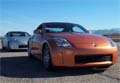
John350 - Nice car! I really like the way those brakes look. For the most part, we were working with flat black or unfinished engineering calipers, although we did use some new, red calipers on one of the tests. It's nice to see four, bright red calipers on your car! The combination of red calipers, drilled rotors, your choice of wheels and the color of your car combine for a stunning look. You need to get some photographs with a more scenic background, though.
I don't work for StopTech, so the layout, the photos, and the content are all mine. It was not my intent to advertise or push the modification of brakes. I was trying to give the reader a flavor for the level of effort StopTech puts into their testing as well as to explain the methodology. (At least to the level of detail their engineers would let me without giving away the fruits of their work.)
If you have any questions, I would be happy to answer them. I'm also a Brembo dealer and an enthusiast, so I won't be bringing any corporate bias into my answers. And if you have any comments or suggestions about the write-up, I would welcome them. If something was confusing, please let me know and I'll try to simplify or word it differently.
The article isn't fully complete yet. I also plan to write about their QA testing of calipers and brake lines. It's not quite as exciting as blasting down a runway in a 350Z, but it is pretty interesting.
John350 - Nice car! I really like the way those brakes look. For the most part, we were working with flat black or unfinished engineering calipers, although we did use some new, red calipers on one of the tests. It's nice to see four, bright red calipers on your car! The combination of red calipers, drilled rotors, your choice of wheels and the color of your car combine for a stunning look. You need to get some photographs with a more scenic background, though.
I don't work for StopTech, so the layout, the photos, and the content are all mine. It was not my intent to advertise or push the modification of brakes. I was trying to give the reader a flavor for the level of effort StopTech puts into their testing as well as to explain the methodology. (At least to the level of detail their engineers would let me without giving away the fruits of their work.)
If you have any questions, I would be happy to answer them. I'm also a Brembo dealer and an enthusiast, so I won't be bringing any corporate bias into my answers. And if you have any comments or suggestions about the write-up, I would welcome them. If something was confusing, please let me know and I'll try to simplify or word it differently.
The article isn't fully complete yet. I also plan to write about their QA testing of calipers and brake lines. It's not quite as exciting as blasting down a runway in a 350Z, but it is pretty interesting.

Registered User
Joined: Jul 2002
Posts: 1,510
Likes: 1
From: Santa Cruz, CA
Well, here's some user data regarding the Standard (non-Brembo) Z Brakes. Just talked to the shop where I had my engine, tranny, and diff fluid replaced and my brakes checked.
10,500 miles
2 Laguna Seca Track Days
3 AutoX's
All on stock brakes, pads, lines, and fluid.
font pads: 34-40% remaining
rear pads: 15% !!! remaining
Brakes are a bit squeaky, and I've been babying them for the last couple thousand miles (since I got back from Laguna), mainly because I was concerned about the pad wear.
I definitely noticed slight fade at Laguna, but it wasn't very bad. Probably mainly due to fluid. I am planning on getting the Stoptech 13" front kit (for both looks and performance - mainly looks), and I'll be looking around for some better rear pads, now that my stocks are about gone. Any suggestions?
My shop currently needs to order the stock rear pads from the dealer, and they are quoting $49.99 each plus $20.00 in lubrication charges (cleaning the pads, I guess). Installation was going to be approximately $160. I figure that now is a good time for me to invest in a jackstands, a floorjack, and the service manual since doing the rear brake job will pay for about half of those things.
Anyhow, just some data for ya!
-D'oh!
10,500 miles
2 Laguna Seca Track Days
3 AutoX's
All on stock brakes, pads, lines, and fluid.
font pads: 34-40% remaining
rear pads: 15% !!! remaining
Brakes are a bit squeaky, and I've been babying them for the last couple thousand miles (since I got back from Laguna), mainly because I was concerned about the pad wear.
I definitely noticed slight fade at Laguna, but it wasn't very bad. Probably mainly due to fluid. I am planning on getting the Stoptech 13" front kit (for both looks and performance - mainly looks), and I'll be looking around for some better rear pads, now that my stocks are about gone. Any suggestions?
My shop currently needs to order the stock rear pads from the dealer, and they are quoting $49.99 each plus $20.00 in lubrication charges (cleaning the pads, I guess). Installation was going to be approximately $160. I figure that now is a good time for me to invest in a jackstands, a floorjack, and the service manual since doing the rear brake job will pay for about half of those things.
Anyhow, just some data for ya!
-D'oh!
Originally posted by z461
What pads would you recommend? I heard by changing brake fluid, ss lines, and pads you can actually get some really good performance out of the stock brakes.. Is this true? What would you recommend?
What pads would you recommend? I heard by changing brake fluid, ss lines, and pads you can actually get some really good performance out of the stock brakes.. Is this true? What would you recommend?
Registered User
Joined: Jun 2002
Posts: 830
Likes: 0
From: Frisco, TX
Originally posted by S38
Slotted rotors are there to release gases created by the pads getting hot, not scrub the pads.
Slotted rotors are there to release gases created by the pads getting hot, not scrub the pads.
Q: Why are some rotors drilled or slotted?
A: Rotors are drilled to reduce rotating weight, an issue near and dear to racers searching for ways to minimize unsprung weight. Drilling diminishes a rotor's durability and cooling capacity.
Slots or grooves in rotor faces are partly a carryover from the days of asbestos pads. Asbestos and other organic pads were prone to "glazing" and the slots tended to help "scrape or de-glaze" them. Drilling and slotting rotors has become popular in street applications for their pure aesthetic value. Wilwood has a large selection of drilled and slotted rotors for a wide range of applications.
http://www.wilwood.com/faq.asp
Michael.
 Great thread!
Interesting test! Glad to see StopTech is doing specific research on the 350Z!
One flaw I noticed in the test...........the stock brakes were tested with OEM pads, and the StopTechs with ?. A better test would be with the same pad material on both set-ups. Then, we could determine if its the "Big Brakes", or an improved pad that made the difference.
A question for Coz@CZP? If I upgrade to SS lines for my stock, non-Brembo Z, are the fittings the same as with the front upgrade StopTecks? Or, phrased another way, are the SS lines the same?
One flaw I noticed in the test...........the stock brakes were tested with OEM pads, and the StopTechs with ?. A better test would be with the same pad material on both set-ups. Then, we could determine if its the "Big Brakes", or an improved pad that made the difference.
A question for Coz@CZP? If I upgrade to SS lines for my stock, non-Brembo Z, are the fittings the same as with the front upgrade StopTecks? Or, phrased another way, are the SS lines the same?
Originally posted by jran76
Do you have the ultimate pads for the rear (non-track)?
If you do, and if it's possible, add that to my order, and how much are they?
Do you have the ultimate pads for the rear (non-track)?
If you do, and if it's possible, add that to my order, and how much are they?
Re: Great thread!
Originally posted by EnthuZ
Interesting test! Glad to see StopTech is doing specific research on the 350Z!
One flaw I noticed in the test...........the stock brakes were tested with OEM pads, and the StopTechs with ?. A better test would be with the same pad material on both set-ups. Then, we could determine if its the "Big Brakes", or an improved pad that made the difference.
A question for Coz@CZP? If I upgrade to SS lines for my stock, non-Brembo Z, are the fittings the same as with the front upgrade StopTecks? Or, phrased another way, are the SS lines the same?
Interesting test! Glad to see StopTech is doing specific research on the 350Z!
One flaw I noticed in the test...........the stock brakes were tested with OEM pads, and the StopTechs with ?. A better test would be with the same pad material on both set-ups. Then, we could determine if its the "Big Brakes", or an improved pad that made the difference.
A question for Coz@CZP? If I upgrade to SS lines for my stock, non-Brembo Z, are the fittings the same as with the front upgrade StopTecks? Or, phrased another way, are the SS lines the same?
Registered User
Joined: Feb 2003
Posts: 109
Likes: 0
From: The distant Desert
I completely disagree. Brakes are a safety feature, and safety comes first. In fact, a lot of the big German "tuners" won't even sell you performance upgrades until you buy better brakes.
Most people who buy these kits are not die hard track junkies. The brakes look cool.
Slotted rotors are there to release gases created by the pads getting hot, not scrub the pads.
Wilwood saying that drilled rotors are lighter is obviously a true statement... but oh my god... how much weight could possibly be saved by drilling 1/4" holes all around the rotors.
Again, I am not a cross drilled rotor ****. I have them on my 911.
But I will argue that neither of them are really necessary for most applications.

New Member
Joined: Nov 2002
Posts: 119
Likes: 1
From: tx
Big brakes are not only for track days... think of commute to and from work... How many times do you brake (80 to 60 or 70 to 50 etc). Here is central Texas IH 35 from GeorgeTown to Buda has lots of these stop / slow downs from these speeds.
I'm glad the test was done with OEM pads. This gives me an idea of why my brakes smelled ... getting too close to the 800 deg mark??
I know I don't do 10 stop of 60 to 0 or 6 from 80 to 0 but I may do one of each and several from 70 to 50 in this stretch of I35. Will this be enough to get me in the range of 700 to 800 deg for OEM brakes on touring? From smell I think I have exceeded this temp range.
For us daily drivers (commuters) a better test would be how many 70 to 50/40 brake applications does it take to heat 'em brakes to 700/800 deg range (just before brake fade).
When I autocrossed the top speed seldom exceed 60 but the brakes did get hot! Yes, teachers always teached to keep speed constant and not to use brake......
So for me, track day consist of braking for SVU cutting me off on the slow lane so that SVU can pass another SVU in the fast lane! Yes, legal limit is 70/75 but actual flow is either 80 or 0 (parking lot).
Another question for this tread is at what temp do OEM brake setup start smelling from heat builtup?
I'm glad the test was done with OEM pads. This gives me an idea of why my brakes smelled ... getting too close to the 800 deg mark??
I know I don't do 10 stop of 60 to 0 or 6 from 80 to 0 but I may do one of each and several from 70 to 50 in this stretch of I35. Will this be enough to get me in the range of 700 to 800 deg for OEM brakes on touring? From smell I think I have exceeded this temp range.
For us daily drivers (commuters) a better test would be how many 70 to 50/40 brake applications does it take to heat 'em brakes to 700/800 deg range (just before brake fade).
When I autocrossed the top speed seldom exceed 60 but the brakes did get hot! Yes, teachers always teached to keep speed constant and not to use brake......
So for me, track day consist of braking for SVU cutting me off on the slow lane so that SVU can pass another SVU in the fast lane! Yes, legal limit is 70/75 but actual flow is either 80 or 0 (parking lot).
Another question for this tread is at what temp do OEM brake setup start smelling from heat builtup?
Registered User
Joined: Feb 2003
Posts: 109
Likes: 0
From: The distant Desert
LOL
Something about that just made me laugh.
"commuters"
I seriously doubt that you are coming close to boiling your brake fluid or even overheating your pads/rotors while driving home from work.
Bottom line is, these cool looking brake kits will waste about $2,000 of your hard earned cash unless your car is used specifically at the track.
If you want them... get them... but I still think they are unecessary.
They do look good though.
For us daily drivers (commuters) a better test would be how many 70 to 50/40 brake applications does it take to heat 'em brakes to 700/800 deg range (just before brake fade).
"commuters"
I seriously doubt that you are coming close to boiling your brake fluid or even overheating your pads/rotors while driving home from work.
Bottom line is, these cool looking brake kits will waste about $2,000 of your hard earned cash unless your car is used specifically at the track.
If you want them... get them... but I still think they are unecessary.
They do look good though.
Registered User
Joined: Dec 2002
Posts: 251
Likes: 0
From: Maplewood, NJ
Originally posted by DEMOman
Bottom line is, these cool looking brake kits will waste about $2,000 of your hard earned cash unless your car is used specifically at the track.
If you want them... get them... but I still think they are unecessary.
They do look good though.
Bottom line is, these cool looking brake kits will waste about $2,000 of your hard earned cash unless your car is used specifically at the track.
If you want them... get them... but I still think they are unecessary.
They do look good though.
When you step on the brake pedal in your totally stock car, there are several inches of pedal travel where nothing happens. Call this the "nothing zone." During this time, your stock, 17 pound iron caliper is centering itself about your rotor.
Next, there is a small zone of non-linear brake response to pedal input. This is where the rubber brake lines are starting to balloon, the floating caliper's frame is flexing, the pads are flexing about the point where the single piston is pushing them.
And finally, after most of the flex has been squeezed out of your system, there is a linear zone where a given input on pedal pressure results in a predictable and linear response in braking force.
With all this going on, there is a distinct delay in the onset of braking.
With an aftermarket, multi-piston brake kit, the caliper is rigidly mounted to the steering knuckle and the only moving parts are the featherweight pistons and the pads. The pedal travel is greatly reduced and linear braking occurs almost as soon as your foot hits the pedal. In other words, if a deer runs in front of your car, you can begin to stop sooner with an aftermarket brake setup than you can with stock.
On the street, when the stop is unexpected (panic stop), this advantage dwarfs the difference in stopping distance due to brake bias. For example, the StopTech brakes gain you 2 to 4 feet over the stock brakes because of their balance. If there's a 0.2 second advantage in reaction time and the driver is going 80 mph, then you've just shaved another 24 feet from the distance your car is going to travel from the point at which the driver starts to react.
This reaction time delay is completely irrelevant on the track because the race driver can always compensate for a delay in the onset of braking by hitting the brakes sooner. This is only important in a panic stop.
So this is one advantage that the big brake kits give you on the street that does not apply to the track. Although, it does help you if you need to brake on the track suddenly and unexpectedly to avoid another driver or some debris.
Big brake kits are very much like bigger sway bars, short shift kits, or big, fat steering wheels. They make the car feel better to drive and the give the driver more self confidence. They just feel good! I have 4-wheel brake kits on both my street cars, even though neither one sees any track time. I have a dedicated track car for that. My wife and I simply learned to love the feel of racing brakes at the track and anything less just feels crummy on the street.