


'Merica! Go big or go home = installing LS engine into drift car


not only syncro issues but at higher power that start grenading as well, throwing 1000 whp into a stock t56 is just asking to have teeth ripped off the gears why the "transzilla"is only rated to 1200 and the "son of transzilla" is only 800 although they both use carbon syncros so syncros are a non issue. based on my experience with gforce i would never in a million years touch anything of theres, they used to hype up there wc t5's to the third gen camaro guys(weak tranny to start with a stock vq would rip it to pieces) as being able to hold 500 whp and they were still shredding gears at only 300. thats coming from experience with them not something i read.
any decent trans that gives you everything you want for competition, smooth quick shifting, longevity, power capacity is going to run you 5-6k+ some of them(coughcoughviperemcocoughcough) will run you as much as 25k
any decent trans that gives you everything you want for competition, smooth quick shifting, longevity, power capacity is going to run you 5-6k+ some of them(coughcoughviperemcocoughcough) will run you as much as 25k
Sorry to hear that, maybe for a HR engine. But here's a chance to make 1500, bc my VQ35DE motor in excellent cond is now up for sale for around 1k, with 6speed.  And yes the Z gearboxes have proven to be tough little boxes. The syncros don't last long though so vs a GForce or similar they are not up for the same kind of competition use, over time they will require slower shifting to get in gear. Sorry if I stepped on anyone's toe calling a weakness on the Z gearbox. The point is a T56 isn't looking to be a whole lot better bc similar issues w syncros during track duty.
And yes the Z gearboxes have proven to be tough little boxes. The syncros don't last long though so vs a GForce or similar they are not up for the same kind of competition use, over time they will require slower shifting to get in gear. Sorry if I stepped on anyone's toe calling a weakness on the Z gearbox. The point is a T56 isn't looking to be a whole lot better bc similar issues w syncros during track duty.
not only syncro issues but at higher power that start grenading as well, throwing 1000 whp into a stock t56 is just asking to have teeth ripped off the gears why the "transzilla"is only rated to 1200 and the "son of transzilla" is only 800 although they both use carbon syncros so syncros are a non issue. based on my experience with gforce i would never in a million years touch anything of theres, they used to hype up there wc t5's to the third gen camaro guys(weak tranny to start with a stock vq would rip it to pieces) as being able to hold 500 whp and they were still shredding gears at only 300. thats coming from experience with them not something i read.
any decent trans that gives you everything you want for competition, smooth quick shifting, longevity, power capacity is going to run you 5-6k+ some of them(coughcoughviperemcocoughcough) will run you as much as 25k
any decent trans that gives you everything you want for competition, smooth quick shifting, longevity, power capacity is going to run you 5-6k+ some of them(coughcoughviperemcocoughcough) will run you as much as 25k

This thread is about the Fueled Racing install so I am reviewing that and posting how it works.




Registered User
Joined: Jun 2012
Posts: 388
Likes: 0
From: West Chester, PA
Fueled Racing's kit is definitely a complete kit and uses a tested and proven Moroso oil pan that is included. I installed mine last night, with the custom oil pickup and gasket that comes with it together with the specific studs and nuts required.
This thread is about the Fueled Racing install so I am reviewing that and posting how it works.
This thread is about the Fueled Racing install so I am reviewing that and posting how it works.

IMO Fueled needs to update their website then. When I have been on it in the past the LS kits for the Z platform are not listed and such. This was part of the turnoff for me.
Looking for good results from this build. Getting itchy to have more WHP again.
Looking for good results from this build. Getting itchy to have more WHP again.
Registered User
Joined: Jun 2012
Posts: 388
Likes: 0
From: West Chester, PA
They have it listed now with everything it includes. No pictures yet though.
To the cam swap. First the front cover has to come off.
There you see the camshaft sprocket, timing chain and the LS2 "tensioner". It's not really a tensioner, it just keeps the chain from flopping around excessively, bc flopping it does even when just turning the crank by hand. That is bound to be making some noise... curious how they got away with that design.

Before removing the sprocket and chain, the oil pump has to come off. Definitely a lot easier when the oil pan is off since the oil pickup tube can be easily removed. Sits with just one 10mm.

The marks on the crank and cam sprocket have to line up when installing. I figure I'll align them already before removing, then they are in the right spot to just bolt back on.

A lot of time has been spent describing how to get the chain on the right tooth. I just lifted the sprocket off with the chain on it, and laid it aside. This only works if not replacing either chain or sprocket. I am keeping the original ones with 20k miles, OEM is usually pretty well tested for durability so not messing with things that work.

This is what it looks like after oil pump and sprocket and chain is removed. The cam plate now has to be removed.

There you see the camshaft sprocket, timing chain and the LS2 "tensioner". It's not really a tensioner, it just keeps the chain from flopping around excessively, bc flopping it does even when just turning the crank by hand. That is bound to be making some noise... curious how they got away with that design.
Before removing the sprocket and chain, the oil pump has to come off. Definitely a lot easier when the oil pan is off since the oil pickup tube can be easily removed. Sits with just one 10mm.
The marks on the crank and cam sprocket have to line up when installing. I figure I'll align them already before removing, then they are in the right spot to just bolt back on.
A lot of time has been spent describing how to get the chain on the right tooth. I just lifted the sprocket off with the chain on it, and laid it aside. This only works if not replacing either chain or sprocket. I am keeping the original ones with 20k miles, OEM is usually pretty well tested for durability so not messing with things that work.
This is what it looks like after oil pump and sprocket and chain is removed. The cam plate now has to be removed.
Before the cam can come out, the lifters have to be either kept up by using dowel rods, or magnets. Or just hoping the lifter guides will hold them up. I just removed the 4 x 10mm bolts that hold the lifter guides and pulled all the lifters out. Less risk for blockage or damage and gives a good insight and change to inspect and lube them with assembly lube, to help the cam get broken in gently.

Now with the lifters out, the cam was a reasonably easy job to gently pull and rotate out. One has to be careful to not damage any bearing races or such inside the engine. A cam removal tool will definitely help for leverage, but putting bolts into the camshaft end for leverage also works. Sorry about the rotated pics, I should have rotated them before upload. This pic shows the empty hole after the cam was removed.

And the camshafts next to eachother. First I didn't really see much difference but then upon closer inspection, the new cam definitely offers longer duration. Any more detailed "data" must be measured and is hard to see just by eyeballing it. The comp cam seems to have some additional "tooth" at one end, must be for engines that have the cam pick up sensor at the rear end of the engine. On the LS2, the cam pickup is done from the cam sprocket.

And the camshafts next to eachother. First I didn't really see much difference but then upon closer inspection, the new cam definitely offers longer duration. Any more detailed "data" must be measured and is hard to see just by eyeballing it. The comp cam seems to have some additional "tooth" at one end, must be for engines that have the cam pick up sensor at the rear end of the engine. On the LS2, the cam pickup is done from the cam sprocket.
Next I wanted to check the oil pan out. It comes nicely packaged with a custom oil dipstick with easy to read markers, and oil pan gasket as well as studs and nuts to replace all the OEM oil pan bolts.

All good to go, so assembly could begin.
First slide in the camshaft and reinstall the lifters and the cam shaft plate.
Then line up the sprocket with the marks 100 million % lined up, and then tighten the sprocket using new ARP bolts.

Regarding the oil pump reassembly btw, it should only be hand tightened, then you rotate the crank multiple times to get the pump to center itself, and then you can tighten it down. Also it is a good time to put the oil pickup tube in place. Also the oil pickup tube is longer, to reach all the way to the back end of the engine. It was easy to install although I had to tap the end of the oil cover underneath the crank a little (1/8in, bottom left corner of the photo below) with a mallet , right under the end of the oil pickup tube, to get the pickup tube to line up perfectly with the oil pump - and here I wanted to have a 100% perfect seal between the pump and the pickup tube.

All good to go, so assembly could begin.
First slide in the camshaft and reinstall the lifters and the cam shaft plate.
Then line up the sprocket with the marks 100 million % lined up, and then tighten the sprocket using new ARP bolts.
Regarding the oil pump reassembly btw, it should only be hand tightened, then you rotate the crank multiple times to get the pump to center itself, and then you can tighten it down. Also it is a good time to put the oil pickup tube in place. Also the oil pickup tube is longer, to reach all the way to the back end of the engine. It was easy to install although I had to tap the end of the oil cover underneath the crank a little (1/8in, bottom left corner of the photo below) with a mallet , right under the end of the oil pickup tube, to get the pickup tube to line up perfectly with the oil pump - and here I wanted to have a 100% perfect seal between the pump and the pickup tube.
Before installing the pan, I took the opportunity to update the Rear Main Seal with the new version. It's really boring work but it's well worth it. The back plate comes off, old seal had to be fought a little, new seal went in pretty easy using the old seal as perfectly matched "socket" to tap on with a mallet to press the new RMS into the rear plate.
Put a fat bead of RTV on the rear seal, they are known to cause minor leaks.

Front plate went on in a similar way - here the harmonic balancer had to be installed again (at least temporarily) to make sure the front plate gets bolted on centered, don't want the Front Main Seal to leak either. Of course make sure surfaces are clean and that the gaskets are good. Also don't tighten too hard / follow specs and go symmetrical to avoid bending those plates bc then you will have leaks to no end. Maybe I will too even though I took great care, we will find out when we start it up....
GM recommends RTV in the corners of the rear and front plates, and where they meet the oil pan. I was concerned a little beforehand about this, but once seeing it, it was not any weird looking gaps or anything, just another few beads of RTV and then put on the Moroso oil pan gasket and bolt it on.
The little studs are neat, and tightens down into the block with allen heads, then it's very easy to line up the oilpan and tighten down the included locking nuts.

Cleaned the top surfaces a little, some more cleaning to do then the heads are ready to go on.

Put a fat bead of RTV on the rear seal, they are known to cause minor leaks.
Front plate went on in a similar way - here the harmonic balancer had to be installed again (at least temporarily) to make sure the front plate gets bolted on centered, don't want the Front Main Seal to leak either. Of course make sure surfaces are clean and that the gaskets are good. Also don't tighten too hard / follow specs and go symmetrical to avoid bending those plates bc then you will have leaks to no end. Maybe I will too even though I took great care, we will find out when we start it up....
GM recommends RTV in the corners of the rear and front plates, and where they meet the oil pan. I was concerned a little beforehand about this, but once seeing it, it was not any weird looking gaps or anything, just another few beads of RTV and then put on the Moroso oil pan gasket and bolt it on.
The little studs are neat, and tightens down into the block with allen heads, then it's very easy to line up the oilpan and tighten down the included locking nuts.
Cleaned the top surfaces a little, some more cleaning to do then the heads are ready to go on.
Last edited by Mr_White; Jul 10, 2013 at 12:21 PM.
Been extremely busy building all the way to engine startup, but here's an update in the following posts. Please feel free to ask if you have questions about any particular part of the installation. You gain a lot of experience doing this with no manual - and hopefully this will help to serve as a kind of overview/manual.
Block cleaned up and headgaskets laid down. Pretty serious gaskets. They are marked which way goes forward and there is only really one way they fit. The marking shows that these are good for both 6.0 and 6.2 liter engines. If you run a 6.0 with heads from a 6.2, you need to ensure you use gaskets for a 6.2.

The next job was to put the heads on. These were assembled with springs strong enough for 0.600 lift, which would be a fairly aggressive cam. If you want really high lift, you have to consider cutouts in the pistons, to avoid PTV contact.

I used ARP headstuds. Use the lube and torque carefully according to specs, and follow the GM instruction to torque the bolts in the correct sequence. This is really important.

Block cleaned up and headgaskets laid down. Pretty serious gaskets. They are marked which way goes forward and there is only really one way they fit. The marking shows that these are good for both 6.0 and 6.2 liter engines. If you run a 6.0 with heads from a 6.2, you need to ensure you use gaskets for a 6.2.
The next job was to put the heads on. These were assembled with springs strong enough for 0.600 lift, which would be a fairly aggressive cam. If you want really high lift, you have to consider cutouts in the pistons, to avoid PTV contact.
I used ARP headstuds. Use the lube and torque carefully according to specs, and follow the GM instruction to torque the bolts in the correct sequence. This is really important.
With the heads on, the intake can be installed. Nothing special here, tighten using the same patterns as on the cylinder heads for even load distribution. They don't have to be torqued hard or anything.

Next, pushrod and rocker time!
Before installing the pushrods, the length needs to be determined. There's a special tool for that, which allows you to adjust a measurement pushrod to a certain length, and then define the preload on the valve spring. There are a few methods to do it. I liked a method where you use a fixed length setting of your measurement pushrod, then tighten the rocker by hand until zero play. Then torque the rocker to spec while counting how many turns you have to turn the bolt to get to spec. Since the thread has a specific value, each turn accounts for a certain amount of "distance" of the rocker to pull down. With the leverage of the rocker, this translates into adjustment of the pre-tension. Different applications need different pre-tension. Mine came out at factory using the factory length pushrods, even with different heads. Some like it tighter (= longer pushrods), it makes less noise, but the risk is that the valves won't close all the way. Too short can result in gaps and the rockers hitting against the pushrods, creating noise and impacts which can break the valvetrain prematurely. The GTO uses hydraulic lifters that will adjust against any noise, and I'd rather have valves that close than having the most silent engine. But I also don't want any play, so the factory pretension seems like a pretty good idea.
As you can see in the photo, LS3 style heads use angled rockers for the intake valves, so you cannot reuse the old straight LS2 rockers. Also the rocker stand supports (rails) do not fit from LS2 heads, need new ones.

Finally, once all the rockers are tightened to spec, the valve covers can be installed.
That fuel rail connecting hose in the photo is not the final one, just there while waiting for a specific 90 degree AN elbow for a correct length hose.
One thing that was pretty nice, is that the VQ injectors work directly in the LS2 intake, so you don't have to buy a full new set, just get two more of what you already have, if your total flow is enough for the power level you are gunning for that is.
I use injectors exclusively from Fiveo Motorsport Fuel Injectors, simply because they are great, calibrated evenly and they have a huge variety of flow rates and compatibility for all kinds of fuels, plus the customer service is top notch, from advice of choosing injectors to simple handling of shipping etc. I had injector delivered overnight, when I placed my order after 4pm, so it really helps. The accuracy of the injectors allows me to run E85 and turbo down the road = BIG flowing injectors, yet very accurate and so quick that idling is never a problem.
In case you want to use VQ injectors with the LS3 intake, you need to shim the fuel rails to sit higher bc VQ injectors are 2.5" tall and LS3 injectors are 2" tall. Also, you need to use thicker o-rings from the stock LS2/3 injectors, to seal in the LS3 intake (you can't use the bottom o-rings from the VQ injectors).

Next, pushrod and rocker time!
Before installing the pushrods, the length needs to be determined. There's a special tool for that, which allows you to adjust a measurement pushrod to a certain length, and then define the preload on the valve spring. There are a few methods to do it. I liked a method where you use a fixed length setting of your measurement pushrod, then tighten the rocker by hand until zero play. Then torque the rocker to spec while counting how many turns you have to turn the bolt to get to spec. Since the thread has a specific value, each turn accounts for a certain amount of "distance" of the rocker to pull down. With the leverage of the rocker, this translates into adjustment of the pre-tension. Different applications need different pre-tension. Mine came out at factory using the factory length pushrods, even with different heads. Some like it tighter (= longer pushrods), it makes less noise, but the risk is that the valves won't close all the way. Too short can result in gaps and the rockers hitting against the pushrods, creating noise and impacts which can break the valvetrain prematurely. The GTO uses hydraulic lifters that will adjust against any noise, and I'd rather have valves that close than having the most silent engine. But I also don't want any play, so the factory pretension seems like a pretty good idea.
As you can see in the photo, LS3 style heads use angled rockers for the intake valves, so you cannot reuse the old straight LS2 rockers. Also the rocker stand supports (rails) do not fit from LS2 heads, need new ones.
Finally, once all the rockers are tightened to spec, the valve covers can be installed.
That fuel rail connecting hose in the photo is not the final one, just there while waiting for a specific 90 degree AN elbow for a correct length hose.
One thing that was pretty nice, is that the VQ injectors work directly in the LS2 intake, so you don't have to buy a full new set, just get two more of what you already have, if your total flow is enough for the power level you are gunning for that is.
I use injectors exclusively from Fiveo Motorsport Fuel Injectors, simply because they are great, calibrated evenly and they have a huge variety of flow rates and compatibility for all kinds of fuels, plus the customer service is top notch, from advice of choosing injectors to simple handling of shipping etc. I had injector delivered overnight, when I placed my order after 4pm, so it really helps. The accuracy of the injectors allows me to run E85 and turbo down the road = BIG flowing injectors, yet very accurate and so quick that idling is never a problem.
In case you want to use VQ injectors with the LS3 intake, you need to shim the fuel rails to sit higher bc VQ injectors are 2.5" tall and LS3 injectors are 2" tall. Also, you need to use thicker o-rings from the stock LS2/3 injectors, to seal in the LS3 intake (you can't use the bottom o-rings from the VQ injectors).
Last edited by Mr_White; Jul 22, 2013 at 08:56 AM.
Next up, a proper clutch and gearbox installation.
ACT Advanced Clutch Systems is a great and proven choice in performance applications, and their single plate disc for LS2 is rated for 925 lb/ft with a very light flywheel.
I really recommend using NEW flywheel bolts. They come from GM pretrated with loctite. Follow the factory torque specs and torque down evenly.
Now clean off the light coat of oil that is on the flywheel during shipping.

Nice 6-puck racedisc, ready to do work.

For the pressure plate, use new or old bolts. I used a little blue/medium strength loctite for vibration resistance. Torque evenly to spec, and go in MANY steps. Don't torque very hard at all in the first few rounds, this is important. It is easy to bend the pressure plate if you torque it unevenly and thiat can kill your clutch system fast.

The little alignment tool comes with the ACT kit and is necessary to install the gearbox.
ACT Advanced Clutch Systems is a great and proven choice in performance applications, and their single plate disc for LS2 is rated for 925 lb/ft with a very light flywheel.
I really recommend using NEW flywheel bolts. They come from GM pretrated with loctite. Follow the factory torque specs and torque down evenly.
Now clean off the light coat of oil that is on the flywheel during shipping.
Nice 6-puck racedisc, ready to do work.
For the pressure plate, use new or old bolts. I used a little blue/medium strength loctite for vibration resistance. Torque evenly to spec, and go in MANY steps. Don't torque very hard at all in the first few rounds, this is important. It is easy to bend the pressure plate if you torque it unevenly and thiat can kill your clutch system fast.
The little alignment tool comes with the ACT kit and is necessary to install the gearbox.
Last edited by Mr_White; Jul 16, 2013 at 11:42 AM.
When it comes to gearbox installation time, it is straightforward, but there are a couple of challenges.
1. The gearbox is heavy.
2. The gearbox wants to stop before it goes all the way on.
Solution to 1: Deal with it. We put the gearbox on a tire, then arranged the engine hoist to the correct level and angle, that way we could wiggle and push the gearbox onto the engine, and you have access to move the outgoing shaft with the gearbox in gear, so that you can adjust the spline to match up with the clutch. Again, the engine and gearbox are heavy pieces, and in between you have a delicate clutch assembly that you don't want to screw up, so it takes some care, to get some sort of "feel" and it comes down to as mentioned above aligning and balancing the engine and gearbox to connect without tension on the shaft.
It works pretty good until about this gap (problem 2 above):

The reason is that the spring loaded release bearing stops any further advancement by using polite force. Now onto the "no compromise" style. Get long bolts with double washers and simple torque the gearbox onto the engine. Obviously, make sure that the gearbox really is centered and is on the splines, if it doesn't get all the way close like in the photo above, check again before using bolts to torque the gap down.
Once you used long bolts to torque the gearbox closer to the engine, start putting in shorter bolts and screw them on evenly, step by step alternating sides and middle bolts. Torque to spec when done.
1. The gearbox is heavy.
2. The gearbox wants to stop before it goes all the way on.
Solution to 1: Deal with it. We put the gearbox on a tire, then arranged the engine hoist to the correct level and angle, that way we could wiggle and push the gearbox onto the engine, and you have access to move the outgoing shaft with the gearbox in gear, so that you can adjust the spline to match up with the clutch. Again, the engine and gearbox are heavy pieces, and in between you have a delicate clutch assembly that you don't want to screw up, so it takes some care, to get some sort of "feel" and it comes down to as mentioned above aligning and balancing the engine and gearbox to connect without tension on the shaft.
It works pretty good until about this gap (problem 2 above):
The reason is that the spring loaded release bearing stops any further advancement by using polite force. Now onto the "no compromise" style. Get long bolts with double washers and simple torque the gearbox onto the engine. Obviously, make sure that the gearbox really is centered and is on the splines, if it doesn't get all the way close like in the photo above, check again before using bolts to torque the gap down.
Once you used long bolts to torque the gearbox closer to the engine, start putting in shorter bolts and screw them on evenly, step by step alternating sides and middle bolts. Torque to spec when done.
Last edited by Mr_White; Jul 16, 2013 at 11:54 AM.
Now you're ready to hang this thing into the car. Almost.
First remove the shifter from the gearbox, as to not damage the shifter linkage.
Also, we found out that before you can fit the engine into the car, you should drop the steering rack. It is enough to remove the rack bolts and steering column joint and let the rack hang in the tierods. The steering rack needs to be gone to give clearance to the oil pan when installing, and later to gain access to install the remote oil filter lines on the driver side of the engine.
Maybe it is because my LS3/L92 cylinder head castings have some extra material on the corners, or the way my subframe (base for engine mounts) has lived it's life, but we found that we had to hammer the firewall on the passenger side to get the engine to fit.

First remove the shifter from the gearbox, as to not damage the shifter linkage.
Also, we found out that before you can fit the engine into the car, you should drop the steering rack. It is enough to remove the rack bolts and steering column joint and let the rack hang in the tierods. The steering rack needs to be gone to give clearance to the oil pan when installing, and later to gain access to install the remote oil filter lines on the driver side of the engine.
Maybe it is because my LS3/L92 cylinder head castings have some extra material on the corners, or the way my subframe (base for engine mounts) has lived it's life, but we found that we had to hammer the firewall on the passenger side to get the engine to fit.
After a few rounds of moving the engine in, then back out to hammer on the firewall and then pushing the engine in again, it is finally in place, on the mounts and with the rear gearbox mount installed.

On my gearbox, there is a tiny extra little piece of aluminum at the back which seems to interfere with the mount. However, the mounts have a lot of material and the holes are elongated so you can adjust a little back and forward, so all we have to do is do open up the center mounting hole which is just a round hole, and slide the entire gearbox mount back about 1/4 inch to clear this little strange casting piece on the tail of the gearbox.
The Fueled Racing driftshaft installs just like the OEM Z shaft. Put it on the outgoing shaft from the gearbox, and bolt on at the back to the diff, reusing the Z bolts.
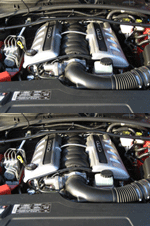
As you can see the cable throttle body and all accessories are on place. Those are all very easy to install compared to installing accessories on a VQ35.
We hung up the Godspeed Project performance radiator to be able to test start the motor (fabrication of radiator/oil cooler mounts and new crash bar is coming up next). Our Godspeed radiator has stock 350Z fit and will work perfect with the already very good stock 350Z dual fans, the fan shroud lines up perfectly. The Godspeed radiator offers 40% higher cooling capacity, this is extremely important for any performance build.

On my gearbox, there is a tiny extra little piece of aluminum at the back which seems to interfere with the mount. However, the mounts have a lot of material and the holes are elongated so you can adjust a little back and forward, so all we have to do is do open up the center mounting hole which is just a round hole, and slide the entire gearbox mount back about 1/4 inch to clear this little strange casting piece on the tail of the gearbox.
The Fueled Racing driftshaft installs just like the OEM Z shaft. Put it on the outgoing shaft from the gearbox, and bolt on at the back to the diff, reusing the Z bolts.
As you can see the cable throttle body and all accessories are on place. Those are all very easy to install compared to installing accessories on a VQ35.
We hung up the Godspeed Project performance radiator to be able to test start the motor (fabrication of radiator/oil cooler mounts and new crash bar is coming up next). Our Godspeed radiator has stock 350Z fit and will work perfect with the already very good stock 350Z dual fans, the fan shroud lines up perfectly. The Godspeed radiator offers 40% higher cooling capacity, this is extremely important for any performance build.
Last edited by Mr_White; Jul 16, 2013 at 12:11 PM.

