


Torque plates--for those of you who like pictures

Thread Starter
Sponsor
builtZmotors
builtZmotors
iTrader: (21)
Joined: Jul 2004
Posts: 2,780
Likes: 0
From: Albuquerque, NM
 Torque plates--for those of you who like pictures
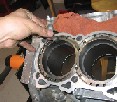
Just thought I'd share some pics of our torque plates...
I always like to see pics of all of these parts that are talked about so often, I had some pics on my camera and figured I would share...

For those of you who are not familiar with the usage of torque plates, I'll provide a brief explanation: The torque plate is an aluminum plate that is torqued onto the blovk before boring and honing...the plate allows for the block to be worked on under load, the same type of load that will occur once the heads are torqued down onto the block. The plate will make the job go smoother and also prevent the tops of the cylinders from slightly tapering during the machining process...ultimately, the sylinder bore will be more precise when machined using a torque plate (if anybody else would liek to add some imput, please do)

I always like to see pics of all of these parts that are talked about so often, I had some pics on my camera and figured I would share...
For those of you who are not familiar with the usage of torque plates, I'll provide a brief explanation: The torque plate is an aluminum plate that is torqued onto the blovk before boring and honing...the plate allows for the block to be worked on under load, the same type of load that will occur once the heads are torqued down onto the block. The plate will make the job go smoother and also prevent the tops of the cylinders from slightly tapering during the machining process...ultimately, the sylinder bore will be more precise when machined using a torque plate
(if anybody else would liek to add some imput, please do)





Trending Topics
torque plates are designed to simulate the block distortion that can happen when head bolts are torqued down. typically you will see a push in or pull out (depending on the design) in the cylinders when the head is torqued down. most any machine shops will bore and hone the block w/o a torque plate unless you ask for it specifically. block design depends heavily on the need for a torque plate. some blocks have the cylinder integrity incorporated with the head bolt casting. in these cases, you will see a noticeable difference in ring sealing. from what i have seen, the distortion can happen midway down the bore, but again, engine design will determine this. i have also seen star patterns worn into rings from not being honed w/ a torque plate.
the VQ35 to me is questionable for needing it. the head bolt layout is such that the deck surface, that the bolt threads into is not part of the cylinder bore. i could be wrong, but that is what i saw. i personally opted for not doing a torque plate hone. i will be cutting apart a block in a week or 2 to check this out. sleeves could possibly eliminate the need for the torque plate.
all in all, the bore needs to be done w/o the torque plate, then put it on and torque it down and do the hone. that will show at what point the block may distort, and if it does. needless to say, the block WILL move when the heads are torqued down, we just need to figure out at what point it does.
not to hyjack todd, but i have another question. how the hell does the crank run straight through the block when the factories idea of "clearance" is mismatching main bearings to get a certain tolerance? also, on seasoned blocks being aluminum, core shift should be huge!! thinking a line hone and a very competent crank guy to bring the mains to a solid consistent #. whooohooo, no more having to figure the stupid stock codes and make it so one matched set can be used. can't wait to inspect my motor when i tear it down shortly. lots to be learned on this motor.
the VQ35 to me is questionable for needing it. the head bolt layout is such that the deck surface, that the bolt threads into is not part of the cylinder bore. i could be wrong, but that is what i saw. i personally opted for not doing a torque plate hone. i will be cutting apart a block in a week or 2 to check this out. sleeves could possibly eliminate the need for the torque plate.
all in all, the bore needs to be done w/o the torque plate, then put it on and torque it down and do the hone. that will show at what point the block may distort, and if it does. needless to say, the block WILL move when the heads are torqued down, we just need to figure out at what point it does.
not to hyjack todd, but i have another question. how the hell does the crank run straight through the block when the factories idea of "clearance" is mismatching main bearings to get a certain tolerance? also, on seasoned blocks being aluminum, core shift should be huge!! thinking a line hone and a very competent crank guy to bring the mains to a solid consistent #. whooohooo, no more having to figure the stupid stock codes and make it so one matched set can be used. can't wait to inspect my motor when i tear it down shortly. lots to be learned on this motor.

Thread Starter
Sponsor
builtZmotors
builtZmotors
iTrader: (21)
Joined: Jul 2004
Posts: 2,780
Likes: 0
From: Albuquerque, NM
Originally Posted by overZealous1
all in all, the bore needs to be done w/o the torque plate, then put it on and torque it down and do the hone. that will show at what point the block may distort, and if it does. needless to say, the block WILL move when the heads are torqued down, we just need to figure out at what point it does.
not to hyjack todd, but i have another question. how the hell does the crank run straight through the block when the factories idea of "clearance" is mismatching main bearings to get a certain tolerance? also, on seasoned blocks being aluminum, core shift should be huge!! thinking a line hone and a very competent crank guy to bring the mains to a solid consistent #. whooohooo, no more having to figure the stupid stock codes and make it so one matched set can be used. can't wait to inspect my motor when i tear it down shortly. lots to be learned on this motor.
not to hyjack todd, but i have another question. how the hell does the crank run straight through the block when the factories idea of "clearance" is mismatching main bearings to get a certain tolerance? also, on seasoned blocks being aluminum, core shift should be huge!! thinking a line hone and a very competent crank guy to bring the mains to a solid consistent #. whooohooo, no more having to figure the stupid stock codes and make it so one matched set can be used. can't wait to inspect my motor when i tear it down shortly. lots to be learned on this motor.
as for you bearing code question/comment:
The journals of the crank differ slightly in size...this is the main factor that makes having to use different sized main and rod bearings..you can inspect the block all day long
, if you use on generic sized bearing for the entire build, the clearances WILL BE OFF!
I know it is a PITA, but the block cradle sizes vary block to block and the crank journals vary as well.
And sure, you could have a machinist alter the crank journals to make them all the same size, but is it really taht difficult to just order the correct sized bearing?
Seems like this route would be more difficult and throws another area for error into the machining process TODD
Last edited by 350zDCalb; Mar 23, 2006 at 06:07 AM.
Thread Starter
Sponsor
builtZmotors
builtZmotors
iTrader: (21)
Joined: Jul 2004
Posts: 2,780
Likes: 0
From: Albuquerque, NM
Originally Posted by Sharif@Forged
Hey Todd, that is DEFINATELY the same company that made ours. They even used the same wax paper and crate.
...they ain't cheap, especially for the pair!!!
Originally Posted by 350zDCalb
Our machinist stated that when he had bored and honed our cylinders before, without the use of the torque plate, that the process was extremely time consuming. He stated that the cylinders would heat up so greatly that he would have to stop the machine and wait for them to cool down for fear of distortion. He was VERY adimant about getting torque plates, saying that this will produce a safer, easier, more consistant/accurate machining job...
as for you bearing code question/comment:
The journals of the crank differ slightly in size...this is the main factor that makes having to use different sized main and rod bearings..you can inspect the block all day long , if you use on generic sized bearing for the entire build, the clearances WILL BE OFF!
I know it is a PITA, but the block cradle sizes vary block to block and the crank journals vary as well.
And sure, you could have a machinist alter the crank journals to make them all the same size, but is it really taht difficult to just order the correct sized bearing? Seems like this route would be more difficult and throws another area for error into the machining process
TODD
as for you bearing code question/comment:
The journals of the crank differ slightly in size...this is the main factor that makes having to use different sized main and rod bearings..you can inspect the block all day long
, if you use on generic sized bearing for the entire build, the clearances WILL BE OFF! I know it is a PITA, but the block cradle sizes vary block to block and the crank journals vary as well.
And sure, you could have a machinist alter the crank journals to make them all the same size, but is it really taht difficult to just order the correct sized bearing?
Seems like this route would be more difficult and throws another area for error into the machining process TODD
Thread Starter
Sponsor
builtZmotors
builtZmotors
iTrader: (21)
Joined: Jul 2004
Posts: 2,780
Likes: 0
From: Albuquerque, NM
Originally Posted by overZealous1
just what i meant by it is that to get a certain clearance nissan will use a thicker bearing on top than the bottom or vice versa for the mains. which has the potential to put more pressure on the upper bearing or have the tendancy to slightly bend the crank. just saying that a line hone to get the mains straight then very minor main journal regrind and then you would be able to get all the same bearings and know the crank is running straight in the block. machining should only be about $200-250 for this at most.
...I wonder if the line hone could align the bottom so that you could still utilize a oem nissan bearing, like a 4 or 5 grade..or if you would need to take off more material and go with an aftermarket bearing
Originally Posted by 350zDCalb
I see...sorry, I missed the line honing part, must have been speedreading ...
I wonder if the line hone could align the bottom so that you could still utilize a oem nissan bearing, like a 4 or 5 grade..or if you would need to take off more material and go with an aftermarket bearing
...I wonder if the line hone could align the bottom so that you could still utilize a oem nissan bearing, like a 4 or 5 grade..or if you would need to take off more material and go with an aftermarket bearing
Originally Posted by theking
Just like overZealous1, I was wondering about main bearing load when it uses a grade 45 bearing(mismatched top and bottom). This is the first motor I've ever seen do that.

The OEM bearing shells are in .0001 differences from one size to the next bigger size.
No machine shop can line bore the mains or turn the journals that close. The factory can and they fine tune their clearances with these shells.
Call your crank grinder and ask how tight and precision he can grind if he tells you .0001" ask him what equipment he uses because Our shop needs this machine since nobody we know makes one that accurate.
No machine shop can line bore the mains or turn the journals that close. The factory can and they fine tune their clearances with these shells.
Call your crank grinder and ask how tight and precision he can grind if he tells you .0001" ask him what equipment he uses because Our shop needs this machine since nobody we know makes one that accurate.

Thread Starter
Sponsor
builtZmotors
builtZmotors
iTrader: (21)
Joined: Jul 2004
Posts: 2,780
Likes: 0
From: Albuquerque, NM
Originally Posted by theking
Just like overZealous1, I was wondering about main bearing load when it uses a grade 45 bearing(mismatched top and bottom). This is the first motor I've ever seen do that.
...the size of the bearing differs because of the cradle in the block that holds the crank and the main bearing caps...the crank journals may be slightly differnt from journal to journal..the differnt size bearings serve to provide EQUAL clearances for all 4 journals on the crank...the idea of a different load isn't a concern..no offense, but this concept doesn't really make sense, one bearing is not pressing on the crank journal any harder than the next, if the clearances are correct, the crank will not have any play, nowhere to move and the load on the bearings will not differ from journal to journal