


copper o-ringed head gaskets



Originally Posted by t32gzz
Sharif, what signs are you seeing that the studs may be the issue. Did you see evidence of stretched studs?
The studs are going the correct job. There is no issue with stretch or studs backing out. A stud is designed and engineered, to provide a specific amount of clamping force, usually measured in pounds/sq inch, at a given trq valve. The trq specification is establish by determining 75% of the yield strength of the stud. The yield point, in simple terms, is when the stud breaks/stretches/deforms. So with the standard ARP steel studs, in the 7/16size, they are rated at 65-70ft/lbs at 75% yield strength. At 65ft lbs, you are getting roughly 14,000 lb clamping force. If you try to overtrq the ARP standard stud, you will yield/break the stud. With a stronger material, such as L19, you have a much higher yield strength, and you able to trq them down much further, for a big increase in clamping force. You can accomplish the same thing, by going to a 1/2 or even larger diameter stud, as Scott was refering to.
Originally Posted by mjedens
I'll blow out a gallon of coolant (distilled water plus additive) at 21 lbs of boost! It wasn't doing it at 17 lbs last week but I'm thinking it will probably go that direction!
 I think your issue will go away for now.



It seems the problem really is that there aren't enough bolts to clamp the heads down and keep them down. Wouldn't it be easier to take a mold of the original top end an modify it a bit to fit more bolts, and recast it? I don't know, maybe i'm thinking a little too wildly? I think it definitely fix the problem.
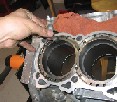
Has anybody actually followed ARP's instructions and retorqued their head studs after a few heat cycles? This will likely help a ton as well (PITA- you have to pull the timing covers/timing gear, to get the cams out to access the head studs)

Sharif - you are 99% sure the clamping force is the issue? 14,000 lbs of clamping force seems like quit a bit. I know there is an equation here, but I do not know what it is. 14.7 psi atmospheric + ~17 psi boost = ~31.7psi X the square inches of the area of the head/ block mating surface.
This is a shot in the dark, so can one of you math gurus finish this or correct it?
This is a shot in the dark, so can one of you math gurus finish this or correct it?
Thread Starter
Registered User
iTrader: (27)
Joined: Sep 2004
Posts: 4,268
Likes: 1
From: tigard oregon
Originally Posted by t32gzz
Sharif - you are 99% sure the clamping force is the issue? 14,000 lbs of clamping force seems like quit a bit. I know there is an equation here, but I do not know what it is. 14.7 psi atmospheric + ~17 psi boost = ~31.7psi X the square inches of the area of the head/ block mating surface.
This is a shot in the dark, so can one of you math gurus finish this or correct it?
This is a shot in the dark, so can one of you math gurus finish this or correct it?
Originally Posted by overZealous1
the one part of the equation missing there is the combustion force. that is what is causing it. light detonation can then double those numbers pretty easily.
Headlifting has a pretty common phenominon in the high whp world. Evo's have been struggling with it for years.
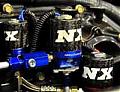
The heads lifting on the VQ motor is directly related to clamping force -
mjedens, what you're experiencing are just the first signs of the failure and unfortunately (IMO) it's going to get worse even though you're lowering the boost. I would begin to plan on pulling your heads soon and doing the following:
1. Replace head gasket
2. Take additional measures to add clamping force
The two current methods that are options are as follows. 1/2" head studs or two L19 stock size head studs. If you have time and money, the 1/2" head studs are probably the best solution. The L19 stock size studs will definitely be a more cost effective and a better solution than what you previously had, but no one really has pushed this setup – my estimates is it will be good for +/- 700whp.
1/2" head studs with either the stock gasket or Cometic on both steel liners and Darton M.I.D. sleeves are holding up to an incredible 40psi... yep you read that right, 40psi! The only unknown with this setup is how it will hold up in a 'Real' street car. All of the tests have been performed on purpose built 1/4 mile race cars.
So, there are probably many people reading this saying – ‘what about all of the people the jumped all over Philthy when he brought up this issue a long time ago? They stated that they didn’t have this problem because of their shops secret cooling parts and techniques…?’ Well, frankly I think they’re full of crap and if they really had a solution they would be selling it like **** on the internet. I can only tell you what I know for a fact and what is being done on the top VQ cars on the planet!
Now it’s up to the select few with probably more money than brains to find out if this will work in a daily driven/beaten street car. I’m thinking that this issue will be closed soon, and people will have two proven options – one that’s pretty much very cost effective, requires little down time and will support up to +/- 700whp or the other one that requires machining of the block and big price tag but will hold true to + 1000whp…
mjedens, what you're experiencing are just the first signs of the failure and unfortunately (IMO) it's going to get worse even though you're lowering the boost. I would begin to plan on pulling your heads soon and doing the following:
1. Replace head gasket
2. Take additional measures to add clamping force
The two current methods that are options are as follows. 1/2" head studs or two L19 stock size head studs. If you have time and money, the 1/2" head studs are probably the best solution. The L19 stock size studs will definitely be a more cost effective and a better solution than what you previously had, but no one really has pushed this setup – my estimates is it will be good for +/- 700whp.
1/2" head studs with either the stock gasket or Cometic on both steel liners and Darton M.I.D. sleeves are holding up to an incredible 40psi... yep you read that right, 40psi! The only unknown with this setup is how it will hold up in a 'Real' street car. All of the tests have been performed on purpose built 1/4 mile race cars.
So, there are probably many people reading this saying – ‘what about all of the people the jumped all over Philthy when he brought up this issue a long time ago? They stated that they didn’t have this problem because of their shops secret cooling parts and techniques…?’ Well, frankly I think they’re full of crap and if they really had a solution they would be selling it like **** on the internet. I can only tell you what I know for a fact and what is being done on the top VQ cars on the planet!
Now it’s up to the select few with probably more money than brains to find out if this will work in a daily driven/beaten street car. I’m thinking that this issue will be closed soon, and people will have two proven options – one that’s pretty much very cost effective, requires little down time and will support up to +/- 700whp or the other one that requires machining of the block and big price tag but will hold true to + 1000whp…
Last edited by Philthy; Mar 30, 2006 at 08:18 AM.
I agree with everything you posted...but 7/16th studs trqed to 95ft/lbs will easily hold MUCH more than 700whp. I am speculating, but since headlift issues start creeping up in the 600whp range, when you add 40% clamping force, you should be fine well past 800whp. Guess someone will have to find out.
Originally Posted by Sharif@Forged
Guess someone will have to find out.
 it's too funny how willing the both of us are to take a calculated risk knowing that we could just blow up our motors...
  You may be right on getting around 800whp, I was just estimating as well...

Thread Starter
Registered User
iTrader: (27)
Joined: Sep 2004
Posts: 4,268
Likes: 1
From: tigard oregon
well now don't you guys go getting your panties in a wad, i am perfectly fine with setting myself up for a blown motor too, hahahahaha.
ok, finally got that blown motor ripped down. we checked it in the machine to do the task i originally planned, it fit with room to spare!!!! also did some drilling and tapping for 1/2" studs and that will be a piece of cake also. since no one is really sure what part of the head is actually lifting or flexing. i have a trick that will solidify between the cylinders in the head also. it will seriously help distibute the load over a large area of the head. that has typically been a problem spot on other motors.
have all the dimensions for the stud to look for, and since everything is getting tapped, thread pitch is not an issue. this is gunna go like butta!!
ok, finally got that blown motor ripped down. we checked it in the machine to do the task i originally planned, it fit with room to spare!!!! also did some drilling and tapping for 1/2" studs and that will be a piece of cake also. since no one is really sure what part of the head is actually lifting or flexing. i have a trick that will solidify between the cylinders in the head also. it will seriously help distibute the load over a large area of the head. that has typically been a problem spot on other motors.
have all the dimensions for the stud to look for, and since everything is getting tapped, thread pitch is not an issue. this is gunna go like butta!!
Last edited by overZealous1; Mar 30, 2006 at 04:05 PM.
Originally Posted by overZealous1
also did some drilling and tapping for 1/2" studs and that will be a piece of cake also.
 you didn't seriously drill and tap the 1/2" studs did you?
 I saw the process my machine shop uses to do this procedure and it's far from a simple drill and tap. You actually need to press the material in the block together under extreme loads to form the threads for the 1/2" studs - the number of shops that have this equipment in the states is limited at best. The results of a simple drill and tap would be disastrous
 the threads would be very weak and the studs would just pull right out of the block under load...
Thread Starter
Registered User
iTrader: (27)
Joined: Sep 2004
Posts: 4,268
Likes: 1
From: tigard oregon
it was mostly a test to see what thread pitches would work best. no need to worry guys, i know what i'm doing, lol. this was the blown block i'm messing with right now. true, you won't get a full thread depth, so material needs to be added. but there are different ways of doing it. also, the depth of the threads in the block is vital, so all in all, pretty easy the way i have it planned. using an end mill for most all the operation.
don't want to give up too much info now till it can all be tested. the guy i am working with has been building race motors for years and we are in agreement that everything will work as planned. only one of 2 things can happen, i blow a head through my hood, or come up with a very simple process that works!! hahaha.
don't want to give up too much info now till it can all be tested. the guy i am working with has been building race motors for years and we are in agreement that everything will work as planned. only one of 2 things can happen, i blow a head through my hood, or come up with a very simple process that works!! hahaha.

3 solutions to one problem. Maybe someone can do it cheaper than the other, but either way you guys are all the answer to alot of our questions. How do we fix.... really fix this head lift?
And, will it hold up when driven on the street. I did not show signs on my first build for about a month to a month and a half. I personally belong to the 1/2 stud AND o-ringed gasket camp. I know we are all staying tuned.
My motor will be out again very soon, so I hope everyone or anyone has success on this.... soon. Please keep us posted.
And, will it hold up when driven on the street. I did not show signs on my first build for about a month to a month and a half. I personally belong to the 1/2 stud AND o-ringed gasket camp. I know we are all staying tuned.
My motor will be out again very soon, so I hope everyone or anyone has success on this.... soon. Please keep us posted.
Thread Starter
Registered User
iTrader: (27)
Joined: Sep 2004
Posts: 4,268
Likes: 1
From: tigard oregon
Originally Posted by t32gzz
3 solutions to one problem. Maybe someone can do it cheaper than the other, but either way you guys are all the answer to alot of our questions. How do we fix.... really fix this head lift?
And, will it hold up when driven on the street. I did not show signs on my first build for about a month to a month and a half. I personally belong to the 1/2 stud AND o-ringed gasket camp. I know we are all staying tuned.
My motor will be out again very soon, so I hope everyone or anyone has success on this.... soon. Please keep us posted.
And, will it hold up when driven on the street. I did not show signs on my first build for about a month to a month and a half. I personally belong to the 1/2 stud AND o-ringed gasket camp. I know we are all staying tuned.
My motor will be out again very soon, so I hope everyone or anyone has success on this.... soon. Please keep us posted.
you have already o-ringed your block? i am doing the o-ringed gaskets, 1/2" studs, block mods, and another head mod. i can't come up with anything else, so if this doesn't do it, i'm not sure at this point what else would (outside of machining new blocks and heads from billet). the cool part about it is all this can be done for not alot of money.

