


Turbonetics fuel pump assembly mod


Originally Posted by phunk
This is all if we are pretending that fuel were to flow thru the FMU during vacuum anyway.

the FMU may allow some or lots of fuel thru it, but you can push thru a walbro pump provided you have adequate pressure and I assumed that was the natural path. I suppose you may be correct in the sense that if the FMU allows fuel to EASILY pass directly thru it in reverse direction, than enough pressure may never build in the feed line to push open the walbro. However, in either case, this will not cause a pressure spike at the rails, which was my intended point to posting even though I became side tracked on this issue. I suppose that since I have never tried on the test bench to push anything in the wrong direction thru a FMU i will not argue with you if you could do it or not, and therefore I cannot promise that any quanity between none or all of the fuel just flows right on thru it. So I will gladly give you that. I never looked at it that way, but then again I never had to because it wouldnt make a difference which way its going.
Last edited by phunk; Dec 5, 2007 at 03:57 PM.
Originally Posted by ZU L8R
eez, do you realize you are arguing with someone that designs and makes fuel systems for a living?
However, in either case, if there was a flow restriction, whether it be an inline pump to push open or a backwords FMU that isnt as free flowing as an open hose, the pressure spike it would create would be between the pump and the restriction, and it would result in a pressure DROP at the engine, which is where you should be measuring pressure. If you were measureing pressure between the primary pump and the FMU you would not be seeing accurate fuel pressure at the engine, ESPECIALLY when the AUX pump comes on and the FMU starts doing its job.
Last edited by phunk; Dec 5, 2007 at 04:03 PM.
Originally Posted by phunk
Its true that he is, but since I design and make high end fuel systems for high end vehicles, I have limited experience on the test bench using ghetto components such as the popular FMUs and voltage boosters... So I will give him that I certainly assumed fuel was naturally passing thru the inline walbro when it is not active, but I do know that it takes a certain pressure to push it open... and if the FMU happily allows reverse flow thru it, the fuel will take the path of least resistence and go thru the FMU. I very well may have been wrong on this one.
However, in either case, if there was a flow restriction, whether it be an inline pump to push open or a backwords FMU that isnt as free flowing as an open hose, the pressure spike it would create would be between the pump and the restriction, and it would result in a pressure DROP at the engine, which is where you should be measuring pressure. If you were measureing pressure between the primary pump and the FMU you would not be seeing accurate fuel pressure at the engine, ESPECIALLY when the AUX pump comes on and the FMU starts doing its job.
However, in either case, if there was a flow restriction, whether it be an inline pump to push open or a backwords FMU that isnt as free flowing as an open hose, the pressure spike it would create would be between the pump and the restriction, and it would result in a pressure DROP at the engine, which is where you should be measuring pressure. If you were measureing pressure between the primary pump and the FMU you would not be seeing accurate fuel pressure at the engine, ESPECIALLY when the AUX pump comes on and the FMU starts doing its job.
I'm just stating my point of view and am not trying to debate this to death. Just want to let you know where I am coming from.
I never said it was causing an increase in pressure, just that it "might", because it was an unusual setup. Most people remove the FMU and AUX pump when upgrading to a walbro 255.
The theory that the FMU may cause the higher pressure was from the same theory that you need to drill out the regulator to reduce the pressure (In my case I didn't have to). I was thinking the smaller inlet of the FMU may be causing higher pressure. Not a spike BTW, since the OP is at 80 PSI until the AUX kicks in and it goes higher.
I assumed the OP was reading fuel pressure after the AUX because he said the pressure increases when the AUX kicks in.
I tried to get compressed air to flow through the AUX pump after I took it off and it was completely closed and would not let any flow until it had power. This is how I know that the fuel flows through the FMU until boost is seen. Then the valve closes and routes the fuel directly through the AUX pump.

Registered User
Joined: Feb 2004
Posts: 1,041
Likes: 0
From: columbia md.
Why does anyone have to be owned...We are here to share and help...
In my particular instance my fuel gauge reads 80 psi (no-walbro drilling) at idle and goes up from there when in boost and Aux kicks in...Been like this for around 10k miles...No problem so far...W/O the vortech fuel system I lean out at high RPM, thus why I left it in...Will be going to a RFS soon..
The schematic description of fuel flow during vac and boost is correct...In my situation the fuel pressure (80 psi) is seen at the fuel rails(injectors). The FMU is an 8:1 fuel pressure amplifier if you will.. It increases fuel press 8psi for every 1 psi of boost...That's how in theory how it's supposed to work...
Why eez fuel pressure in not 80 psi since it's the same set up as mine (no-drilling) is puzzling..Anyone have a suggestion and don't say I have a restriction somewhere because others have reported 80 psi W/O the drilling to Walbro.
In my particular instance my fuel gauge reads 80 psi (no-walbro drilling) at idle and goes up from there when in boost and Aux kicks in...Been like this for around 10k miles...No problem so far...W/O the vortech fuel system I lean out at high RPM, thus why I left it in...Will be going to a RFS soon..
The schematic description of fuel flow during vac and boost is correct...In my situation the fuel pressure (80 psi) is seen at the fuel rails(injectors). The FMU is an 8:1 fuel pressure amplifier if you will.. It increases fuel press 8psi for every 1 psi of boost...That's how in theory how it's supposed to work...
Why eez fuel pressure in not 80 psi since it's the same set up as mine (no-drilling) is puzzling..Anyone have a suggestion and don't say I have a restriction somewhere because others have reported 80 psi W/O the drilling to Walbro.
Originally Posted by jpc350z
.W/O the vortech fuel system I lean out at high RPM
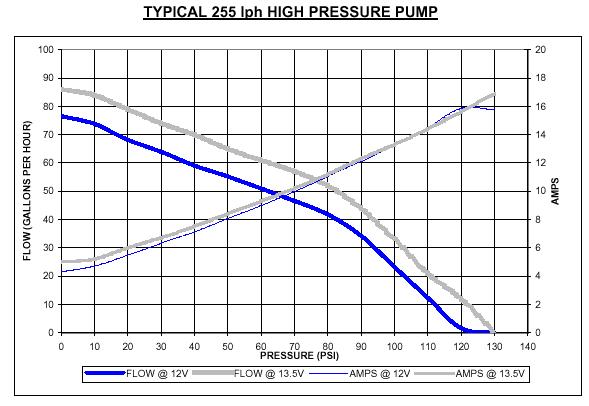
ok i found one http://www.autoperformanceengineerin...l/fpspecs.html
Last edited by eez; Dec 6, 2007 at 07:56 AM.

Thread
Thread Starter
Forum
Replies
Last Post
Colombo
Forced Induction
35
Nov 9, 2020 10:27 AM
