


Is A Larger Exhaust Better For Vortech/Procharger Kits



Originally Posted by iStan
Yes please.


Originally Posted by eltness350
i went pretty big when i had my procharger and lost a ton of low end tq/hp...i had strup headers,2.5 inch downpipes, aam dual 3inch exhaust....got max top end but when i look back on it...prob wasnt worth it...
get a nice cat-back and maybe some high flow cats....have some back pressure and like jeremy said....all u have to do is change the pulley to make up for the lost powa
get a nice cat-back and maybe some high flow cats....have some back pressure and like jeremy said....all u have to do is change the pulley to make up for the lost powa

Last edited by sentry65; Jul 7, 2008 at 10:38 AM.

Originally Posted by sentry65
however at high rpms there's less time for the air to enter so you end up with less air per engine cycle. That difference in lost power per stroke is made up for by increasing the rpms so those weaker combustions are happening more often.
..less time for the air to enter as opposed to using stock cams? please explain this one...the valve lift/duration doesnt change with rpms...
at 1000 rpms, each cylinder chamber has ample time to fully fill up then ignite.
At 8000 rpms, it has 1/8 the time to fill up.
The cylinder chamber is only as big as it is. It can only hold so much air at a natural ambient pressure. To hold more air would require larger displacement or FI
Gasses (air) can only move so fast naturally. When under pressure via FI, it's a little different story since the air can then be actively forced in
The valve lift usually doesn't change on most engines, unless it has VTEC.
Just as much air gets sucked into an engine with small exhaust/cams as a large exhaust/cams. What the difference is, is that small exhaust/cams make that air heat up more via friction and making the air more compressed
Having high lift/duration cams at first seems it's going to suck in more air, but what's really happening is at high rpms it's letting the fast moving air to pass through easier with less heat building up from friction and compressing. At low rpms, it's releasing some of the air so the ignition is less potent. Without high rpms, the engine isn't spinning fast enough to maintain an incoming high pressure of air
What you're really doing is changing the efficiency of the engine at different areas of the rpms. The only way to physically run MORE air through an engine is to either go FI, or increase the displacement via a larger bore and/or stroke.
At 8000 rpms, it has 1/8 the time to fill up.
The cylinder chamber is only as big as it is. It can only hold so much air at a natural ambient pressure. To hold more air would require larger displacement or FI
Gasses (air) can only move so fast naturally. When under pressure via FI, it's a little different story since the air can then be actively forced in
The valve lift usually doesn't change on most engines, unless it has VTEC.
Just as much air gets sucked into an engine with small exhaust/cams as a large exhaust/cams. What the difference is, is that small exhaust/cams make that air heat up more via friction and making the air more compressed
Having high lift/duration cams at first seems it's going to suck in more air, but what's really happening is at high rpms it's letting the fast moving air to pass through easier with less heat building up from friction and compressing. At low rpms, it's releasing some of the air so the ignition is less potent. Without high rpms, the engine isn't spinning fast enough to maintain an incoming high pressure of air
What you're really doing is changing the efficiency of the engine at different areas of the rpms. The only way to physically run MORE air through an engine is to either go FI, or increase the displacement via a larger bore and/or stroke.
Last edited by sentry65; Jul 7, 2008 at 06:41 PM.
Originally Posted by sentry65
What the difference is, is that small exhaust/cams make that air heat up more via friction and making the air more compressed
that makes absolutely no sense..along with most of the stuff you just said..you know hot air expands right? the colder the air the more compressed it is..heat has nothing to do with it...the bottom line is aftermarket cams will make more power up top than stock ones..theres no way around it..and rpms also have absolutely no effect on how much air enters the engine...if what you are saying is correct then power should fall off up top since LESS air??? enters the engine....fuel+air+spark makes power..the more air and fuel the more power....and cams allow more air to enter the engine at any given point than the stock ones do.
power does fall off the top though if you reved high enough. Just look at any dyno curve, especially NA ones. The way to combat that is with a larger exhaust/cams. The tq curve always drops up high unless the engine is specifically tuned to make efficient power at high rpms. It's a little easier to understand if you just look at the tq curve and not the hp curve.
Fuel+air+spark = a bunch of burning fire, not power.
More air = a larger and brighter flame, not power
Add in some compression to those ingredients and then you'll get a violent explosion or released energy that has the capability to move something and create power.
higher lift, more duration cams are leaving the cylinder chamber open longer. You're going to lose compression at low rpms without high rpms keeping the air velocity high. It's great for high rpms, but loses power at low rpms unless the stock cams were not tuned well for the engine in the first place
hot air expands, but it doesn't have a free environment to expand into inside an engine, so it creates more heat via friction or the air molecules moving faster and that heat gets absorbed into the engine. With large cams/exhaust, that heat can just exit instead of getting stuck to warm up future incoming air
Originally Posted by SnyperZ
fuel+air+spark makes power..the more air and fuel the more power...
More air = a larger and brighter flame, not power
Add in some compression to those ingredients and then you'll get a violent explosion or released energy that has the capability to move something and create power.
higher lift, more duration cams are leaving the cylinder chamber open longer. You're going to lose compression at low rpms without high rpms keeping the air velocity high. It's great for high rpms, but loses power at low rpms unless the stock cams were not tuned well for the engine in the first place
hot air expands, but it doesn't have a free environment to expand into inside an engine, so it creates more heat via friction or the air molecules moving faster and that heat gets absorbed into the engine. With large cams/exhaust, that heat can just exit instead of getting stuck to warm up future incoming air
Last edited by sentry65; Jul 7, 2008 at 07:14 PM.

been following this out of a morbid curiosity. As rude as the OP seems from your advice, are you trying to defend credibility with this guy sentry? He only seems to use your often seeked advice to be more arrogant with each reply.
Let him make his own mistakes or do his own homework, rather than beg for quick answers then complain they arent good enough.
Edit*
Sorry OP, Snyperz just being the trouble maker
Let him make his own mistakes or do his own homework, rather than beg for quick answers then complain they arent good enough.
Edit*
Sorry OP, Snyperz just being the trouble maker
Last edited by cheatthe1; Jul 8, 2008 at 10:13 AM.

Thread Starter
Registered User
iTrader: (13)
Joined: Jan 2007
Posts: 17
Likes: 0
From: No Place Like Home
Originally Posted by cheatthe1
been following this out of a morbid curiosity. As rude as the OP seems from your advice, are you trying to defend credibility with this guy sentry? He only seems to use your often seeked advice to be more arrogant with each reply.
Let him make his own mistakes or do his own homework, rather than beg for quick answers then complain they arent good enough.
Let him make his own mistakes or do his own homework, rather than beg for quick answers then complain they arent good enough.

Fights On!

Joined: Jan 2008
Posts: 94
Likes: 0
From: Texas
Back to the original question and the OP.........I agree with sentry65 and Jeremy that it is not simply a matter of getting a larger exhaust to get more power.
For most SC builds the only fixed parameter is the bore and stroke (most of us use the stock block) while the intake, plenum, cams, headers, injectors, catalytic convertors, exhaust and which kit/pulley used are all variables that must be balanced to achieved the best results over the broadest rpm range. This is where experience and intuition make a big difference as there is no effective way to completely 'model' the environment that occurs in our engines during daily operation. Which gear, what temperature, the barometric pressure, humidity, state of 'tune', speed, etc., etc., etc. all change the nature of the explosion that generates power in a motor. 400 dyno sheets is a good start on building a statistical universe but it won't answer everyone's questions.
Talk to Jeremy, Sharif, MRC, GTM, SGP and any of the other respected tuners in the community about what YOU want your build to do, weigh their advice and then spend your money. It's always a compromise and there are no guarantees.
The point of this long-winded diatribe is that, of course, I recommend the HKS exhaust because it's what I know and has worked very well (with the other equipment listed in my sig) on a daily driver for over 5,000 miles. And here's my dyno.
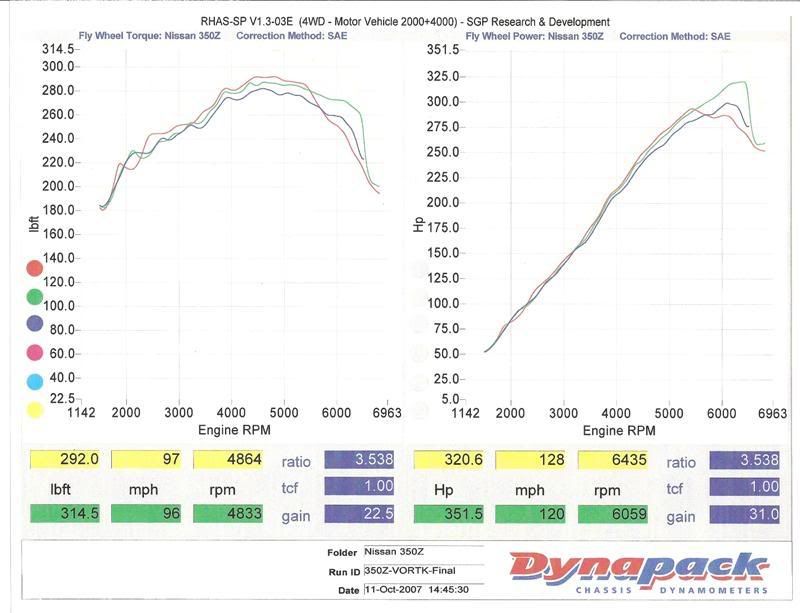
Good luck.
For most SC builds the only fixed parameter is the bore and stroke (most of us use the stock block) while the intake, plenum, cams, headers, injectors, catalytic convertors, exhaust and which kit/pulley used are all variables that must be balanced to achieved the best results over the broadest rpm range. This is where experience and intuition make a big difference as there is no effective way to completely 'model' the environment that occurs in our engines during daily operation. Which gear, what temperature, the barometric pressure, humidity, state of 'tune', speed, etc., etc., etc. all change the nature of the explosion that generates power in a motor. 400 dyno sheets is a good start on building a statistical universe but it won't answer everyone's questions.
Talk to Jeremy, Sharif, MRC, GTM, SGP and any of the other respected tuners in the community about what YOU want your build to do, weigh their advice and then spend your money. It's always a compromise and there are no guarantees.
The point of this long-winded diatribe is that, of course, I recommend the HKS exhaust because it's what I know and has worked very well (with the other equipment listed in my sig) on a daily driver for over 5,000 miles. And here's my dyno.
Good luck.

Registered User
Joined: Feb 2004
Posts: 1,041
Likes: 0
From: columbia md.
The OP basically asked the question relative to dual exhaust and power.. The responses seem to be all over the terrain relative to his question..The issue I am raising is with those who that say dual will reduce low end power. I am challenging those who believe it does by asking for DATA that verifies it. Simple as that..Changing an exhaust is expensive and anyone deciding on it should have some credible reliable info as to what he may be sacrificing vs gain..

I friend of mine has an Eaton M62 (twin screw) supercharger on his 1997 Ford Probe GT. It's virtually the same setup that I have except exhaust. He has a Borla 2.25" exhaust and I have a pacesetter 2.5" exhaust. I make a bit more power though. He recently got an electric exhaust cutout and installed it just down from the collector pipe. So it was back to the dyno, net result after two pulls on the same dyno was a 12whp gain when the cutout was open.
So a larger exhaust in this case would yield more power. No othere changes were done to the car between the two pulls on the dyno.
So a larger exhaust in this case would yield more power. No othere changes were done to the car between the two pulls on the dyno.

no car, no matter, FI, or NA, needs backpressue. People too often confuse backpressure for velocity...they are not the same. Backpressure is bad, velocity is good.
Last edited by Z1 Performance; Jul 8, 2008 at 05:30 AM.
Registered User
Joined: Feb 2004
Posts: 1,041
Likes: 0
From: columbia md.
[QUOTE=Z1 Performance]no car, no matter, FI, or NA, needs backpressue. People too often confuse backpressure for velocity...they are not the same. Backpressure is bad, velocity is good.[/QUOTE
The question remains does a dual exhaust vs a single reduce low end Tq for a centrifugal S/C?
The question remains does a dual exhaust vs a single reduce low end Tq for a centrifugal S/C?
There is no magic answer...it will depend on the exact exhaust, the exact modifications. All too often people are looking for the easy answer where none exists. This is one such example
Registered User
Joined: Feb 2004
Posts: 1,041
Likes: 0
From: columbia md.
Originally Posted by Z1 Performance
There is no magic answer...it will depend on the exact exhaust, the exact modifications. All too often people are looking for the easy answer where none exists. This is one such example

So while we are on this topic I have to ask about my setup. I kept my stock exhaust and just did test pipes because I didn't want to lose any low end power. I was told by Sharif that I was losing power with my stock exhaust when he tuned it and I am only making 330whp on a DD. I was considering a new exhaust per his advice but haven't pulled the trigger yet. Even though I have test pipes is the stock exhaust too restrictive here? I was considering a Borla but now it seems like the true dual is not the way to go with a supercharger.

Originally Posted by jpc350z
Not looking for any magic, do you have any experience with centrifugal S/C's that show low end power loss w/dual any dual? This low end power loss is often stated on this forum with no specific reliable supporting data..
Registered User
Joined: Feb 2004
Posts: 1,041
Likes: 0
From: columbia md.
Originally Posted by 350Z400rwhp
So while we are on this topic I have to ask about my setup. I kept my stock exhaust and just did test pipes because I didn't want to lose any low end power. I was told by Sharif that I was losing power with my stock exhaust when he tuned it and I am only making 330whp on a DD. I was considering a new exhaust per his advice but haven't pulled the trigger yet. Even though I have test pipes is the stock exhaust too restrictive here? I was considering a Borla but now it seems like the true dual is not the way to go with a supercharger.
Originally Posted by jpc350z
Not looking for any magic, do you have any experience with centrifugal S/C's that show low end power loss w/dual any dual? This low end power loss is often stated on this forum with no specific reliable supporting data..
Registered User
Joined: Feb 2004
Posts: 1,041
Likes: 0
From: columbia md.
Originally Posted by Z1 Performance
I didn't make any such claim. All I am trying to say is that there is not automatically 1 right or wrong answer. If you search around, I am sure you can find plenty of examples of various exhaust setups on various Vortech equipped cars, for you, or anyone else, to make their own decision from.
Originally Posted by Z1 Performance
no car, no matter, FI, or NA, needs backpressue. People too often confuse backpressure for velocity...they are not the same. Backpressure is bad, velocity is good.
Originally Posted by cheatthe1
been following this out of a morbid curiosity. As rude as the OP seems from your advice, are you trying to defend credibility with this guy sentry? He only seems to use your often seeked advice to be more arrogant with each reply.
Let him make his own mistakes or do his own homework, rather than beg for quick answers then complain they arent good enough.
Let him make his own mistakes or do his own homework, rather than beg for quick answers then complain they arent good enough.
Originally Posted by jpc350z
I have searched and only find urban legend B.S.
I still don't think dual or single matters at all really. What matters is your overall flow between your plenum, heads, cams, headers, cats, and exhaust as a whole. Changing one of those parts isn't going to be a magic answer. You could change a combo of those parts and get pretty much the same overall result if you changed a different combo of parts.
I think having the two sides connected has some benefits for NA and supercharged setups, but being dual or single isn't what really matters.
Centrifugals don't create a lot of boost at low rpms but do a lot of boost at high rpms. Most people that get centrifugal SC's opt to optimize their high rpm range by getting higher flowing exhaust parts. I've never seen someone gain low end power from changing an exhaust part on the exhaust side. I have on the intake side of things - plenum, supercharger pulley, etc
Originally Posted by jpc350z
The OP basically asked the question relative to dual exhaust and power.. The responses seem to be all over the terrain relative to his question..The issue I am raising is with those who that say dual will reduce low end power. I am challenging those who believe it does by asking for DATA that verifies it. Simple as that..Changing an exhaust is expensive and anyone deciding on it should have some credible reliable info as to what he may be sacrificing vs gain..
Last edited by sentry65; Jul 8, 2008 at 02:13 PM.