


Considering Fi Jwt Turbo System Worth The Wait?


 JWT
JWT
I haven't seen the actual kit , but I can give IMO responses.
a)The 400hp , i beleive is at the "crank". The reason for this target is to make a CARB legal system out of the box. Much more and it gets much more difficult. I am guessing that 400 at the crank can be had at <6 psi on this kit? I don't think the factroy clutch could take much more , for very long.
b) I'm pretty certain that without "internal mods, ie low comp pistons, forged rods, studded head bolts etc.", that this kit could be readily pumped up to beyond 400rwhp.If done properly it could still be safe on 91 pump , but not CARB legit.
c) to get to >400rwhp, a few things wouldl need to be expanded upon, possilbly larger injectors + ECU re-flash, a BOV etc.
d) maybe with tweaking you could get >550 a the crank, but the smallish 530BB and ICs are on not optimum for these power levels.
e) For the major "cost is no object tuner" , it may be possible to upgrade the 530BBs for 700BBs. But at this level we're taking a highly reworked bottom end, and I wouldn't think the smaller dual ICs and fuel rails+pump provided with the base kit are safely up to the task. Of course how the factory drive train (trans, diff, half shafts) could handle >500rwp is yet to be seen.
a)The 400hp , i beleive is at the "crank". The reason for this target is to make a CARB legal system out of the box. Much more and it gets much more difficult. I am guessing that 400 at the crank can be had at <6 psi on this kit? I don't think the factroy clutch could take much more , for very long.
b) I'm pretty certain that without "internal mods, ie low comp pistons, forged rods, studded head bolts etc.", that this kit could be readily pumped up to beyond 400rwhp.If done properly it could still be safe on 91 pump , but not CARB legit.
c) to get to >400rwhp, a few things wouldl need to be expanded upon, possilbly larger injectors + ECU re-flash, a BOV etc.
d) maybe with tweaking you could get >550 a the crank, but the smallish 530BB and ICs are on not optimum for these power levels.
e) For the major "cost is no object tuner" , it may be possible to upgrade the 530BBs for 700BBs. But at this level we're taking a highly reworked bottom end, and I wouldn't think the smaller dual ICs and fuel rails+pump provided with the base kit are safely up to the task. Of course how the factory drive train (trans, diff, half shafts) could handle >500rwp is yet to be seen.

 Re: Re: JWT
Originally posted by gurgenpb01
Oh Man
I am glad I am not getting the Greddy, didn't know they are NOT ballbearing turbos.
Gurgen
Oh Man
I am glad I am not getting the Greddy, didn't know they are NOT ballbearing turbos.
Gurgen
BB turbos
With a properly designed oiling system , good oil (preferrably synthetic) and regular change intervals, the BB turbos do not represent a longevity risk when compared to a sleeve based designs.
The main reason that most manufactures do no use BBs is the added Turbo manufactureing cost's up front.
The main reason that most manufactures do no use BBs is the added Turbo manufactureing cost's up front.
Re: BB turbos
Originally posted by G3po
With a properly designed oiling system , good oil (preferrably synthetic) and regular change intervals, the BB turbos do not represent a longevity risk when compared to a sleeve based designs.
The main reason that most manufactures do no use BBs is the added Turbo manufactureing cost's up front.
With a properly designed oiling system , good oil (preferrably synthetic) and regular change intervals, the BB turbos do not represent a longevity risk when compared to a sleeve based designs.
The main reason that most manufactures do no use BBs is the added Turbo manufactureing cost's up front.
Gurgen
Re: Re: BB turbos
A little trivia. One of the few engines known to exceed a 1 million mile service life before rebulid was an engine offered by MBZ which had BB main and rod bearings , not the typical sleeve type. bearings.
Historically the primary early failure to bearings of any type in a Turbo was due to cokeing. This problem was mostly solved when water cooled turbos became offered on OEM turbo vehilces. The main reason for failures though were mostly due to lack of diligent oil change intervals by the OEM buyer. Now with special Turbo formulated motor oils or nearly all good Synthetics, cokeing is no longer the main concern.
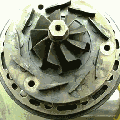
Something else to note about the JWT 530BB Turbos , they use an integrated waste gate. This in itself is not the ultimate for performance; however, it does reolve one of the most leak prone areas of a turbo system , were the WG exits back into the exhaust. This is were thermal stress is greatest. At least the Garret design attempts to separate the WG and turbo exhaust as much as possible in a common casting. So ti is a compromise , beter suited for street + strip use.
The Greddy setup uses external WGs , which no doubt have a larger upside HP potential and ulitmately better race potential. Ideally you want to dump your WG gasses back into the exhaust as far away from the Turbo impeller exit as possible to minimize turbulence/ wash back into the turbo. The best being a toaly separate exhaust for the WG. Howver; this would never meet emissions requirements.
PS. Fro more info Corkey Bell's book " Extreme Boost " is very comprehensive on these topics. It can be bought on Amazon.
Historically the primary early failure to bearings of any type in a Turbo was due to cokeing. This problem was mostly solved when water cooled turbos became offered on OEM turbo vehilces. The main reason for failures though were mostly due to lack of diligent oil change intervals by the OEM buyer. Now with special Turbo formulated motor oils or nearly all good Synthetics, cokeing is no longer the main concern.
Something else to note about the JWT 530BB Turbos , they use an integrated waste gate. This in itself is not the ultimate for performance; however, it does reolve one of the most leak prone areas of a turbo system , were the WG exits back into the exhaust. This is were thermal stress is greatest. At least the Garret design attempts to separate the WG and turbo exhaust as much as possible in a common casting. So ti is a compromise , beter suited for street + strip use.
The Greddy setup uses external WGs , which no doubt have a larger upside HP potential and ulitmately better race potential. Ideally you want to dump your WG gasses back into the exhaust as far away from the Turbo impeller exit as possible to minimize turbulence/ wash back into the turbo. The best being a toaly separate exhaust for the WG. Howver; this would never meet emissions requirements.
PS. Fro more info Corkey Bell's book " Extreme Boost " is very comprehensive on these topics. It can be bought on Amazon.
Re: Re: Re: BB turbos
It sounds very much liek the PE BB turbos are far better than greddy's. Can you confirm this, G3pro?
Also, I placed an order fr the book mentioned, always wanted to read up more on the subject. But you meant "Maximum Boost" not "extreme boost" right?
Gurgen
Also, I placed an order fr the book mentioned, always wanted to read up more on the subject. But you meant "Maximum Boost" not "extreme boost" right?
Gurgen
JWT
Sorry , yes the book is called "Maximum Boost".
He also wrote a book on superchargers.
The two books have a large overlap in material.
I can't comment on the PE turbos since I gave up following the PE solution for a few reasons.
a) No plans fo CARB
b) PE used Stainless Steel Exhaust manifolds. For street longevity , good ole ugly cast iron is proven to be more durable. Many SS designs eventually heat stress fracture and leak. Both Greddy and JWT are useing Cast Iron.
My G35C 6MT is a daily driver in Ca., so as far as TT setups go , I am most interested in the JWT setup.
He also wrote a book on superchargers.
The two books have a large overlap in material.
I can't comment on the PE turbos since I gave up following the PE solution for a few reasons.
a) No plans fo CARB
b) PE used Stainless Steel Exhaust manifolds. For street longevity , good ole ugly cast iron is proven to be more durable. Many SS designs eventually heat stress fracture and leak. Both Greddy and JWT are useing Cast Iron.
My G35C 6MT is a daily driver in Ca., so as far as TT setups go , I am most interested in the JWT setup.
I agree with you on the SS manifolds. But I' drather opt for the quality/longevity of the turbos, a superb parts list, and the ability to easily tune the stock ECu with a custom program, not needing additional computers.
Gurgen
Gurgen
JWT
It sounds like the JWT setup does re-flash the ECU which implies an injector upgrade. I don't know whos injectors or how big they are. Gnerally they won't be too large since idling and emissions issues could arise. But the approach is clearly better than an FMU approach.
Thread Starter
Registered User
Joined: Oct 2003
Posts: 345
Likes: 0
From: ca
Re: JWT
Originally posted by G3po
It sounds like the JWT setup does re-flash the ECU which implies an injector upgrade. I don't know whos injectors or how big they are. Gnerally they won't be too large since idling and emissions issues could arise. But the approach is clearly better than an FMU approach.
It sounds like the JWT setup does re-flash the ECU which implies an injector upgrade. I don't know whos injectors or how big they are. Gnerally they won't be too large since idling and emissions issues could arise. But the approach is clearly better than an FMU approach.
JWT SYSTEM will not require injector upgrade.

 Re: Re: JWT
Originally posted by bigern1970
JWT SYSTEM will not require injector upgrade.
JWT SYSTEM will not require injector upgrade.
Huh, a kit that's gonna be costing in the high $6K range not to include injectors? That's another 1K for new injectors if you wanna go higher. That gives me pause.
Gurgen
JWT TT
bigern1970
I did not intend to imply that JWT would sell an inferior implementation. I think the group in general wants to know how much upside is built into the base setup and how it could be expanded. I'm not the type to leave a canned solution alone, since there is always room for improvement, that's part of the hobby. Could you poke around and find out what type of fuel delivery method will be included in the base setup?
Fueling?
With factory injector(s) an FMU+booster pump approach is the most likely method. If so, who's FMU? Even if an FMU is used in the base setup, this can useually be replaced with new injectors and either a piggyback controller or ECU remap. Issue with the factory ECU is it is "not" boost aware (no MAP input) and the factory MAF has limited dynamic range. So a piggyback unit provdes the most tuneablity.
Timing?
Will timing be re-mapped in the ECU or via external controller?
Same basic ECU issue as above, not designed fro +psi. Gneral method reuires open loop extrapolation. Adeqaute , but not ideal.
I did not intend to imply that JWT would sell an inferior implementation. I think the group in general wants to know how much upside is built into the base setup and how it could be expanded. I'm not the type to leave a canned solution alone, since there is always room for improvement, that's part of the hobby. Could you poke around and find out what type of fuel delivery method will be included in the base setup?
Fueling?
With factory injector(s) an FMU+booster pump approach is the most likely method. If so, who's FMU? Even if an FMU is used in the base setup, this can useually be replaced with new injectors and either a piggyback controller or ECU remap. Issue with the factory ECU is it is "not" boost aware (no MAP input) and the factory MAF has limited dynamic range. So a piggyback unit provdes the most tuneablity.
Timing?
Will timing be re-mapped in the ECU or via external controller?
Same basic ECU issue as above, not designed fro +psi. Gneral method reuires open loop extrapolation. Adeqaute , but not ideal.
Re: JWT TT
Originally posted by G3po
So a piggyback unit provdes the most tuneablity.
So a piggyback unit provdes the most tuneablity.
I will also go out on a limb here and say the JWT IS inferior to PE with the arguable exception of the cast iron manifolds vs. PE's SS manifolds. Other than that, PE is superior in ALMOST EVERY way (larger oil pan - leading to lower oil temps, upgraded plug-in injectors). The quality of the turbos on the PE and JWT is a toss up, they are both very good, however I would still say that the IHI/PE trubos are better.
Also, the output range of the stock MAF is sufficient for the low (4-5PSI) boost thatis being used here. So the ECU can be flashed with the right timings to handle/interpret the new MAF outputs.
Gurgen
Thread Starter
Registered User
Joined: Oct 2003
Posts: 345
Likes: 0
From: ca
Re: Re: JWT TT
Originally posted by gurgenpb01
I disagree. Changing the programming is within the native ECU is not only not inferior to the piggyback, it is far superior. Whether it is a piggiback computer that is holding the new memory/maps or the native ECU reflashed with the new memory/maps does not matter. Only having a piggyback ECU introduces a extra piece of hardware that does NOT need to be there.
I will also go out on a limb here and say the JWT IS inferior to PE with the arguable exception of the cast iron manifolds vs. PE's SS manifolds. Other than that, PE is superior in ALMOST EVERY way (larger oil pan - leading to lower oil temps, upgraded plug-in injectors). The quality of the turbos on the PE and JWT is a toss up, they are both very good, however I would still say that the IHI/PE trubos are better.
Also, the output range of the stock MAF is sufficient for the low (4-5PSI) boost thatis being used here. So the ECU can be flashed with the right timings to handle/interpret the new MAF outputs.
Gurgen
I disagree. Changing the programming is within the native ECU is not only not inferior to the piggyback, it is far superior. Whether it is a piggiback computer that is holding the new memory/maps or the native ECU reflashed with the new memory/maps does not matter. Only having a piggyback ECU introduces a extra piece of hardware that does NOT need to be there.
I will also go out on a limb here and say the JWT IS inferior to PE with the arguable exception of the cast iron manifolds vs. PE's SS manifolds. Other than that, PE is superior in ALMOST EVERY way (larger oil pan - leading to lower oil temps, upgraded plug-in injectors). The quality of the turbos on the PE and JWT is a toss up, they are both very good, however I would still say that the IHI/PE trubos are better.
Also, the output range of the stock MAF is sufficient for the low (4-5PSI) boost thatis being used here. So the ECU can be flashed with the right timings to handle/interpret the new MAF outputs.
Gurgen