


Guys... I got a problem... Car Smoking...

Thread Starter

Joined: Aug 2003
Posts: 1,211
Likes: 1
From: Los Angeles, CA
 Guys... I got a problem... Car Smoking...
Hey Guys
Ok...here is the deal.... Got the manifolds fixed Tuesday (they were cracked ... but that's another story) and put in new test pipes (LaBree, resonated) the next morning (wednesday). BTW, the car got considerably quieter with the resonated test pipes compared to the awful RT cats (which by the way were definitely on their way out if not already there).
Ok, here is the problem. If I do a run (full or even partial boost) or just rev the car while at rest (idling in N), then 3-5 seconds later whitish/greyish/blueish smoke begins to come out of the tailpipe. The harder the run, the more smoke is expelled and for a longer period of time. For example, I did a 100-150 yard 1st gear run to about 50-60mph, and coasted for another 1/4 mile, when, as i come to a red light a HUGE plume of smoke just screens the rear of my car. And NO, it never happens during the run, but a while after! That's what's so peculiar.
This had never happened before, and only came to be after my test pipe install the fixing of the manifold.
Needless to say, the first thing we (Clint, THX723) thought was blow by and worn rings! Well, i did a very meticulous compression check this morning, and here are the results (compared to those done exactly 2.5 months ago):
Cyl: Compression (June 16) Compression (TODAY - Sept 2)
1 205 201
2 200 200
3 212 197
4 200 185
5 210 205
6 200 192
The numbers look good. Each time, a different instrument was used (this last one was done with a new comprssion gauge, the first by a mechanic with my participation and oversight).
What do you guys think. I just don't think it can be the rings. It could be the PCV system... but heck there is only one valve their.
Thanks in advance
Gurgen
Ok...here is the deal.... Got the manifolds fixed Tuesday (they were cracked ... but that's another story) and put in new test pipes (LaBree, resonated) the next morning (wednesday). BTW, the car got considerably quieter with the resonated test pipes compared to the awful RT cats (which by the way were definitely on their way out if not already there).
Ok, here is the problem. If I do a run (full or even partial boost) or just rev the car while at rest (idling in N), then 3-5 seconds later whitish/greyish/blueish smoke begins to come out of the tailpipe. The harder the run, the more smoke is expelled and for a longer period of time. For example, I did a 100-150 yard 1st gear run to about 50-60mph, and coasted for another 1/4 mile, when, as i come to a red light a HUGE plume of smoke just screens the rear of my car. And NO, it never happens during the run, but a while after! That's what's so peculiar.
This had never happened before, and only came to be after my test pipe install the fixing of the manifold.
Needless to say, the first thing we (Clint, THX723) thought was blow by and worn rings! Well, i did a very meticulous compression check this morning, and here are the results (compared to those done exactly 2.5 months ago):
Cyl: Compression (June 16) Compression (TODAY - Sept 2)
1 205 201
2 200 200
3 212 197
4 200 185
5 210 205
6 200 192
The numbers look good. Each time, a different instrument was used (this last one was done with a new comprssion gauge, the first by a mechanic with my participation and oversight).
What do you guys think. I just don't think it can be the rings. It could be the PCV system... but heck there is only one valve their.
Thanks in advance
Gurgen

Gurgen, compression looks good. I bet the smoke is from the resonators breaking in. Also could be that the straight pipes just show more smoke, since the cats arent cleaning the exhuast stream.

That doesn't sound like a normal amount of smoke. It's possible that there something in the resonators that needs to burn its way out, I guess. But it sounds like we're talking about a lot more than a few wisps.
Any chance a couple of rats climbed into the downpipes during the test pipe install?
--Steve
Any chance a couple of rats climbed into the downpipes during the test pipe install?
--Steve

Thread Starter
Joined: Aug 2003
Posts: 1,211
Likes: 1
From: Los Angeles, CA
Sharif, Steve....
I just don't see how it could be down pipes.... I was getting honked at on the fwy, after which they would pull up nest to me and yelll "You car is on fire, your car is on fire". Embarassing. It is really THAT much smoke sometimes.
There is oil being burned, that's the only way you could have that smoke. Now, how does the oil get into the combustion chamber and why does it happen only after (a while after) a high-load run? Thats the question.
Gurgen
I just don't see how it could be down pipes.... I was getting honked at on the fwy, after which they would pull up nest to me and yelll "You car is on fire, your car is on fire". Embarassing. It is really THAT much smoke sometimes.
There is oil being burned, that's the only way you could have that smoke. Now, how does the oil get into the combustion chamber and why does it happen only after (a while after) a high-load run? Thats the question.
Gurgen
Last edited by GurgenPB; Sep 2, 2004 at 07:45 PM.


Registered User
Joined: Feb 2003
Posts: 449
Likes: 0
From: Silverdale, WA
Sounds like the oil seals in the turbos. After the high rpms (higher oil pressure) the higher vacum from the closed throttle condtion is drawing oil past the oil seals. I'd pull the charge pipe (output side of the compressor) and check for oil. There is probably a light coat but if it's heavy there is a problem.
This could also be caused by a restriction on the intake side of the compressor. Causing high vacum in the compressor.
The PCV is a idea to check. If it is the problem you will see it on the intake side of the compressor with heavy oil on the blades and in the pipe.
HTH
Gary
This could also be caused by a restriction on the intake side of the compressor. Causing high vacum in the compressor.
The PCV is a idea to check. If it is the problem you will see it on the intake side of the compressor with heavy oil on the blades and in the pipe.
HTH
Gary
Last edited by 7 eleven; Sep 2, 2004 at 08:37 PM.
Trending Topics
Thread Starter
Joined: Aug 2003
Posts: 1,211
Likes: 1
From: Los Angeles, CA
Originally posted by 7 eleven
Sounds like the oil seals in the turbos. After the high rpms (higher oil pressure) the higher vacum from the closed throttle condtion is drawing oil past the oil seals. I'd pull the charge pipe (output side of the compressor) and check for oil. There is probably a light coat but if it's heavy there is a problem.
This could also be caused by a restriction on the intake side of the compressor. Causing high vacum in the compressor.
The PCV is a idea to check. If it is the problem you will see it on the intake side of the compressor with heavy oil on the blades and in the pipe.
HTH
Gary
Sounds like the oil seals in the turbos. After the high rpms (higher oil pressure) the higher vacum from the closed throttle condtion is drawing oil past the oil seals. I'd pull the charge pipe (output side of the compressor) and check for oil. There is probably a light coat but if it's heavy there is a problem.
This could also be caused by a restriction on the intake side of the compressor. Causing high vacum in the compressor.
The PCV is a idea to check. If it is the problem you will see it on the intake side of the compressor with heavy oil on the blades and in the pipe.
HTH
Gary
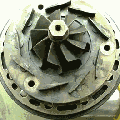
Here are some images ...
See the oil in the pre-TB tube? A thin film was present in the tubes and maf housing that he took off....


See the rising rate FPR right outside the fuel tank? I've been asked for this picture.. so hear it is (off topic in my own thread, but while we're on the subject of PE).

Gurgen

 What about the Check Valve ? Going to Master Cylinder?
Originally posted by gurgenpb01
That's good advice, thanks Gary. That may be it.... makes me wonder what could the PE head engineer (Makoto Ono) have done to cause this? He took the d-side turbo off, replaced the manifold, checked everything over again, installed a new FPR (the a/f is now perfect and smooth 11.8-11.4 across the band WITH A STOCK ECU program) .... i dont think he dropped the turbo or anything.... Could he have misconnected something? I don't see how, there are only two lines, in and out, and i seriously doubt he switched them. Can't believe this.... i've done everything right, careful tuning, daily 4 psi driving, never took the car above 7 psi except for 2 times (and that was a while ago)..... Damn it! Should've known better than do this, with my luck...
Here are some images ...
See the oil in the pre-TB tube? A thin film was present in the tubes and maf housing that he took off....
Gurgen
That's good advice, thanks Gary. That may be it.... makes me wonder what could the PE head engineer (Makoto Ono) have done to cause this? He took the d-side turbo off, replaced the manifold, checked everything over again, installed a new FPR (the a/f is now perfect and smooth 11.8-11.4 across the band WITH A STOCK ECU program) .... i dont think he dropped the turbo or anything.... Could he have misconnected something? I don't see how, there are only two lines, in and out, and i seriously doubt he switched them. Can't believe this.... i've done everything right, careful tuning, daily 4 psi driving, never took the car above 7 psi except for 2 times (and that was a while ago)..... Damn it! Should've known better than do this, with my luck...
Here are some images ...
See the oil in the pre-TB tube? A thin film was present in the tubes and maf housing that he took off....
Gurgen
Check your Brake Fluid Level !!
In greddy kit the One Way Valve is a real issue.. - On installation
"be careful not to cut the ristrictor ( just passanger side of the spot where the provided One way valve is to be inserted in the hose to Vacuum" Installation of the one way valve improperly will cause a loss of brakeing.."
Cheers
Thread Starter
Joined: Aug 2003
Posts: 1,211
Likes: 1
From: Los Angeles, CA
Wow... that's a first for me... I will check into this. thanks
at this point I am leaning toward a bad turbo seal.
Is there a sequence of things i can try to diagnose the problem. I.e., if it is...
(1) oil being dumped into the intake tube from the crankcase via the PCV system
(2) oil leaking out of the turbo seals into the compressor side.
(3) oil leaking out of the turbo seals into the exhaust side directly.
Note: I took off the top plenum to inspect for the presence of oil around the intake runners; was amazed at how clean it was under there... dry and almost no trace of oil.
This suggests that it is NOT (1) and (2) and is more likely (3). Is this a valid assumption?
Thanks
G
at this point I am leaning toward a bad turbo seal.
Is there a sequence of things i can try to diagnose the problem. I.e., if it is...
(1) oil being dumped into the intake tube from the crankcase via the PCV system
(2) oil leaking out of the turbo seals into the compressor side.
(3) oil leaking out of the turbo seals into the exhaust side directly.
Note: I took off the top plenum to inspect for the presence of oil around the intake runners; was amazed at how clean it was under there... dry and almost no trace of oil.
This suggests that it is NOT (1) and (2) and is more likely (3). Is this a valid assumption?
Thanks
G
Last edited by GurgenPB; Sep 3, 2004 at 12:13 AM.

As much as I hate to say it ...
I had suspected the turbo seals ... as I've already mentioned to you, after we made sure your compression check were ok.
Let's hope that's not it, however!
I had suspected the turbo seals ... as I've already mentioned to you, after we made sure your compression check were ok.
Let's hope that's not it, however!
Turbos leaking oil into the exhaust would certainly explain why it only happens well after a spirited run. The oil has to have the chance to start burning.
I vote to check oil level and call PE.
Also, I'm curious about this new FPR. What is different about it than the one that comes with the kit (other than the way it looks)? Why did they switch it out?
--Steve
I vote to check oil level and call PE.
Also, I'm curious about this new FPR. What is different about it than the one that comes with the kit (other than the way it looks)? Why did they switch it out?
--Steve
Good discussion...so much for my theory of resonator break-in smoke. 
So how do you "check" the PCV valve?
Gurgen, unless it's just freak chance, this all began happening after your had the new manifolds installed. Maybe take it back to PE and have them recheck everything. Wish I had some better advice.
So how do you "check" the PCV valve?
Gurgen, unless it's just freak chance, this all began happening after your had the new manifolds installed. Maybe take it back to PE and have them recheck everything. Wish I had some better advice.

Registered User
Joined: May 2004
Posts: 100
Likes: 0
From: Mesa, Az
Perhaps a kinked or plugged turbo oil drain line. Too much oil in the crankcase can also slow the gravity oil return. If oil doesn't drain completed the level can build up to the shaft and it will leak into the turbine since there is no real seal.

Registered User
Joined: Sep 2003
Posts: 1,751
Likes: 0
From: Chicago Burbs
I agree with pretty much everyone else.
Anytime i have seen oil leaks like that, it is either the turbo seals, PCV, or oil return lines.
on MR2's, if you keep the PCV valve plugged into the intake you can get a fair amount of oil build up. I always just plugged it and put a catch can and breather filter on the PCV hose. (i had removed all the emissions equipment anyways, no need for that)
Your compression still looks good, so i dont think it would be the rings or any internal part of your engine. I would put my money on a plugged oil return line on the turbos or bad seals. I have used Greddy turbos before (TD06's) and have gotten 1 or 2 that the internal seals were fried upon installation and had to send them back to be rebuilt.
good luck
Anytime i have seen oil leaks like that, it is either the turbo seals, PCV, or oil return lines.
on MR2's, if you keep the PCV valve plugged into the intake you can get a fair amount of oil build up. I always just plugged it and put a catch can and breather filter on the PCV hose. (i had removed all the emissions equipment anyways, no need for that)
Your compression still looks good, so i dont think it would be the rings or any internal part of your engine. I would put my money on a plugged oil return line on the turbos or bad seals. I have used Greddy turbos before (TD06's) and have gotten 1 or 2 that the internal seals were fried upon installation and had to send them back to be rebuilt.
good luck
So Gurgen, if you are certain the car wasnt smoking prior to the the reinstallation of the manifolds the other day....it's unlikey the turbo just suddenly failed. Again...it would be a freak chance of that were the case.
Oil drain lines are a good place to start, as mentioned above. I am hoping it's something simple like that. Can you crawl under the car and examine the drain lines?
Oil drain lines are a good place to start, as mentioned above. I am hoping it's something simple like that. Can you crawl under the car and examine the drain lines?
I agree. There's no doubt the oil is likely from the turbo itself ... but the cause is VERY likely a foul return line rather than a bad seal. You mentioned to me they also worked on the oil lines. Maybe he screwed that particular leaky fitting in a bit too deep and effectively restricted the oil flow. It could also be a simple kink in the line.
Let me know what you fine ... better yet, call me.
May the force be with you!
Let me know what you fine ... better yet, call me.
May the force be with you!

Joined: Mar 2004
Posts: 80
Likes: 0
From: Fort Worth TX
We have built here at MVP and sold parts to some of the fastest and most powerful Supras in the world. What you are describing I've heard 1000 times. If you are getting smoke off acceleration and at idle, or either one for that matter, it's a turbo issue. It could be seals, rings, bearings, or the lines themselves too. But after acceleration or at idle is an immediate sign of a turbo problem.
Thread Starter
Joined: Aug 2003
Posts: 1,211
Likes: 1
From: Los Angeles, CA
Originally posted by zimbo
Turbos leaking oil into the exhaust would certainly explain why it only happens well after a spirited run. The oil has to have the chance to start burning.
I vote to check oil level and call PE.
Also, I'm curious about this new FPR. What is different about it than the one that comes with the kit (other than the way it looks)? Why did they switch it out?
--Steve
Turbos leaking oil into the exhaust would certainly explain why it only happens well after a spirited run. The oil has to have the chance to start burning.
I vote to check oil level and call PE.
Also, I'm curious about this new FPR. What is different about it than the one that comes with the kit (other than the way it looks)? Why did they switch it out?
--Steve
The FPR looks identical to my old one, only it has a stiffer spring. THey wanted to have an ideal a/f with a STOCK ecu program, which is what I put in before I went there. So now, I do not even need to put in a TS reflash to make this work, that is of course if I pla nto stay at 4-5 psi , which I am not... But, the fuel curve without the ecu reflash waas 12.5-12.0, with this fpr (stiffer spring) the A/f got to be 11.8-11.2 or so - PERFECT (for 4-5 psi of course)! Haven't turned it up yet... but will do that later.
Gurgen
Thread Starter
Joined: Aug 2003
Posts: 1,211
Likes: 1
From: Los Angeles, CA
Originally posted by Trent@MVP
We have built here at MVP and sold parts to some of the fastest and most powerful Supras in the world. What you are describing I've heard 1000 times. If you are getting smoke off acceleration and at idle, or either one for that matter, it's a turbo issue. It could be seals, rings, bearings, or the lines themselves too. But after acceleration or at idle is an immediate sign of a turbo problem.
We have built here at MVP and sold parts to some of the fastest and most powerful Supras in the world. What you are describing I've heard 1000 times. If you are getting smoke off acceleration and at idle, or either one for that matter, it's a turbo issue. It could be seals, rings, bearings, or the lines themselves too. But after acceleration or at idle is an immediate sign of a turbo problem.
I agree. There's no doubt the oil is likely from the turbo itself ... but the cause is VERY likely a foul return line rather than a bad seal. You mentioned to me they also worked on the oil lines. Maybe he screwed that particular leaky fitting in a bit too deep and effectively restricted the oil flow. It could also be a simple kink in the line.
That would explain it for sure... he did take off the feeder and the return line. So, SHould I just take them both off?? I do also think that it is more likely to be a return line issue... rather than a bad seal... Given the circumstances of how/when it happened.
I talked with PE USA, they are about to get back to me after speaking to Mokoto. There is just no way in hell that it is a coincidence!
Gurgen