


Does my stock Z have a sub mounting bracket?


Thread Starter
Registered User
Joined: Jan 2003
Posts: 158
Likes: 0
From: irvine
 Does my stock Z have a sub mounting bracket?
i have a 2003 and want to install a sub where the bose sub is. Does the stock Z already have a sub mounting bracket there even tho I dont have the touring model with the bose sub? i have an enthusisast 2003


There is a hole cut out for it in the panel, but you will still have to build a custom box to fit in that space so you can put a sub in there. That will cost money. One more thing, in terms of sound quality, that is a bad place to put a sub. A sound wave takes about 8 feet to develop. It if hits your ears before that it will not sound clean because the wave will not have fully developed properly. That is why the best place to put a sub is rear firing in the trunk. It will bounce off the glass and be just about 8 feet and fully developed by the time it hits your ear so you will have a good clean sound coming from your system.

Let me share some lessons - in my +25 years of professional broadcast engineering and acoustical measurements I done more than a bit of study and work in the science of acoustics. Have a friend play a violin in an empty field and stand 12" or 12' from the instrument and the timbre is the same - room acoustics and boundary effects will come into play if played in a room that is small enough or the instrument is close enough to one to create reflections. It is impossible to mount a speaker in a car without creating reflections.
Amplitude, of course, varies inversely with the square of the distance but will not rise perceptibly with distance. An enclosed room will have a critical distance where the inverse square law will seem to fail - at this distance the reflections off the far wall reinforce the fading primary waves. I routinely measure the critical distance in projects that I'm developing but couldn't imagine doing anything worthwhile inside an auto!
Waves develop at the transducer - whether it's a mechanical one like on an instrument or electro-mechanical one like a speaker element. Inside a car they fold, reflect, form nodal and anti-nodal points like crazy. It's senseless to try to do anything with them beyond tweeter/upper-midrange placement. Find me a guy with a set of $20,000 home speakers sitting in his bathroom - hopefully you're not. Home theater and stereo systems are designed (if done correctly) to avoid early reflections - say within 6-8 feet which will cause nodal and anti-nodal points. In a room set up this way moving your head a inch or so in either direction will change the timbre of the music. The "sound stage" is the mind's perception of the sound's phase and amplitude - reflections in a car caused by legs, glass, the roof ... all cause the sound to become a confused mess. Subwoofers suffer this much much less - it's not unusual to have a single mono fed subwoofer in a system. Mid-bass suffer a bit more than the true subwoofer. Tweeters and true mid-ranges suffer the most as it's in this part of the musical range where the subtle harmonics fall giving us the illusion of depth in the music.
Of course the wavelength of a sound wave is equal to the velocity divided by the frequency in hertz. In air the velocity of sound can be considered to be 1125 feet per second. Eight feet is a nice 140 Hz tone. The normal range of hearing is considered to be 20 Hz to 20KHz which corresponds to wavelengths of 56' to 5/8". I have done RTA measurements inside a couple of Z's and found significant resonance at distances equal to the length, height, and width of the cabin - and these things fall in the mid-bass.
I wouldn't put the subwoofer behind the driver's seat because it's so darn hard to seal that area up dead nutz solid air tight. The smallest pin hole leak makes a difference (see Thiel-Small ... but then that's another lecture!)
@&#$ I should be a freaking college instructor.
Amplitude, of course, varies inversely with the square of the distance but will not rise perceptibly with distance. An enclosed room will have a critical distance where the inverse square law will seem to fail - at this distance the reflections off the far wall reinforce the fading primary waves. I routinely measure the critical distance in projects that I'm developing but couldn't imagine doing anything worthwhile inside an auto!
Waves develop at the transducer - whether it's a mechanical one like on an instrument or electro-mechanical one like a speaker element. Inside a car they fold, reflect, form nodal and anti-nodal points like crazy. It's senseless to try to do anything with them beyond tweeter/upper-midrange placement. Find me a guy with a set of $20,000 home speakers sitting in his bathroom - hopefully you're not. Home theater and stereo systems are designed (if done correctly) to avoid early reflections - say within 6-8 feet which will cause nodal and anti-nodal points. In a room set up this way moving your head a inch or so in either direction will change the timbre of the music. The "sound stage" is the mind's perception of the sound's phase and amplitude - reflections in a car caused by legs, glass, the roof ... all cause the sound to become a confused mess. Subwoofers suffer this much much less - it's not unusual to have a single mono fed subwoofer in a system. Mid-bass suffer a bit more than the true subwoofer. Tweeters and true mid-ranges suffer the most as it's in this part of the musical range where the subtle harmonics fall giving us the illusion of depth in the music.
Of course the wavelength of a sound wave is equal to the velocity divided by the frequency in hertz. In air the velocity of sound can be considered to be 1125 feet per second. Eight feet is a nice 140 Hz tone. The normal range of hearing is considered to be 20 Hz to 20KHz which corresponds to wavelengths of 56' to 5/8". I have done RTA measurements inside a couple of Z's and found significant resonance at distances equal to the length, height, and width of the cabin - and these things fall in the mid-bass.
I wouldn't put the subwoofer behind the driver's seat because it's so darn hard to seal that area up dead nutz solid air tight. The smallest pin hole leak makes a difference (see Thiel-Small ... but then that's another lecture!)
@&#$ I should be a freaking college instructor.
Last edited by Paul350Z; Jun 26, 2007 at 11:37 AM.

Great post- way to summarize years of acoustical insight! Which brings me to one question-
Is there *any* way to get a decent low-end sound using the stock sub bracket behind the seat? I guess there are certain subs made to cater to this kind of placement but are they worth even trying? I'd like to have the install be as "hidden" as possible but still give some "punch"... more for rock, not deep sustained lows for hip-hop/R&B stuff.
Rob
Is there *any* way to get a decent low-end sound using the stock sub bracket behind the seat? I guess there are certain subs made to cater to this kind of placement but are they worth even trying? I'd like to have the install be as "hidden" as possible but still give some "punch"... more for rock, not deep sustained lows for hip-hop/R&B stuff.
Rob
I tried myself with a "Free air" woofer. It was better than stock but not good enough for my tastes. I like old rock-n-roll and need something that will support a bass guitar. The best I can advise you is to look at the Infinity (and others) woofer/amplifier in a box solutions. Not the best but simple to install and they kick (like an angry 8 year old) a bit. Have a listen to them in a local store before you put your hard earned money down on them. They are no way the equal of twin 8" or 10" woofers driven with hundreds (and hundreds) of watts worth of power ... but they are better than Bose.
I love this picture. The big silver "can" isn't the missing magnet structure from the Bose - it's one of the tuning slugs for the Infinity.
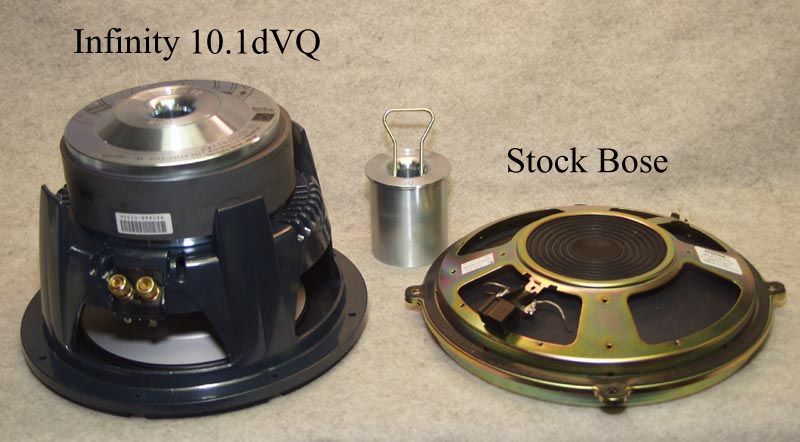
I love this picture. The big silver "can" isn't the missing magnet structure from the Bose - it's one of the tuning slugs for the Infinity.


Thread
Thread Starter
Forum
Replies
Last Post
Dark Knight
Wheels Tires
7
Nov 11, 2015 08:40 PM
