


i keep hearing it, what are A pillars?


Registered User
Joined: Oct 2007
Posts: 53
Likes: 0
From: Indianapolis, IN

I think most people are not going to answer this question because it is on the thin line of being stupid. BUT, I am going to spare the effort for others to reply in a kind way. First- searching of any form would be helpful in your case. Second- Are you familiar with a gauge pod pillar? Third- "A Pillar" is actually referring to the sheet metal sub-frames that help structurally reinforce your car and also aid in other tasks as well.
For Example: the plastic moldings in the four corners that usually start from your dash to the overhead lining, some of your upgraded trim levels have manufactured molds for tweeters in the "A-pillars". In the car enthusiast industry a lot of people buy or have custom pillar pods for their gauges.
I'm not completely sure on this tid-bit but someone can correct me if I am wrong, mainly just explaining the gist. A pillar is on the driver side, B pillar is on the passenger side , C pillar is on the passenger left, and the D pillar is on the passenger right side.
If you need an idea of what one looks like go to autometer.com
For Example: the plastic moldings in the four corners that usually start from your dash to the overhead lining, some of your upgraded trim levels have manufactured molds for tweeters in the "A-pillars". In the car enthusiast industry a lot of people buy or have custom pillar pods for their gauges.
I'm not completely sure on this tid-bit but someone can correct me if I am wrong, mainly just explaining the gist. A pillar is on the driver side, B pillar is on the passenger side , C pillar is on the passenger left, and the D pillar is on the passenger right side.
If you need an idea of what one looks like go to autometer.com

Just a clarification.......
A-pillars are the driver's and passenger's side columns flanking the windshield. B-pillars are the next columns back, behind the doors on the Z. C-pillars would be the columns flanking the hatch opening.
A-pillars are the driver's and passenger's side columns flanking the windshield. B-pillars are the next columns back, behind the doors on the Z. C-pillars would be the columns flanking the hatch opening.


psychedelic one

Joined: Nov 2005
Posts: 3,084
Likes: 1
From: In-A-Gadda-Da-Vida
How about pictures ... with fabulous different colors!!!!
http://en.wikipedia.org/wiki/Image:P...29_colored.svg
p.s. There will be a short quiz next period.
http://en.wikipedia.org/wiki/Image:P...29_colored.svg
p.s. There will be a short quiz next period.

New Member


Joined: Dec 2006
Posts: 7,337
Likes: 204
From: Edina, Minnesota
OK… we’ve got the “pillar alphabet” down cold. Thanks guys for the info. I had no idea that there was anything past A-Pillar. B… C… D…
So you probably want to see what it looks like (tweeter in the A-Pillar). This is a picture of tweeters mounted in the A-pillar.
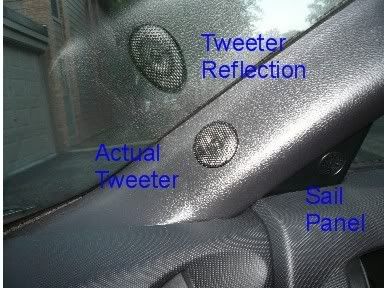
“Sail Panel" is where Nissan mounts the OEM tweeter.
“Actual Tweeter” is where you can mount a tweeter in the A-Pillar.
"Tweeter Reflection" is not where the tweeter is mounted; this is the reflection of the tweeter's sound projection off the front windshield. With this arrangement, the tweeter's very directional sound bounces from that angle of the windshield towards the middle of the car.
--Spike
So you probably want to see what it looks like (tweeter in the A-Pillar). This is a picture of tweeters mounted in the A-pillar.
“Sail Panel" is where Nissan mounts the OEM tweeter.
“Actual Tweeter” is where you can mount a tweeter in the A-Pillar.
"Tweeter Reflection" is not where the tweeter is mounted; this is the reflection of the tweeter's sound projection off the front windshield. With this arrangement, the tweeter's very directional sound bounces from that angle of the windshield towards the middle of the car.
--Spike
Originally Posted by Z MANIA
How about pictures ... with fabulous different colors!!!!
http://en.wikipedia.org/wiki/Image:P...29_colored.svg
p.s. There will be a short quiz next period.
http://en.wikipedia.org/wiki/Image:P...29_colored.svg
p.s. There will be a short quiz next period.
Trending Topics


Not that I don't love Wikipedia, but I have to add some info I recieved from a three of my buddies who are engineers for a few auto manufactures you may have heard of, Nissan, Honda, and huuaaahh.....Ford. (me puking BTW)
The second picture in the Wiki with the car with only A and C pillars is incorrect. The pillars go in sequence no matter how many there are. In other words, the first one is A, and second is B, then C and so on. Therefore in that picture it should be labeled A in the front and B in the back.
This can be confusing because with a few exceptions (such as a 60's Impala hardtop, Le Baron Convertable's, and a few others), hardly any cars ever made have only had two sets of pillars connecting the lower body to the roof. And I don't know if all this is true, but that is definately how engineers from the previously mentioned automakers refer to them.
The second picture in the Wiki with the car with only A and C pillars is incorrect. The pillars go in sequence no matter how many there are. In other words, the first one is A, and second is B, then C and so on. Therefore in that picture it should be labeled A in the front and B in the back.
This can be confusing because with a few exceptions (such as a 60's Impala hardtop, Le Baron Convertable's, and a few others), hardly any cars ever made have only had two sets of pillars connecting the lower body to the roof. And I don't know if all this is true, but that is definately how engineers from the previously mentioned automakers refer to them.
Originally Posted by HIGHTECHZ
Not that I don't love Wikipedia, but I have to add some info I recieved from a three of my buddies who are engineers for a few auto manufactures you may have heard of, Nissan, Honda, and huuaaahh.....Ford. (me puking BTW)
The second picture in the Wiki with the car with only A and C pillars is incorrect. The pillars go in sequence no matter how many there are. In other words, the first one is A, and second is B, then C and so on. Therefore in that picture it should be labeled A in the front and B in the back.
This can be confusing because with a few exceptions (such as a 60's Impala hardtop, Le Baron Convertable's, and a few others), hardly any cars ever made have only had two sets of pillars connecting the lower body to the roof. And I don't know if all this is true, but that is definately how engineers from the previously mentioned automakers refer to them.
The second picture in the Wiki with the car with only A and C pillars is incorrect. The pillars go in sequence no matter how many there are. In other words, the first one is A, and second is B, then C and so on. Therefore in that picture it should be labeled A in the front and B in the back.
This can be confusing because with a few exceptions (such as a 60's Impala hardtop, Le Baron Convertable's, and a few others), hardly any cars ever made have only had two sets of pillars connecting the lower body to the roof. And I don't know if all this is true, but that is definately how engineers from the previously mentioned automakers refer to them.
You would be correct. they do go in alpha order regardless of how many there are. The 2nd pic in Wiki is indeed wrong.
Ken <<upset he didn't pick up on that>>


Just one little addition, A-pillars are typically a TERRIBLE place to mount tweeters.
The higher the audio frequency the more direction the sound is going to be. So, the higher the frequency the more important it is to equalize the path lengths of the sound waves.
A-pillar mounting does not provide anywhere near equal distance path lengths. So, unless you have a really good processor that can delay the tweeters the front sound stage will be heavily biased to the left.
The higher the audio frequency the more direction the sound is going to be. So, the higher the frequency the more important it is to equalize the path lengths of the sound waves.
A-pillar mounting does not provide anywhere near equal distance path lengths. So, unless you have a really good processor that can delay the tweeters the front sound stage will be heavily biased to the left.
Last edited by KPierson; Oct 26, 2007 at 02:57 AM.
New Member
Joined: Dec 2006
Posts: 7,337
Likes: 204
From: Edina, Minnesota
Originally Posted by KPierson
Just one little addition, A-pillars are typically a TERRIBLE place to mount tweeters.
The higher the audio frequency the more direction the sound is going to be. So, the higher the frequency the more important it is to equalize the path lengths of the sound waves.
A-pillar mounting does not provide anywhere near equal distance path lengths. So, unless you have a really good processor that can delay the drivers tweet the front sound stage will be heavily biased to the left.
The higher the audio frequency the more direction the sound is going to be. So, the higher the frequency the more important it is to equalize the path lengths of the sound waves.
A-pillar mounting does not provide anywhere near equal distance path lengths. So, unless you have a really good processor that can delay the drivers tweet the front sound stage will be heavily biased to the left.
I tested different tweeter/speaker mounts, and the A-Pillar is quite good. Of course any reasonable person plans staging the sound, and the A-Pillar is an excellent location when you do a correct layout.
Are you saying you cannot mount tweeters in the A-Pillar and get good sound?
--Spike
Sorry, I edited my original post so that is is easier to read. I left in an extra word that I removed.
I'm saying that the a-pillar is not the ideal place to mount high frequency speakers (tweeters) because the path lengths will way off. Putting tweeters in the kick panels will make the path lengths much closer, which will help center the sound stage.
This isn't rocket science, and can be proved with a tape measure.
Here is a great article on imaging and sound stages that has pictures to help explain what I'm saying: http://www.crutchfieldadvisor.com/S-...oundstage.html
Here is another explanation: http://www.carstereo.com/help/Articles.cfm?id=50
I'm saying that the a-pillar is not the ideal place to mount high frequency speakers (tweeters) because the path lengths will way off. Putting tweeters in the kick panels will make the path lengths much closer, which will help center the sound stage.
This isn't rocket science, and can be proved with a tape measure.
Here is a great article on imaging and sound stages that has pictures to help explain what I'm saying: http://www.crutchfieldadvisor.com/S-...oundstage.html
Here is another explanation: http://www.carstereo.com/help/Articles.cfm?id=50
Last edited by KPierson; Oct 26, 2007 at 02:58 AM.
New Member
Joined: Dec 2006
Posts: 7,337
Likes: 204
From: Edina, Minnesota
Kevin... Thanks for the additional explanation and the good links. I didn’t mention in my post that I have the midrange mounted in the stock door position (more about that later), and of course that takes the discussion on a different path.
Everyone has different needs. If I could use kicks, that is what I would do since I think it is a great place to mount component speakers in the Z. I have a minor back issue, and having the dead pedal available keeps me comfortable on long drives. That eliminates using kicks in my case. The next best location is door pods, but my parking space is very close to a wall preventing me from opening the door widely. I’m already scraping the stock speaker grill with my foot so door pods won’t work for me. I’m sure that some people would say that door pods are better than kicks, but that’s another discussion.
That leaves me with the stock speaker location, which I think is the worst option; but it’s certainly workable. Along with some of the other problems using the stock door location for the midrange (concave and thick grill, figuring out the mount and spacers, etc.) is where to mount the tweeter. I didn’t want to do surgery on an expensive door panel (I was concerned about botching-up the panel). I decided to use the stock Sail Panel. That didn’t work at all, primarily for the reason you mention:
Mounting the midrange in the door and the tweeter in the Sail Panel puts the tweeter too far from the rest of the components, and a quality tweeter really blasts into the driver’s and passenger’s ears. The tweeter is simply too close to the listener(s) when mounted in the Sail Panel, and that position violates a basic premise of sound staging.
To achieve proper sound staging, you want to create the effect that the sound is in front of the listener. Since woofers and midranges are not as directional as the higher frequencies coming from a tweeter, it’s possible to put these components into the door and still expect reasonable sound. It’s the tweeters which present the biggest challenge (when you don’t use kicks) since the sound from these is very directional. Here’s a quote from one of the links you posted:
“Directivity of sound is related to frequency. At higher frequencies it is easier to pinpoint where the sound is coming from than lower frequencies. This can be used to our advantage in car stereo. Tweeters are the most important part of getting good staging. They should be aimed towards the middle of the car.”
The challenge was respecting this premise when mounting a quality tweeter. That is why I picked the A-Pillar. Using this position, I was able to bounce the very directional high-frequency sound coming from the tweeter towards the center of the car (see my picture posted earlier on this thread). It works. The sound is great, and it definitely creates the illusion that it is coming from the front of the car (as the article you reference recommends).
If you cannot use kicks to mount components, the A-Pillar is a good choice for your tweeter.
--Spike
Everyone has different needs. If I could use kicks, that is what I would do since I think it is a great place to mount component speakers in the Z. I have a minor back issue, and having the dead pedal available keeps me comfortable on long drives. That eliminates using kicks in my case. The next best location is door pods, but my parking space is very close to a wall preventing me from opening the door widely. I’m already scraping the stock speaker grill with my foot so door pods won’t work for me. I’m sure that some people would say that door pods are better than kicks, but that’s another discussion.
That leaves me with the stock speaker location, which I think is the worst option; but it’s certainly workable. Along with some of the other problems using the stock door location for the midrange (concave and thick grill, figuring out the mount and spacers, etc.) is where to mount the tweeter. I didn’t want to do surgery on an expensive door panel (I was concerned about botching-up the panel). I decided to use the stock Sail Panel. That didn’t work at all, primarily for the reason you mention:
Originally Posted by KPierson
… I'm saying that the a-pillar is not the ideal place to mount high frequency speakers (tweeters) because the path lengths will way off. …
To achieve proper sound staging, you want to create the effect that the sound is in front of the listener. Since woofers and midranges are not as directional as the higher frequencies coming from a tweeter, it’s possible to put these components into the door and still expect reasonable sound. It’s the tweeters which present the biggest challenge (when you don’t use kicks) since the sound from these is very directional. Here’s a quote from one of the links you posted:
“Directivity of sound is related to frequency. At higher frequencies it is easier to pinpoint where the sound is coming from than lower frequencies. This can be used to our advantage in car stereo. Tweeters are the most important part of getting good staging. They should be aimed towards the middle of the car.”
The challenge was respecting this premise when mounting a quality tweeter. That is why I picked the A-Pillar. Using this position, I was able to bounce the very directional high-frequency sound coming from the tweeter towards the center of the car (see my picture posted earlier on this thread). It works. The sound is great, and it definitely creates the illusion that it is coming from the front of the car (as the article you reference recommends).
If you cannot use kicks to mount components, the A-Pillar is a good choice for your tweeter.
--Spike
Originally Posted by Spike100
The challenge was respecting this premise when mounting a quality tweeter. That is why I picked the A-Pillar. Using this position, I was able to bounce the very directional high-frequency sound coming from the tweeter towards the center of the car (see my picture posted earlier on this thread). It works. The sound is great, and it definitely creates the illusion that it is coming from the front of the car (as the article you reference recommends).
If you cannot use kicks to mount components, the A-Pillar is a good choice for your tweeter.
--Spike
I've actually never seen anyone achieve good results with bouncing sound waves off the windshield. Typically when bounced off the curved glass it is very hard to get acceptable results. How long did it take you to get them positioned correctly?
New Member
Joined: Dec 2006
Posts: 7,337
Likes: 204
From: Edina, Minnesota
Originally Posted by KPierson
Thats why I said 'typically'. If someone were to simply mount some tweeters to the A-pillar without experimenting and finding an acceptable balance they will sound terrible - I've seen it a 100 times. People think simply because they add tweeters they will just magically sound good.
I've actually never seen anyone achieve good results with bouncing sound waves off the windshield. Typically when bounced off the curved glass it is very hard to get acceptable results. How long did it take you to get them positioned correctly?
I've actually never seen anyone achieve good results with bouncing sound waves off the windshield. Typically when bounced off the curved glass it is very hard to get acceptable results. How long did it take you to get them positioned correctly?
I’m surprised you say “I've actually never seen anyone achieve good results with bouncing sound waves off the windshield. Typically when bounced off the curved glass it is very hard to get acceptable results.”
If you bounce the sound off a hard surface such as the windshield, where will the sound go other than back into the car’s passenger compartment? If you’re worried about very precise direction, you’re fretting about nothing. The advantage of using this setup for staging and directionality is simply that the glass reflects almost perfectly, and the sound now comes from the front towards the listener and the middle of the car. It’s just an easy and ideal way of doing this. It’s a very common method that provides excellent sound from high frequency sources.
--Spike
Ha, I don't claim to know everything about car audio. I used to be an installer years ago, but since I quit installing I haven't kept up with the 'scene'.
That being said, the fact I haven't seen something isn't surprising, it was just a statement. I was just thinking about the overall unpredictability of bouncing waves off of glass and then the associated timing effects it would have on the overall music.
I was always big on 'sound staging'. Here are some pics of my last custom audio system (all self installed):


My sound stage consisted of 5 1/4" midranges with 1" tweeters in the kick panel. Then, I had two 8" free air subs used as midbasses in the center console. I had no rear speakers at all. The music sounded like it was coming from right above the center of the dash - absolutely amazing.
I spent tons of time on that system, mostly making it look nice (everything is trimmed in black plexiglass). I do miss it now, but believe it or not my G35 is bone stock when it comes to audio. Most people on here complain about the Bose system, but I don't mind it at all. It serves its purpose and oddly enough I'm happy with it.
That being said, the fact I haven't seen something isn't surprising, it was just a statement. I was just thinking about the overall unpredictability of bouncing waves off of glass and then the associated timing effects it would have on the overall music.
I was always big on 'sound staging'. Here are some pics of my last custom audio system (all self installed):
My sound stage consisted of 5 1/4" midranges with 1" tweeters in the kick panel. Then, I had two 8" free air subs used as midbasses in the center console. I had no rear speakers at all. The music sounded like it was coming from right above the center of the dash - absolutely amazing.
I spent tons of time on that system, mostly making it look nice (everything is trimmed in black plexiglass). I do miss it now, but believe it or not my G35 is bone stock when it comes to audio. Most people on here complain about the Bose system, but I don't mind it at all. It serves its purpose and oddly enough I'm happy with it.
New Member
Joined: Dec 2006
Posts: 7,337
Likes: 204
From: Edina, Minnesota
Your installation looks nice and I'm sure sounds very good. I was wondering why you were so vested in kicks; now I see why.
My setup provides the same "travel distance" for sound from the midrange and tweeters (midrange in the doors and tweeters in the A-Pillar), and that is why it works and is very easy to stage. A measurement of the distance shows it to be within an inch or two to the listener's ear. The downside of my installation is the tweeters are located a long distance from the midranges (although the distance to the listener's ear is the same). The challenge is staging this setup so that the sound comes from the front of the car. You can do this with the setup I describe.
Your setup using kicks is probably better, and certainly from the standpoint of "ease and reliability." Professional Installers often favor this location. I've already stated why kicks don't work for me, and that's why I selected a different location(s) for my components. My point is there are various options that are workable.
--Spike
My setup provides the same "travel distance" for sound from the midrange and tweeters (midrange in the doors and tweeters in the A-Pillar), and that is why it works and is very easy to stage. A measurement of the distance shows it to be within an inch or two to the listener's ear. The downside of my installation is the tweeters are located a long distance from the midranges (although the distance to the listener's ear is the same). The challenge is staging this setup so that the sound comes from the front of the car. You can do this with the setup I describe.
Your setup using kicks is probably better, and certainly from the standpoint of "ease and reliability." Professional Installers often favor this location. I've already stated why kicks don't work for me, and that's why I selected a different location(s) for my components. My point is there are various options that are workable.
--Spike