


Taking tire temps

 Taking tire temps
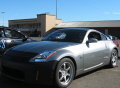
Since the Z is capable of boiling almost every fluid it has, I am having difficulty taking accurate tire temps. Last time I pulled into the pits to take temps, my brakes were billowing, and almost every fluid in the car boiled while I waited for my helper to take the tire temps. I warped a set of good rotors when I first got the car car while taking temps as well. My understanding is that you have to bring the tires up to full operating temperature to get accurate readings. It also seemed like by the time my helper got to the rear tires, they were already cooling off and were 10 degrees less than my fronts (I was expecting them to be hotter).
Is there a better way to get tire temps?? What is everyone else doing?
Any tips or tricks would be helpful.
Is there a better way to get tire temps?? What is everyone else doing?
Any tips or tricks would be helpful.

I'm surprised none of the veterans have chipped in on this one.
My local club/track etiquette dictates no monkeying around in the staging area (though I have seen a few pull up tight to the wall for quick checks). I guess you have to play it by ear. Most people seem to check temps & pressures back in the paddock after the session, not true operating temps, but close enough to check wear patterns I guess.
I'd like to hear a lot more on the pressure & temp subject from experienced board members. Should you run higher or lower pressures on the outboard wheels, or the same all around? How much temp/pressure variance from corner to corner is acceptable before a tweak is necessary? I'll be the first to admit vast ignorance on the subject. I made it through the season on one set of Yok' A032's, a pressure gauge and dumb luck. Set it and forget it worked O.K. for a while but a pyrometer and a clue are on the wish list for next year.
My local club/track etiquette dictates no monkeying around in the staging area (though I have seen a few pull up tight to the wall for quick checks). I guess you have to play it by ear. Most people seem to check temps & pressures back in the paddock after the session, not true operating temps, but close enough to check wear patterns I guess.
I'd like to hear a lot more on the pressure & temp subject from experienced board members. Should you run higher or lower pressures on the outboard wheels, or the same all around? How much temp/pressure variance from corner to corner is acceptable before a tweak is necessary? I'll be the first to admit vast ignorance on the subject. I made it through the season on one set of Yok' A032's, a pressure gauge and dumb luck. Set it and forget it worked O.K. for a while but a pyrometer and a clue are on the wish list for next year.
I use an infrared temp gun. I take my normal cool down lap pull off the track jump out and take the temps. Pull a temp off the outside, middle and inside of the tire. Takes maybe 30 seconds to do all 4. I generally look for the outside to be within a 10 degrees of the inside all the way around. Although my front tires have been coming out pretty smooth all the way across.

+1 for Zillinois. The new infrared guns are great. Take a moderate cooldown lap to cool the brakes somewhat (the tires and brakes will still be quite hot). Ideally, it's best to have two people doing the tire check - one to take the readings and one to write them down. Have them practice when cold so they are not fumbling around when things are hot. A good crew can do a tire check in less than 10 seconds for each tire. I also agree on the 10 degree figure. That's about as close as you can expect, all the way across the tire.

Did your tire guy try reading the backs first to see if cooling is an issue. I'm wondering if you're understeering too much and plowing (which would explain the front to rear differential in temps) instead of using throttle through a turn and using the rear to point your car along the line.


Joined: May 2002
Posts: 8,634
Likes: 1,395
From: Aurora, Colorado
If you're serious about taking tire temps, than I'd consider the following: #1- infrared temp guages are great and convenient, but not all that accurate. To get accurate tire temps use a dedicated tire probe that actually comes into contact and slightly inside the outer, middle and inner sections of the tire surface. #2- This may not be practical for HPDEs, if the pit-out and pit-in lanes are the same, BUT I like to go out for a five lap session. The out lap should be used to gently warm the tires (and car) and the next four should be at FULL STICK to get increasingly quick times. #3- Drive the fifth lap quickly, but be prepared to duck into the pits under control. Identify an area you can safely take tire temps at near a particular pit box or section of the hot pits. Have your crew (or friend, wife, whatever) ready to take temps the instant you come to a complete stop. Turn your wheels to the left or right so they have easy access to the front tires. I use the LF, RF, RR and LR pattern because the memory feature on my Compugauge temp guage is set that way.
Your heatsink and boiling problems shouldn't be too bad using this method. The biggest factor is getting skilled at inserting the probe and getting an accurate reading quickly. IMHO- this is the best way to get accurate, repeatable results. Hope it helps!
David Muramoto
Sport Z Magazine Motorsports Editor
Your heatsink and boiling problems shouldn't be too bad using this method. The biggest factor is getting skilled at inserting the probe and getting an accurate reading quickly. IMHO- this is the best way to get accurate, repeatable results. Hope it helps!
David Muramoto
Sport Z Magazine Motorsports Editor
Tires cool down very quickly so it is important take temps after a hot lap. You can take pressures after a cool down lap but not temperatures. Ideally you should check the side of the car that is opposite to the last corner taken (ie if the last corner taken was a right hander, you should check the left tires)
Probe type pyrometers are better than infrared because you can get down below the surface where the temps hold a little longer. Are the new infrared pytometers you guys mentioned any different than those of a few years ago?
Yes, the rears were hotter when checked first. It doesn't take long for tires to cool off.
Basically, I got all the readings I needed to make my adjustments. I think what it comes down to it, I need a faster pit crew.. If you ever watch the pit crews at grand-am or even F1, they've got multiple people taking temps and they're able to do it in under 10 seconds for the whole car.
Probe type pyrometers are better than infrared because you can get down below the surface where the temps hold a little longer. Are the new infrared pytometers you guys mentioned any different than those of a few years ago?
Did your tire guy try reading the backs first to see if cooling is an issue. I'm wondering if you're understeering too much and plowing (which would explain the front to rear differential in temps) instead of using throttle through a turn and using the rear to point your car along the line.
Basically, I got all the readings I needed to make my adjustments. I think what it comes down to it, I need a faster pit crew..
If you ever watch the pit crews at grand-am or even F1, they've got multiple people taking temps and they're able to do it in under 10 seconds for the whole car.
Trending Topics
The new IR thermometers have a 3 laser aiming system which greatly increases accuracy of temps. The more expensive IR thermometers also have the accuracy cert which guarantee's accuracy to a certain point. My experience has been that the temp difference stays in the tires long enough that you can correct the pressures if needed even after cool down. The last corner will skew your results of the average tire condition over the whole track, IMO, if you take readings immediately after pulling in to the pits hot.
I'm taking a data acquistion class right now and there is a really slick IR setup which has a sensor at the outside, middle and inside of the tire permanently mounted to give you an immediate snap shot as well as having the numbers logged for each corner. If IR sensors are good enough for NEXTEL cars, they're probably good enough for club racers and HPDEr's.
http://www.auto-ware.com/webinar_home.html
I'm taking a data acquistion class right now and there is a really slick IR setup which has a sensor at the outside, middle and inside of the tire permanently mounted to give you an immediate snap shot as well as having the numbers logged for each corner. If IR sensors are good enough for NEXTEL cars, they're probably good enough for club racers and HPDEr's.
http://www.auto-ware.com/webinar_home.html
Originally Posted by dkmura
If you're serious about taking tire temps, than I'd consider the following: #1- infrared temp guages are great and convenient, but not all that accurate. To get accurate tire temps use a dedicated tire probe that actually comes into contact and slightly inside the outer, middle and inner sections of the tire surface. #2- This may not be practical for HPDEs, if the pit-out and pit-in lanes are the same, BUT I like to go out for a five lap session. The out lap should be used to gently warm the tires (and car) and the next four should be at FULL STICK to get increasingly quick times. #3- Drive the fifth lap quickly, but be prepared to duck into the pits under control. Identify an area you can safely take tire temps at near a particular pit box or section of the hot pits. Have your crew (or friend, wife, whatever) ready to take temps the instant you come to a complete stop. Turn your wheels to the left or right so they have easy access to the front tires. I use the LF, RF, RR and LR pattern because the memory feature on my Compugauge temp guage is set that way.
Your heatsink and boiling problems shouldn't be too bad using this method. The biggest factor is getting skilled at inserting the probe and getting an accurate reading quickly. IMHO- this is the best way to get accurate, repeatable results. Hope it helps!
David Muramoto
Sport Z Magazine Motorsports Editor
Your heatsink and boiling problems shouldn't be too bad using this method. The biggest factor is getting skilled at inserting the probe and getting an accurate reading quickly. IMHO- this is the best way to get accurate, repeatable results. Hope it helps!
David Muramoto
Sport Z Magazine Motorsports Editor
By the end of the day, I got the car exactly where I wanted her. I've got some ideas for further tweaking next season but I may also have to ditch the toyos for hoosiers to keep up with the jones's in my class. Which of course will mean back to the old drawing board.
Zillinois thanks for the explanation. I think part of it comes down to how quickly one can get the readings. It sounds like the nextel sensors are acquiring data while the car is in motion so outer surface temps would be ideal. My understanding was that you need to measure the tires right after a corner because that is what you are trying to optimize. You want a flat contact patch at full corner load to obtain maximum grip. Seems to me that after a cool down lap, your're not using the tire to it's fullest? What kind of temps to you get after a cool down lap? My 'hot lap' readings are right in the suggested range that toyo suggests (160F - 220F). Are your readings within that range or are they below?
Great discussion, I'd be curious to hear the cliff notes of the class you are taking.
Mine are in the 140-170 range. What I find important about temps is the delta between inner, middle and outer. And my experience is that the delta stays approximately the same within the time frame that I measure. My tires have just not cooled off too quickly to get a measurement. I rarely have more than 5-6 degrees between either side of the car. I initially tried hot pitting, but did not like some of the undesireable side effects which you already mentioned. It has also been my experience that the cool off actually allows the distribution of heat through the tire to essentially smooth for outliers or error, giving an "average" reading of my usage of the tires.
I'll definitely give a review of the D.A. course. So far it is very fascinating. What I have discovered already is that there is no answer. There is only harmony or dissonance. In engineering terms, you look for the most desireable set of compromises when making changes to your car. For the vast majority of us, the driver is the weak link. What it has already made me decide is to NOT get a datalogger. I will have my car sorted out by a temp install of a datalogger, but after that, 99 percent of the onnus of driving fast is on the driver, not car setup. (This is not meant to pertain to the above conversation) Here's how dumb I am. I drove my Diasio two weeks ago at Autobahn for 1 whole session with only 8lbs of air in the rear right tire and I didn't even know it. Most cars have so much capability today that looking at the car is almost pointless, unless your in that top 10% of drivers.
I'll definitely give a review of the D.A. course. So far it is very fascinating. What I have discovered already is that there is no answer. There is only harmony or dissonance. In engineering terms, you look for the most desireable set of compromises when making changes to your car. For the vast majority of us, the driver is the weak link. What it has already made me decide is to NOT get a datalogger. I will have my car sorted out by a temp install of a datalogger, but after that, 99 percent of the onnus of driving fast is on the driver, not car setup. (This is not meant to pertain to the above conversation) Here's how dumb I am. I drove my Diasio two weeks ago at Autobahn for 1 whole session with only 8lbs of air in the rear right tire and I didn't even know it. Most cars have so much capability today that looking at the car is almost pointless, unless your in that top 10% of drivers.
Hey, as someone said in another post "work on the nut that holds the steering wheel first.." I couldn't agree more. That being said, the one time I got a look at a pyrometer my tire temps varied widely edge to edge. Something like 155/168/180F (inside to out on the RFwheel, CC track), and quite a bit from wheel to wheel as well. I'm limited to tire pressure as the sole tuning variable (stock suspension and alignment on a G), so I'm certainly interested in hearing more info - It's All Good!
Originally Posted by Tim Mahoney
Hey, as someone said in another post "work on the nut that holds the steering wheel first.." I couldn't agree more. That being said, the one time I got a look at a pyrometer my tire temps varied widely edge to edge. Something like 155/168/180F (inside to out on the RFwheel, CC track), and quite a bit from wheel to wheel as well. I'm limited to tire pressure as the sole tuning variable (stock suspension and alignment on a G), so I'm certainly interested in hearing more info - It's All Good!
Great thread! I think some of this info was in another thread not long ago, but nice to see it again. zillinois was kind enough to share his pyrometer with me at the many events we ran together. Something I'm not sure of is that if my front tires are reading the same temps all across the tread, is my set-up correct? I'm thinking that I could possibly need a softer front bar setting to allow a touch more body roll, heating up the outside edge a tiny bit more. I did try softening the bar one hole on one side of the sway bar, but my next track day was at Road America, which is too long at 4 miles to get any meaningful data.
Also, my rear tires (255/40-17 Falkin 615's all around) are wearing about twice as fast as my fronts, also with near equal temps. And, my Z is pretty neutral currently.
Also, my rear tires (255/40-17 Falkin 615's all around) are wearing about twice as fast as my fronts, also with near equal temps.
And, my Z is pretty neutral currently.
Originally Posted by EnthuZ
Great thread! I think some of this info was in another thread not long ago, but nice to see it again. zillinois was kind enough to share his pyrometer with me at the many events we ran together. Something I'm not sure of is that if my front tires are reading the same temps all across the tread, is my set-up correct? I'm thinking that I could possibly need a softer front bar setting to allow a touch more body roll, heating up the outside edge a tiny bit more. I did try softening the bar one hole on one side of the sway bar, but my next track day was at Road America, which is too long at 4 miles to get any meaningful data.
Also, my rear tires (255/40-17 Falkin 615's all around) are wearing about twice as fast as my fronts, also with near equal temps. And, my Z is pretty neutral currently.
Also, my rear tires (255/40-17 Falkin 615's all around) are wearing about twice as fast as my fronts, also with near equal temps.
And, my Z is pretty neutral currently.edit: another indication would be that your rear tires are hotter is their hot pressure will increase about 2 lbs more than your fronts.
My pyrometer testing has shown me how much more pressure to put up front to balance out the extra heat generated in my rear.
Last edited by daveh; Nov 16, 2005 at 02:19 PM.
Joined: May 2002
Posts: 8,634
Likes: 1,395
From: Aurora, Colorado
Originally Posted by daveh
That is the exact technique I used. There was too much fumbling going on with my helper. Meanwhile, smoke was billowing out of my brakes. Can't really criticise someone who was doing me a favor and helping out.
By the end of the day, I got the car exactly where I wanted her. I've got some ideas for further tweaking next season but I may also have to ditch the toyos for hoosiers to keep up with the jones's in my class. Which of course will mean back to the old drawing board.
Zillinois thanks for the explanation. I think part of it comes down to how quickly one can get the readings. It sounds like the nextel sensors are acquiring data while the car is in motion so outer surface temps would be ideal. My understanding was that you need to measure the tires right after a corner because that is what you are trying to optimize. You want a flat contact patch at full corner load to obtain maximum grip. Seems to me that after a cool down lap, your're not using the tire to it's fullest? What kind of temps to you get after a cool down lap? My 'hot lap' readings are right in the suggested range that toyo suggests (160F - 220F). Are your readings within that range or are they below?
Great discussion, I'd be curious to hear the cliff notes of the class you are taking.
By the end of the day, I got the car exactly where I wanted her. I've got some ideas for further tweaking next season but I may also have to ditch the toyos for hoosiers to keep up with the jones's in my class. Which of course will mean back to the old drawing board.
Zillinois thanks for the explanation. I think part of it comes down to how quickly one can get the readings. It sounds like the nextel sensors are acquiring data while the car is in motion so outer surface temps would be ideal. My understanding was that you need to measure the tires right after a corner because that is what you are trying to optimize. You want a flat contact patch at full corner load to obtain maximum grip. Seems to me that after a cool down lap, your're not using the tire to it's fullest? What kind of temps to you get after a cool down lap? My 'hot lap' readings are right in the suggested range that toyo suggests (160F - 220F). Are your readings within that range or are they below?
Great discussion, I'd be curious to hear the cliff notes of the class you are taking.
All that made me recognize that is what I have a racecar for. Now I adjust tire pressure and play with the rebound adjustment of my shocks. And, as has been pointed out previously, I tighten the NUT behind the wheel and have a little fun at track days and HPDEs!
[/QUOTE]All that made me recognize that is what I have a racecar for. Now I adjust tire pressure and play with the rebound adjustment of my shocks. And, as has been pointed out previously, I tighten the NUT behind the wheel and have a little fun at track days and HPDEs![/QUOTE]
dkmura, we're on the same page. I think Zillinios and DaveH are prepping for TT's, have a lot more variables to sort out, and are squeezing everything out of their setups. I'm just out for kicks in my daily driver but am still trying to keep pace with the advanced group - always looking for MORE GRIP. Any knowledge gathered from you more experienced folks is a bonus, and I hope reciprocate some day.
dkmura, we're on the same page. I think Zillinios and DaveH are prepping for TT's, have a lot more variables to sort out, and are squeezing everything out of their setups. I'm just out for kicks in my daily driver but am still trying to keep pace with the advanced group - always looking for MORE GRIP. Any knowledge gathered from you more experienced folks is a bonus, and I hope reciprocate some day.
I'm one of those nuts that actually enjoys tinkering with all these variables. I don't think I'd really be happy if I weren't messing with something 
Actually now that I've got my baseline, I don't make too many adjustments. It's "arrive and drive" from here on out. Why buy all these adjustable parts and not use them to their fullest?
dkmura, yes my next upgrade is brake ducts for my stoptechs
Actually now that I've got my baseline, I don't make too many adjustments. It's "arrive and drive" from here on out. Why buy all these adjustable parts and not use them to their fullest?
dkmura, yes my next upgrade is brake ducts for my stoptechs
Originally Posted by daveh
If you are getting same temps across the whole tire you need more camber. You should be running 10-20 degrees hotter on the INSIDE. Softening up the front bar would actually make things worse because you would lean more and get more positive camber under hard cornering. If your rears are wearing twice as fast as your fronts that is an indication that your rears are working harder (they should be), however with the evidence that your rears are working harder, they should be getting hotter than the fronts. Unitech told me to work towards +20 degrees in the rear. Were you also taking temps after a cool down lap? What kind of camber are you running up front. It sounds like you've got more grip to be had up there!
edit: another indication would be that your rear tires are hotter is their hot pressure will increase about 2 lbs more than your fronts.
My pyrometer testing has shown me how much more pressure to put up front to balance out the extra heat generated in my rear.
edit: another indication would be that your rear tires are hotter is their hot pressure will increase about 2 lbs more than your fronts.
My pyrometer testing has shown me how much more pressure to put up front to balance out the extra heat generated in my rear.
 is that everyone I've seen at the track is wearing out their outside edges of their tires, and I wore out my race tires outer edge on my race car which was running 2 1/2 degrees negative camber up front. I stand corrected!
  BUT.....if I run more negative camber up front, I'll get more stick there, increasing my near oversteer condition I currently have. Sadly, I don't have adjustable front upper A-Arms. I was running with 1.25 FT camber, rear 2.5 neg. So, with my current set-up, should I increase my rear tire size? Or soften the rear spring rate? I still have a bit of front bump steer, so I don't want to stiffen up the front. I still need to add adjustable sway bar links to remove my preload, which I'll be doing over the Winter. And, a corner balance is on order!
With my pyrometer testing, my tires wear very evenly across the tread. Perhaps a tad more on the inside. My rears of course wear faster but I am able to rotate them since I have the same size all around. My toyos have lasted me all year because of this. I've lost count with how many days I've got on them. Perhaps 15 days or so. I guess in that sense the pyrometer has paid for itself. In 10 more years the camber arms will pay for themselves 

Thread
Thread Starter
Forum
Replies
Last Post