


Baller Bolts


Registered User
Joined: Mar 2010
Posts: 16
Likes: 0
From: Chandler, AZ

I guess I should introduce myself. My name is Ryan Hampton. I am a former Formula D, I.R.L driver and Grand Am champion. I have been involved with motorsports for 22 years including the building of 10 race cars in which I drove. I have been involved with racing Nissans since the start of my career.
$1800 - is for the complete front and rear subframe, transmission mounts, all the suspension on the car and axle nuts. All really big fasteners and a lot of them.
Titanium is really expensive and even more expensive when you are using Ti-6AL4V alloy aircraft grade. The process in which titanium fasteners are manufactured is much more expensive than typical bolts. Carbon, stainless and alloy steel is cold rolled when it is processed. Titanium must be hot rolled and annealed and also the heads must be hot forged as well. The pure manufacturing cost of titanium fasteners is 4 times that of other fasteners.
I invite you to observe some prices of titanium hardware and compare them to us.
http://www.probolt-usa.com/Products/M6_100mm
http://www.mettec.com/category/m_six...t_head_bolts/2
http://www.hyperbolts.com/catalog/in...8a0e3ja0lkabv5
http://www.yoyodyneti.com/Category.aspx?CategoryID=2774
I would also like you to compare some of the chrome dress up kit prices to ours and then come back and talk about mark up.
No titanium is not for everyone, it is however the strongest metal per weight you can buy and is more corrosion resistant than stainless steel, it will never rust.
Here are the advantages and disadvantages of each type of fastener materials
While stainless steel looks really nice and offers some amount of corrosion resistance, it lacks strength and is relatively brittle or is a "dry" metal. The other disadvantage is weight. Stainless is heaver than steel, alloy steel, or titanium. There are several grades of stainless steel fasteners. The two common grades are A2-50 and A2-70. The -50 and the -70 are either soft or cold worked. There is a high strength stainless, but it is only common to Mil-Spec or NAS hardware which is A286. However, the price for fasteners in A286 surpasses the price of titanium.
Alloy and Carbon Steel are the most common fasteners by far. Carbon steel is what you are going to find on your vehicle. Carbon Steel offers strength, but lacks corrosion resistance. This is why you will often see a zinc coating offered in either silver or gold. These fasteners you will commonly see in metric grades of 8.8 and 10.9. The typical OEM bolts fall in the grade of 8.8. Alloy Steel is a 12.9 grade and is among the highest grade of metric hardware that offers extremely high tensile strength. The downside of grade 12.9 is the only corrosion resistance is an oxide coating which is in effect a form of rust.
Titanium is offered in several grades. Grade 1-4 are commercially pure titanium, but offer relatively low tensile strength. Grades 5-29 are alloyed titanium. The grading scale for titanium is not directly related to strength properties. In other words a grade 6 is not stronger in terms of tensile strength to grade 5. When you alloy titanium it becomes extremely strong. Grade 5 (6AL4V) is the strongest in terms of tensile strength that is readily available. It is in the strength class between 10.9 and 12.9 metric grade hardware. There are some beta alloys of titanium that surpass grade 12.9 but are extremely expensive. Then there is the weight factor. Titanium is 45% the weight of steel, but offers the same tensile strength. The other advantage is corrosion resistance. Titanium surpasses stainless steel in terms of corrosion resistance. In other words, it will never rust and is resistant to most acids and bases. That is the main reason you see it used to repair the human body....
Tensile Strength Table:
A2-50 Stainless - 70,000 PSI
A2-70 Stainless - 100,000 PSI
A286 Super Alloy - 145,000 PSI
Grade 8.8 - 120,00 PSI
Grade 10.9 - 150,000 PSI
Grade 12.9 - 176,000 PSI
Titanium Grade 4 - 79,000 PSI
Titanium Grade 5 - 145,000 PSI
Titanium Grade 5 Heat Treated - 160,000 PSI
The fasteners we carry are all Grade 5 (6AL4V) and are heat treated. We also carry a full line of stainless steel and alloy steel hardware as well.
$1800 - is for the complete front and rear subframe, transmission mounts, all the suspension on the car and axle nuts. All really big fasteners and a lot of them.
Titanium is really expensive and even more expensive when you are using Ti-6AL4V alloy aircraft grade. The process in which titanium fasteners are manufactured is much more expensive than typical bolts. Carbon, stainless and alloy steel is cold rolled when it is processed. Titanium must be hot rolled and annealed and also the heads must be hot forged as well. The pure manufacturing cost of titanium fasteners is 4 times that of other fasteners.
I invite you to observe some prices of titanium hardware and compare them to us.
http://www.probolt-usa.com/Products/M6_100mm
http://www.mettec.com/category/m_six...t_head_bolts/2
http://www.hyperbolts.com/catalog/in...8a0e3ja0lkabv5
http://www.yoyodyneti.com/Category.aspx?CategoryID=2774
I would also like you to compare some of the chrome dress up kit prices to ours and then come back and talk about mark up.
No titanium is not for everyone, it is however the strongest metal per weight you can buy and is more corrosion resistant than stainless steel, it will never rust.
Here are the advantages and disadvantages of each type of fastener materials
While stainless steel looks really nice and offers some amount of corrosion resistance, it lacks strength and is relatively brittle or is a "dry" metal. The other disadvantage is weight. Stainless is heaver than steel, alloy steel, or titanium. There are several grades of stainless steel fasteners. The two common grades are A2-50 and A2-70. The -50 and the -70 are either soft or cold worked. There is a high strength stainless, but it is only common to Mil-Spec or NAS hardware which is A286. However, the price for fasteners in A286 surpasses the price of titanium.
Alloy and Carbon Steel are the most common fasteners by far. Carbon steel is what you are going to find on your vehicle. Carbon Steel offers strength, but lacks corrosion resistance. This is why you will often see a zinc coating offered in either silver or gold. These fasteners you will commonly see in metric grades of 8.8 and 10.9. The typical OEM bolts fall in the grade of 8.8. Alloy Steel is a 12.9 grade and is among the highest grade of metric hardware that offers extremely high tensile strength. The downside of grade 12.9 is the only corrosion resistance is an oxide coating which is in effect a form of rust.
Titanium is offered in several grades. Grade 1-4 are commercially pure titanium, but offer relatively low tensile strength. Grades 5-29 are alloyed titanium. The grading scale for titanium is not directly related to strength properties. In other words a grade 6 is not stronger in terms of tensile strength to grade 5. When you alloy titanium it becomes extremely strong. Grade 5 (6AL4V) is the strongest in terms of tensile strength that is readily available. It is in the strength class between 10.9 and 12.9 metric grade hardware. There are some beta alloys of titanium that surpass grade 12.9 but are extremely expensive. Then there is the weight factor. Titanium is 45% the weight of steel, but offers the same tensile strength. The other advantage is corrosion resistance. Titanium surpasses stainless steel in terms of corrosion resistance. In other words, it will never rust and is resistant to most acids and bases. That is the main reason you see it used to repair the human body....
Tensile Strength Table:
A2-50 Stainless - 70,000 PSI
A2-70 Stainless - 100,000 PSI
A286 Super Alloy - 145,000 PSI
Grade 8.8 - 120,00 PSI
Grade 10.9 - 150,000 PSI
Grade 12.9 - 176,000 PSI
Titanium Grade 4 - 79,000 PSI
Titanium Grade 5 - 145,000 PSI
Titanium Grade 5 Heat Treated - 160,000 PSI
The fasteners we carry are all Grade 5 (6AL4V) and are heat treated. We also carry a full line of stainless steel and alloy steel hardware as well.
Last edited by RyanHampton; Mar 7, 2010 at 06:58 AM.

So I guess my question would be, do people often have issues with bolts breaking off their cars to where something stronger than OEM is needed?
If one were to buy that nut/bolt set for the entire chassis, what would be the weight savings over OEM?
Sorry, not here to knock anyone's products or company, but it just seems like one of those mods that you do just to tell people you have it. I just can't see lap times or 1/4 mile times dropping significantly due to swapping out some bolts. Then again, I am not an automotive engineer, so what do I know.
If one were to buy that nut/bolt set for the entire chassis, what would be the weight savings over OEM?
Sorry, not here to knock anyone's products or company, but it just seems like one of those mods that you do just to tell people you have it. I just can't see lap times or 1/4 mile times dropping significantly due to swapping out some bolts. Then again, I am not an automotive engineer, so what do I know.




If someone told me that, I would look at them like this..........

High priced rice IMHO.
Registered User
Joined: Mar 2010
Posts: 16
Likes: 0
From: Chandler, AZ
To answer some of the questions.
OEM hardware is perfectly fine for the street. If your car remains on the street for all of its useful life, then yes there is no performance advantage to change from OEM hardware. If your car makes to to the race track however, OEM hardware is not suitable. Will the OEM stand up to the rigors of road racing? Possibly? I have seen several OEM bolts fail on track cars yes. OEM fasteners were not meant to take bouncing off apex curbing at the possible bloody edge of cornering. If this were the case, then all race cars would have OEM hardware.
On the subject of weight savings, when we built our S13 GTU car we used all titanium and aluminum hardware to construct our the car. We saved 42 lbs in hardware alone. Doing all of the suspension mounting in titanium hardware saves the most important weight on the car: UN-SPRUNG WEIGHT. The second most important application is: ROTATIONAL MASS. Using titanium in the drive line components will directly relate to 1/4 mile times. Shedding weight off the drive line directly translates into faster acceleration. That is why in the Stage 3 kit axle nuts and axle bolts are titanium.
If Home Depot hardware was suitable for Indy Cars or GT cars you would see it on there. What you do see is aerospace hardware. Why, strength and weight.
Formula 1 cars use complete titanium hardware for their construction. Indy cars use titanium hardware, GT cars use titanium hardware so your statement of its rice is totally without basis.
On the contrary, titanium hardware is the closest thing to race not rice as you can get.
As was stated previously, titanium hardware is not for everyone, but there is a very functional value for it.
As for the name, it is easy to remember and is a bit humorous. If you notice we don't just do titanium hardware. We do hardware for race applications including NAS and MS products as well.
OEM hardware is perfectly fine for the street. If your car remains on the street for all of its useful life, then yes there is no performance advantage to change from OEM hardware. If your car makes to to the race track however, OEM hardware is not suitable. Will the OEM stand up to the rigors of road racing? Possibly? I have seen several OEM bolts fail on track cars yes. OEM fasteners were not meant to take bouncing off apex curbing at the possible bloody edge of cornering. If this were the case, then all race cars would have OEM hardware.
On the subject of weight savings, when we built our S13 GTU car we used all titanium and aluminum hardware to construct our the car. We saved 42 lbs in hardware alone. Doing all of the suspension mounting in titanium hardware saves the most important weight on the car: UN-SPRUNG WEIGHT. The second most important application is: ROTATIONAL MASS. Using titanium in the drive line components will directly relate to 1/4 mile times. Shedding weight off the drive line directly translates into faster acceleration. That is why in the Stage 3 kit axle nuts and axle bolts are titanium.
If Home Depot hardware was suitable for Indy Cars or GT cars you would see it on there. What you do see is aerospace hardware. Why, strength and weight.
Formula 1 cars use complete titanium hardware for their construction. Indy cars use titanium hardware, GT cars use titanium hardware so your statement of its rice is totally without basis.
On the contrary, titanium hardware is the closest thing to race not rice as you can get.
As was stated previously, titanium hardware is not for everyone, but there is a very functional value for it.
As for the name, it is easy to remember and is a bit humorous. If you notice we don't just do titanium hardware. We do hardware for race applications including NAS and MS products as well.
Last edited by RyanHampton; Mar 8, 2010 at 03:36 AM.
Registered User
Joined: Mar 2010
Posts: 16
Likes: 0
From: Chandler, AZ
As per requests from members of this board, we are going to do a stainless dress up kit for the 350Z. We also will do a chrome version as well. Since we have ti kits for the enigne cover, we will offer one in stainless and in chrome as well for the folks who don't want the titanium expense, but want a better looking engine bay.

I've seen these on a few cars that were done at Intense Power...they look amazing! Had the honor of meeting Ryan there when he was putting a kit on a car...great guy and definitely knows his product!!!

As per requests from members of this board, we are going to do a stainless dress up kit for the 350Z. We also will do a chrome version as well. Since we have ti kits for the enigne cover, we will offer one in stainless and in chrome as well for the folks who don't want the titanium expense, but want a better looking engine bay.
will you be making these type in stainless?
These are the one i am most interested in as i think they look the best with the integrated washer.
Registered User
Joined: Mar 2010
Posts: 16
Likes: 0
From: Chandler, AZ
Thanks all!
The problem with stainless is, you cannot anodize them like you see in the picture. The ones in that picture are titanium and they can be anodized any color but red. Stainless can be anodized, but it is very costly and the colors are very muted. The thing about anodized titanium is, it will never fade in the sun, never go away through chemical process and its as hard as the titanium itself so it will not be easy to scratch.
The bolts in the picture do not have a washer. They do have a wide surface area however so you don't need a washer.
The problem with stainless is, you cannot anodize them like you see in the picture. The ones in that picture are titanium and they can be anodized any color but red. Stainless can be anodized, but it is very costly and the colors are very muted. The thing about anodized titanium is, it will never fade in the sun, never go away through chemical process and its as hard as the titanium itself so it will not be easy to scratch.
The bolts in the picture do not have a washer. They do have a wide surface area however so you don't need a washer.
Registered User
Joined: Mar 2010
Posts: 16
Likes: 0
From: Chandler, AZ
I probably wouldn't do hex heads as they did. I am going to be doing the kit in either a low head allen, or a standard socket cap in stainless. If we do a stainless kit, it would be so competitively priced it couldn't be passed up. We also do the Gallery Fresh kits, but I would do a simpler version.
The other possible solution which I haven't seen yet is flat head with countersunk washers......hmmm.
The other possible solution which I haven't seen yet is flat head with countersunk washers......hmmm.
Last edited by RyanHampton; Mar 10, 2010 at 02:06 AM.
I like the countersunk washer, but they would again need to be a coloured option so you cover all buyers.
You want to appeal to ALL buyers, not just people who prefer a stainless finish as there are not many of them out there (inc myself).
Another example:
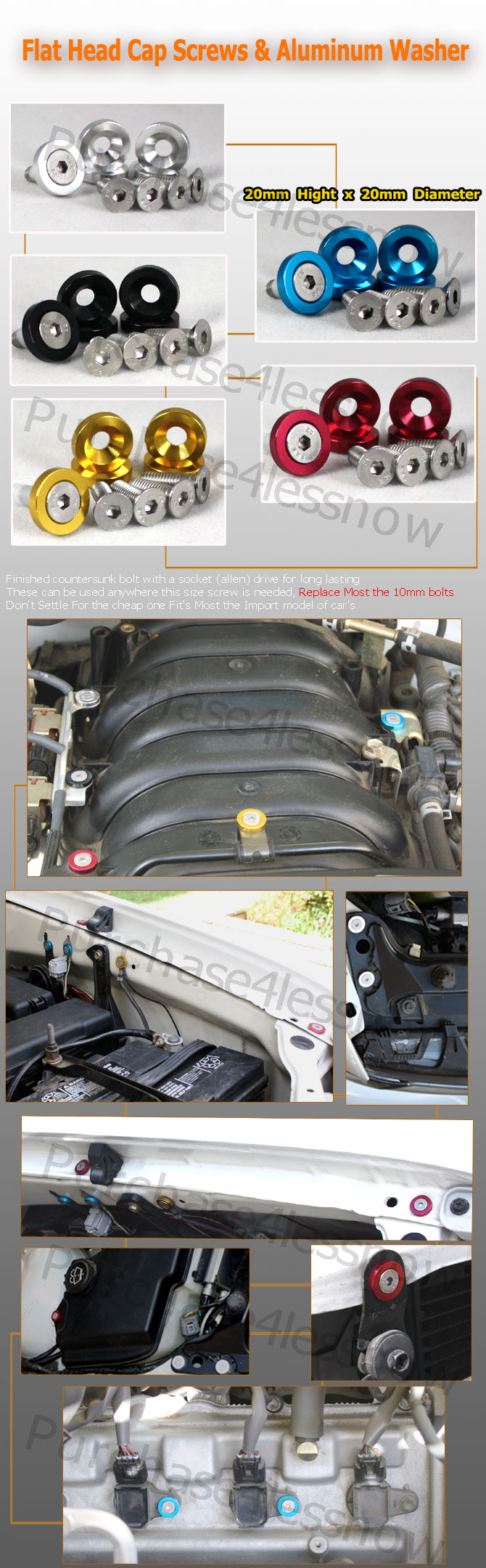
If you designed a complete kit for our engine bay like above, i will most certainly make a purchase. However i'd like the ends of the counter sunk washer to be slanted/curved down like your titanium ones:

You want to appeal to ALL buyers, not just people who prefer a stainless finish as there are not many of them out there (inc myself).
Another example:
If you designed a complete kit for our engine bay like above, i will most certainly make a purchase. However i'd like the ends of the counter sunk washer to be slanted/curved down like your titanium ones:
Last edited by _ink; Mar 10, 2010 at 02:33 AM.

I can't pretend that I've got the cash to blow on Ti hardware, but I do have a question about it and would appreciate your knowledge about how to limit corrosion on Ti threads engaged in a steel or Al part, since Ti is on the opposite end of the galvanic scale. Dry lube the threads?
Will (wishes his formula SAE team had the money to find out first hand)
Will (wishes his formula SAE team had the money to find out first hand)
Registered User
Joined: Mar 2010
Posts: 16
Likes: 0
From: Chandler, AZ
Those are kinda what I had in mind, but I know of some that are tapered (but not angled). I think that setup looks really nice and I should be able to find a manufacturer with no problem. I see you saw my vision. (That's a hell of a statement by the way)
As far as galvanic corrosion, the single best way to prevent it is to dab a little bit of anti seize on the threads of the titanium. The copper is anti-seize is supposedly the best for this, but I have had plenty of luck with the grey stuff. We have had titanium bolted into stainless steel, alloy steel and aluminum for decades using this method with no corrosion. The other thing I have had good luck with is blue loctite. I think the biggest issue is to have some sort of intermediate barrier between the titanium and the host metal.
As far as galvanic corrosion, the single best way to prevent it is to dab a little bit of anti seize on the threads of the titanium. The copper is anti-seize is supposedly the best for this, but I have had plenty of luck with the grey stuff. We have had titanium bolted into stainless steel, alloy steel and aluminum for decades using this method with no corrosion. The other thing I have had good luck with is blue loctite. I think the biggest issue is to have some sort of intermediate barrier between the titanium and the host metal.


So I guess my question would be, do people often have issues with bolts breaking off their cars to where something stronger than OEM is needed?
If one were to buy that nut/bolt set for the entire chassis, what would be the weight savings over OEM?
Sorry, not here to knock anyone's products or company, but it just seems like one of those mods that you do just to tell people you have it. I just can't see lap times or 1/4 mile times dropping significantly due to swapping out some bolts. Then again, I am not an automotive engineer, so what do I know.
If one were to buy that nut/bolt set for the entire chassis, what would be the weight savings over OEM?
Sorry, not here to knock anyone's products or company, but it just seems like one of those mods that you do just to tell people you have it. I just can't see lap times or 1/4 mile times dropping significantly due to swapping out some bolts. Then again, I am not an automotive engineer, so what do I know.

