


Fairlady emblem...


Thread Starter
Registered User
iTrader: (3)
Joined: Sep 2008
Posts: 1,817
Likes: 1
From: Galactica BS-75
 Fairlady emblem...
First thing I've really done to my base model Z... turned over 100,000 miles a week ago and just thought I'd spice things up after new ngk plugs and a royal purple oil change.
Always been a fan of the history/heritage associated with the Fairlady name.
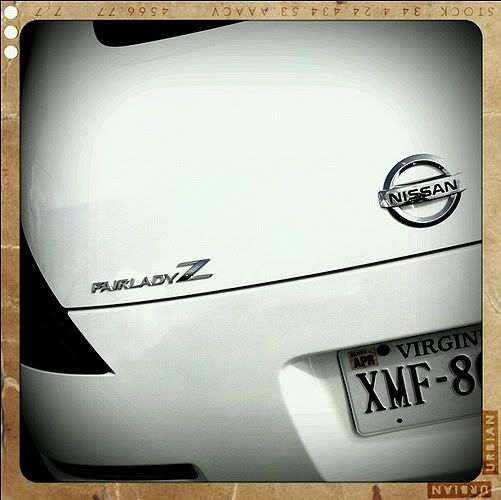
Always been a fan of the history/heritage associated with the Fairlady name.


Thread Starter
Registered User
iTrader: (3)
Joined: Sep 2008
Posts: 1,817
Likes: 1
From: Galactica BS-75

Also, I don't see how something is rice when it came in "genuine nissan parts" packaging.

Trending Topics
GTR badges are "genuine nissan parts" so it would be perfectly acceptable to put them on my car. So are Titan badges, i think im going to have a FairladyGTRtitanZ, all OEM , so not rice.


Registered User
Joined: Feb 2011
Posts: 32
Likes: 0
From: New Bedford, MA
you are absolutely correct sir, did not look at it that way since a 350z and a fairlady z are so different just like it would be from all your other examples there. I know this discussion has been debated so much over here that it's played out. Why don't we just move along and stop with the hating and misunderstanding of the word "rice".
Thread Starter
Registered User
iTrader: (3)
Joined: Sep 2008
Posts: 1,817
Likes: 1
From: Galactica BS-75
All that matters is that I like it and I just wanted to share it with others.
I used to use Mobil 1 religiously but I have heard good things over the years about RP that I decided to try it. Car seems to idle smoother than before but that's about it... prob getting better mpg with the plug change as well. I change oil once a month due to driving nearly an hour to work all highway... I had been using high mileage Mobil 1 but it was nearly the same price per qt for the RP and has an oil change frequency of 12,000 miles (though I wont run it that high, maybe 6-8000 at the highest).
I just enjoy my350z.com and wanted to share since I hardly ever make threads.
I used to use Mobil 1 religiously but I have heard good things over the years about RP that I decided to try it. Car seems to idle smoother than before but that's about it... prob getting better mpg with the plug change as well. I change oil once a month due to driving nearly an hour to work all highway... I had been using high mileage Mobil 1 but it was nearly the same price per qt for the RP and has an oil change frequency of 12,000 miles (though I wont run it that high, maybe 6-8000 at the highest).
I just enjoy my350z.com and wanted to share since I hardly ever make threads.


Registered User
Joined: Jun 2011
Posts: 50
Likes: 0
From: Bellbrook Ohio


Registered User
Joined: Jun 2011
Posts: 50
Likes: 0
From: Bellbrook Ohio
Do you know the whole story behind the 'Fairlady' name? Not a really cool story to tell...[/QUOTE]
why is that not a cool story to tell? It's just history, dont see anything wrong with it?
why is that not a cool story to tell? It's just history, dont see anything wrong with it?

Registered User
Joined: Jun 2011
Posts: 29
Likes: 0
From: New Haven, CT
Is anyone aware of an aftermarket emblem consisting of the Nissan 'Z' in place of the word "NISSAN" in the main rear emblem? I thought it would be cool to strip the "350 Z" emblem off and have 'Z' be the only emblem on the car. Might have to be a CNC job...
Thread Starter
Registered User
iTrader: (3)
Joined: Sep 2008
Posts: 1,817
Likes: 1
From: Galactica BS-75
For those of you that don't know the story:
The Short Story:
Fair Lady and later Fairlady - The name given to the first line of sports cars designed and built by Nissan Motors Japan after W.W.II, with the specific intent of being marketed in the USA - 1960.
The name "Fair Lady" was given to the new sports car line by Mr. Katsuji Kawamata, President Of Nissan Motors Japan, after he attended the Broadway Musical "My Fair Lady" while visiting the US in 1958. He felt that the name would invoke an image of beauty for the car - because people would think of the beauty of the music and the leading lady in that Broadway Musical.
This is a common and accepted practice within the Japanese culture for selecting automotive names. It is not a usual cultural method here in the US however - so Nissan more commonly used engine size and model numbers as Model Names for the US market.
The More Complete Story: The SPL212 was introduced in 1960. It was a two passenger car with a 1.2 Liter four cycl. engine ( 2 12). The "S" stood for Sport, the "P" was the designation for the Bluebird chassis, and the "L" stood for left hand drive. It is significant to note that "L" left hand drive cars could not be sold in Japan at that time. Thus Nissan's first Sports Car was specifically intended for the US market.
To understand why the name "Fair Lady" was given to a Sports Car, one has to think in terms of the Japanese culture, rather than that of the America culture. The Japanese revere traditions of Art, Music, Philosophy and the study of Beauty. All of these cultural values are considered to be acquired tastes and skills, gained over a lifetime, through personal study and practice.
Here in the US we place a much higher cultural value on personal creativity. Art and Music are considered to be more a matter of inspiration, personal expression and creativity. We therefore place a higher value on personal creativity and expression, than the resulting traditions of the art or music.
While Mr. Katsuji Kawamata, the President of Nissan Motors Ltd., was visiting the United States in 1958 he attended a performance, on-Broadway, of the hit musical "My Fair Lady".
A couple of years later (1960), when Nissan was about to introduce its new Sports Car Line, Mr. Kawamata gave it the official name of "Fair Lady". He had been so impressed with the beauty of the music and the leading lady in that Broadway Musical, that he thought everyone would relate the name of Nissans new sports car "the Fair Lady" to the beauty of the music and the leading lady in the play. Indeed, that is what happened in Japan, the name made perfect sense there and was readily accepted in that market.
The Fairlady (now one word) Sport Car line continued to evolve through the 1960's with the introduction of the Fairlady 1500 in Oct. of 1962, then the Fairlady 1600 in 1965. Along with this evolution of its product lines, Nissan Motors was attempting to increase it's exports to the US Market.
Mr. Yutaka Kayatama, then President of Nissan Motors USA, knew that his customers would not accept the name "Fairlady" for a Sports Car here in the USA, so the Sales and Marketing departments in the US had used the cars model numbers for the most part, in advertising and sales promotion, and with the introduction of the new models for 1965 the badging on the front fenders was changed, on the US cars, from "Fairlady" to "Datsun 1600".
When the new HLS30 Sports/GT was designed and built for the US Market - Mr. Katayama suggested that it not be badged as the "Fairlady' in the US. Mr. K. thought that the car should be named something more aggressive, like "Tiger" or "Shark" in keeping with US cultural traditions and values. That idea having been turned down in Japan, he was willing to accept "Datsun 240-Z". The 240 was a shortened version of the 2400cc engine displacement, and the "Z", which had been the new car's product file designation within Nissan's Design Department.
Mr. Teiichi Hara, General Manager of the Design Department, had given the original sports car plans the file designation "Type Z", as most all of the other characters in the roman alphabet had been previously used.
Fair Lady and later Fairlady - The name given to the first line of sports cars designed and built by Nissan Motors Japan after W.W.II, with the specific intent of being marketed in the USA - 1960.
The name "Fair Lady" was given to the new sports car line by Mr. Katsuji Kawamata, President Of Nissan Motors Japan, after he attended the Broadway Musical "My Fair Lady" while visiting the US in 1958. He felt that the name would invoke an image of beauty for the car - because people would think of the beauty of the music and the leading lady in that Broadway Musical.
This is a common and accepted practice within the Japanese culture for selecting automotive names. It is not a usual cultural method here in the US however - so Nissan more commonly used engine size and model numbers as Model Names for the US market.
The More Complete Story: The SPL212 was introduced in 1960. It was a two passenger car with a 1.2 Liter four cycl. engine ( 2 12). The "S" stood for Sport, the "P" was the designation for the Bluebird chassis, and the "L" stood for left hand drive. It is significant to note that "L" left hand drive cars could not be sold in Japan at that time. Thus Nissan's first Sports Car was specifically intended for the US market.
To understand why the name "Fair Lady" was given to a Sports Car, one has to think in terms of the Japanese culture, rather than that of the America culture. The Japanese revere traditions of Art, Music, Philosophy and the study of Beauty. All of these cultural values are considered to be acquired tastes and skills, gained over a lifetime, through personal study and practice.
Here in the US we place a much higher cultural value on personal creativity. Art and Music are considered to be more a matter of inspiration, personal expression and creativity. We therefore place a higher value on personal creativity and expression, than the resulting traditions of the art or music.
While Mr. Katsuji Kawamata, the President of Nissan Motors Ltd., was visiting the United States in 1958 he attended a performance, on-Broadway, of the hit musical "My Fair Lady".
A couple of years later (1960), when Nissan was about to introduce its new Sports Car Line, Mr. Kawamata gave it the official name of "Fair Lady". He had been so impressed with the beauty of the music and the leading lady in that Broadway Musical, that he thought everyone would relate the name of Nissans new sports car "the Fair Lady" to the beauty of the music and the leading lady in the play. Indeed, that is what happened in Japan, the name made perfect sense there and was readily accepted in that market.
The Fairlady (now one word) Sport Car line continued to evolve through the 1960's with the introduction of the Fairlady 1500 in Oct. of 1962, then the Fairlady 1600 in 1965. Along with this evolution of its product lines, Nissan Motors was attempting to increase it's exports to the US Market.
Mr. Yutaka Kayatama, then President of Nissan Motors USA, knew that his customers would not accept the name "Fairlady" for a Sports Car here in the USA, so the Sales and Marketing departments in the US had used the cars model numbers for the most part, in advertising and sales promotion, and with the introduction of the new models for 1965 the badging on the front fenders was changed, on the US cars, from "Fairlady" to "Datsun 1600".
When the new HLS30 Sports/GT was designed and built for the US Market - Mr. Katayama suggested that it not be badged as the "Fairlady' in the US. Mr. K. thought that the car should be named something more aggressive, like "Tiger" or "Shark" in keeping with US cultural traditions and values. That idea having been turned down in Japan, he was willing to accept "Datsun 240-Z". The 240 was a shortened version of the 2400cc engine displacement, and the "Z", which had been the new car's product file designation within Nissan's Design Department.
Mr. Teiichi Hara, General Manager of the Design Department, had given the original sports car plans the file designation "Type Z", as most all of the other characters in the roman alphabet had been previously used.

