


What is the weak link above 500 rwhp?


Thread Starter
Registered User
Joined: Jan 2005
Posts: 14
Likes: 0
From: Scottsdale, Az
 What is the weak link above 500 rwhp?
These motors put 7M's and 2JZ's to shame as far as torque curve and power at 10-15 psi. 500whp doesn't seem to be enough to cause reliablitly issues without knock on a 3.5l. I'm new to the board so I'm still learning about the VQ35 though. I hear alot of people say the rods are the weak link or the block will come apart. Is it detonation than eventually causes the failures or is it a stressrpm issue?
It would be nice to put one into a 240Z and loose weight while doing it. I wouldn't mind putting in lower CR pistons but I didn't know what the block can take.
It would be nice to put one into a 240Z and loose weight while doing it. I wouldn't mind putting in lower CR pistons but I didn't know what the block can take.

It's been said that the block can take 800 or so HP, at least in the short term... Some very experienced people have told me that at around 600 hp, you are likely to need to at least half-close the deck to have reliable power. in the short term, the highest I have seen a fully built/sleeved engine taken is 940 hp on an engine dyno...so that crank can take that much in the short term...

Originally posted by gurgenpb01
It's been said that the block can take 800 or so HP, at least in the short term... Some very experienced people have told me that at around 600 hp, you are likely to need to at least half-close the deck to have reliable power. in the short term, the highest I have seen a fully built/sleeved engine taken is 940 hp on an engine dyno...so that crank can take that much in the short term...
It's been said that the block can take 800 or so HP, at least in the short term... Some very experienced people have told me that at around 600 hp, you are likely to need to at least half-close the deck to have reliable power. in the short term, the highest I have seen a fully built/sleeved engine taken is 940 hp on an engine dyno...so that crank can take that much in the short term...

Originally posted by gurgenpb01
It's been said that the block can take 800 or so HP, at least in the short term... Some very experienced people have told me that at around 600 hp, you are likely to need to at least half-close the deck to have reliable power.
It's been said that the block can take 800 or so HP, at least in the short term... Some very experienced people have told me that at around 600 hp, you are likely to need to at least half-close the deck to have reliable power.
are you referring to rwhp figures or crank hp..or did your source specify?


The weakest link is irrelevant, becuase if you plan to exceed 500whp on a regular basis, you need to tear the motor apart and build it up. Doing so, you would change pistons, rods, studs, and maybe sleeveing. Sleeving would be the only optional item. Like Gurgen said, above 600whp or so.....the longevity and stability of the stock sleeves would come into question...even with low CR pistons and forged rods. There arent enough 600whp+ daily driven 350Z's on the road....so only time will tell. By the looks of things on this board, there are roughly 30 built motors in the works..and plenty of them will be exceeding 550-600whp on a daily basis. 
Trending Topics
If you sleeve it, it essentially becomes closed. There remiains a few water channels for coollant...more like holes. Your block is essentially bullet proof.
My turbos will max out at somewhere south of 700whp..in all likelyhood...so if I needed sleeves for more power, I would need to change out the turbos, head work,etc.
Maybe stage II..LOL.
Do you guys realize how much power we are talking about?? LOL...
;
600whp is about 700crank HP. More than ANY supercar...almost.
My turbos will max out at somewhere south of 700whp..in all likelyhood...so if I needed sleeves for more power, I would need to change out the turbos, head work,etc.
Maybe stage II..LOL.
Do you guys realize how much power we are talking about?? LOL...
;
600whp is about 700crank HP. More than ANY supercar...almost.

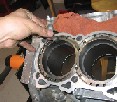
I was able to get a really good look at the Performance Motorsports 1400hp VQ35 block today, and guess what, no sleeves... Yep, they are just running Darton Liners...
I was also able to see both the AEBS and Darton MID sleeves installed in VQ35 blocks, and the Darton MID look really good!
I was also able to see both the AEBS and Darton MID sleeves installed in VQ35 blocks, and the Darton MID look really good!

Sponsor
Forged Internals.com
Forged Internals.com
Joined: May 2003
Posts: 5,566
Likes: 1
From: Valdosta, GA
Originally posted by Philthy
I was able to get a really good look at the Performance Motorsports 1400hp VQ35 block today, and guess what, no sleeves... Yep, they are just running Darton Liners...
I was also able to see both the AEBS and Darton MID sleeves installed in VQ35 blocks, and the Darton MID look really good!
I was able to get a really good look at the Performance Motorsports 1400hp VQ35 block today, and guess what, no sleeves... Yep, they are just running Darton Liners...
I was also able to see both the AEBS and Darton MID sleeves installed in VQ35 blocks, and the Darton MID look really good!

Sponsor
Forged Internals.com
Forged Internals.com
Joined: May 2003
Posts: 5,566
Likes: 1
From: Valdosta, GA
Originally posted by Philthy
I'll be back down at the machine shop in a week or two, and I'll take some pictures of all the different options, AEBS seelves, Darton sleeves, and Darton Liners...
I'll be back down at the machine shop in a week or two, and I'll take some pictures of all the different options, AEBS seelves, Darton sleeves, and Darton Liners...


Registered User
Joined: Nov 2004
Posts: 376
Likes: 0
From: tennessee
Re: What is the weak link above 500 rwhp?
Originally posted by Clifton in AZ
...I hear alot of people say the rods are the weak link or the block will come apart. Is it detonation than eventually causes the failures or is it a stress rpm issue? ...I wouldn't mind putting in lower CR pistons but I didn't know what the block can take.
...I hear alot of people say the rods are the weak link or the block will come apart. Is it detonation than eventually causes the failures or is it a stress rpm issue? ...I wouldn't mind putting in lower CR pistons but I didn't know what the block can take.
It takes ample skill & self-discipline to drive a car with big power. Just spend some money, and you can own a car with a well-built engine, suspension upgrades, a big brake kit, etc., but what are you going to do to prepare *yourself* to drive such a machine?
A good guy I knew in high school, Hugh, drove his car sideways into a tree at 90mph. Unfortunately, 3 of my friends were along for the ride. Bowan was crushed into a lifeless coma for two days before life-support was terminated. Kenny and Craig were badly injured, both scarred for life. My new friend Hugh... was violently decapitated. Days later, stricken with overwhelming grief and guilt, the property owner (!) had the tree removed, roots and all.
Sweet Jesus, what anguish!

I read about all these power adders with great interest. I marvel at the technology, skill, and patience required to produce gobs of reliable horse-power and torque. And sometimes... I worry.
Be safe.

Good words bullseye! I will be happy with 400whp and under for my daily driver. I dont like drag racing, so anymore would pretty much be useless to me.
Also, not to be off topic too much, but i noticed you live in memphis...I live in Cordova, around the wolfchase area..let me know if you wanna meet up anytime, or anything like that.
talk to ya later,
Jon
Email: AGORDON3@midsouth.rr.com
Also, not to be off topic too much, but i noticed you live in memphis...I live in Cordova, around the wolfchase area..let me know if you wanna meet up anytime, or anything like that.
talk to ya later,
Jon
Email: AGORDON3@midsouth.rr.com
Thread Starter
Registered User
Joined: Jan 2005
Posts: 14
Likes: 0
From: Scottsdale, Az
Re: Re: What is the weak link above 500 rwhp?
Originally posted by bullseye
We are learning how to make big power w/ the VQ35. But please consider this: The weakest link is probably the driver.
It takes ample skill & self-discipline to drive a car with big power. Just spend some money, and you can own a car with a well-built engine, suspension upgrades, a big brake kit, etc., but what are you going to do to prepare *yourself* to drive such a machine?
Be safe.
We are learning how to make big power w/ the VQ35. But please consider this: The weakest link is probably the driver.
It takes ample skill & self-discipline to drive a car with big power. Just spend some money, and you can own a car with a well-built engine, suspension upgrades, a big brake kit, etc., but what are you going to do to prepare *yourself* to drive such a machine?
Be safe.
I've been doing more searching on transmissions and sleeves. Bluefish has been making alot of power without sleeves. Coming from a cast iron block background I have no idea what the difference between a sleeve and a liner is. Looks like it will be a hit or miss on the gear box. Anyone know if the VG30's have the same bellhousing bolt pattern?
Originally posted by Philthy
I was able to get a really good look at the Performance Motorsports 1400hp VQ35 block today, and guess what, no sleeves... Yep, they are just running Darton Liners...
I was also able to see both the AEBS and Darton MID sleeves installed in VQ35 blocks, and the Darton MID look really good!
I was able to get a really good look at the Performance Motorsports 1400hp VQ35 block today, and guess what, no sleeves... Yep, they are just running Darton Liners...
I was also able to see both the AEBS and Darton MID sleeves installed in VQ35 blocks, and the Darton MID look really good!
Here is a pic

Another option vs. sleeving is called pinning or bracing the block. Essentially, the stock sleeves remain, but metal inserts are placed between the block and cylinder walls. having seen it done on the VQ, but it is very common in the honda world...and much cheaper than sleeving. Sleeving is a $2000 operation, including labor and lparts.
Last edited by Sharif@Forged; Jan 29, 2005 at 09:58 AM.
Here is some additional information from Darton's website. They also gaurantee the sleeves from defects or sinking for the life of the car...when Darton does the sleeve installation.
Darton pioneered modular sleeve designs and specialty ductile iron material beginning with our manufacture of top fuel sleeves for Keith Black Racing Engines and Milodon Engineering in 1978. This experience, our racing heritage, and our highly experienced staff of machinists and racing engine builders offered a unique set of blended talent to solve inherent block weakness design in the currently available engines where bore sizes were intended to be increased.
Many production cast iron and aluminum blocks suffer from a design weakness of cylinder stability by nature of poor support at the upper deck area. The manufacturing process of "cast in sleeves" provides for economy of scale in low horsepower engines, but does not accommodate high horsepower, high boost, or larger bore sizes.
Darton has engineered a superior solution by using a unique designed cylinder sleeve which when siamesed and nested,creates a solid deck of sleeve flanges held in tension, reinforcing the upper deck area and provides for in-field replacement with what we call Modular Integrated Deck (MID). In addition, Darton designs' manage and enhance water flow from block to head to promote stability of cooling and all sleeves are of the "Wet" design.
The enhanced water flow in and around the flange area is possible because of ported water flow control engineering we call "swirl coolant technology". This process begins with specific engineering models of respective cylinder head and combustion chamber designs and then we promote increased flow of water in those areas of the upper sleeve area subjected to the most heat. There is a different engineering model for each engine and cylinder design. While heat is generally considered to translate into energy, high resident heat in the combustion chamber can lead to detonation, the single highest cause of engine failure in the high horsepower regimes. High RPM normally translates into efficient scavenging of air-flow but during misfires or incomplete flame propagation, high cylinder pressures and temperatures are created. Our MID design compensates for this high resident heat soak condition.
In the normal dry sleeve installation the cooling medium, water, must transfer heat absorption through block material and sleeves, which may be dissimilar metals. When dry sleeves are pressed in with interference fit, the materials interface is not perfect which further exacerbates heat transfer. This thermal conductivity is inefficient and as more heat is generated, the combustion process is compromised. Even in wet sleeve designs of the past, water is never efficiently processed or flowed between the block and head to provide for maximum heat dissipation in the combustion chamber. Inherent in open or closed deck engine blocks of cast iron or aluminum is a certain amount of water stagnation. This is like pouring water through a funnel, there is really no flow or velocity until the water exits the spigot. In the case of blocks and heads, the casting ports are designed for ease of casting not efficient flow. Now with Darton's "MID", swirl coolant technology the cooling medium is ported and directed to significantly improve heat transfer where it is needed most, in the upper cylinder wall/flange area.
The Darton Pro-Sleeve Kit is available for many series of 4, 6, and 8 cylinder import and domestic engines and provides for maximum bore sizes and boost potential. The benefits of our pro-series kits are:
Darton pioneered modular sleeve designs and specialty ductile iron material beginning with our manufacture of top fuel sleeves for Keith Black Racing Engines and Milodon Engineering in 1978. This experience, our racing heritage, and our highly experienced staff of machinists and racing engine builders offered a unique set of blended talent to solve inherent block weakness design in the currently available engines where bore sizes were intended to be increased.
Many production cast iron and aluminum blocks suffer from a design weakness of cylinder stability by nature of poor support at the upper deck area. The manufacturing process of "cast in sleeves" provides for economy of scale in low horsepower engines, but does not accommodate high horsepower, high boost, or larger bore sizes.
Darton has engineered a superior solution by using a unique designed cylinder sleeve which when siamesed and nested,creates a solid deck of sleeve flanges held in tension, reinforcing the upper deck area and provides for in-field replacement with what we call Modular Integrated Deck (MID). In addition, Darton designs' manage and enhance water flow from block to head to promote stability of cooling and all sleeves are of the "Wet" design.
The enhanced water flow in and around the flange area is possible because of ported water flow control engineering we call "swirl coolant technology". This process begins with specific engineering models of respective cylinder head and combustion chamber designs and then we promote increased flow of water in those areas of the upper sleeve area subjected to the most heat. There is a different engineering model for each engine and cylinder design. While heat is generally considered to translate into energy, high resident heat in the combustion chamber can lead to detonation, the single highest cause of engine failure in the high horsepower regimes. High RPM normally translates into efficient scavenging of air-flow but during misfires or incomplete flame propagation, high cylinder pressures and temperatures are created. Our MID design compensates for this high resident heat soak condition.
In the normal dry sleeve installation the cooling medium, water, must transfer heat absorption through block material and sleeves, which may be dissimilar metals. When dry sleeves are pressed in with interference fit, the materials interface is not perfect which further exacerbates heat transfer. This thermal conductivity is inefficient and as more heat is generated, the combustion process is compromised. Even in wet sleeve designs of the past, water is never efficiently processed or flowed between the block and head to provide for maximum heat dissipation in the combustion chamber. Inherent in open or closed deck engine blocks of cast iron or aluminum is a certain amount of water stagnation. This is like pouring water through a funnel, there is really no flow or velocity until the water exits the spigot. In the case of blocks and heads, the casting ports are designed for ease of casting not efficient flow. Now with Darton's "MID", swirl coolant technology the cooling medium is ported and directed to significantly improve heat transfer where it is needed most, in the upper cylinder wall/flange area.
The Darton Pro-Sleeve Kit is available for many series of 4, 6, and 8 cylinder import and domestic engines and provides for maximum bore sizes and boost potential. The benefits of our pro-series kits are:
Originally posted by gq_626 ACtually, I think the Darton liners you are refering to are actualy the Darton Mid Sleeves.
I'll get some pictures from Weston and post them so you can see the difference. With the Liners you don't need to machine out much material from the block, with Sleeves (Darton MID or AEBS) a lot of material needs to be removed from the block.