


question on blowing up an engine due to piston damage


Thread Starter

Joined: Mar 2004
Posts: 9,722
Likes: 2
From: phoenix, AZ
 question on blowing up an engine due to piston damage
Obviously if you break a rod, the rod will fly thru the block, turning it into scrap metal.
However if the pistons go bad - if they crack, or the oil rings break or whatever, would the block still be reusable if it were to be rebuilt?
seems like the 2nd weakest link with the block aside from the rods is the pistons.
I get the impression that high tq setups break rods, and low tq FI kits burn up pistons usually
However if the pistons go bad - if they crack, or the oil rings break or whatever, would the block still be reusable if it were to be rebuilt?
seems like the 2nd weakest link with the block aside from the rods is the pistons.
I get the impression that high tq setups break rods, and low tq FI kits burn up pistons usually
Last edited by sentry65; Jun 7, 2006 at 12:34 PM.


If the piston breaks/cracks, it could score the cylinder wall. Which wouldn't make the block useless, but it would require you to bore it out to get rid of the scoring, or you could install a sleeve kit. Otherwise, as long as there isn't scoring, you should be ok.
Thread Starter
Joined: Mar 2004
Posts: 9,722
Likes: 2
From: phoenix, AZ
what i'm getting at is from talking with the few people who have blown up engines with a vortech, they've usually burned up pistons and were able to reuse the block a lot of times. Where turbo cars almost always end up throwing rods when something goes wrong from what I've seen - but maybe those are the cases that people talk about the most?
I've only talked with a couple people though so wanting to get a broader audience's input
It'd be nice to burn a piston and still be able to trade in the block to a company that builds engines instead of having to pay full price
I've only talked with a couple people though so wanting to get a broader audience's input
It'd be nice to burn a piston and still be able to trade in the block to a company that builds engines instead of having to pay full price
Last edited by sentry65; Jun 7, 2006 at 12:40 PM.
Thread Starter
Joined: Mar 2004
Posts: 9,722
Likes: 2
From: phoenix, AZ
just passing info along with what I was told
A knowledgable person who's had a lot of experience with ARP head studs and built many high hp cars, told me the ARP studs are way way stronger than stock, but they have dramaticly less flexing which means if the engine isn't fully warmed up that you could create head lift because of how stiff the ARP studs are. The head and block will end up deforming way before the ARP studs would if driven cold
He's built really high hp cars - usually WRX's with stock studs and recommends sticking with stock studs for a street driven car and ARP studs really only for race cars that will only be driven hard when seeing full temps
he was also saying with ARP studs you really need to pay attention to how much they're torqued and what oil you use because the oil will make the difference of anywhere from 1-10 lbs of tq to torque them down. Also that people usually torque them too much which lessens the flex even more so you end up with a setup with extremely stiff studs, and very deformable heads and block that don't deform at the same rate and create head lift
A knowledgable person who's had a lot of experience with ARP head studs and built many high hp cars, told me the ARP studs are way way stronger than stock, but they have dramaticly less flexing which means if the engine isn't fully warmed up that you could create head lift because of how stiff the ARP studs are. The head and block will end up deforming way before the ARP studs would if driven cold
He's built really high hp cars - usually WRX's with stock studs and recommends sticking with stock studs for a street driven car and ARP studs really only for race cars that will only be driven hard when seeing full temps
he was also saying with ARP studs you really need to pay attention to how much they're torqued and what oil you use because the oil will make the difference of anywhere from 1-10 lbs of tq to torque them down. Also that people usually torque them too much which lessens the flex even more so you end up with a setup with extremely stiff studs, and very deformable heads and block that don't deform at the same rate and create head lift
Last edited by sentry65; Jun 7, 2006 at 12:50 PM.
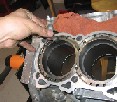
u can score a cylinder wall if a piston ring goes bad...this can usually be salveaged with a 40thousandths overbore, if the scoring doesn't diminish at this amount, then sleeving would be a viable option
as far as the stud discussion, the stock studs have the ability to undergo slight stretch and rebound, whereas the arp studs should not stretch, but if they do, they immediately undergo plastic deformation-they will not rebound..if this occurs, cylinder head lift will show its ugly head more and more often...
and yes, arp recommends two different torque specs on their studs based off of a 75% yield and what type of lubrication is used...for example...
standard size ARP studs: with ARP molylube: 75ft lbs, with motor oil: 85ft lbs
ARP 1/2" studs: with moly: 105ft lbs, with motor oil: up to 120-130 ft lbs
-TODD
as far as the stud discussion, the stock studs have the ability to undergo slight stretch and rebound, whereas the arp studs should not stretch, but if they do, they immediately undergo plastic deformation-they will not rebound..if this occurs, cylinder head lift will show its ugly head more and more often...
and yes, arp recommends two different torque specs on their studs based off of a 75% yield and what type of lubrication is used...for example...
standard size ARP studs: with ARP molylube: 75ft lbs, with motor oil: 85ft lbs
ARP 1/2" studs: with moly: 105ft lbs, with motor oil: up to 120-130 ft lbs
-TODD

Originally Posted by sentry65
A knowledgable person who's had a lot of experience with ARP head studs and built many high hp cars, told me the ARP studs are way way stronger than stock, but they have dramaticly less flexing which means if the engine isn't fully warmed up that you could create head lift because of how stiff the ARP studs are. The head and block will end up deforming way before the ARP studs would if driven cold
He's built really high hp cars - usually WRX's with stock studs and recommends sticking with stock studs for a street driven car and ARP studs really only for race cars that will only be driven hard when seeing full temps
Trending Topics


Registered User
Joined: May 2004
Posts: 100
Likes: 0
From: Mesa, Az
Originally Posted by sentry65
just passing info along with what I was told
A knowledgable person who's had a lot of experience with ARP head studs and built many high hp cars, told me the ARP studs are way way stronger than stock, but they have dramaticly less flexing which means if the engine isn't fully warmed up that you could create head lift because of how stiff the ARP studs are. The head and block will end up deforming way before the ARP studs would if driven cold
He's built really high hp cars - usually WRX's with stock studs and recommends sticking with stock studs for a street driven car and ARP studs really only for race cars that will only be driven hard when seeing full temps
he was also saying with ARP studs you really need to pay attention to how much they're torqued and what oil you use because the oil will make the difference of anywhere from 1-10 lbs of tq to torque them down. Also that people usually torque them too much which lessens the flex even more so you end up with a setup with extremely stiff studs, and very deformable heads and block that don't deform at the same rate and create head lift
A knowledgable person who's had a lot of experience with ARP head studs and built many high hp cars, told me the ARP studs are way way stronger than stock, but they have dramaticly less flexing which means if the engine isn't fully warmed up that you could create head lift because of how stiff the ARP studs are. The head and block will end up deforming way before the ARP studs would if driven cold
He's built really high hp cars - usually WRX's with stock studs and recommends sticking with stock studs for a street driven car and ARP studs really only for race cars that will only be driven hard when seeing full temps
he was also saying with ARP studs you really need to pay attention to how much they're torqued and what oil you use because the oil will make the difference of anywhere from 1-10 lbs of tq to torque them down. Also that people usually torque them too much which lessens the flex even more so you end up with a setup with extremely stiff studs, and very deformable heads and block that don't deform at the same rate and create head lift
All high strength fasteners stretch when torqued which is how clamping force is maintained over time. If you continue to torque a fastener beyond the recommended level it will reach what is called tensile yield. Beyond this point is called the plastic zone, which means that when the torque is relaxed the fastener will not return to its original length, and is toast.
When ARP designs a fastener they tensile test it to determine the tensile yield and then back off about 20% to ensure you won't damage the fastener during normal use. You therefore can torque one of their fasteners beyond their suggested torque but it will also reduce the safety margin and increase the chance of fastener failure.
When a high strength fastener is torqued on a cold alum engine the clamping force is sufficient to retain the gasket if the sealing surfaces are perfect. When the engine heats up the clamping force will increase (also slight increase in fastener length) since the steel fastener does not expand as much as the alum head and block but when the engine cools the fastener will return to its original installed length. It goes without saying that you shouldn't flog a cold engine for more reasons than head gaskets retention.
Bottom line is that an ARP fastener because of the stronger material/torque will provide more clamping force than OEM under all conditions.

Thread Starter
Joined: Mar 2004
Posts: 9,722
Likes: 2
From: phoenix, AZ
yeah it was something like that. The main thing that was explained to me was that the ARP studs are not as forgiving as the stock studs and there's more potential for headlift with them for people who don't make sure they're torqued to the proper spec and that the engine isn't fully warmed up before pushing the car hard on the street or dyno etc

Thread
Thread Starter
Forum
Replies
Last Post
FromGtoZ
Intake Exhaust
2
Sep 20, 2015 03:41 PM
