


ITB with air box !!! woow sick



Dave - keep in mind that GT500 cars also run weeny restrictors and run individual throttle bodies, not a single common plenum design. The great things these cars don't have is a unibody  Not to mention, they are NA. Way harder (overall) to design a proper NA manifold than it is to do it for boost. As Charles eluded to, when you're forcing the air into the plenum you can get away with alot that just isn't even thinkable when you're asking the engine to ingest the air.

I don't even want to know the cost to design that manifold, let alone build it. I'd bet the first one would easily have bought you a new Z !
A twin setup can certainly be executed nicely, and quite cleanly as well, but definitely requires more thinking, alot more cost, and a bit of fanagling. But, you also get into the cost issues (probably not a huge concern for those who would legitimately buy such a part, and have the setup to warrant it, but it is part of the equation), not to mention having to then think about the entry point from the rad support (depending on the turbo kit). A single entry system where the throttle body is placed dead center, just over the front timing cover, and a single pipe can run through existing channels without really having to hack anything up. Sort of like the LS engines do it.
Not to mention, they are NA. Way harder (overall) to design a proper NA manifold than it is to do it for boost. As Charles eluded to, when you're forcing the air into the plenum you can get away with alot that just isn't even thinkable when you're asking the engine to ingest the air.I don't even want to know the cost to design that manifold, let alone build it. I'd bet the first one would easily have bought you a new Z !
A twin setup can certainly be executed nicely, and quite cleanly as well, but definitely requires more thinking, alot more cost, and a bit of fanagling. But, you also get into the cost issues (probably not a huge concern for those who would legitimately buy such a part, and have the setup to warrant it, but it is part of the equation), not to mention having to then think about the entry point from the rad support (depending on the turbo kit). A single entry system where the throttle body is placed dead center, just over the front timing cover, and a single pipe can run through existing channels without really having to hack anything up. Sort of like the LS engines do it.
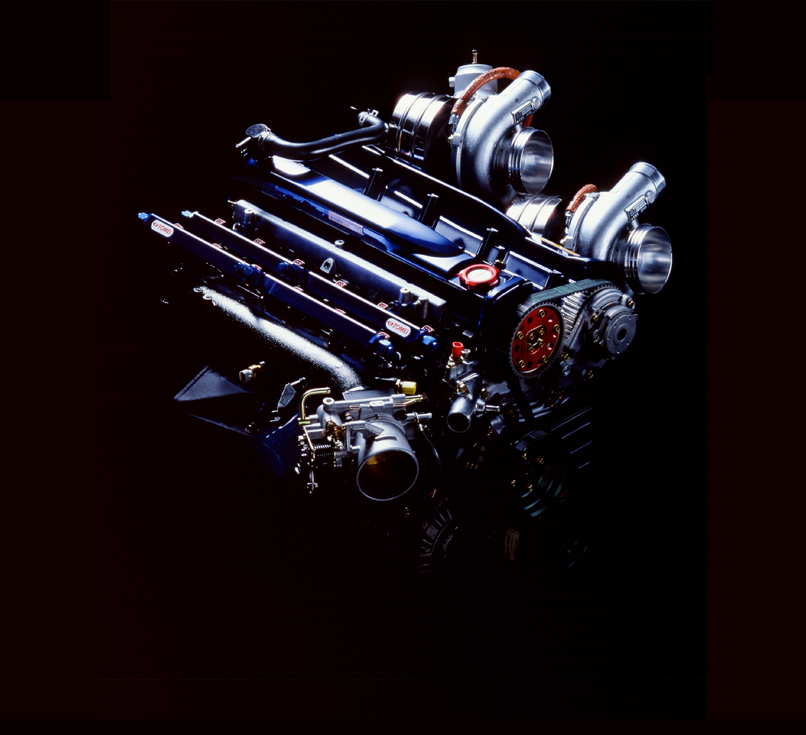
The motor you posted is what is used in the Super GT series for 2007 and 2008 in the Z and GT-R. Its a V8.
From 2004 to 2006 they used the VG30DETT. Here's a photo I've found on Wikipedia:
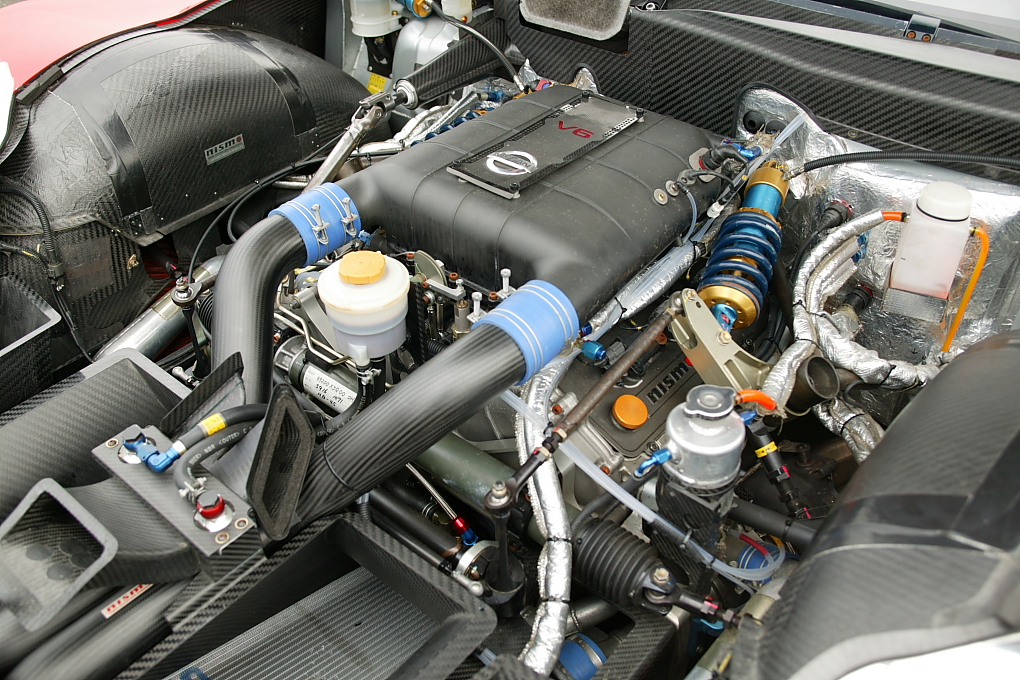
You can see they continue to use ITB's but with twin intakes. One for each turbo. I have also seen other versions of this motor with plenum volume at almost twice the size (or maybe its not plenum volume but horn length???). This also makes the piping bewteen Turbo and IC and IC and Intercooler MUCH shorter. This equals MUCH better throttle response and less lag.
Restictors are a bunch of crap! Super GT uses ballast as the true way of keeping cars competative and its the only true way to "restrict" an engine. I have a client with a custom built VQ35 making 400HP on the engine dyno through a 37MM restictor (SCCA GT2). It dynoed out on my Dyno Dynamics at ~320RWHP with restrictor. This is with a stock modified lower intake manifold, modified lower plenum and modified APS Upper Plenum. Due to contractial obligations I can't show you pictures but the modifications are minimal overall.
I still come back to the fact that Nissan, the OEM manufacturer with about a gizzillion more $$$ then any of us and more importantly a quadrazillion more brains cells has decided for the GT-R a factory turbo VQ based motor to use TWIN throttles and TWIN plenums. I mean isn't this just reinvent the wheel thats already been made?
Without a doubt the Jenevy ITB's with twin plenums or at a minimium twin inlets (so air is brought to the front of the horns) with single plenum will be the best of all world's. This is needed becasue of the angle of their throttles. Tune-ability, throttle reponse, high RPM power and the ever important "WOW" factor.

Does anyone have a price on the ITB's?

Banned
Joined: Jun 2007
Posts: 1,342
Likes: 0
From: under the hood
I have seen you intake manifold. A beautiful piece to say the least! If that is your basis for the discussion then, yes, a single throttle has little effect flow wise.
I will speak from personal experience though regarding the piping leading to the single throttle. It sucks. Repositioning the MAF and getting a 3" pipe to fit on the SFR manifold was not fun. Servicability then became an issue. Also adding a 90 deg bend just before the TB never helped power. Installing an IC with a second outlet or adding an outlet to the existing IC (depending on kit) suddenly becomes much easier and serviceability is again restored. This is assuming that the user has a standalone, which they should if looking for those type of power levels, since twin maf's are not easy to integrate on a non-HR motor.
One downside to the integrated horn that you are producing is that there is no tune-ability to the runner length. Runner length is so important to WHERE torque is produced on the RPM scale. I mean I want to have my cake and eat it to! Also from a cost perspective there are many generic horns available that could be cut and "tuned" to specific setups. The HUGE chunk of aluminum and massive time involved in machining is VERY expensive. Casting takes time and volume. Cosworth is proof of that.
I'm looking from a road race perspective as that's the bulk of my focus. I'm curious how much lower RPM TRQ is lost from the short runner length. In road racing the motor needs to produce a broad power band so that coming off corners there is power available and then down the straights there is power. This is even more important for a heavy Z chassis. A light car like a Lotus Elise or S2000 doesn't need that torque.
Also with the horns not being integrated I would be able to tune the manifold to the course that's being run. Short tight tracks = longer length Long high speed tracks = shorter runner length.
Road racing to me translates much better to the street car then other forms of racing.
I'd like to go back to the JZ/RB vs VQ part. I've driven a 550RWHP Supra (Single)@18PSI and a 550 RWHP (Twin) Z@16PSI. By far the Z was faster and MUCH easier to drive fast. The JZ/RB technology is made to produce super high RPM peak torque (@~7K RPMs!) which in turn gives a large Peak HP # but is very misleading. Reving to 9K+ RPM on a consistant basis shortens the life of the motor considerably. Esspecially on an V6 which has its own inherent vibration problems.
And again to jump around a bit. If I want different horn lengths some that might be significantly longer then in your design then a single center feed throttle will be feeding the horns from the backside. Again never a good idea and a compromise.
If that is your basis for the discussion then, yes, a single throttle has little effect flow wise. I will speak from personal experience though regarding the piping leading to the single throttle. It sucks.
Repositioning the MAF and getting a 3" pipe to fit on the SFR manifold was not fun. Servicability then became an issue. Also adding a 90 deg bend just before the TB never helped power. Installing an IC with a second outlet or adding an outlet to the existing IC (depending on kit) suddenly becomes much easier and serviceability is again restored. This is assuming that the user has a standalone, which they should if looking for those type of power levels, since twin maf's are not easy to integrate on a non-HR motor.One downside to the integrated horn that you are producing is that there is no tune-ability to the runner length. Runner length is so important to WHERE torque is produced on the RPM scale. I mean I want to have my cake and eat it to!
Also from a cost perspective there are many generic horns available that could be cut and "tuned" to specific setups. The HUGE chunk of aluminum and massive time involved in machining is VERY expensive. Casting takes time and volume. Cosworth is proof of that. I'm looking from a road race perspective as that's the bulk of my focus. I'm curious how much lower RPM TRQ is lost from the short runner length. In road racing the motor needs to produce a broad power band so that coming off corners there is power available and then down the straights there is power. This is even more important for a heavy Z chassis. A light car like a Lotus Elise or S2000 doesn't need that torque.
Also with the horns not being integrated I would be able to tune the manifold to the course that's being run. Short tight tracks = longer length Long high speed tracks = shorter runner length.
Road racing to me translates much better to the street car then other forms of racing.
I'd like to go back to the JZ/RB vs VQ part. I've driven a 550RWHP Supra (Single)@18PSI and a 550 RWHP (Twin) Z@16PSI. By far the Z was faster and MUCH easier to drive fast. The JZ/RB technology is made to produce super high RPM peak torque (@~7K RPMs!) which in turn gives a large Peak HP # but is very misleading. Reving to 9K+ RPM on a consistant basis shortens the life of the motor considerably. Esspecially on an V6 which has its own inherent vibration problems.
And again to jump around a bit. If I want different horn lengths some that might be significantly longer then in your design then a single center feed throttle will be feeding the horns from the backside. Again never a good idea and a compromise.
Last edited by go-fast; Jan 6, 2009 at 10:59 AM.

I have seen you intake manifold. A beautiful piece to say the least! If that is your basis for the discussion then, yes, a single throttle has little effect flow wise.
I will speak from personal experience though regarding the piping leading to the single throttle. It sucks. Repositioning the MAF and getting a 3" pipe to fit on the SFR manifold was not fun. Servicability then became an issue. Also adding a 90 deg bend just before the TB never helped power. Installing an IC with a second outlet or adding an outlet to the existing IC (depending on kit) suddenly becomes much easier and serviceability is again restored. This is assuming that the user has a standalone, which they should if looking for those type of power levels, since twin maf's are not easy to integrate on a non-HR motor.
If that is your basis for the discussion then, yes, a single throttle has little effect flow wise. I will speak from personal experience though regarding the piping leading to the single throttle. It sucks.
Repositioning the MAF and getting a 3" pipe to fit on the SFR manifold was not fun. Servicability then became an issue. Also adding a 90 deg bend just before the TB never helped power. Installing an IC with a second outlet or adding an outlet to the existing IC (depending on kit) suddenly becomes much easier and serviceability is again restored. This is assuming that the user has a standalone, which they should if looking for those type of power levels, since twin maf's are not easy to integrate on a non-HR motor.One downside to the integrated horn that you are producing is that there is no tune-ability to the runner length. Runner length is so important to WHERE torque is produced on the RPM scale. I mean I want to have my cake and eat it to! Also from a cost perspective there are many generic horns available that could be cut and "tuned" to specific setups. The HUGE chunk of aluminum and massive time involved in machining is VERY expensive. Casting takes time and volume. Cosworth is proof of that.
Also from a cost perspective there are many generic horns available that could be cut and "tuned" to specific setups. The HUGE chunk of aluminum and massive time involved in machining is VERY expensive. Casting takes time and volume. Cosworth is proof of that. I'm looking from a road race perspective as that's the bulk of my focus. I'm curious how much lower RPM TRQ is lost from the short runner length. In road racing the motor needs to produce a broad power band so that coming off corners there is power available and then down the straights there is power. This is even more important for a heavy Z chassis. A light car like a Lotus Elise or S2000 doesn't need that torque.
now, the big question that we need to find out thru testing, is how much of that loss the midrange will translate to a boosted car, even a 500-600rwhp car... once you hit a psi or 2, which happens nearly instantly, i think that loss will be unseen and then the gains on top will take over, but thats a test away... for top end power i hardly have any doubts, i cant fathom that this unit like we gave SP wouldnt outflow the stock unit once your flowing big air. based on Chris' recent post, perhaps SP will have time to test that for us on their car.
Also with the horns not being integrated I would be able to tune the manifold to the course that's being run. Short tight tracks = longer length Long high speed tracks = shorter runner length.
Road racing to me translates much better to the street car then other forms of racing.
I'd like to go back to the JZ/RB vs VQ part. I've driven a 550RWHP Supra (Single)@18PSI and a 550 RWHP (Twin) Z@16PSI. By far the Z was faster and MUCH easier to drive fast. The JZ/RB technology is made to produce super high RPM peak torque (@~7K RPMs!) which in turn gives a large Peak HP # but is very misleading. Reving to 9K+ RPM on a consistant basis shortens the life of the motor considerably. Esspecially on an V6 which has its own inherent vibration problems.
Road racing to me translates much better to the street car then other forms of racing.
I'd like to go back to the JZ/RB vs VQ part. I've driven a 550RWHP Supra (Single)@18PSI and a 550 RWHP (Twin) Z@16PSI. By far the Z was faster and MUCH easier to drive fast. The JZ/RB technology is made to produce super high RPM peak torque (@~7K RPMs!) which in turn gives a large Peak HP # but is very misleading. Reving to 9K+ RPM on a consistant basis shortens the life of the motor considerably. Esspecially on an V6 which has its own inherent vibration problems.
ill let you know soon when our length compares to the revup lower... it might not be all that much shorter, and i think we can add an inch as an option before shrouding the velocity stacks. we'll see.
but for displacement, i continue to disagree with you guys... there is a lot of space on top of that engine so long as you offset your boundries.
Very nice craftsmanship!
You mentioned SolidWorks in an earlier post. Do you create a 3d model and generate CNC paths to mill one of these plenums? I suspect there is still quite a bit of hand finishing work. That is one gorgeous piece of aluminum!
I'm just curious, so if you feel that revealing that information would jeopardize your work in some way, you don't need to reply.
You mentioned SolidWorks in an earlier post. Do you create a 3d model and generate CNC paths to mill one of these plenums? I suspect there is still quite a bit of hand finishing work. That is one gorgeous piece of aluminum!
I'm just curious, so if you feel that revealing that information would jeopardize your work in some way, you don't need to reply.
i am learning solidworks personally... all of our creations have gone from concept to reality in mastercam CAD software. my business partner, brandon, is amazing with mastercam and can draw anything the 2 of us think us... so this baby is just as much his as its mine, if not more... i would say the concept lends to be a bit more mine, but the actual reality of it is more his LOL.
but ya its all drawn in CAD, and the software creates the tool paths and we basically load in a solid chunk of aluminum, square it up, and hit the green button.
Banned
Joined: Jun 2007
Posts: 1,342
Likes: 0
From: under the hood
cutting the hood would be the ultimate solution for optimizing a front center throttle... but pretty soon ill give you guys some more details specs showing that we were able to get the throttles transition to the plenum to be rather unrestrictive.
but for displacement, i continue to disagree with you guys... there is a lot of space on top of that engine so long as you offset your boundries.
but for displacement, i continue to disagree with you guys... there is a lot of space on top of that engine so long as you offset your boundries.
Last edited by go-fast; Jan 6, 2009 at 11:39 AM.
You can see they continue to use ITB's but with twin intakes. One for each turbo. I have also seen other versions of this motor with plenum volume at almost twice the size (or maybe its not plenum volume but horn length???). This also makes the piping bewteen Turbo and IC and IC and Intercooler MUCH shorter. This equals MUCH better throttle response and less lag.
[/QUOTE]
I still come back to the fact that Nissan, the OEM manufacturer with about a gizzillion more $$$ then any of us and more importantly a quadrazillion more brains cells has decided for the GT-R a factory turbo VQ based motor to use TWIN throttles and TWIN plenums. I mean isn't this just reinvent the wheel thats already been made?
i can imagine that a really small plenum might aid throttle response at the very low end for tiny displacement engines, but i would think that most performance intakes are long past that. if i can get some solid reason or evidence that there is no actual "too big", then brandon and I can pull the trigger and make this sucker ginormouse... but for now we were just staying reasonable and figured from there all we can do is test it, and then try something bigger and test it. our design can accomodate spacers much like stock for testing higher displacement without having to build an entirely new prototype.
Last edited by phunk; Jan 6, 2009 at 12:00 PM.



At WOT ITB's and Single/Dual Throttle makes no difference. Runner length from the tip of the horn to the face of the valve is still the same which determines your TRQ curve. Plenum volume would also be the same. ITB's are often confused as making more power just because they're ITB's. This is incorrect. ITB's provide exceptional throttle response first and less restriction second. The additional PEAK HP is due to the shorter runner length and high revving of the engine. Again BMW is a great example. Euro M3 came with ITB's and runners approx 5" shorter then the US M3. Also the plenum volume on the Euro car was larger. Other then that motors were essentially the same. Euro had solid lifters and a a higher redline, US had hydrolic lifter and so a lower redline. US engines make 240 BHP Euro engines make 300+ BHP.
The motor you posted is what is used in the Super GT series for 2007 and 2008 in the Z and GT-R. Its a V8.
From 2004 to 2006 they used the VG30DETT. Here's a photo I've found on Wikipedia:
You can see they continue to use ITB's but with twin intakes. One for each turbo. I have also seen other versions of this motor with plenum volume at almost twice the size (or maybe its not plenum volume but horn length???). This also makes the piping bewteen Turbo and IC and IC and Intercooler MUCH shorter. This equals MUCH better throttle response and less lag.
From 2004 to 2006 they used the VG30DETT. Here's a photo I've found on Wikipedia:
You can see they continue to use ITB's but with twin intakes. One for each turbo. I have also seen other versions of this motor with plenum volume at almost twice the size (or maybe its not plenum volume but horn length???). This also makes the piping bewteen Turbo and IC and IC and Intercooler MUCH shorter. This equals MUCH better throttle response and less lag.
I still come back to the fact that Nissan, the OEM manufacturer with about a gizzillion more $$$ then any of us and more importantly a quadrazillion more brains cells has decided for the GT-R a factory turbo VQ based motor to use TWIN throttles and TWIN plenums. I mean isn't this just reinvent the wheel thats already been made?
Last edited by Z1 Performance; Jan 6, 2009 at 02:28 PM.
you would be surprised at how easy to is to fit that... i wish i felt comfortable at this time telling you exactly what we got last time we measured, but ill say its significantly more than that. we have been doing custom intake manifolds here and there for one-off customer cars various makes and models for a while... im pretty familiar with the minimum displacement a plenum should have for its application.... the hard part is deciding where to stop... i dont really know at what point, if ever, it becomes too big. based on ITBs with no plenum, it would appear that there is no too big? cause open air ITBs have endless displacement LOL.
i can imagine that a really small plenum might aid throttle response at the very low end for tiny displacement engines, but i would think that most performance intakes are long past that. if i can get some solid reason or evidence that there is no actual "too big", then brandon and I can pull the trigger and make this sucker ginormouse... but for now we were just staying reasonable and figured from there all we can do is test it, and then try something bigger and test it. our design can accomodate spacers much like stock for testing higher displacement without having to build an entirely new prototype.
i can imagine that a really small plenum might aid throttle response at the very low end for tiny displacement engines, but i would think that most performance intakes are long past that. if i can get some solid reason or evidence that there is no actual "too big", then brandon and I can pull the trigger and make this sucker ginormouse... but for now we were just staying reasonable and figured from there all we can do is test it, and then try something bigger and test it. our design can accomodate spacers much like stock for testing higher displacement without having to build an entirely new prototype.
I'd tend to disagree with you, as it's really not that quantifiable. The plenum you use for an ITB is, by it's nature, not the same plenum as you would use for the single throttle body setup. This is why you can't just toss an enclosure on an ITB and expect it to work properly. There is quite a lot of design work that goes into it, as you know. So, the potential for hp is far greater with the ITB setup, as it lets you adjust runner length, lip design, taper angle, etc to suit (within the confines of the engine bay you're working on). What restricts that is of course the packaging. The BMW is a perfect example of what I'm saying - the throttle bodies differed, and so did plenum volume, so as a result the power differs too, but within the confines of the engine bay, they still made more power. You also have the ability to balance the individual cylinder air to fuel trims with an ITB, something not really afforded to you with the same degree of accuracy, with a single body setup. The downside to the ITB is of course overall complexity, tuning, driveability, etc. But it's like anything else - the results are determined largely by the people involved, punching the keys, and the overall design.
I will again use BMW as the reference when it comes to the ITB field. They offer the most engines with ITB's both for racing and as production vehicles.
The easiest example is the BMW S54 Engine used in the '00 to '04 M3 and M Roadster/Coupes. These engine came with ITB's from the factory and BMW Motorsports has produced multiple Racing CF versions.
OEM Plenum - 333RWHP

BMW Motorsports CF Plenum

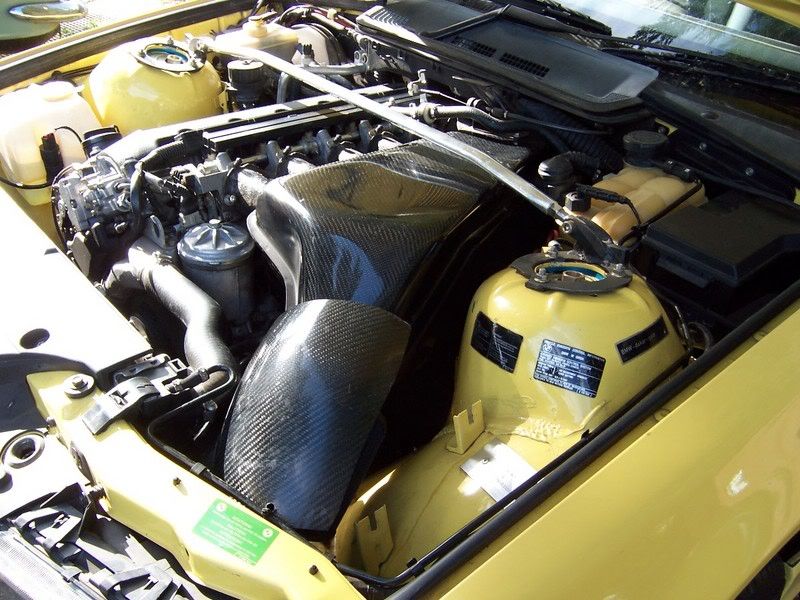
This plenum was used on the M3 CSL in Euro which produced 360 to 380 BHP with the same redline as the US M3. The only other difference I could quickly find between the CSL and US versions is a upgrade to the headers. Obviously the plenum design does not increase power as significantly as we might believe assuming some power was gained through aggressive tuning (hand-built motors) and the headers. Regardless this plenum is a mechanical bolt on affair for any S54 motor.
NOW I'm gonna kinda blow your mind. Tomei is a VERY well respected Nissan tuner. If anything they were most likely involved with all of Nismo's racing engine development or at least part of it for the VG and VK JGTC engines.
The R33/4 GT-R RB26 is an FI ITB car (not sure about R32). See the example here:
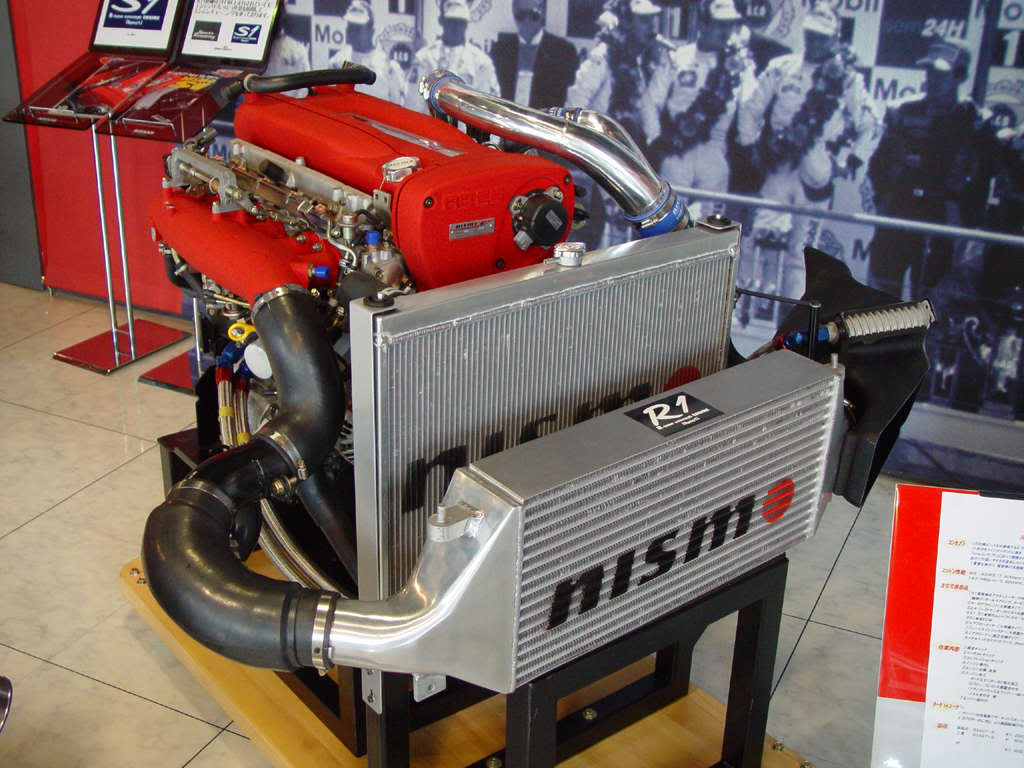
Note there is no throttle on the entrance to the intake plenum and the throttle linkage on the top of the plenum to control the ITB's.
Now Tomei made their one off drag car. Here's a picture of the motor:
Notice anything different? Plenum is essentially the same. The only addtition is a simple single throttle body.
Links to more info on the car.
http://www.tomei-p.co.jp/_2003web-ca...drag_sale.html
I've been knee deep in this stuff for nearly a year now, as it's something I've been working on steadily for my own car (albeit NA). I have not even given thought to the plenum side of the equation, for the simple reason that the cost involved is more than even the ITB's set me back (I decided to not go with Jenvey's, wanted to try something in a bit of a different direction). On my own setup, just as an example, I have way more runner length than stock (significant amount) and a much better flow angle vs any of the stock setups (revup or non). I have not compared it to an HR setup yet as I have not gotten my hands on one to play with.
I knew you would head towards ITB just wondered when. I hope in your testing you get the chance to adjust runner length and taper to see where the power can be lost and gained.


nope, I fully understand that ITB's have nothing to do with plenums at all - the two are mutually exclusive. However, if you are looking to enclose ITB's into a plenum, they must obviously be designed around one another, which is what I was saying.
With the BMW engines, and the GTR shown, etc, again it's all about that balancing act. They are choosing different routes to the same end for different reasons. The fact that the GTR is maintaining twin turbos and not using any sort of cam advance on the exhaust side, I'm sure has something to do with why they chose the single. Serviceability might be another reason, I don't know.
With the BMW engines, and the GTR shown, etc, again it's all about that balancing act. They are choosing different routes to the same end for different reasons. The fact that the GTR is maintaining twin turbos and not using any sort of cam advance on the exhaust side, I'm sure has something to do with why they chose the single. Serviceability might be another reason, I don't know.
Last edited by Z1 Performance; Jan 8, 2009 at 08:59 AM.


For a FI application, you obviously cannot have open air ITB's. They need a plenum to surround them. That plenum must be specifically designed for those ITB's, or those ITB's must be redesigned around that plenum. You cannot just take the bodies and put them in an enclosure and expect results -the box must be specifically designed to house those bodies, in the same way that a sub box should be specifically designed around a particular sub. The ITB's behave one way when they are breathing open air. They can act vastly different when they are enclosed in a plenum/box, regardless of how much volume that plenum might hold. I say can, because it will of course depend on the specifics of that engine (head cc, valve diameter, cam lift and duration), and also depend on the bodies being used (going back to runner length, lip thickness, taper, where the shaft is placed, etc). Getting them to act nearly the same in both scenarios is where the R&D of the plenum comes in. That's why it's not really enough to say that plenum volume would be the same whether you have ITB's or a single/dual throttle body (it might, it might not). In the case of the GTR for example, it might be that given the type of ITB's that Nissan uses, perhaps given the body design, the valve timing, cam specs, etc, they are not overly sensitive to the plenum they are placed in. For other engines, this might not be the case at all. That's the only area I disagreed with you
Really the only way to know, is to take a particular car, and try each form of plenum on that car, and retune it accordingly each time. Only then can you really see what setup that car prefers. The ITB setup becomes harder to test, simply because it can be reconfigured any number of different ways. Will be cool to see how this all shakes out on a variety of a cars!
Last edited by Z1 Performance; Jan 8, 2009 at 09:52 AM.
Correct, that's exactly what I am saying
For a FI application, you obviously cannot have open air ITB's. They need a plenum to surround them. That plenum must be specifically designed for those ITB's, or those ITB's must be redesigned around that plenum. You cannot just take the bodies and put them in an enclosure and expect results -the box must be specifically designed to house those bodies, in the same way that a sub box should be specifically designed around a particular sub. The ITB's behave one way when they are breathing open air. They can act vastly different when they are enclosed in a plenum/box, regardless of how much volume that plenum might hold. I say can, because it will of course depend on the specifics of that engine (head cc, valve diameter, cam lift and duration), and also depend on the bodies being used (going back to runner length, lip thickness, taper, where the shaft is placed, etc). Getting them to act nearly the same in both scenarios is where the R&D of the plenum comes in. That's why it's not really enough to say that plenum volume would be the same whether you have ITB's or a single/dual throttle body (it might, it might not). In the case of the GTR for example, it might be that given the type of ITB's that Nissan uses, perhaps given the body design, the valve timing, cam specs, etc, they are not overly sensitive to the plenum they are placed in. For other engines, this might not be the case at all. That's the only area I disagreed with you
Really the only way to know, is to take a particular car, and try each form of plenum on that car, and retune it accordingly each time. Only then can you really see what setup that car prefers. The ITB setup becomes harder to test, simply because it can be reconfigured any number of different ways. Will be cool to see how this all shakes out on a variety of a cars!
For a FI application, you obviously cannot have open air ITB's. They need a plenum to surround them. That plenum must be specifically designed for those ITB's, or those ITB's must be redesigned around that plenum. You cannot just take the bodies and put them in an enclosure and expect results -the box must be specifically designed to house those bodies, in the same way that a sub box should be specifically designed around a particular sub. The ITB's behave one way when they are breathing open air. They can act vastly different when they are enclosed in a plenum/box, regardless of how much volume that plenum might hold. I say can, because it will of course depend on the specifics of that engine (head cc, valve diameter, cam lift and duration), and also depend on the bodies being used (going back to runner length, lip thickness, taper, where the shaft is placed, etc). Getting them to act nearly the same in both scenarios is where the R&D of the plenum comes in. That's why it's not really enough to say that plenum volume would be the same whether you have ITB's or a single/dual throttle body (it might, it might not). In the case of the GTR for example, it might be that given the type of ITB's that Nissan uses, perhaps given the body design, the valve timing, cam specs, etc, they are not overly sensitive to the plenum they are placed in. For other engines, this might not be the case at all. That's the only area I disagreed with you
Really the only way to know, is to take a particular car, and try each form of plenum on that car, and retune it accordingly each time. Only then can you really see what setup that car prefers. The ITB setup becomes harder to test, simply because it can be reconfigured any number of different ways. Will be cool to see how this all shakes out on a variety of a cars!
We might just be discussing semantics at this point. The issue at hand is the thread started as Jenevy ITB's with a plenum to be used on street cars with a filter. Also we included phunk's design and our personal opinions on how it might be optimized. I just want to make sure there's no confusion on the part of all the people watching this thread and its EXTREMELY technical aspects.
To those that have been reading this and are looking at ITB's for FI or NA this is the pro's and con's:
PRO's
More Power
Better Throttle Response
Tunability for Runner Length - Depending on cars usage, mods, etc
Con's
Price (Isn't it always)
EMS - This is a whole other subject
Fitment and Additional Mods to Work with FI kit or EMS or Both
Neutral
-NA/FI
To OPTIMIZE power the plenum should be designed specifically for the application (None of us has the software, hardware or engineering expertise to do this so its kind a moot point and basically we're using the best guesstimate we can)
It will still make more power if you just put a reasonably sized plenum over the ITB's with runners that have been tested correctly for your application
-FI
You will make more power, mostly due to runner length/taper options
Plenum design is less significant becasue you are FORCING air into the plenum, this allows us to ignore factors of optimizing velocity and venturi effects
Last edited by DaveFunction2ND; Jan 8, 2009 at 10:20 AM.
OK I see. So my examples of the BMW's make no impact on your thoughts of how a plenum has a minimal effect on HOW the motor reacts? Plenum design is obviously more about optimizing power then getting a car to run properly. You're giving everyone the impression that if they don't have some special plenum designed for ITB's then the car will not run properly. Is that your contention?
But to start off, it simply isn't in the cards for me, as the design costs and fab costs of just a simple test unit alone are more than the cost of the ITB setup was. It really gives you appreciation for the hows and whys the OEM's do what they do.Thanks for the edit..we're def. on the same basic page
Just for ***** and giggles when it comes time to do my formal on car test work, I'm going to start first with open filters, then try a variety of filter types. From there, we'll work around the horn design and length, as I've got tons of room to play with on my setup. I've got all the diagnostic stuff here to be able to log the affects these things have on IAT, vacuum, balance between cylinders. I won't have an EGT as there just is no room. I might go so far as to have twin widebands, but I think in my case it's probably not necessary
Last edited by Z1 Performance; Jan 8, 2009 at 11:50 AM.