


Audible Knocking above 3K RPM's


Thread Starter
Registered User
iTrader: (50)
Joined: Apr 2007
Posts: 1,747
Likes: 0
From: Chesapeake, VA/The Bronx

All I need is a new crank, piston rings, and bearings and the motor is good to go. However I'm in the middle of trying to buy a house, so the motor is on hold for now. I still have my stock block, but I don't want to use it until I know what caused all of this.
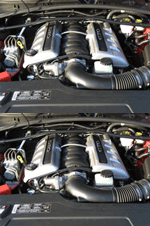

Not to be a downer, but you may be underestimating it a bit. Is there enough material on the block to resurface everything? Are the bearings fully intact? If any bearing material got free it may be much worse.... trust me on this one.

A/F were always right on. Forged were the ones who hooked up the HKS Knock amp to the stock knock sensor. I got no knock count before this happen.
All I need is a new crank, piston rings, and bearings and the motor is good to go. However I'm in the middle of trying to buy a house, so the motor is on hold for now. I still have my stock block, but I don't want to use it until I know what caused all of this.
All I need is a new crank, piston rings, and bearings and the motor is good to go. However I'm in the middle of trying to buy a house, so the motor is on hold for now. I still have my stock block, but I don't want to use it until I know what caused all of this.
Last edited by stormcrow; Mar 22, 2010 at 04:46 PM.
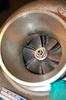
Don't forget about re-building the turbo's. Not to add insult to injury, but they have to get professionally cleaned out or else they will pollute your new motor with the first turn of the key. FYI.
Thread Starter
Registered User
iTrader: (50)
Joined: Apr 2007
Posts: 1,747
Likes: 0
From: Chesapeake, VA/The Bronx
I would double-check the hook up of that Knock-Amp...no matter who installed it. That silver color is due to detonation. Unless my eyes deceive me, that is some pretty good pitting on the number 1 piston. I wouldn't reuse that piston due to possible failure on the ringlands later. If it's not pitting, then the picture is deceiving.
That all taking care of.

Another thought to consider if fuel injector testing comes back ok: oil contamination in cylinder 1 could cause an effective decrease in octane and result in single cylinder detonation without an air flow or fuel flow imbalance. This could be the result of an internal leak past the piston or through the valves. Do you have pictures of the valves and cylinder walls during the disassembly process?
Even if there's not pitting (and it looks like there is but I'd take the word of someone examining it in person), I wouldn't reuse that piston. Something caused that detonation in that cylinder only - what if those rings are permitting excess blow by? Not saying Kyle made a mistake, but I think it's very easy to see signs of detonation and write it off to the tune, when it's highly likely that there's something about cylinder 1 that's different. Did you have any visible smoking when the car was running?
Last edited by rcdash; Mar 24, 2010 at 07:01 PM.

Citymunky,
What do the cylinder heads look like, in particular the valve seals on cylinder 1 ?
An often over looked culprit to single cylinder detonation is oil originating at the valve guide area - it is a major contributor to single-cylinder detonation. I have access to a couple of folks locally I trust that build motors and do analysis - sent them your pics from this thread, thats what they suggested as a possible root cause.
If a single cylinder detonation problem occurrs they tell me 90% chance its due to oil leaking into the combustion chamber through the valve seal. Since its just one cylinder and we are FI, very difficult to pick this up with a visual cue or even audible cue. Any kind of oil contamination inside the combustion chamber is very bad news. Oil is a great breeding ground for creating detonation. The best way to avoid this is to ensure tight valve-to-guide clearances and leak-free valve guide seals. This is also why oil catch cans are a generic good idea for FI.
You state the heads had 20K miles, just a thought since they are the piece of the build with the most miles and prone to failure/leaks - also something else to look into.
Any additional pictures of the piston skirts (all pistons), cylinder heads and headgasket ?
Other culprits for single cylinder det. injector (already stated) or an intake gasket leak on just cylinder one.
Toast
What do the cylinder heads look like, in particular the valve seals on cylinder 1 ?
An often over looked culprit to single cylinder detonation is oil originating at the valve guide area - it is a major contributor to single-cylinder detonation. I have access to a couple of folks locally I trust that build motors and do analysis - sent them your pics from this thread, thats what they suggested as a possible root cause.
If a single cylinder detonation problem occurrs they tell me 90% chance its due to oil leaking into the combustion chamber through the valve seal. Since its just one cylinder and we are FI, very difficult to pick this up with a visual cue or even audible cue. Any kind of oil contamination inside the combustion chamber is very bad news. Oil is a great breeding ground for creating detonation. The best way to avoid this is to ensure tight valve-to-guide clearances and leak-free valve guide seals. This is also why oil catch cans are a generic good idea for FI.
You state the heads had 20K miles, just a thought since they are the piece of the build with the most miles and prone to failure/leaks - also something else to look into.
Any additional pictures of the piston skirts (all pistons), cylinder heads and headgasket ?
Other culprits for single cylinder det. injector (already stated) or an intake gasket leak on just cylinder one.
Toast
Last edited by ToastZ; Mar 25, 2010 at 03:08 PM.
Thread Starter
Registered User
iTrader: (50)
Joined: Apr 2007
Posts: 1,747
Likes: 0
From: Chesapeake, VA/The Bronx
^^^^
On Monday I can go get the heads out of my car and see. I'll take pic's and post them also.
However as far as the valve guild seals, I got them replaced with new seals from my OEM Engine Gasket Kit at a local Head Shop. I also replaced all the intake gaskets. I trashed the Head gaskets during the break down of the block. (They were Cosworth)
On Monday I can go get the heads out of my car and see. I'll take pic's and post them also.
However as far as the valve guild seals, I got them replaced with new seals from my OEM Engine Gasket Kit at a local Head Shop. I also replaced all the intake gaskets. I trashed the Head gaskets during the break down of the block. (They were Cosworth)
Thread Starter
Registered User
iTrader: (50)
Joined: Apr 2007
Posts: 1,747
Likes: 0
From: Chesapeake, VA/The Bronx

It wasn't the #1 cylinder with a poor rating, though. I think this is what Raj was trying to point out. There is another reason for detonation in that cylinder besides the first guess of faulty injector.

I have a really hard time believing that a spray pattern can be "poor" and then be rated "excellent" and have virtually no increase in flow (1-2 percent?). I am also a little skeptical about their qualitative ranking and whether or not it had a significant impact on the issue at hand here. I don't claim to be an expert, but I like to see a little more raw data and explanation of that data rather than an entirely subjective "take my word for it" kind of interpretation.
Last edited by rcdash; Jul 15, 2010 at 07:44 PM.

what i'm curious about is how a flow of 619 is only "good" before but then a flow of 611 in the after column is rated as "excellent"
if i did my math correctly 619 is higher than 611....
if i did my math correctly 619 is higher than 611....