


TT setup running out of fuel up top??


Thread Starter
Registered User
Joined: Dec 2009
Posts: 58
Likes: 0
From: USA
 TT setup running out of fuel up top??
The setup I'm running is a JWT TT 700bb kit w/ built block. My fuel setup is a warlbro 255lph to an Aeromotive A1000 and FPR with RC 1000cc injectors.
My tuner called me today and said that it seems like it's running out of fuel up top. Any reason this could be happening? I figured that my setup would flow more than enough for this.
My tuner called me today and said that it seems like it's running out of fuel up top. Any reason this could be happening? I figured that my setup would flow more than enough for this.

Thread Starter
Registered User
Joined: Dec 2009
Posts: 58
Likes: 0
From: USA


Your shop can't figure it out? I'd be hesitant to work with them then... That is if you want to push your setup.
What size lines are you running?


What are you tuning with? +1 if your tuner can't come up with ideas for more fuel locate a new tuner. I'm building my block now for my JWT 700BB kit. Below you'll find my fuel system choice & EMS. If you're using stock rails no way they'll be supplying enough for your 1000cc injectors. Also the Aeromotive 340 pump is a better investment imo.
~ CJM Stage 2 Return Fuel System w/ Blue Billet Fuel Rails
~~ Aeromotive 340lph In-Tank Fuel Pump
~~ Injector Dynamics 1000cc Injectors
~ HalTech Plug-In Pro ECU Replacement EMS
~~ HalTech Air Temp Sensor
~~ HalTech Boost Control Solenoid
~~ HalTech Dual Wideband Kit w/ 2 Sensors
~~ Dual Wideband Gauge
~ CJM Stage 2 Return Fuel System w/ Blue Billet Fuel Rails
~~ Aeromotive 340lph In-Tank Fuel Pump
~~ Injector Dynamics 1000cc Injectors
~ HalTech Plug-In Pro ECU Replacement EMS
~~ HalTech Air Temp Sensor
~~ HalTech Boost Control Solenoid
~~ HalTech Dual Wideband Kit w/ 2 Sensors
~~ Dual Wideband Gauge
What are you tuning with? +1 if your tuner can't come up with ideas for more fuel locate a new tuner. I'm building my block now for my JWT 700BB kit. Below you'll find my fuel system choice & EMS. If you're using stock rails no way they'll be supplying enough for your 1000cc injectors. Also the Aeromotive 340 pump is a better investment imo.
~ CJM Stage 2 Return Fuel System w/ Blue Billet Fuel Rails
~~ Aeromotive 340lph In-Tank Fuel Pump
~~ Injector Dynamics 1000cc Injectors
~ HalTech Plug-In Pro ECU Replacement EMS
~~ HalTech Air Temp Sensor
~~ HalTech Boost Control Solenoid
~~ HalTech Dual Wideband Kit w/ 2 Sensors
~~ Dual Wideband Gauge
~ CJM Stage 2 Return Fuel System w/ Blue Billet Fuel Rails
~~ Aeromotive 340lph In-Tank Fuel Pump
~~ Injector Dynamics 1000cc Injectors
~ HalTech Plug-In Pro ECU Replacement EMS
~~ HalTech Air Temp Sensor
~~ HalTech Boost Control Solenoid
~~ HalTech Dual Wideband Kit w/ 2 Sensors
~~ Dual Wideband Gauge
Trending Topics
Thread Starter
Registered User
Joined: Dec 2009
Posts: 58
Likes: 0
From: USA
The EMS I'm running is a HKS Fcon Vpro with Knock amp.
And perhaps I'm jumping the gun on starting this thread since they didn't delve into it yet. They pretty much were tuning it and saw the occurence. They're going to look into it tomorrow most likely.
They're a pretty reputable shop that builds tunes GTRs on a daily basis. I hope they'll figure it out.
And perhaps I'm jumping the gun on starting this thread since they didn't delve into it yet. They pretty much were tuning it and saw the occurence. They're going to look into it tomorrow most likely.
They're a pretty reputable shop that builds tunes GTRs on a daily basis. I hope they'll figure it out.



^ I don't know that anyone has ever definitively concluded a pump wearing out prematurely because of a BAP. It only activates above 4 psi and output voltage can be adjusted to whatever you need. The key is that voltage is held steady throughout the rpm range. A larger pump is pushing more fuel at idle than it needs to and still drops off at higher pressures, when you need it most. Scaling voltage with a smaller pump seems more efficient.
EDIT: from http://www.kennebell.net/techinfo/ge...Focus_kens.pdf
EDIT: from http://www.kennebell.net/techinfo/ge...Focus_kens.pdf
And, contrary to the opinions of some, the BAP will actually INCREASE the life of the pumps
because they do not have to work as hard with the increased voltage and amperage supplied by
the BAP (see our post at http://www.modularfords.com/forums/s...ead.php?t=7819 - LOOK
AT THE CHARTS). Note how much LESS duty cycle is imposed on the pump when the BAP is
used? LESS DUTY CYCLE = LONGER PUMP LIFE.
because they do not have to work as hard with the increased voltage and amperage supplied by
the BAP (see our post at http://www.modularfords.com/forums/s...ead.php?t=7819 - LOOK
AT THE CHARTS). Note how much LESS duty cycle is imposed on the pump when the BAP is
used? LESS DUTY CYCLE = LONGER PUMP LIFE.
Last edited by rcdash; Mar 11, 2012 at 10:45 AM.
^ I don't know that anyone has ever definitively concluded a pump wearing out prematurely because of a BAP. It only activates above 4 psi and output voltage can be adjusted to whatever you need. The key is that voltage is held steady throughout the rpm range. A larger pump is pushing more fuel at idle than it needs to and still drops off at higher pressures, when you need it most. Scaling voltage with a smaller pump seems more efficient.
EDIT: from http://www.kennebell.net/techinfo/ge...Focus_kens.pdf
EDIT: from http://www.kennebell.net/techinfo/ge...Focus_kens.pdf
That's the manufacture. LOL Of course they won't bad mouth their own product. And FYI: I've have to sent back BAP due to failure or completely did not work. Also the fuse that came with the BAP was too small for the amps it was pulling and would pop. This happen to one C6 owner at the Texas mile at WOT. Not something you want to happen but it could happen with an aftermarket pump as well. HOWEVER (LOL) if the BAP wasn't pulling and pushing more amperage the fuse would have never got hot. And lets not forget that also all the wiring has that increase load as well.
I guess I rather have a pump at factory 5v produce 340lph vs a factory 5v rated pump at 6.5v produce 125-150% of it's capacity. It's like a turbo. It might be able to produce more boost but it will be outside its efficiency.
Last edited by Robert_K; Mar 11, 2012 at 11:07 AM.
Gerotor pumps apparently fail with pulse width modulation, so reducing duty cycle is not an option with all pumps. So I'll agree some of KB's responses are not applicable to our cars. The new turbine style pumps I think can be modulated with PWM and I think it is possible to reduce wear and tear at low load and increase performance only when needed (if your EMS supports this).
I don't know enough about fuel pumps to identify precisely how susceptible they are to wear with increased voltage/current applied. If there is only one pump and it fails or the KB blows a fuse, then the car dies, but does not lean out, which is an acceptable outcome for me. So I prefer a KB vs a twin pump. Now there are larger pumps available and I will likely move to the DW300.
I don't know enough about fuel pumps to identify precisely how susceptible they are to wear with increased voltage/current applied. If there is only one pump and it fails or the KB blows a fuse, then the car dies, but does not lean out, which is an acceptable outcome for me. So I prefer a KB vs a twin pump. Now there are larger pumps available and I will likely move to the DW300.
Last edited by rcdash; Mar 11, 2012 at 12:24 PM.
Gerotor pumps apparently fail with pulse width modulation, so reducing duty cycle is not an option with all pumps. So I'll agree some of KB's responses are not applicable to our cars. The new turbine style pumps I think can be modulated with PWM and I think it is possible to reduce wear and tear at low load and increase performance only when needed (if your EMS supports this).
I don't know enough about fuel pumps to identify precisely how susceptible they are to wear with increased voltage/current applied. If there is only one pump and it fails or the KB blows a fuse, then the car dies, but does not lean out, which is an acceptable outcome for me. So I prefer a KB vs a twin pump. Now there are larger pumps available and I will likely move to the DW300.
I don't know enough about fuel pumps to identify precisely how susceptible they are to wear with increased voltage/current applied. If there is only one pump and it fails or the KB blows a fuse, then the car dies, but does not lean out, which is an acceptable outcome for me. So I prefer a KB vs a twin pump. Now there are larger pumps available and I will likely move to the DW300.
I wasn't a fan of the twin pump as well. So when I saw the Aeromotive 340 released I was sold.
^ Also just fyi, please note that DW300 is spec'd to receive 18 volts. Compare the flow data vs anything else. E85 compatible, 3 yr warranty, and flow at 18v is very good...
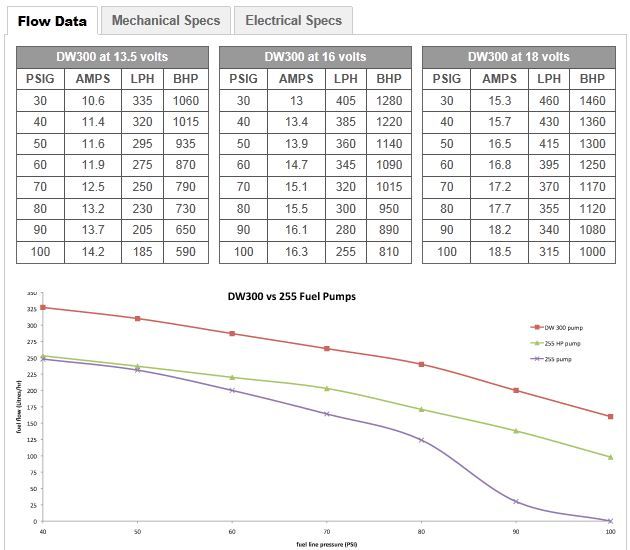

Gerotor pumps apparently fail with pulse width modulation, so reducing duty cycle is not an option with all pumps. So I'll agree some of KB's responses are not applicable to our cars. The new turbine style pumps I think can be modulated with PWM and I think it is possible to reduce wear and tear at low load and increase performance only when needed (if your EMS supports this).
I don't know enough about fuel pumps to identify precisely how susceptible they are to wear with increased voltage/current applied. If there is only one pump and it fails or the KB blows a fuse, then the car dies, but does not lean out, which is an acceptable outcome for me. So I prefer a KB vs a twin pump. Now there are larger pumps available and I will likely move to the DW300.
I don't know enough about fuel pumps to identify precisely how susceptible they are to wear with increased voltage/current applied. If there is only one pump and it fails or the KB blows a fuse, then the car dies, but does not lean out, which is an acceptable outcome for me. So I prefer a KB vs a twin pump. Now there are larger pumps available and I will likely move to the DW300.
 I feel the same way, and will most likely end up with either the Walbro 400 or Aeromotive 340...
might be a dumb question, but what kind of voltage do we run at our pumps at full go?
Last edited by tonyzS/C03; Mar 11, 2012 at 12:45 PM.
Nominal alternator output voltage is 13 - 13.5 volts. I have logged the 12v supply line to the coils before and noted that they dropped to under 11.5v at high rpm. I have a HO alternator now though. I wouldn't be surprised if stock fuel pump voltage on stock wiring similarly declines at high rpm, but have never logged it.