


Variable cam tuning Intake / Exhaust w/dyno charts, Tuners please step in


Thread Starter
Registered User
iTrader: (7)
Joined: Jul 2008
Posts: 253
Likes: 2
From: Greensboro, NC
 Variable cam tuning Intake / Exhaust w/dyno charts, Tuners please step in
There is just not a whole lot of info on variable cam tuning.
Straight out of the FSM
Intake valve timing- "This makes it possible to control the shut/open timing of the intake
valve to increase engine torque in low/mid speed range and output in high-speed range."
Exhaust valve timing- " This makes it possible to control the shut/open timing of the exhaust
valve to increase engine torque and output in a range of high engine speed."
Here is a dyno graph, i just did this testing this past Thursday.
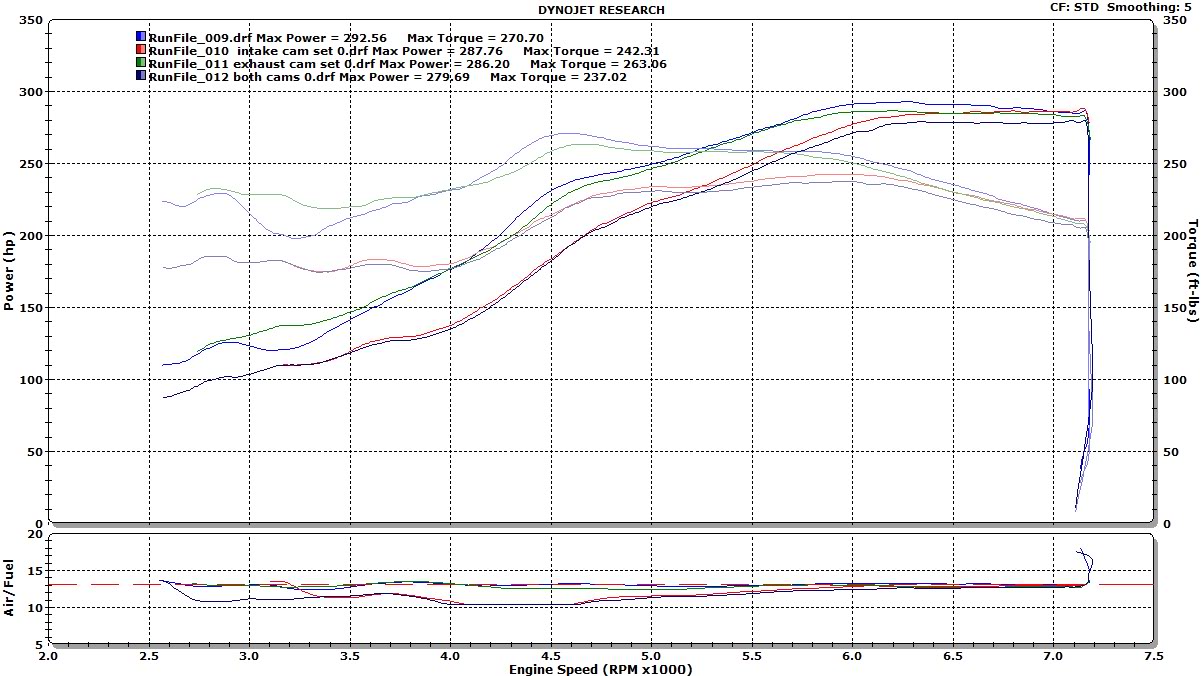
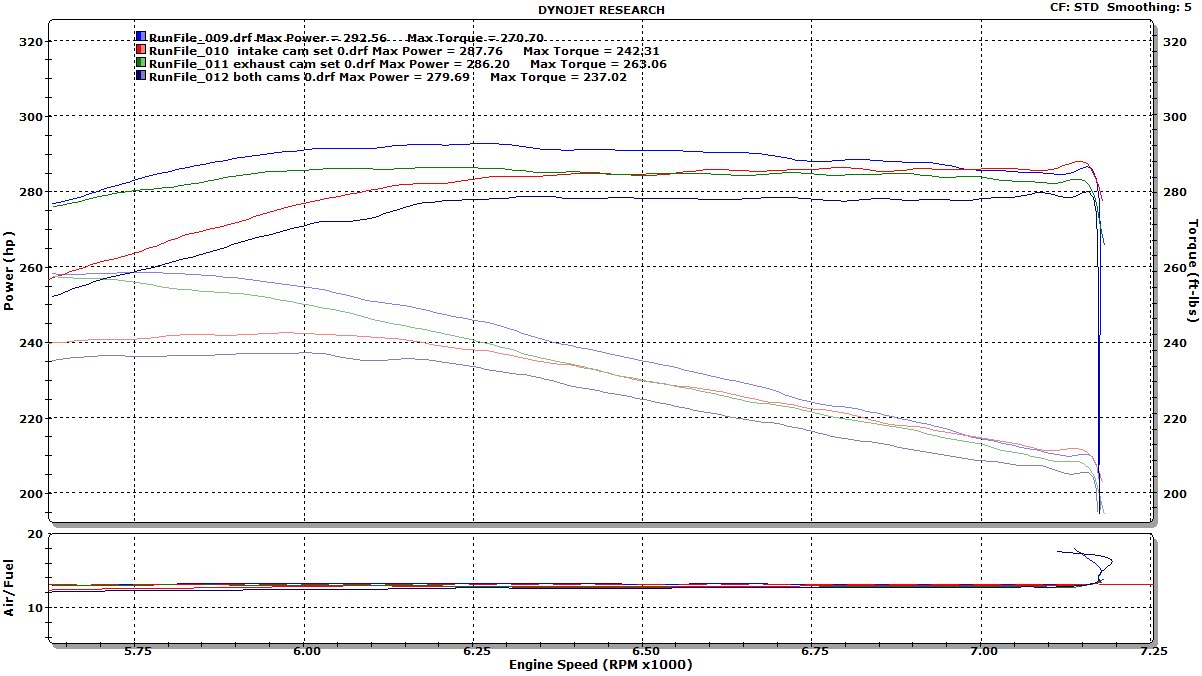
So as you can see EVT is good for in mid range and high. Meanwhile IVT def has a huge impact on midrange power.
My biggest concern is EVT, im running 11-9 degrees of advancement and its making ~5 hp more than with EVT off at 6k+. The stock haltech map puts EVT on 15 degrees i reduced it because i was kinda confused and thought EVT was for low end power. So i need to put mine back on stock 15 degrees.
Can any VQ35 tuners step and and help out here?
What are the limits? Can you cause valve damage if you advance the cams too much at high rpm? or any rpm really? (Ive assumed that the variable system on VQ's its impossible to cause damage as they dont move that much) but i could be totally wrong. This is why im posting here.
What is the range of IVT and EVT? IVT is 40degrees, and EVT is 30???
The stock haltech runs 15 advancement on EVT from 3500+ would 20, 25 make more top end power?
Is cam timing tuning where you make the TQ line flatter? (not falling off a lot after 5500)?
Does anyone have any back to back variable cam testing graphs? I really didn't find much at all. other than a low compression built motor.
Straight out of the FSM
Intake valve timing- "This makes it possible to control the shut/open timing of the intake
valve to increase engine torque in low/mid speed range and output in high-speed range."
Exhaust valve timing- " This makes it possible to control the shut/open timing of the exhaust
valve to increase engine torque and output in a range of high engine speed."
Here is a dyno graph, i just did this testing this past Thursday.
So as you can see EVT is good for in mid range and high. Meanwhile IVT def has a huge impact on midrange power.
My biggest concern is EVT, im running 11-9 degrees of advancement and its making ~5 hp more than with EVT off at 6k+. The stock haltech map puts EVT on 15 degrees i reduced it because i was kinda confused and thought EVT was for low end power. So i need to put mine back on stock 15 degrees.
Can any VQ35 tuners step and and help out here?
What are the limits? Can you cause valve damage if you advance the cams too much at high rpm? or any rpm really? (Ive assumed that the variable system on VQ's its impossible to cause damage as they dont move that much) but i could be totally wrong. This is why im posting here.
What is the range of IVT and EVT? IVT is 40degrees, and EVT is 30???
The stock haltech runs 15 advancement on EVT from 3500+ would 20, 25 make more top end power?
Is cam timing tuning where you make the TQ line flatter? (not falling off a lot after 5500)?
Does anyone have any back to back variable cam testing graphs? I really didn't find much at all. other than a low compression built motor.
Last edited by SurraTT; Feb 26, 2012 at 03:47 PM.


All I know is what you already posted pretty much... intake cam advance improves low/mid power up to a certain RPM where it actually can start hurting power.. thats why the charts usually zero out the intake cam advance some time before redline. Exhaust cam advance increases top end power.. no experience here because I have a non-revup DE. Adjust each to get the best overall power figure.
Thread Starter
Registered User
iTrader: (7)
Joined: Jul 2008
Posts: 253
Likes: 2
From: Greensboro, NC
All I know is what you already posted pretty much... intake cam advance improves low/mid power up to a certain RPM where it actually can start hurting power.. thats why the charts usually zero out the intake cam advance some time before redline. Exhaust cam advance increases top end power.. no experience here because I have a non-revup DE. Adjust each to get the best overall power figure.
Haha yeah, im trying to see whats up with some cars having a flatter tq curve, with not a lot of mods and def not built. And i want to know the limits, if i get on the dyno and mess with cam timing can i cause valve damage?
Thread Starter
Registered User
iTrader: (7)
Joined: Jul 2008
Posts: 253
Likes: 2
From: Greensboro, NC
OK i called JWT to get some info as they are def up on VQ cam stuff!
Clark helped me out a lot! He really knows what real customer service is about!
Some good notes:
IVT- old motors have 40 degrees advancement, the newer HR head system has 50 degrees of advancement.
EVT- old (rev up) 30 degrees, new HR is 40 degrees. This is actually retarding the cam.
There can be no valve damage done with stock cams and stock piston setup!!!!!!!!!!! Which i was pretty sure that was the case but its good to know!
Clark helped me out a lot! He really knows what real customer service is about!
Some good notes:
IVT- old motors have 40 degrees advancement, the newer HR head system has 50 degrees of advancement.
EVT- old (rev up) 30 degrees, new HR is 40 degrees. This is actually retarding the cam.
There can be no valve damage done with stock cams and stock piston setup!!!!!!!!!!! Which i was pretty sure that was the case but its good to know!



Trending Topics


nice info.
The first graph shows 10:1 a/f ratio between 4000-4600 with the 2 lowest torque pulls. This low of an a/f on a NA engine is crazy rich and would cause a huge hit in midrange torque and power. Because of that it's hard to compare what the midrange torque loss or gain would be since the a/f on 2 of the runs wasn't in the same range that the other 2 are. A/f swing that huge makes a huge power difference. heck, just between 11.8 and down to just under 11:1 change lost quite a bit of power for me.
The first graph shows 10:1 a/f ratio between 4000-4600 with the 2 lowest torque pulls. This low of an a/f on a NA engine is crazy rich and would cause a huge hit in midrange torque and power. Because of that it's hard to compare what the midrange torque loss or gain would be since the a/f on 2 of the runs wasn't in the same range that the other 2 are. A/f swing that huge makes a huge power difference. heck, just between 11.8 and down to just under 11:1 change lost quite a bit of power for me.
Thread Starter
Registered User
iTrader: (7)
Joined: Jul 2008
Posts: 253
Likes: 2
From: Greensboro, NC
nice info.
The first graph shows 10:1 a/f ratio between 4000-4600 with the 2 lowest torque pulls. This low of an a/f on a NA engine is crazy rich and would cause a huge hit in midrange torque and power. Because of that it's hard to compare what the midrange torque loss or gain would be since the a/f on 2 of the runs wasn't in the same range that the other 2 are. A/f swing that huge makes a huge power difference. heck, just between 11.8 and down to just under 11:1 change lost quite a bit of power for me.
The first graph shows 10:1 a/f ratio between 4000-4600 with the 2 lowest torque pulls. This low of an a/f on a NA engine is crazy rich and would cause a huge hit in midrange torque and power. Because of that it's hard to compare what the midrange torque loss or gain would be since the a/f on 2 of the runs wasn't in the same range that the other 2 are. A/f swing that huge makes a huge power difference. heck, just between 11.8 and down to just under 11:1 change lost quite a bit of power for me.
Yeah that was when i totally turned IVT off. But from 5500+ its a much closer afr.
The best thing is seeing what EVT done to top end power. I have since tuned EVT more and I think its making even more power with just evt alone now.
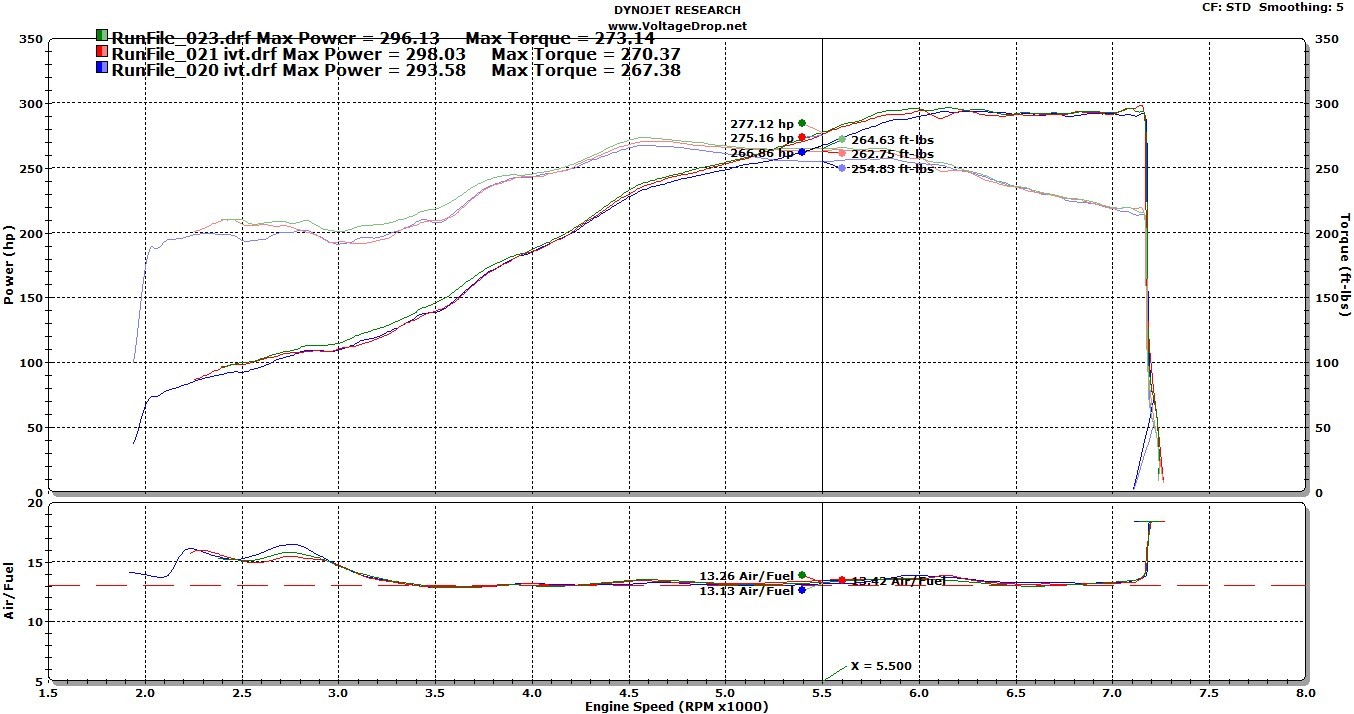
I see your second graph has the a/f nice and smooth between runs. Good gains in just cam timing adjustment!


Thread
Thread Starter
Forum
Replies
Last Post
Colombo
Forced Induction
35
Nov 9, 2020 10:27 AM
