


Thinking of putting spacers on the z


 Thinking of putting spacers on the z
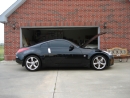
so i think it would like pretty nice to have the rears stick out further than the fronts. is this dangerous in anyway? for some reason i feel insecure about doing this especially since i was in my friends mustang and as we are driving down the freeway i see his wheel fly by us. this was not due to spacers though it was because he had 20 inch spokes on his stang. tell me why or why not should i do this.


I had 25mm spacers on the rear with 3" inch lip rims and it looked sick as hell. Got rid of both when I parted the car, and it never looked the same again. 
Two thumbs up from me.
Two thumbs up from me.

Everyone is saying get rims that fit....Many people like the factory volk racing wheels that come on the track, but even then they dont sit flush....Nissan developed w wheel that doesnt even sit flush...Hubcentric spacers are fine...Go to eibachs website and get some 25mm and call it a day.

I'm in the same sort of predicament as you. I would suggest just avoid any insane spacers like 30mm, and also make sure they are proper (ie hubcentric). Unless you track the hell out of your car, I wouldn't worry too much as they should be fine for daily driving. In fact, I can recall reading about folks running them during track days and having no problems either. Ultimately, however there will always be a debate and the right thing is to eventually upgrade to a set of properly offset wheels. But for those of us (like me) who cannot afford 3k for some volks, this is a good interim strategy.


Trending Topics


Registered User
Joined: Dec 2007
Posts: 12
Likes: 0
From: missouri
i am currently running 25mm eibach spacers on the rear with the stock 17" wheels and some falken azenis rt 615 tires. I have no problems with the spacers and only have great things to say about running them. The handling is much improved with the extra width. I autox mine alot and will be going with 20mm in the front soon as well. Stick with quality spacers like said above and make sure they are hubcentric and you will not regret it.

Does "hubcentric" mean you need extended lugs... or is that with all spacers. I'm in the same situation... i.e. can't afford 34G's for some GT-F's or LE's at the moment, but hopefully sooner than later.

hubcentric simply means that the center of the wheel fits tightly around the base of the hub. Most aftermarket wheels have large-diameter hub openings to allow for a multitude of fitaments; hubcentric rings "fill the gap", in effect creating a wider-diameter hub to allow the aftermarket wheel to fit snugly around the hub base like OEM. Even though your wheel may have the correct bolt pattern, by not running hubcentric rings you would be relying on the lugs to center the wheel (known as lugcentric), which will likely lead to vibrations because the wheel will not be completely centered on the hub.
As for extended lugs (I think you mean studs here), you can get spacers in one of two configurations: with built-in studs or without. Personally I think the built-in stud spacers like Project Kics and Eibach are a lot less PITA--just bolt them on and go. The new studs are built in to the spacer so you don't need to hammer out your OEM ones. The OEM studs slip on to the spacer and are secured with spacer bolts. Just be sure that the back of your wheel allows for this; look at that the underside of the wheel hub, and if you see blank spaces between each lug hole, then you are fine. Chances are, your wheels will work flawlessly; I have only seen one set of wheels (OEM or otherwise) that didn't allow for spacers. I am running 20mm front/25mm rear spacers on my OEMs without issue.
As for extended lugs (I think you mean studs here), you can get spacers in one of two configurations: with built-in studs or without. Personally I think the built-in stud spacers like Project Kics and Eibach are a lot less PITA--just bolt them on and go. The new studs are built in to the spacer so you don't need to hammer out your OEM ones. The OEM studs slip on to the spacer and are secured with spacer bolts. Just be sure that the back of your wheel allows for this; look at that the underside of the wheel hub, and if you see blank spaces between each lug hole, then you are fine. Chances are, your wheels will work flawlessly; I have only seen one set of wheels (OEM or otherwise) that didn't allow for spacers. I am running 20mm front/25mm rear spacers on my OEMs without issue.

Originally Posted by moforeynolds
how do you figure that??? I know plenty of guys running spacers on track cars.
i had spacers on my Z... i had to take em off, drivin on the track with spacers was


Originally Posted by davidv
Wheel spacers are a never ending debate.
If you want to do it right get wheels that fit.
Or you can go ghetto with spacers.
If you want to do it right get wheels that fit.
Or you can go ghetto with spacers.
Originally Posted by moforeynolds
hubcentric simply means that the center of the wheel fits tightly around the base of the hub. Most aftermarket wheels have large-diameter hub openings to allow for a multitude of fitaments; hubcentric rings "fill the gap", in effect creating a wider-diameter hub to allow the aftermarket wheel to fit snugly around the hub base like OEM. Even though your wheel may have the correct bolt pattern, by not running hubcentric rings you would be relying on the lugs to center the wheel (known as lugcentric), which will likely lead to vibrations because the wheel will not be completely centered on the hub.
As for extended lugs (I think you mean studs here), you can get spacers in one of two configurations: with built-in studs or without. Personally I think the built-in stud spacers like Project Kics and Eibach are a lot less PITA--just bolt them on and go. The new studs are built in to the spacer so you don't need to hammer out your OEM ones. The OEM studs slip on to the spacer and are secured with spacer bolts. Just be sure that the back of your wheel allows for this; look at that the underside of the wheel hub, and if you see blank spaces between each lug hole, then you are fine. Chances are, your wheels will work flawlessly; I have only seen one set of wheels (OEM or otherwise) that didn't allow for spacers. I am running 20mm front/25mm rear spacers on my OEMs without issue.
As for extended lugs (I think you mean studs here), you can get spacers in one of two configurations: with built-in studs or without. Personally I think the built-in stud spacers like Project Kics and Eibach are a lot less PITA--just bolt them on and go. The new studs are built in to the spacer so you don't need to hammer out your OEM ones. The OEM studs slip on to the spacer and are secured with spacer bolts. Just be sure that the back of your wheel allows for this; look at that the underside of the wheel hub, and if you see blank spaces between each lug hole, then you are fine. Chances are, your wheels will work flawlessly; I have only seen one set of wheels (OEM or otherwise) that didn't allow for spacers. I am running 20mm front/25mm rear spacers on my OEMs without issue.

I've had spacers on my Z now for almost two years without issues. I've been autocrossing my Z with spacers, and they're fine. More recently, I've driven on a road course without any problems with the spacers.
BTW, a Z with spacers is not any different than a Z with low offset rims.
BTW, a Z with spacers is not any different than a Z with low offset rims.