


Reason for gap between Z32 and Z33 production???


Thread Starter
Registered User
Joined: Jan 2004
Posts: 170
Likes: 0
From: Upland, CA
 Reason for gap between Z32 and Z33 production???
So I was thinking...what was the real reason behind the "no Z car" gap in production from the Z32 to Z33? Was this only for countries outside of Japan or did Japan go for a period of time without any Z car available? Same goes for other makes too like how there is supposedly a 5th gen Supra and 4th gen RX-7 in the make. Kind of makes me think if they are building their cars only because the Z made a come back and if the 350Z was never produced that there would be no serious push from other Japanese makes for sports cars anymore. I would think that with the wonderful legend of these cars that they would try to offer the next generation right after the previous one without having an empty gap in between and leaving enthusiasts wondering what the fate of the car will be.

Registered User
Joined: May 2002
Posts: 625
Likes: 0
From: Az.
Plain and simple.Z was nearly 45K when production was stopped in 1996. Dollar to yen ratio made the Z unaffordable. Insurance was high and the SUV craze just started. 2 seat sports cars were by the wayside.



Joined: May 2002
Posts: 8,629
Likes: 1,394
From: Aurora, Colorado
Don't forget that Nissan itself was in deep debt and close to going under. In the 90's, they were forced to cut back to offering the core products (Maxima, Altima and Sentra) to stay afloat. There was little funding for R & D on new products, certainly none for a new Z car.
People don't realize HOW CLOSE Nissan was to closing the doors in 1996!
With new capitalization from Renault and a fresh philosophy from Ghoen, Nissan pulled itself back from the brink. The Z (and more specifically, the FM platform) is truly emblematic of one method the company has used to thrust itself back into the thick of the worldwide market. Platform engineering and broad use of the award-winning VQ engine series brought Nissan from a engineering-focused company to a profit-centered one. Blue skies and bright horizons are ahead, but that 'gap' you speak of represented a black storm that the ship barely managed to sail out of...
People don't realize HOW CLOSE Nissan was to closing the doors in 1996!
With new capitalization from Renault and a fresh philosophy from Ghoen, Nissan pulled itself back from the brink. The Z (and more specifically, the FM platform) is truly emblematic of one method the company has used to thrust itself back into the thick of the worldwide market. Platform engineering and broad use of the award-winning VQ engine series brought Nissan from a engineering-focused company to a profit-centered one. Blue skies and bright horizons are ahead, but that 'gap' you speak of represented a black storm that the ship barely managed to sail out of...
Last edited by dkmura; Jul 10, 2005 at 08:44 PM.

Registered User
Joined: May 2005
Posts: 366
Likes: 0
From: Oregon, USA
Nissan had some economic woes to deal with and the Z car sales were falling off due to stiff competition and high insurance rates. Nissan was teetering on the brink of financial collapse and could not, would not, spend the money to design, develop and bring forth a lot of new and updated models. They had to bide their time and when things were improved by a better exchange rate and an infusion of cash, they began the slow process of redesigning their line and meeting the new challenges that faced them in the global markets.
I for one am glad they finally brought the Z back.
I for one am glad they finally brought the Z back.
Thread Starter
Registered User
Joined: Jan 2004
Posts: 170
Likes: 0
From: Upland, CA
wow but knowing that bit of info, it still amazes me that in Japan at the time they were still able to turn out the Stagea, Silvia, and Skyline despite their struggle to stay alive.


Trending Topics

Thread Starter
Registered User
Joined: Jan 2004
Posts: 170
Likes: 0
From: Upland, CA
probably using the same VQ engine as other cars like the Maxima, G35, FX35, etc kept costs down. Plus for some reason Japanese sports cars were real expensive back in the mid 90s with the 300ZX TT, 3000GT VR4, SupraTT, and RX-7 all pushing upwards of $40-50K!!! but then again they had much more power potential than the cars offered today.

Everyone blames the decline of Japanese sports cars sales in the U.S. on the escalating sticker prices. Actually, in the mid '90s, all sports car sales went down, including European and Domestic. For example, the 240sx, Camaro, and Firebird were all cancelled due to poor sales. None of these cars prices had escalated beyond the normal inflation rate.
What happened then? Well, as sports car sales decreased, SUV sales increased. Price had nothing to do with it, in fact America's economy was at its peak, when sports car sales were at their slump. So, instead of buying a Supra Turbo, Joe bought a Land Cruiser. Instead of buying a 240sx, Jim bought a Pathfinder. And even though Bubba had wanted a Z28 Camaro, he went and bought a Suburban, because it was the new cool thing.
...since it was no longer profitable in the U.S., Japan stopped importing sports cars.
The RX-8 went into production immediatley after the RX-7 ceased. It was sold until 2002. I believe the same is true for the 300zx and 350z. Production on the Supra has halted.
What happened then? Well, as sports car sales decreased, SUV sales increased. Price had nothing to do with it, in fact America's economy was at its peak, when sports car sales were at their slump. So, instead of buying a Supra Turbo, Joe bought a Land Cruiser. Instead of buying a 240sx, Jim bought a Pathfinder. And even though Bubba had wanted a Z28 Camaro, he went and bought a Suburban, because it was the new cool thing.
...since it was no longer profitable in the U.S., Japan stopped importing sports cars.
The RX-8 went into production immediatley after the RX-7 ceased. It was sold until 2002. I believe the same is true for the 300zx and 350z. Production on the Supra has halted.
Last edited by Lawn Dart; Jul 11, 2005 at 11:37 AM.


The reason why 350Z is cheaper than earlier version is because of sharing platform. Thats why its heavier and not as light an S2000 which is a convertible. I would have loved to see Z's with the weight of S2000 and the power of VQ35.
Here is what I found: Z shares platform
FR-L/FM: This is Front-engine, Rear-drive, Large and Front Mid-ship. It accounts for an array of products, including the Infiniti FX 45/35, M45 Concept, G35 coupe and sedan, Nissan 350Z, Stagea (Japan market wagon), Skyline (Japan market G35), and Fairlady Z (Japan market 350Z). One thing worth thinking about is that the FX is a five-passenger SUV and the 350Z is a two-passenger sports car, yet they fall within the same platform grouping.
FR-L/FM platform The Infiniti M45 Concept, G35 coupe, FX 45, and Nissan 350Z and Stagea are all built on the FR-L/FM platform. This indicates not only what can be done on a platform, but also the effort that is underway at Nissan to consolidate on platforms to increase economies of scale.
Here is what I found: Z shares platform
FR-L/FM: This is Front-engine, Rear-drive, Large and Front Mid-ship. It accounts for an array of products, including the Infiniti FX 45/35, M45 Concept, G35 coupe and sedan, Nissan 350Z, Stagea (Japan market wagon), Skyline (Japan market G35), and Fairlady Z (Japan market 350Z). One thing worth thinking about is that the FX is a five-passenger SUV and the 350Z is a two-passenger sports car, yet they fall within the same platform grouping.
FR-L/FM platform The Infiniti M45 Concept, G35 coupe, FX 45, and Nissan 350Z and Stagea are all built on the FR-L/FM platform. This indicates not only what can be done on a platform, but also the effort that is underway at Nissan to consolidate on platforms to increase economies of scale.
Last edited by spacemn_spiff; Jul 11, 2005 at 01:06 PM.
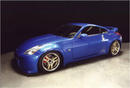
The gap was not as big as it seems, although Nissan stopped bringing the 300Z to the US in 1996 it stayed in production until 1999 and sold the last ones in 2000 and then the 350Z came out in 2002 so only a couple of years which is not bad considering the huge change in design.

Thread
Thread Starter
Forum
Replies
Last Post
Colombo
Forced Induction
35
Nov 9, 2020 10:27 AM
