


Running without sways at the track

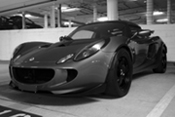

 Running without sways at the track
...is interesting...
Last night I made a late discovery - my rear swaybar endlink was broken. After much deliberation, I decided to run anyway this weekend at Summit Point. As a result, my rear swaybar is in essence, not functioning whatsoever (pretend it isn't there - I should have removed it for weight savings ).
).
First session I maintained the full stiff setting on the front. As predicted, the car plowed, but on many turns, I would experience significant exit oversteer (on throttle of course). I then softened the front setting to full soft, and the car plowed again, but not as long. However, the car felt really sloppy, and I was tossing it everywhere and having to constantly correct at random parts of turns. Again, lots of exit oversteer.
Despite my suspension shortcomings, I was still pulling consistent 1:27s on my 3rd session. I figure I can break into the 1:25s if I have my suspension back to "normal" and I can drive alone.
Moral of the story - swaybars are good. The theory that sway bars can be replaced by higher spring rates is a joke on our cars. That is all...
Last night I made a late discovery - my rear swaybar endlink was broken. After much deliberation, I decided to run anyway this weekend at Summit Point. As a result, my rear swaybar is in essence, not functioning whatsoever (pretend it isn't there - I should have removed it for weight savings
). First session I maintained the full stiff setting on the front. As predicted, the car plowed, but on many turns, I would experience significant exit oversteer (on throttle of course). I then softened the front setting to full soft, and the car plowed again, but not as long. However, the car felt really sloppy, and I was tossing it everywhere and having to constantly correct at random parts of turns. Again, lots of exit oversteer.
Despite my suspension shortcomings, I was still pulling consistent 1:27s on my 3rd session. I figure I can break into the 1:25s if I have my suspension back to "normal" and I can drive alone.
Moral of the story - swaybars are good. The theory that sway bars can be replaced by higher spring rates is a joke on our cars. That is all...

I think that you could replace the rear bar with higher spring rates but they would have to be like 1200 lbs inboard springs on each corner. Not that I have any proof to back that statement up.
Well, I have access to 1000 springs - perhaps I'll give it a whirl tomorrow. Of course my corner weighting will go to ****, but it's probably off now anyways since I set it up 2 years ago.

A 1000lbs spring rate in the rear equals 360lbs of force at the rear wheel.
A 672lbs spring rate in the rear equals 242lbs of force at the rear wheel.
A 400lbs spring rate in the rear equals 144lbs of force at the rear wheel.
You'll end up dumping time from the shear inabilty of the rear dampners to control that much spring anyhow (and that's without looking any other setup issue.
A 672lbs spring rate in the rear equals 242lbs of force at the rear wheel.
A 400lbs spring rate in the rear equals 144lbs of force at the rear wheel.
You'll end up dumping time from the shear inabilty of the rear dampners to control that much spring anyhow (and that's without looking any other setup issue.
John, nice analysis.
We have to keep in mind that swaybars are not just to dial-in more or less oversteer.
They transfer load diagonally to the opposed wheel on the other axle as well as to the opposed wheel on the same axle.
Swaybars sends loads all around
The "real" way of sellecting a spring rate, in motorsports anyways, is to select a spring that will keep the car low enough while still preventing the suspension from bottoming out on the curbs on full weight transfer. Spring rate is a factor of suspension travel...
Have you bought Caroll Smith's book Engineer in Your Pocket ?
We have to keep in mind that swaybars are not just to dial-in more or less oversteer.
They transfer load diagonally to the opposed wheel on the other axle as well as to the opposed wheel on the same axle.
Swaybars sends loads all around
The "real" way of sellecting a spring rate, in motorsports anyways, is to select a spring that will keep the car low enough while still preventing the suspension from bottoming out on the curbs on full weight transfer. Spring rate is a factor of suspension travel...
Have you bought Caroll Smith's book Engineer in Your Pocket ?
I think my current setup has got you beat.
Koni and stock shocks randomly scattered on different corners with a mixture of springs, upper mounts and ride heights thrown in for good measure. Cornerweights similar to a tricycle.
Moral of the story - a blown koni is still better than a stock shock.
Turning isn't the hard part with this well engineered setup. Going 65mph in a straight line is the biggest challenge. Is it possible to have corner exit oversteer when you're going straight?
Koni and stock shocks randomly scattered on different corners with a mixture of springs, upper mounts and ride heights thrown in for good measure. Cornerweights similar to a tricycle.
Moral of the story - a blown koni is still better than a stock shock.
Turning isn't the hard part with this well engineered setup. Going 65mph in a straight line is the biggest challenge. Is it possible to have corner exit oversteer when you're going straight?
Sounds like you take the cake on having the most distorted setup Dave.
I didn't feel like wrenching at all on Sunday since I have company at the track. I managed to push it a little harder, and was in the 1:26s. Once I replace my endlinks, I should be back in action and capable of 1:25s at Summit.
I didn't feel like wrenching at all on Sunday since I have company at the track. I managed to push it a little harder, and was in the 1:26s. Once I replace my endlinks, I should be back in action and capable of 1:25s at Summit.

Thread
Thread Starter
Forum
Replies
Last Post
Lt_Ballzacki
Brakes & Suspension
39
Aug 6, 2021 06:19 AM

