


What mods to improve stopping distance?


Registered User
Joined: Dec 2006
Posts: 22
Likes: 0
From: Scotts Valley CA

Originally Posted by amolaver
If hitting the brake pedal can still lock the tires (or activate ABS), and you want shorter stopping distances, you need to increase grip. Stickier tires, alternate alignment (reducing negative camber likely making handling worse), better damping, or increased downforce are the likely candidates. Realistically, increased downforce (perhaps the new splitter being advertised here?) stickier tires, and less weight are probably the best choices. Better suspension will probably help to some degree, but I would surmise only minimally unless your braking zones are especially bumpy.
ahm
ahm
Ask yourself: Are the brakes overheating? Am i unable to lock up the tires? Do they lock up at different times?
Once you know what is holding you back, it is easier to find your fix. But dropping weight ALWAYS improves braking. Try taking the passenger seat(or passenger) out at the next event.
Chris Lock


Originally Posted by DRE350
1. If I'm only doing 20-25 minute track sessions, would a BBK provide any real world benefits. And by real world I mean improvement in lap times.
If you feel like walking and jumping around when you get out of your car, you're probably not braking has hard as you could...

It sounds silly, but many people just don't push on that pedal hard enough!

Originally Posted by betamotorsports
Stickier tires and learning how to brake. The hardest "driving" thing to learn is how to apply, control, and release the brakes at the traction limit.
I agree with both statements. One of the most important and useful things that I learned at Skippy School was how to use the brakes to their full potential. Their braking excercise is second to none. You really can't imagine how hard you can use a car's brakes until you actually get a chance to do so.

The stealership I bought the car from put the ****tiest brake pads known to man on my front brakes before the car was sold. I get brake fade on my non-brembos after warming the brakes and probably 2-3 good threshold brakes. I bedded the pads and everything ..
..
OP- If you get a BBK I'll try and buy those brembo's off you. Otherwise it's the megans for me....
..OP- If you get a BBK I'll try and buy those brembo's off you. Otherwise it's the megans for me....
Last edited by jimmyloose; Feb 16, 2007 at 10:00 PM.



Originally Posted by TheLastSpartan
dont slotted (and drilled rotors) just dissipate heat faster? they dont make you stop any faster theyre just good for long track sessions where your brakes get really heated?
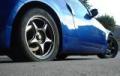
A BBK is definitely worth it. I blew out the caliper seal on my stock single pistons and when the brake fluid hit the hot rotor it caught on fire. Not fun. Had to rent a car to get home.
I now have 13inch slotted stoptechs (wanted to stick to 17inch wheels/tires) out front and braking is considerably better. I need to upgrade the rears next.
Pad choice is crucial. Street pads do not suffice at the track.
Might also want to look into some brake ducting to keep the temps down.
I now have 13inch slotted stoptechs (wanted to stick to 17inch wheels/tires) out front and braking is considerably better. I need to upgrade the rears next.
Pad choice is crucial. Street pads do not suffice at the track.
Might also want to look into some brake ducting to keep the temps down.

Originally Posted by betamotorsports
Stickier tires and learning how to brake. The hardest "driving" thing to learn is how to apply, control, and release the brakes at the traction limit.
 +1 John's very succinct point, supported by the comments of Steve (KnightWhite99) and Kolia, both very experienced in tracking also, is so on the money I wanted to add an exclamation point to it. Parts and mods are fun, and they do help, but you will be stunned at how a great driver in a POS car can just rip through a field of superior machinery at the track. Until you are driving at a level that is beyond the capability of your equipment...why spend the money on the parts? The stuff you have on the car is way beyond anything you need to have outstanding and safe performance on the street. So you don't need it there. But if you have not exceeded the capacity of your brakes as they are configured now...why drop the big bucks to upgrade? When you have the skills to drive beyond the capacity of the brakes......then you have to upgrade or be frustrated.
Tires stop cars, not brakes. Brakes only stop wheel rotation. Even pretty modest brakes can do that. By getting grippier tires (that may be compound, width, aspect ratio, tread design) and lighter unsprung weight (again tire size and compound, and do not forget wheel weight) so that the brake is fighting less inertial force from the rotating mass it is trying to slow, you will improve stopping distance much more effectively than slapping a bigger rotor on there. The bigger rotor is a bigger surface and mass to absorb and dissipate heat from so it will stand up to the repeated hard braking demands of a track that may overwhelm a street performance set up, but it is not going to give the kind of stopping distance returns that the abovementioned changes will.
But the biggest factor of all is you. You have to "learn how to learn" to brake.
It is a combination of feel and experience, and it is especially hard for true car enthusiasts to bring themselves to do to their cars...because it feels like you are pounding the snot out of the car....your precious jewel. And in fact, that is exactly what you are doing. You are destroying your pads and rotors and tires at a highly accelerated rate for one purpose, to go faster around a circuit. It is psychologically almost like doing a six hour Zaino polish job on your car, then going out and throwing the contents of a vacuum cleaner bag all over it with a handful of beach sand for good measure.
In a nutshell, you go as hard and fast at a corner as you can until the absolute last possible moment, then STAND HARD on the brake, as hard as you can without the wheels locking up. Not a long gradual squeeze, but not a stomp either. It has feeling and at the very end of the hard short squeeze you are searching for that last extra bit of pressure just short of lockup. And you have to modulate or adjust that pressure as you slow down and of course make turn in. A great exercise, and you need a remote safe place to do it, and a buddy, is to get up to a set speed, then have a cone or mark to initiate your braking to a turn (which you can lay out with more cones, inside and outside. Have extras because you are going to eat some of them up). Come down a straight section and then have a tall or flagged cone as your initial brake cone. Remember, be WOT up to that flagged cone. Then transition to brake, and make the turn. Smoothly. Have your buddy move the cone three feet closer to the turn. Do it again. Keep moving the cone up. Note that as you move the cone up, you are not only shortening the distance to the turn for your braking, but increasing your speed before initiating braking because you are on throttle longer. If you have a little radio or intercom, use it, so your buddy can watch, from a safe distance to the side, whether you are waiting to brake at the cone, locking or engaging abs if you have it, etc. He can give you "real time" comment and critique, and you come around for your next pass and make adjustments, to speed your learning. Measure the distances etc. and keep a little log book of the exercise. Then switch and let your friend in his car do it while you keep the book for him. Remember to do it for turns in BOTH directions to work on your steering skills. (many drivers are better at right to left than they are at left to right). You don't have to be going 100mph for this drill, just do it in second gear. You can also do it in first gear and do it as a stopping exercise and measure your distance. Then try that from second gear.
Then, when you go to the track, do the same thing with markers for your brake points and work it, work it, work it. This is not a casual thing. Your lap times should drop significantly. If you brake in this fashion, you will exceed the capability of the car's current brake set up to shed heat on a track (on the practice session described above you should be fine if you just do it five times and then rest it, taking turns). But if you instead pursue a more traditional slow drag on the brake from farther away from the turn, you can do pretty well, and still go quite quickly. But you won't be fast.
Once you get this down and are moving smoothly around the circuit...you need to introduce heel and toe downshifting if you are not doing it already. It will save you another chunk of time. And then after you have that down, trail braking, which will really heat up the brakes as you are on them a bit longer.
Last edited by Eagle1; Feb 27, 2007 at 05:06 AM.

Thread
Thread Starter
Forum
Replies
Last Post
Gruppe-S
Body Interior
13
May 16, 2016 10:42 PM
Tochigi_236
Feedback & Suggestions for Our Forum
8
Sep 27, 2015 03:40 PM


