


Track Junkies w/ VQs - Is an oil cooler a must have?


roughly? reputable companies provide all the info you need.
http://www.setrabusa.com/pdf/ProLine-Dims-Apps.pdf
the 19 row I have is the p/n 50-619-7612.
http://www.setrabusa.com/pdf/ProLine-Dims-Apps.pdf
the 19 row I have is the p/n 50-619-7612.
roughly? reputable companies provide all the info you need.
http://www.setrabusa.com/pdf/ProLine-Dims-Apps.pdf
the 19 row I have is the p/n 50-619-7612.
http://www.setrabusa.com/pdf/ProLine-Dims-Apps.pdf
the 19 row I have is the p/n 50-619-7612.
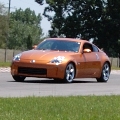


Bumping an old thread.. but I (finally) got my oil temp gauge installed via AAM oil pan spacer.. and (finally) got back out the track. It's a local 1.5 mile course on a warm 80degree cloudy day. I saw oil temps above 280F in my '06 revup.
Now I know why oil analysis saw my 10w30 oil being sheered down to a 20W. Just an example of what temps your oil is seeing on a track day.
so yeah.. I'm starting to shop.
Now I know why oil analysis saw my 10w30 oil being sheered down to a 20W. Just an example of what temps your oil is seeing on a track day.
so yeah.. I'm starting to shop.






A lot depends on where you're reading the oil temps. If 280F is the oil temp as its getting back into the pan then that's not a bad number. If 280F is the temp of the oil coming out of the pan and into the engine then you need to cool it down.
Also, regarding the oil analysis showing the base viscosity at 20W for a 10W-30 oil; isn't the base oil viscosity the lower number (10) and the additive package is what increases the viscosity to 30 when the polymer chains unwind due to heat?
Also, regarding the oil analysis showing the base viscosity at 20W for a 10W-30 oil; isn't the base oil viscosity the lower number (10) and the additive package is what increases the viscosity to 30 when the polymer chains unwind due to heat?
A lot depends on where you're reading the oil temps. If 280F is the oil temp as its getting back into the pan then that's not a bad number. If 280F is the temp of the oil coming out of the pan and into the engine then you need to cool it down.
Also, regarding the oil analysis showing the base viscosity at 20W for a 10W-30 oil; isn't the base oil viscosity the lower number (10) and the additive package is what increases the viscosity to 30 when the polymer chains unwind due to heat?
Also, regarding the oil analysis showing the base viscosity at 20W for a 10W-30 oil; isn't the base oil viscosity the lower number (10) and the additive package is what increases the viscosity to 30 when the polymer chains unwind due to heat?
My 280F+ reading was from the sensor sitting in the oil pan (spacer). (Defi gauge and sensor).
I know the best place to have the sensor is in the pan, but I just have mine in a sandwich plate, not sure how accurate that spot is, but when I installed it, I figured it was better than nothing

As I posted in another thread, when monitoring oil (or any temp) is:
1. The change in temp - does it rise and stabilize or continue to rise?
2. The rate of change - steady of spikey?
3. The actual temp.
Notice the actual temp is the least important.
If the temp rises and stabilizes then there's enough BTU capacity in the cooling system. It might stabilize at a temp that you consider too high, but the system is working.
If the temp continues to rise then there is not enough BTU capacity and the system needs to be changed.
If the system rises at a steady linear pace then its well damped and the heat exchange is occurring. If the system spikes then there is air in the system and/or the heat exchanger is shrouded and not working properly.
If the actual temp is too high (or too low) then increase/decrease air or fluid flow through the heat exchanger or increase/decrease the heat exchanger capacity.
Data logging is the best way to evaluate this. If you can't do that, then check and log the oil temp at least once per lap in the exactly same place on track. Its better if you check in two place on track every lap.
1. The change in temp - does it rise and stabilize or continue to rise?
2. The rate of change - steady of spikey?
3. The actual temp.
Notice the actual temp is the least important.
If the temp rises and stabilizes then there's enough BTU capacity in the cooling system. It might stabilize at a temp that you consider too high, but the system is working.
If the temp continues to rise then there is not enough BTU capacity and the system needs to be changed.
If the system rises at a steady linear pace then its well damped and the heat exchange is occurring. If the system spikes then there is air in the system and/or the heat exchanger is shrouded and not working properly.
If the actual temp is too high (or too low) then increase/decrease air or fluid flow through the heat exchanger or increase/decrease the heat exchanger capacity.
Data logging is the best way to evaluate this. If you can't do that, then check and log the oil temp at least once per lap in the exactly same place on track. Its better if you check in two place on track every lap.
Last edited by betamotorsports; Jun 28, 2012 at 08:18 AM.

Thread
Thread Starter
Forum
Replies
Last Post
