


alignment with wrong car specs?? advice please!


Thread Starter
Registered User
iTrader: (4)
Joined: Dec 2005
Posts: 409
Likes: 0
From: san diego/Rowland Heights
 alignment with wrong car specs?? advice please!
I drive a G35C 6MT (OEM 19" rims)
I had my alignment done at big o tire and they used the factory settings for the 350z with 18" wheels.
I was in a hurry so I dind't look at the printout until I got home(2 hours away)
here's the speccs
LF(left front) -> RF -> LR - RR
camber -1.7 -2.5 -1.9 -2.0
caster 7.8 8.0 0.04 0.04
toe 0.03 0.05
SAI 6.1 6.0
included angle 4.5 3.5
don't look good to me.. why do the camber of the front left and right side differ so much. even if they were out of camber they should technically be the same??
I had my alignment done at big o tire and they used the factory settings for the 350z with 18" wheels.
I was in a hurry so I dind't look at the printout until I got home(2 hours away)
here's the speccs
LF(left front) -> RF -> LR - RR
camber -1.7 -2.5 -1.9 -2.0
caster 7.8 8.0 0.04 0.04
toe 0.03 0.05
SAI 6.1 6.0
included angle 4.5 3.5
don't look good to me.. why do the camber of the front left and right side differ so much. even if they were out of camber they should technically be the same??

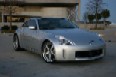
I was told the front camber is not adjustable unless you buy adjustable control arms. The only adjustment the front has from the factory is the toe and i believe one other but i cant think of the name of it right now.
Thread Starter
Registered User
iTrader: (4)
Joined: Dec 2005
Posts: 409
Likes: 0
From: san diego/Rowland Heights
can anyone tell me why the left front camber differs so much from the right front camber if they're not adjustable at all? they should be the same if they're not adjustable right?

Registered User
Joined: Oct 2003
Posts: 984
Likes: 0
From: Marietta, Georgia
As you lower or raise the body height the front camber changes roughly 0.83 degrees per inch, so a side to side difference of 1/4" will create a camber difference of 0.2 degrees.
Was your weight in driverseat when the alignment was done? If not I would expect the driverside to be higher and thus have less camber.
Camber/body height varies with load [passengers, trunk, fuel amount] you must decide at what conditions you want the numbers to be.
Ideal front camber is negative 0.5-0.75 degrees........you BADLY need camber adjustment arms to correct!
Was your weight in driverseat when the alignment was done? If not I would expect the driverside to be higher and thus have less camber.
Camber/body height varies with load [passengers, trunk, fuel amount] you must decide at what conditions you want the numbers to be.
Ideal front camber is negative 0.5-0.75 degrees........you BADLY need camber adjustment arms to correct!
Trending Topics
Registered User
Joined: Oct 2003
Posts: 984
Likes: 0
From: Marietta, Georgia
Tires are designed to function well with up to -0.75 degrees of static camber beyond that amount, the tread contact shape becomes more and more trapezoidal.
Remember oem alignment specs are actually the amount of MISALIGNMENT necessary to correct for rolling thrust forces which at highway speed push the tire away from the ideal..................so they misset the system to have minimal toe at 60mph going straight.
The oems measure alignment at speed and develop the amounts necessary STOPPED to correct the situation..............unfortunately brand new is not used rubber bushings so the correction numbers change as the miles accumulate and the bushings wear and become sloppy.
In a stop the front dives a few inches and thus acts the same as a not lowered non braking car. 0.5 static becomes -2.1 [-2 become -3.6].
Ideal braking requires the maximal squarish [not trapezoidal] contact patch so too much static negative camber can significantly increase braking distances.
On rear tires too much static negative camber can reduce acceleration friction and increase launch time and quarter mile because the rear drops [the converse of braking].
A tire with 1000 pounds on it inflated to 35 psi will have a 28.57 square inch contact patch regardless of camber. However excess camber will concentrate the forces on the inside were the area is smallest, raising the interface temperature and increasing scrub wear there!
Remember oem alignment specs are actually the amount of MISALIGNMENT necessary to correct for rolling thrust forces which at highway speed push the tire away from the ideal..................so they misset the system to have minimal toe at 60mph going straight.
The oems measure alignment at speed and develop the amounts necessary STOPPED to correct the situation..............unfortunately brand new is not used rubber bushings so the correction numbers change as the miles accumulate and the bushings wear and become sloppy.
In a stop the front dives a few inches and thus acts the same as a not lowered non braking car. 0.5 static becomes -2.1 [-2 become -3.6].
Ideal braking requires the maximal squarish [not trapezoidal] contact patch so too much static negative camber can significantly increase braking distances.
On rear tires too much static negative camber can reduce acceleration friction and increase launch time and quarter mile because the rear drops [the converse of braking].
A tire with 1000 pounds on it inflated to 35 psi will have a 28.57 square inch contact patch regardless of camber. However excess camber will concentrate the forces on the inside were the area is smallest, raising the interface temperature and increasing scrub wear there!

Originally Posted by Cloud
also does anyone know the max drop u can do to a 350z/g35 without having to buy a camber kit?
Their is the answer that is geared towards the question, so I'm a little out of spec, can I justify the expence to correct that end of the car? Only the owner can decide that one.
Their is the answer that is geared towards at what point will a given modified chassis not roll over and ruthlessly eat up the insides of the tires. I have found that by controlling roll, I work the tires better and have no complaints about inner tire wear at a 1.5" drop (equal to a coupe dropped 1").

Thread
Thread Starter
Forum
Replies
Last Post
etkms
Engine & Drivetrain
29
Jun 19, 2022 06:30 PM
