


VQ Oil Analysis and Info


Originally Posted by Resolute
Both oils are fine to use.
The castrol Syntec 5W-30 is not on the recommended list because the Syntec 0W-30 has better average results, more samples taken, and costs the same. So, I would use it over the 5W-30, hence why it is on the list and the 5W-30 is not.
The Castrol Syntec 5W-30 does have better average results than the M1 5W-30, looking at the comparison chart:
Syntec 5W-30 has lead and copper wear of 5 and 2 ppm, respectively
M1 5W-30 has lead and copper wear of 7 and 8 ppm, respectively
Syntec 5W-30 has chromium and tin wear of 1 and 0, respectively
M1 5W-30 has chromium and tin wear of 2 and 1, respectively
The Syntec 5W-30 doesn't have a TBN test done on any of the VQ35DE samples, but judging the TBN of the HR samples, the oil looks good for a 6k mile OCI.
The M1 has a really high TBN, and will easily last for a 6k mile OCI.
Between the two, Syntec has lower wear rates than the M1, so for a 6k mile oil change interval, I would pick the Syntec 5W-30 over the M1 5W-30 if it was a choice between those two.
Does that make sense? Reading the comparison charts to discern which oils are a better buy was supposed to be easy, but if it's confusing let me know why, so that I can make doing the steps I just went through easier for people to do on their own.
Will
The castrol Syntec 5W-30 is not on the recommended list because the Syntec 0W-30 has better average results, more samples taken, and costs the same. So, I would use it over the 5W-30, hence why it is on the list and the 5W-30 is not.
The Castrol Syntec 5W-30 does have better average results than the M1 5W-30, looking at the comparison chart:
Syntec 5W-30 has lead and copper wear of 5 and 2 ppm, respectively
M1 5W-30 has lead and copper wear of 7 and 8 ppm, respectively
Syntec 5W-30 has chromium and tin wear of 1 and 0, respectively
M1 5W-30 has chromium and tin wear of 2 and 1, respectively
The Syntec 5W-30 doesn't have a TBN test done on any of the VQ35DE samples, but judging the TBN of the HR samples, the oil looks good for a 6k mile OCI.
The M1 has a really high TBN, and will easily last for a 6k mile OCI.
Between the two, Syntec has lower wear rates than the M1, so for a 6k mile oil change interval, I would pick the Syntec 5W-30 over the M1 5W-30 if it was a choice between those two.
Does that make sense? Reading the comparison charts to discern which oils are a better buy was supposed to be easy, but if it's confusing let me know why, so that I can make doing the steps I just went through easier for people to do on their own.
Will
You gave your choice of Castrol Syntec based on the assumption of the 6k mile OCI. Are you stating that M1 could go for a much longer OCI but just causes more wear on the engine?
Thanks for your expertise


Originally Posted by UltraYellow350z
You gave your choice of Castrol Syntec based on the assumption of the 6k mile OCI. Are you stating that M1 could go for a much longer OCI but just causes more wear on the engine?
Will

Will,
Do you have Virgin analysis on the Rotella T-Syn 5W40? I am hoping to have my analysis back from Blackstone by Friday. I'd like to compare it to the VOA.
Thanks,
Andrew
Do you have Virgin analysis on the Rotella T-Syn 5W40? I am hoping to have my analysis back from Blackstone by Friday. I'd like to compare it to the VOA.
Thanks,
Andrew

Registered User
Joined: Nov 2006
Posts: 1,604
Likes: 0
From: Roseville, CA
Originally Posted by Resolute
Thanks,
BL comments aren't going to be made as a comparison to other oils, they just let you know if anything's an issue.
There is nothing wrong with using RP as your oil, and there is nothing to worry about in your UOA result. I only compare the results to other averages in order to look for trends that exist from one oil to another. These are the trends that have come up so far:
RP 30 weights shear down to a 20 weight oil- this is neither good nor bad. The fact that it is so thin probably helps hp numbers and fuel economy. I find it interesting that it has a difficult time staying in grade, but as long as the wear numbers are good, then it's not an issue.
The RP 10W-30 has an average copper wear of 9ppm, based on three samples. Your sample, the fourth one, has a copper wear of 6ppm. That's a good bit better than average, due to your mostly highway driving, but still higher than the Pennzoil Platinum 10W-30 average copper wear of 3ppm. I mentioned this because if you are paying $6/qt for an oil and another synthetic of the same weight has, on average, half the wear for less than half the cost, then that might be worth knowing.
As far as being high, 6ppm is not high in terms of universal averages- in fact you are right in line with them. But, the copper is much higher than the lead or tin, or every other wear metal except for iron, which is 7ppm. Copper wear is high relative to the other metals, and while it is not anyhting to worry about, that sinmply strikes me as odd. Copper is rarely the highest wearing metal in an engine, especially with lead and tin wear as low as yours was. So, it makes me wonder about the addition of any sulfer additives, which are used as a surface hardener for most metals but causes corrosion in yellow metals- like copper. I find the wear rate interesting is all, and just speculated out loud about a possible reason.
Now, this oil looks pretty good, and would be a good oil to use, but let's compare it to another oil and see how the averages stack up against each other:
Castrol GTX 5W-30 vs RP 10W-30
Aluminum 3ppm vs 4ppm
Chromium 1ppm vs 1ppm
Iron 9ppm vs 7ppm
Copper 3ppm vs 6ppm
Lead 0ppm vs 1ppm
Tin 0ppm vs 1ppm
Now, I'm not sure where Roseville is in CA, or how the weather looks there, but if you can use a 5W-xx oil that costs less than the RP 10W-30 and produces better wear numbers, then that seems a good decision to me. The GTX will do fine for the 4k mile OCI you ran on the RP, for less money, and better average wear numbers. There is nothing wrong with your RP, and the sample you have there looks good, but I compare results to see what's better. There isn't one oil or weight that's "best", but there are several options that are better than the others. Finding out which ones are which is the main focus of this thread.
Will
BL comments aren't going to be made as a comparison to other oils, they just let you know if anything's an issue.
There is nothing wrong with using RP as your oil, and there is nothing to worry about in your UOA result. I only compare the results to other averages in order to look for trends that exist from one oil to another. These are the trends that have come up so far:
RP 30 weights shear down to a 20 weight oil- this is neither good nor bad. The fact that it is so thin probably helps hp numbers and fuel economy. I find it interesting that it has a difficult time staying in grade, but as long as the wear numbers are good, then it's not an issue.
The RP 10W-30 has an average copper wear of 9ppm, based on three samples. Your sample, the fourth one, has a copper wear of 6ppm. That's a good bit better than average, due to your mostly highway driving, but still higher than the Pennzoil Platinum 10W-30 average copper wear of 3ppm. I mentioned this because if you are paying $6/qt for an oil and another synthetic of the same weight has, on average, half the wear for less than half the cost, then that might be worth knowing.
As far as being high, 6ppm is not high in terms of universal averages- in fact you are right in line with them. But, the copper is much higher than the lead or tin, or every other wear metal except for iron, which is 7ppm. Copper wear is high relative to the other metals, and while it is not anyhting to worry about, that sinmply strikes me as odd. Copper is rarely the highest wearing metal in an engine, especially with lead and tin wear as low as yours was. So, it makes me wonder about the addition of any sulfer additives, which are used as a surface hardener for most metals but causes corrosion in yellow metals- like copper. I find the wear rate interesting is all, and just speculated out loud about a possible reason.
Now, this oil looks pretty good, and would be a good oil to use, but let's compare it to another oil and see how the averages stack up against each other:
Castrol GTX 5W-30 vs RP 10W-30
Aluminum 3ppm vs 4ppm
Chromium 1ppm vs 1ppm
Iron 9ppm vs 7ppm
Copper 3ppm vs 6ppm
Lead 0ppm vs 1ppm
Tin 0ppm vs 1ppm
Now, I'm not sure where Roseville is in CA, or how the weather looks there, but if you can use a 5W-xx oil that costs less than the RP 10W-30 and produces better wear numbers, then that seems a good decision to me. The GTX will do fine for the 4k mile OCI you ran on the RP, for less money, and better average wear numbers. There is nothing wrong with your RP, and the sample you have there looks good, but I compare results to see what's better. There isn't one oil or weight that's "best", but there are several options that are better than the others. Finding out which ones are which is the main focus of this thread.
Will
I will consider on the next round Pennzoil Platinum 10W-30.
Very good comparison on Castrol vs RP, as you stated on your opening first page that Castrol GTX 5w30 can have better results than some synthetics. Every metal particle is lower than RP except the iron, amazing and to think I changed from Castrol to RP at 37k miles on engine. Makes me wonder if I should stick with what the dealer recommends Castrol GTX. I am interested in testing a few more types, until I find the best across the board.
It’s all a crap shoot, although very interesting to see which one is going to give my engine the best protection for my driving habits and cost per qrt. We will see how the Mobil 1 0w-40 tests out and then probably try the Pennzoil.
Roseville weather is around 35 degrees in the winter warming up to maybe 45-55 degrees. Summer is on average of 75-95 degrees.
Thanks again
Curtis

Originally Posted by QuadCam
Will,
Do you have Virgin analysis on the Rotella T-Syn 5W40? I am hoping to have my analysis back from Blackstone by Friday. I'd like to compare it to the VOA.
Thanks,
Andrew
Do you have Virgin analysis on the Rotella T-Syn 5W40? I am hoping to have my analysis back from Blackstone by Friday. I'd like to compare it to the VOA.
Thanks,
Andrew
Any Update on this?
Here's a funny update. 
I received my oil sample back in the mail on Saturday. Somehow the USPS shipped my oil sample to me.
  Everything was labeled correctly, but the Post Office people are assumin that the automated machines must have read my return address as the shipping address. I don't know how that would happen; the bar code on the shipping label had the correct address for Blackstone.
At any rate, the oil sample got sent again to Blackstone today. Hopefully, they'll have it on Wednesday ro Thursday.
Next time, I won't use Blackstone's black container as the shipping container. I'll pack the black container inside a cardboard box and then ship it.
I received my oil sample back in the mail on Saturday.
Somehow the USPS shipped my oil sample to me. Everything was labeled correctly, but the Post Office people are assumin that the automated machines must have read my return address as the shipping address. I don't know how that would happen; the bar code on the shipping label had the correct address for Blackstone.At any rate, the oil sample got sent again to Blackstone today. Hopefully, they'll have it on Wednesday ro Thursday.
Next time, I won't use Blackstone's black container as the shipping container.
I'll pack the black container inside a cardboard box and then ship it.
Sorry, no VOA on the T-Syn. Looking at their MSDS for the oil, though, we can expect a LOT of ZDDP to show up in the UOA samples. 1.8% !!! Gotta love diesel oils, I can't wait to see what the UOA results will be like with this oil from my Z.
Will
Will
Originally Posted by Resolute
Sorry, no VOA on the T-Syn. Looking at their MSDS for the oil, though, we can expect a LOT of ZDDP to show up in the UOA samples. 1.8% !!! Gotta love diesel oils, I can't wait to see what the UOA results will be like with this oil from my Z.
Will
Will
What is ZDDP? I think I have seen that in advertisements for "ZMax."
I did read somewhere that the T-syn has very little Moly. Is that necessarily a bad thing? Can you have too much or too little moly? Do you know of any Moly additives? Sorry for all the little questions.
This is getting retarded. USPS should have delivered my oil sample by now. Today was day 3 of the 2-3 day priority shipping, and Blackstone said they have not received it. I am going on almost 2 weeks since I 1st tried sending it.
Lesson to all.........Don't ship your oil sample via USPS.....they are morons!!!!
USPS should have delivered my oil sample by now. Today was day 3 of the 2-3 day priority shipping, and Blackstone said they have not received it. I am going on almost 2 weeks since I 1st tried sending it.Lesson to all.........Don't ship your oil sample via USPS.....they are morons!!!!
Last edited by QuadCam; Dec 21, 2007 at 06:17 AM.


Originally Posted by QuadCam
This is getting retarded. USPS should have delivered my oil sample by now. Today was day 3 of the 2-3 day priority shipping, and Blackstone said they have not received it. I am going on almost 2 weeks since I 1st tried sending it.
Lesson to all.........Don't ship your oil sample via USPS.....they are monons!!!!
USPS should have delivered my oil sample by now. Today was day 3 of the 2-3 day priority shipping, and Blackstone said they have not received it. I am going on almost 2 weeks since I 1st tried sending it.Lesson to all.........Don't ship your oil sample via USPS.....they are monons!!!!
Originally Posted by QuadCam
What is ZDDP? I think I have seen that in advertisements for "ZMax."
I did read somewhere that the T-syn has very little Moly. Is that necessarily a bad thing? Can you have too much or too little moly? Do you know of any Moly additives? Sorry for all the little questions.
I did read somewhere that the T-syn has very little Moly. Is that necessarily a bad thing? Can you have too much or too little moly? Do you know of any Moly additives? Sorry for all the little questions.
ZDDP is the abbreviation for a very common anti-wear additive known as zincdialkyldithiophosphate. It is a combination of zinc and organophosphates that serves as the workhorse anti-wear and friction modifying additive for most lubricants. It also possesses some antioxidant properties as well. In the list of oil additive types on the first page of this sticky, I think it's in post #3 or 4, you will see ZDDP listed under several additive types. It shows up in a UOA under the zinc and phosphorous levels.
ZDDP is one of the few anti-wear additives to be universally tested as an effective anti-wear and friction-modifying additive regardless of oil life. It is especially popular in older flat-tappet engines since ZDDP is very effective in reducing wear and friction under that type of contact, as proven by several SAE papers, such as #860374, that show engine oils with high ZDDP to offer a substantial reduction in engine wear.
However, as far back as 1975, it was estimated that ZDDP might pose an issue to catalytic converter operation and life-span (SAE paper #750447). Since then, the American Petroleum Institute and the SAE have been doing extensive study into this effect, and put research into other AW/FM additives that will duplicate ZDDP effectiveness with no environmental impact. This has led to a whole slew of "new school" additives such as Boron and Antimony based structures.
The ILSAC and ACEA have recently worked with the API to make new regulations that lower the amount of phosphorous in engine oils in an effort to increase catalytic converter life and lower emissions. The API regulation is known as the SM approval, while ILSAC GF-4 is the European equivalent. Soon, the GF-5 requirement will be out and this will further reduce the amount of ZDDP in engine oils, and the API is working on the same measure for it's next approval code. The new AW/FM additives have become more popular and are one reason why engine oil prices climb since these newer additives are not as cheap (readily available or proven) as ZDDP.
Oils that use a lot of ZDDP still are Redline, whose oils are NOT API approved for this and other reasons, and Diesel oils. Diesel oils are also coming to grips with low SAPS (sulfur, ash, phosphorous) requirements and will also see a reduction in ZDDP, but still have more than most passenger car oils.
The use of ZDDP alone does not mean the oil is superior, just as base stock doesn't guarantee a superior oil. The overall chemistry is the key to a great oil, and ZDDP is a very effective ingredient when used properly.
The same may be said for the use of Moly in an engine oil. MoTDC (molybdenum trialkyldithiocarbamate) is another proven AW/FM additive that is used in some engine oils. It alone doesn't guarantee anything, but there are some effective oils that have this compound, and ZDDP, in good chemistry. Schaeffer's has long had the value of these compounds in the right chemistry, as evidenced by the very good UOA results.
Will
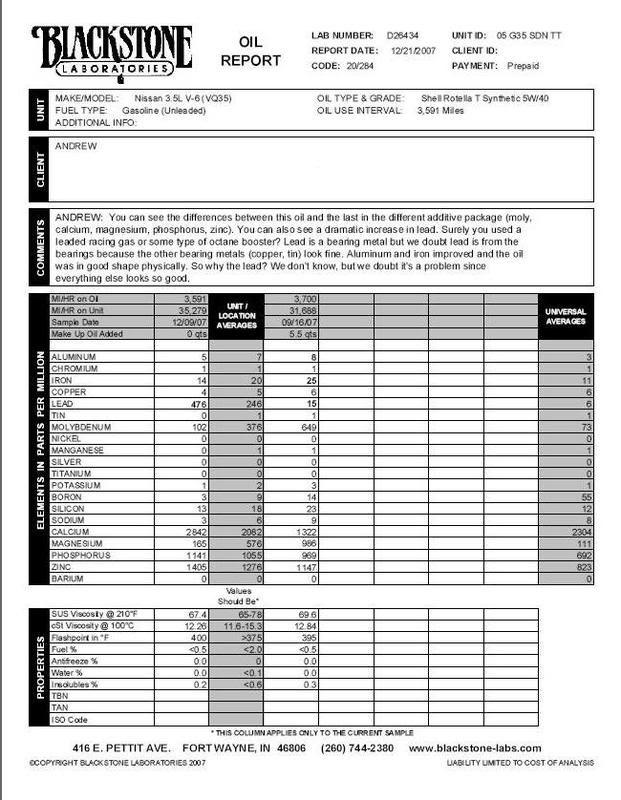
Finally, I have my UOA for the Rotella T-Syn 5W40. This oil looks to be a good one, but I'll let Will give his analysis. Also, Blackstone is correct in regards to the lead content. I am guilty of running Citgo 110; I ran a whole tank of it (about 18 gallons) toward the end of this oil sample (probably in the last 750-1000 miles of use). My previous oil was Motul 300V 5W40. You can see that the Motul UOA came back with much higher levels of Aluminum and Iron than in the Rotella UOA. I guess I won't be switching back overhyped, overpriced Motul. Here it is:
Last edited by QuadCam; Dec 21, 2007 at 08:03 PM.

Registered User
Joined: Nov 2007
Posts: 56
Likes: 0
From: Colorado, Denver Metro
Rotella T 5w40 synthetic tech data
I had a hard time finding this and thought others may have as well.
http://www.shellusserver.com/product...TSynthetic.pdf
http://www.shellusserver.com/product...TSynthetic.pdf
Registered User
Joined: Nov 2007
Posts: 56
Likes: 0
From: Colorado, Denver Metro
Originally Posted by Resolute
Sorry, no VOA on the T-Syn. Looking at their MSDS for the oil, though, we can expect a LOT of ZDDP to show up in the UOA samples. 1.8% !!! Gotta love diesel oils, I can't wait to see what the UOA results will be like with this oil from my Z.
Will
Will
Someone elses VOA on the Rotella T syn.
http://www.bobistheoilguy.com/forums...89#Post1040289

Registered User
Joined: Mar 2007
Posts: 61
Likes: 0
From: SF Bay Area
A UOA does not tell you everything, in fact, according to this post it doesn't say much about how your engine is really wearing and can be deceiving.
http://www.bobistheoilguy.com/forums...049921&fpart=1
http://www.bobistheoilguy.com/forums...049921&fpart=1
I was just looing at that VOA for the T-Syn. I noticed it showed 0 moly. If it has 0 Moly.....how'd I end up with a value of 100 in my UOA? left over moly from the previous oil?
Originally Posted by QuadCam
I was just looing at that VOA for the T-Syn. I noticed it showed 0 moly. If it has 0 Moly.....how'd I end up with a value of 100 in my UOA? left over moly from the previous oil?
Your UOA looks good. Too bad the leaded gasoline has contaminated the bearing wear for you, but it shows a noticeable improvement over the Motul you used last time. The higher numbers of wear metals that were seen in your last UOA have been cut in half, and the viscosity looks good. That's a nice sample, thanks for posting it. Because you're FI I won't add it to the comparison charts, but for your own peace of mind you can safely say you've found a good oil for a lot less money. Are you still using it, or are you using something new?
Will
I just refilled with more Rotella T-Syn when I changed my oil (and took this sample.) I had forgotten about that tank of Citgo 110. It is hard to believe that 1 tank of leaded fuel can throw off the lead values in the UOA that much......but I guess that leaded fuel is loaded with lead!
I just changed out the Nippon Eneos 4w-40 out of the NA VQ35DE, and will be shipping it off tomorrow.
I am now running Redline 20w-50 in the Twin Turbo VQ35De, and will be sending that off also. I will probably just switch to the Rotella T-syn at that change and see how the Redline looks.
I am now running Redline 20w-50 in the Twin Turbo VQ35De, and will be sending that off also. I will probably just switch to the Rotella T-syn at that change and see how the Redline looks.