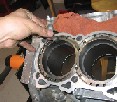
Are stock rods suitable for FI VQ engines?

New Member
Joined: May 2002
Posts: 1,026
Likes: 0
From: Atlanta

I've always wondered, is a "spun bearing" the same thing as a failed bearing, or is it a more specialized case of bearing failure?
And why is it called a spun bearing? If a bearing spins, then isn't it working correctly? Seems like seized bearing would be a better term.
--
Jeff
And why is it called a spun bearing? If a bearing spins, then isn't it working correctly? Seems like seized bearing would be a better term.
--
Jeff



I have come across this very same problem on the Ford 351m and 400m engines.
The fix (in the Ford engine case) is to install an oil restrictor so that the heads and valve train do not get "all" the oil .... thereby insuring that the main bearings get enough.
Most racing engines do have baffling in their oil pans to insure against starvation. This is just common sense.
.........I think I'll go top-off my oil level now.......
The fix (in the Ford engine case) is to install an oil restrictor so that the heads and valve train do not get "all" the oil .... thereby insuring that the main bearings get enough.
Most racing engines do have baffling in their oil pans to insure against starvation. This is just common sense.
.........I think I'll go top-off my oil level now.......
Last edited by JCat; Mar 4, 2005 at 05:51 AM.
Peter,
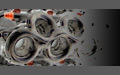
The bearing in the picture had 36,000 miles on it. 13,000 of those miles were boosted.
Detonation is definatly a possibility in the wear of my upper bearing shells... but I have been somewhat ruling it out for 2 reasons... I thought the length of the wear looked more like a friction problem (I could be wrong), and I also thought that if I was experiencing enough detonation to hurt my bearings... I surely would have broken something in all that beating? On my spark plugs and pistons I have not seen any other signs to make me think it was detonation, but its always a possibility.
The bearing in the picture had 36,000 miles on it. 13,000 of those miles were boosted.
Detonation is definatly a possibility in the wear of my upper bearing shells... but I have been somewhat ruling it out for 2 reasons... I thought the length of the wear looked more like a friction problem (I could be wrong), and I also thought that if I was experiencing enough detonation to hurt my bearings... I surely would have broken something in all that beating? On my spark plugs and pistons I have not seen any other signs to make me think it was detonation, but its always a possibility.

Originally posted by palmerwmd
Why dont we see more failures of Stock engines in autoX then?
Fred...? ?
?
Why dont we see more failures of Stock engines in autoX then?
Fred...?
?


This is a great discussion...couple additional things to keep in mind.
I drove my car hard for 14000 FI miles and my bearings were in virtually new condition. Second, if you look at most of the engine failures, they were NOT a result of high RPM operation, or even sustained boosted operation. People were snapping rods at 3500rpm just cruising around on the street. Going Deep's engine let go when he was just cruising along under normal loads.
Some time ago, Cheston went from a stock oil pan to aftermarket PE oilpan, and noticed a slighly drop in oil temps..roughly 10-15 degrees IIRC. And many of us have do repeated pulls on the freeway with oil temp gauges and dont notice a significant increase in oil temp.
Although oil starvation may have something to do with it, I am not conviced is is the sole cause of the failures. Almost always, a spun bearing is the result of sustained high g loads (such as on a road course), or excessive high RPM operation, or other oil starvation issues.
I am still leaning towards catastrophic timing (CAS shielded wire issue), and poor tuning as the main culprits. The stock rods, high compression, and high boost, are all very tough on the engine.
At the end of the day, there are several possible causes of engine failure, but its nearly impossible to nail down just one as the CAUSE of the failure.
I drove my car hard for 14000 FI miles and my bearings were in virtually new condition. Second, if you look at most of the engine failures, they were NOT a result of high RPM operation, or even sustained boosted operation. People were snapping rods at 3500rpm just cruising around on the street. Going Deep's engine let go when he was just cruising along under normal loads.
Some time ago, Cheston went from a stock oil pan to aftermarket PE oilpan, and noticed a slighly drop in oil temps..roughly 10-15 degrees IIRC. And many of us have do repeated pulls on the freeway with oil temp gauges and dont notice a significant increase in oil temp.
Although oil starvation may have something to do with it, I am not conviced is is the sole cause of the failures. Almost always, a spun bearing is the result of sustained high g loads (such as on a road course), or excessive high RPM operation, or other oil starvation issues.
I am still leaning towards catastrophic timing (CAS shielded wire issue), and poor tuning as the main culprits. The stock rods, high compression, and high boost, are all very tough on the engine.
At the end of the day, there are several possible causes of engine failure, but its nearly impossible to nail down just one as the CAUSE of the failure.
Originally posted by gq_626
This is a great discussion...couple additional things to keep in mind.
I drove my car hard for 14000 FI miles and my bearings were in virtually new condition. Second, if you look at most of the engine failures, they were NOT a result of high RPM operation, or even sustained boosted operation. People were snapping rods at 3500rpm just cruising around on the street. Going Deep's engine let go when he was just cruising along under normal loads.
Some time ago, Cheston went from a stock oil pan to aftermarket PE oilpan, and noticed a slighly drop in oil temps..roughly 10-15 degrees IIRC. And many of us have do repeated pulls on the freeway with oil temp gauges and dont notice a significant increase in oil temp.
Although oil starvation may have something to do with it, I am not conviced is is the sole cause of the failures. Almost always, a spun bearing is the result of sustained high g loads (such as on a road course), or excessive high RPM operation, or other oil starvation issues.
I am still leaning towards catastrophic timing (CAS shielded wire issue), and poor tuning as the main culprits. The stock rods, high compression, and high boost, are all very tough on the engine.
At the end of the day, there are several possible causes of engine failure, but its nearly impossible to nail down just one as the CAUSE of the failure.
This is a great discussion...couple additional things to keep in mind.
I drove my car hard for 14000 FI miles and my bearings were in virtually new condition. Second, if you look at most of the engine failures, they were NOT a result of high RPM operation, or even sustained boosted operation. People were snapping rods at 3500rpm just cruising around on the street. Going Deep's engine let go when he was just cruising along under normal loads.
Some time ago, Cheston went from a stock oil pan to aftermarket PE oilpan, and noticed a slighly drop in oil temps..roughly 10-15 degrees IIRC. And many of us have do repeated pulls on the freeway with oil temp gauges and dont notice a significant increase in oil temp.
Although oil starvation may have something to do with it, I am not conviced is is the sole cause of the failures. Almost always, a spun bearing is the result of sustained high g loads (such as on a road course), or excessive high RPM operation, or other oil starvation issues.
I am still leaning towards catastrophic timing (CAS shielded wire issue), and poor tuning as the main culprits. The stock rods, high compression, and high boost, are all very tough on the engine.
At the end of the day, there are several possible causes of engine failure, but its nearly impossible to nail down just one as the CAUSE of the failure.
I know you added the APS oil pan to your Greddy. My question is, where are the pickup lines if you do this? Are they in a spacer? Are they in the very bottom of the pan like the Greddy? I already use the JWT oil pan spacer for the extra quart, but does the APS pan actually raise the level of the pickup lines?

I am very interested in going single turbo and now moreso if I am POSITIVE that the stock internals can hold up to STOCK single turbo boost from either the Turbonetics kit or the APS kit. As of now I am leaning towards the APS just because of the things that they have found that could be issue with the car inm the long run. I like the way they manage fuel, cam and crank angle sensor, and now their oil pan.
I do have a question though. Will this oil pan be included in the single turbo setup? I see that there are two holes in the pan for the turbo return lines on the TT. But when you only have one return line... what happens with the other hole? Or will seperate pans be made or what?
I do have a question though. Will this oil pan be included in the single turbo setup? I see that there are two holes in the pan for the turbo return lines on the TT. But when you only have one return line... what happens with the other hole? Or will seperate pans be made or what?
Registered User
Joined: Nov 2004
Posts: 430
Likes: 1
From: Nuclear Power
Originally posted by foochdawg
Is it threaded? Or am I going to have to pull out the ole tap and die kit lol
Is it threaded? Or am I going to have to pull out the ole tap and die kit lol


Here you can see the oil return line installed.