


JWT TT Kit update


Thread Starter
Registered User
Joined: Nov 2003
Posts: 869
Likes: 2
From: Washington
 JWT TT Kit update
There's a minor update on the JWT TT:
50Z TWIN TURBO KIT UPDATE
Date:3/7/2005
The G35 TT kits are finished and awaiting final CARB certification. While this has been almost a full year of work, it will be the only street legal turbo kit for the G35 and 350Z available. The good news is that the 350Z version has been completed and in dyno testing mode at this time. Below is the 350Z engine layout. Both kits will be ready to ship once the certification process is complete. Note the intercoolers on the 350Z below. A completely integral center casting was designed to achieve a near perfect flow to the throttle tube, while using the maximum frontal area of the stock body nose. No stock parts including bumber bar or air bag sensors are moved or modified! Also note that all of the fluid bottles retain the stock locations.
http://www.jimwolftechnology.com/news.asp
50Z TWIN TURBO KIT UPDATE
Date:3/7/2005
The G35 TT kits are finished and awaiting final CARB certification. While this has been almost a full year of work, it will be the only street legal turbo kit for the G35 and 350Z available. The good news is that the 350Z version has been completed and in dyno testing mode at this time. Below is the 350Z engine layout. Both kits will be ready to ship once the certification process is complete. Note the intercoolers on the 350Z below. A completely integral center casting was designed to achieve a near perfect flow to the throttle tube, while using the maximum frontal area of the stock body nose. No stock parts including bumber bar or air bag sensors are moved or modified! Also note that all of the fluid bottles retain the stock locations.
http://www.jimwolftechnology.com/news.asp

Sponsor
Forged Internals.com
Forged Internals.com
Joined: May 2003
Posts: 5,566
Likes: 1
From: Valdosta, GA
Thanks for the link.
Anyone else think when this kit comes out that it will be a direct competitor with APS? Anyone have a MSRP on this? What did they do about fuel and engine management? What would this kit be capable of?
Anyone else think when this kit comes out that it will be a direct competitor with APS? Anyone have a MSRP on this? What did they do about fuel and engine management? What would this kit be capable of?

I dont think anyone is a direct competitor for APS especially if price is the same, but even then the APS would get my vote hands down....well until at least JWT gets some people on this board to sell me their product and can convince me...
New Member
Joined: May 2002
Posts: 1,026
Likes: 0
From: Atlanta
I wonder how import taxes and exchange rates affect the APS kit? It seems possible that JWT could win on that front.
Though, I guess that APS could have a USA holding company that adds American manufactured parts to the APS parts to create the complete kits. That would avoid some taxes and the expense of shipping USA parts to Australia and back again.
--
Jeff
Though, I guess that APS could have a USA holding company that adds American manufactured parts to the APS parts to create the complete kits. That would avoid some taxes and the expense of shipping USA parts to Australia and back again.
--
Jeff


Trending Topics

One benefit this kit will have over APS is it being CARBO certified when you purchase it. It has been stated that APS and Greddy are in the process of getting their CARBO # but have yet to get theirs. Don’t get me wrong, I won’t hesitate to drop $7000 on the APS kit if it is CARBO certified, but living in California I have to take this into consideration.

Sponsor
Forged Internals.com
Forged Internals.com
Joined: May 2003
Posts: 5,566
Likes: 1
From: Valdosta, GA
BTW, if anyone was wondering where the tubing goes and thinking it was cluttered...it goes like this...
The exhaust travels out the exhaust manifolds into the exhaust housing and then out the intake housing through the tubing to the intercoolers, and then a tube comes out of the middle of the two intercoolers (that are welded together) and goes to the throttle body, the intake has two tubes, one goes to the turbo on each side.
The exhaust travels out the exhaust manifolds into the exhaust housing and then out the intake housing through the tubing to the intercoolers, and then a tube comes out of the middle of the two intercoolers (that are welded together) and goes to the throttle body, the intake has two tubes, one goes to the turbo on each side.

Originally Posted by nis350ztt
BTW, if anyone was wondering where the tubing goes and thinking it was cluttered...it goes like this...
The exhaust travels out the exhaust manifolds into the exhaust housing and then out the intake housing through the tubing to the intercoolers, and then a tube comes out of the middle of the two intercoolers (that are welded together) and goes to the throttle body, the intake has two tubes, one goes to the turbo on each side.
The exhaust travels out the exhaust manifolds into the exhaust housing and then out the intake housing through the tubing to the intercoolers, and then a tube comes out of the middle of the two intercoolers (that are welded together) and goes to the throttle body, the intake has two tubes, one goes to the turbo on each side.
If it really does cost almost $7k when it comes out I'd rather just go APS for a few hundred more...
Originally Posted by xxlbeerZ
I actually like that layout better since it reduced the piping diameter post turbo and reduced the intercooler height so that way all the stock parts remain intact (even the water bottles!).
If it really does cost almost $7k when it comes out I'd rather just go APS for a few hundred more...
If it really does cost almost $7k when it comes out I'd rather just go APS for a few hundred more...


Originally Posted by MIAPLAYA
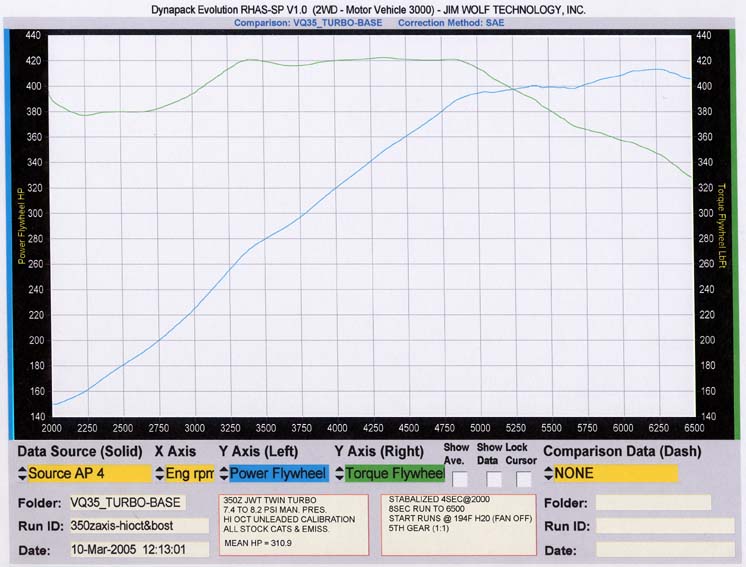
Nope look at the graph that is flywheel Horsepower. Now factor in drivetrain loss.
Originally Posted by THX723
That is a 'DynaPak' print out ... it is not a 'flywheel' figure unless Jim Wolf actually took the time to input the TCF (Transmission Correction Factor), which is defaulted to 1.0 (zero correction). I've yet seen any DynaPak operator that has bothered with TCF value. Effectively, what you see there is the 'rear axle' power (no wheels/tires used for a DynaPak). DynaPak figures are almost always higher than a comparable DynaJet setup. There's not a very accurate way to convert from DynaPak figures to DynoJets and vice versa, but it's not uncommon to find DynaPak to be roughly 4-8% higher than DynoJets.