


Engine Build - RTV Liquid Gasket Removal


 Engine Build - RTV Liquid Gasket Removal
I just spent the weekend slowly removing RTV off the front engine covers, as part of my engine build, with a small pick and wire brushes
What are others using for this job?
I did a search on the web and found a few different chemicals that claim they can remove RTV but Im interested to see what others are using?
EDIT: This was posted in the FI area as it contains the most information about engine builds and those people who have gone through the process.
What are others using for this job?
I did a search on the web and found a few different chemicals that claim they can remove RTV but Im interested to see what others are using?
EDIT: This was posted in the FI area as it contains the most information about engine builds and those people who have gone through the process.
Last edited by mchapman; May 1, 2006 at 12:49 AM.

Originally Posted by punish_her
Havn't built up a VQ but other engines I have buile that had an a$$ load of RTV in the groves of items I used a Dremel tool with a wire brush attachment. It will come off.
What speed did you set it at?
I managed to remove it from the covers but there is still the sump and few other areas which need doing. I cleaned them with a degreaser afterwards and they came up looking brand new.
 The hand method is effective but slow, i'll definately test out the dremel on the next lot to see how much quicker it is.
Last edited by mchapman; May 1, 2006 at 03:17 AM.
If you figure the Service Manual tells you to use a tool like a paint scrapper and a pic type item, a dremel is like toilet paper compared to a p!ssed off tired person with a paint scrapper.
Yeah those will do way more damage than the dremel wire brush. The wire brush is just stiff enough to remove the RTV but will not destroy the mating surfaces.
Yeah those will do way more damage than the dremel wire brush. The wire brush is just stiff enough to remove the RTV but will not destroy the mating surfaces.
Originally Posted by punish_her
If you figure the Service Manual tells you to use a tool like a paint scrapper and a pic type item, a dremel is like toilet paper compared to a p!ssed off tired person with a paint scrapper.
Yeah those will do way more damage than the dremel wire brush. The wire brush is just stiff enough to remove the RTV but will not destroy the mating surfaces.
Yeah those will do way more damage than the dremel wire brush. The wire brush is just stiff enough to remove the RTV but will not destroy the mating surfaces.
Cool... what speed did you set the Dremel at? Slow?
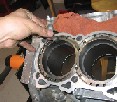
we have fabricated a few little tools out of screwdrivers, edges that fit in the groove and scrape the gasket right out...as far as the surfaces, get as much as you can off with a razor blade, then buff the xurface with some fine abrasion air tools (circular tools)...very little attention in each area, trying not remove any aluminum material...
this is the tedious part, I'm actually heading over today to go prep out my front and rear timing cover for my personal motor!
what fun?!
this is the tedious part, I'm actually heading over today to go prep out my front and rear timing cover for my personal motor!
what fun?!
Trending Topics

First, I use a gasket scraper. Craftsmans makes some good ones. Then a use a small punch tool to scrap it out of the channels. I wouldnt use a dremel, as it will likely remove too much metal, and might cause leaks. There is a plastic brush attachment they you can hook up to a dremel...those work well.


ya i scrape the surface first with a razor in a dragging motion. then a small flat blade screw driver, drag it on down one side then the other, and the whole strip will pop out. then a stainless steel brush. that is about the fastest way and you will end up with 98% of it off. just did all the gasket surfaces in my car in about 40 minutes. you do not need to get it perfect, the new sealant will adhere to the old if little tiny pieces are left. but the stainless brush will get most all of it out.
Seems the manual method of using a blade for the flat surfaces, flat or rounded pick device for the groove, and wire brush to finish it is the way to go.
Thats what ive been doing so good to know everyone else is doing the same. Im currently using a thin piece of metal that has been grinded to match the groove but after your responses I will try to find a suitable screw driver with a proper handle which should allow better control and hopfully speed things up for that part of the process.
Awesome thanks for the responses guys!
40mins has got to be some kind of record!!!
OverZealous mentioned removing about 98%, I removed 100%...
How much is everyone else removing?
Thats what ive been doing so good to know everyone else is doing the same. Im currently using a thin piece of metal that has been grinded to match the groove but after your responses I will try to find a suitable screw driver with a proper handle which should allow better control and hopfully speed things up for that part of the process.
Awesome thanks for the responses guys!
40mins has got to be some kind of record!!!
OverZealous mentioned removing about 98%, I removed 100%...
How much is everyone else removing?
Last edited by mchapman; May 1, 2006 at 03:59 PM.
ya, it doesn't have to be absolutely completely free of any trace of prior sealant. the main thing is just removing the parts that might get in the way. meaning, in theory you could just run another thin bead of the rtv and not remove any of the previous rtv. but that would be cheesy, lol.
the first time i did it, i took my time first to figure out the best and quickest method. now i can fly through it.
the first time i did it, i took my time first to figure out the best and quickest method. now i can fly through it.

I know Im going to get reprimanded by those that go by the BOOK --But for years Iv used a wire wheel on my 4 inch grinder to get the worst and NEVER had a mating surface prob---The dremel deal would work also for the fine work. Main thing is patience and a light touch.
You can probably get away with it. Everyone is going to perform this process slightly differently. Keeping in mind, that we arent trying to hold back a high pressure flow of oil, and the silicon gasket is going to fill in the small imperfections in the mating material.
To each his own.
To each his own.
Originally Posted by Eazzzzzzy
I know Im going to get reprimanded by those that go by the BOOK --But for years Iv used a wire wheel on my 4 inch grinder to get the worst and NEVER had a mating surface prob---The dremel deal would work also for the fine work. Main thing is patience and a light touch.
Thats a great way for the big a$$ oil pans for chevy V8's. I was thinking it may have been too cumbersome with the ackward shape of the front and rear timming timming covers. The dremmel would mainly be for the channel.

Thread
Thread Starter
Forum
Replies
Last Post
