


Crankcase Ventilation Mod w/Pics



If you're not concerned with emissions or smell, then why not pull the crossover hose connecting both valve covers and add 2 more breathers? In effect doubling your crankcase venting potential.
Last week I was trying that out. 4 breathers total. 2 on each side. I did notice that my valvetrain suddenly got louder. Especially at a cold start.
Why, I dont quite know. Leads me to suspect that somehow vacuum in the crankcase at idle is aiding in oil lubrication or in sealing something. Things were just rattling around quite a bit more up top. According to my ear.
Last week I was trying that out. 4 breathers total. 2 on each side. I did notice that my valvetrain suddenly got louder. Especially at a cold start.
Why, I dont quite know. Leads me to suspect that somehow vacuum in the crankcase at idle is aiding in oil lubrication or in sealing something. Things were just rattling around quite a bit more up top. According to my ear.

Last week I was trying that out. 4 breathers total. 2 on each side. I did notice that my valvetrain suddenly got louder. Especially at a cold start.
Why, I dont quite know. Leads me to suspect that somehow vacuum in the crankcase at idle is aiding in oil lubrication or in sealing something. Things were just rattling around quite a bit more up top. According to my ear.
adding breathers or a vac source on the valve cover will effect oil pressure zero. oil is being FORCED into the valvetrain from a pump, having a couple psi negative air vacuum will not affect the flow of this. Fluid pressure beats air pressure 100% of the time because fluid can't be compressed therefore oil pressure is constant in reguards to the small amount of pressure that might accumulate in the valve covers at idle. Truthfully there shouldn't be any pressure at idle. Mine doesn't have any pressure from the valve cover ports if i cover them with my fingers at idle.

Registered User
Joined: Nov 2009
Posts: 133
Likes: 2
From: Redondo Beach
Just want to point something out - using an OCC does separate out contaminants that cause sludge to form in the intake over time, but contamination of the fuel/intake charge is not an issue. I agree that an OCC does not filter the air entirely - there is still a bit of blowby that passes the can. But what it doesn't catch certainly is not enough to reduce effective octane of the fuel. This is a preventative mod, not a performance mod.
Let me repeat that. Using any type of crankcase ventilation does not improve your intake air charge quality in any significant way. If it did, you would see dyno gains from this mod alone. Yes it's better for the combustion process theoretically, but the concentration of contaminants is so low compared to the volume of air/fuel in the cylinder - it doesn't impact the combustion process in a way large enough to be measured.
It's not possible to apply a vacuum to your crankcase unless you hook up a vacuum pump. The VQ engine is designed with positive pressure in the crankcase. Blowby gasses are what cause this pressure build as the engine runs. It's engineered that way - controlled by piston ring end gap sizes. Even under boost, the crankcase has positive pressure - it's just lower than the boost pressure. So your diagram is probably not accurate - when the engine is under vacuum the crank case still pushes gas out. There is never a point when gasses are flowing into the valve covers, unless you are boosting them. And there's no reason to do that - probably a lot of reasons not to.
Could it change the tone or sound of the engine? Sure. But the real point of a catch can is to save your engine from sludge build up long term. This is especially important in boosted cars because they blowby a lot more in a shorter period of time than NA. Not just because of higher pressures, but also forged internals don't expand at the same rate as the block with heat; impacting piston ring end gap & increasing blowby.
Your system will still work because of the one way check valves. That's a good solution - I plan on doing the same. Actually - can you list the part numbers or website where you found them?
As for the exhaust idea - Bernoulli's principal really only applies to FLOW (that's what the formula calculates). The fact that flow from one tube can be used to create suction in a second attached tube is true, and I think that's what you are trying to do?
The sizes of the OCC lines and the flow rate of the exhaust will play into the ability to get suction. As flow rate increases or decreases from both the blowby AND the exhaust flow, you could lose vacuum entirely. If you graph the Bernoulli calculation against both flow rates, you will get a line that curves. Below a certain RPM (flow rate for OCC lines and flow rate for exhaust) the exhaust gasses would try to move up the OCC line. The positive pressure from the crankcase would also be pushing out - further changing the pressure where the OCC line and exhaust pipe meet each other. Getting suction at all engine speeds isn't possible, and getting reverse flow at some speeds could be possible depending on your setup.
But I like your thinking and do think you could work out a way to use that principal to get enough suction for it to work. I would think it would be open air (instead of exhaust) - so as car speed increases, you get flow across an open tube "mouth" that is connected to your OCC line. The mouth could be in the engine bay or maybe even a fender vent? The suction from the wind moving over the mouth would pull out the blowby but again - mouth size and windspeed matter - you gotta start with formulas to figure out the sizes.
Let me repeat that. Using any type of crankcase ventilation does not improve your intake air charge quality in any significant way. If it did, you would see dyno gains from this mod alone. Yes it's better for the combustion process theoretically, but the concentration of contaminants is so low compared to the volume of air/fuel in the cylinder - it doesn't impact the combustion process in a way large enough to be measured.
It's not possible to apply a vacuum to your crankcase unless you hook up a vacuum pump. The VQ engine is designed with positive pressure in the crankcase. Blowby gasses are what cause this pressure build as the engine runs. It's engineered that way - controlled by piston ring end gap sizes. Even under boost, the crankcase has positive pressure - it's just lower than the boost pressure. So your diagram is probably not accurate - when the engine is under vacuum the crank case still pushes gas out. There is never a point when gasses are flowing into the valve covers, unless you are boosting them. And there's no reason to do that - probably a lot of reasons not to.
Could it change the tone or sound of the engine? Sure. But the real point of a catch can is to save your engine from sludge build up long term. This is especially important in boosted cars because they blowby a lot more in a shorter period of time than NA. Not just because of higher pressures, but also forged internals don't expand at the same rate as the block with heat; impacting piston ring end gap & increasing blowby.
Your system will still work because of the one way check valves. That's a good solution - I plan on doing the same. Actually - can you list the part numbers or website where you found them?
As for the exhaust idea - Bernoulli's principal really only applies to FLOW (that's what the formula calculates). The fact that flow from one tube can be used to create suction in a second attached tube is true, and I think that's what you are trying to do?
The sizes of the OCC lines and the flow rate of the exhaust will play into the ability to get suction. As flow rate increases or decreases from both the blowby AND the exhaust flow, you could lose vacuum entirely. If you graph the Bernoulli calculation against both flow rates, you will get a line that curves. Below a certain RPM (flow rate for OCC lines and flow rate for exhaust) the exhaust gasses would try to move up the OCC line. The positive pressure from the crankcase would also be pushing out - further changing the pressure where the OCC line and exhaust pipe meet each other. Getting suction at all engine speeds isn't possible, and getting reverse flow at some speeds could be possible depending on your setup.
But I like your thinking and do think you could work out a way to use that principal to get enough suction for it to work. I would think it would be open air (instead of exhaust) - so as car speed increases, you get flow across an open tube "mouth" that is connected to your OCC line. The mouth could be in the engine bay or maybe even a fender vent? The suction from the wind moving over the mouth would pull out the blowby but again - mouth size and windspeed matter - you gotta start with formulas to figure out the sizes.
Last edited by jumbosrule; Aug 8, 2010 at 10:37 AM.
jumbosrule, not sure why you want to keep pointing out the obvious while throwing in a healthy dose of misinformation. The fact is that you have no idea to what extent a catch can is reducing the effective octane of a fuel in any particular engine or set up. Fuel octane is not tied to dyno performance unless you are knock limited. Have engines blown up on the dyno because of octane issues? Probably! Please leave your hypothetical musings out of the thread unless you have real world data (pics, data logs, actual experience) to share.
I run a catch can to minimize smell at idle in conjunction with crankcase ventilation, reduce oil in the intake tract (to keep it clean and not contaminate the fuel air charge) and make the car look like its emissions friendly. We've already established this thread is not about performance.
As for the exhaust idea, it's nothing new, and Moroso, among others, makes parts specifically for it. The fact is that it's too much trouble (requires welding) when other methods work just fine.
My crankcase has negative pressure, about -2.5 psi (5 inHg) until boost reaches about 3 psi, where crankcase pressure equalizes to about 0 and stays there. On logs it does get as high as 0.5 psi, but only transiently. On my old (stock) setup, with crankcase pressure exceeding 3 psi, I would have oil passing the compressor seals and oil filling up my intercoooler. Not sure why you think the crankcase in the VQ was designed for positive pressure... It was designed for positive crankcase ventilation, which is an entirely different concept.
I run a catch can to minimize smell at idle in conjunction with crankcase ventilation, reduce oil in the intake tract (to keep it clean and not contaminate the fuel air charge) and make the car look like its emissions friendly. We've already established this thread is not about performance.
As for the exhaust idea, it's nothing new, and Moroso, among others, makes parts specifically for it. The fact is that it's too much trouble (requires welding) when other methods work just fine.
My crankcase has negative pressure, about -2.5 psi (5 inHg) until boost reaches about 3 psi, where crankcase pressure equalizes to about 0 and stays there. On logs it does get as high as 0.5 psi, but only transiently. On my old (stock) setup, with crankcase pressure exceeding 3 psi, I would have oil passing the compressor seals and oil filling up my intercoooler. Not sure why you think the crankcase in the VQ was designed for positive pressure... It was designed for positive crankcase ventilation, which is an entirely different concept.
Last edited by rcdash; Aug 17, 2010 at 05:44 AM.
ya, i'm not worried about octane or any of that. I just don't like the nasty gases going into my engine again along with all the clutter of my engine bay with the hoses and catch cans. Simple is as simple does.
Registered User
Joined: Nov 2009
Posts: 133
Likes: 2
From: Redondo Beach
My crankcase has negative pressure, about -2.5 psi (5 mm Hg) until boost reaches about 3 psi, where crankcase pressure equalizes to about 0 and stays there. On logs it does get as high as 0.5 psi, but only transiently. On my old (stock) setup, with crankcase pressure exceeding 3 psi, I would have oil passing the compressor seals and oil filling up my intercoooler. Not sure why you think the crankcase in the VQ was designed for positive pressure... It was designed for positive crankcase ventilation, which is an entirely different concept.

Just wanted to make a quick post showing what im working on. Like I mentioned previously I have a 1/2 inch barb on the valve cover with a breather on it, after a few runs I see a lil bit of oil around the beather and a little dripping under it. So I visited home depot where I get most my car parts LOL and came up with this.....
I will put a short hose inside so the airflow comes out the bottom of the can, otherwise it will just vent out instantly without going to the bottom of the can, I will be filling the can with steel wool or something like that.
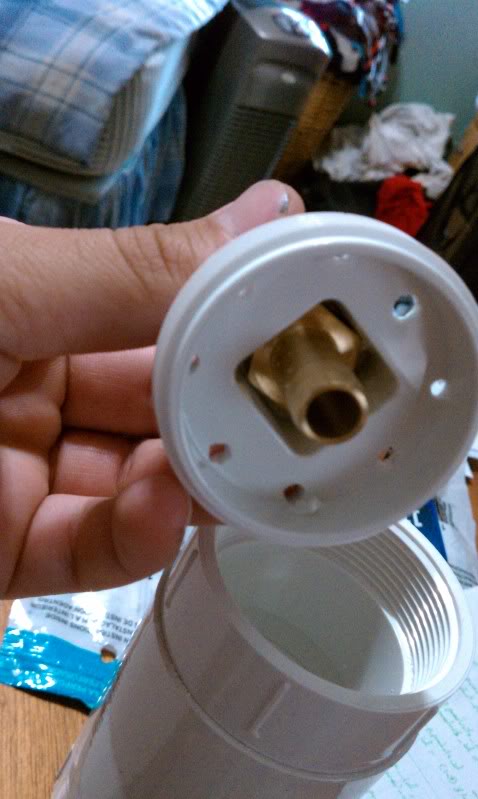
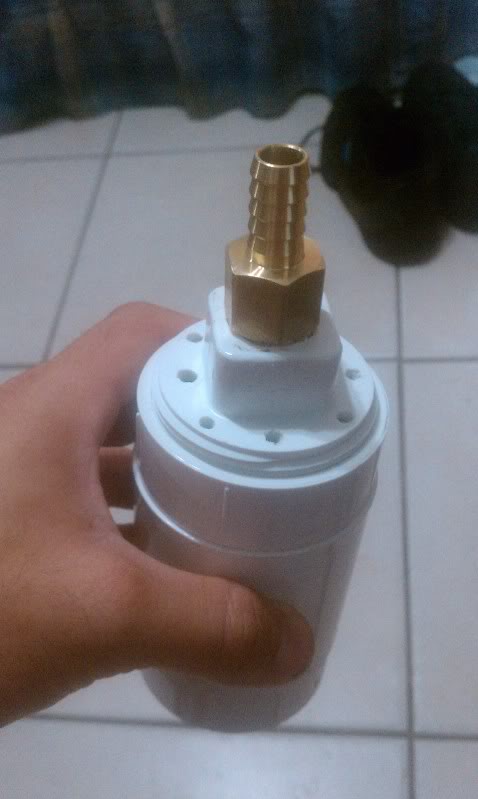
I will put a short hose inside so the airflow comes out the bottom of the can, otherwise it will just vent out instantly without going to the bottom of the can, I will be filling the can with steel wool or something like that.


And what about this vented catch can.
http://cjsupra.kendra.com/PCV-Can.html
Along with some additional info to add more to this thread.

http://cjsupra.kendra.com/PCV-Can.html
Along with some additional info to add more to this thread.
Last edited by rrmedicx; Aug 10, 2010 at 01:29 PM.
lol actually I had taken the laundry all out to wash it right before the pic  .
.
I will be putting the catch can on today and see if I get any oil, anyone recommend anything I can stuff the can with? I think steel wool is a pretty good idea.
.I will be putting the catch can on today and see if I get any oil, anyone recommend anything I can stuff the can with? I think steel wool is a pretty good idea.
Registered User
Joined: Nov 2009
Posts: 133
Likes: 2
From: Redondo Beach
I have used this in the past on a similar DIY - available at most grocery stores:
http://www.amazon.com/Stainless-Stee.../dp/B000BAV904
Just make sure there are no detergents on the scrubber - just want plain stainless.
This photo was the third catch can I tried - I'm now on number 6 and had it custom made because it was going beyond DIY (for me, anyway).

Last edited by jumbosrule; Aug 10, 2010 at 09:17 AM.
Honestly thought I was being helpful. Please correct anything I might have said wrong. As far as pointing out the obvious, I say something, then read a post that illustrates a lack of understanding, so try to explain it again in a different way. Again - just trying to be helpful.
My bad - guess I should have said efficiency - mpgs, rather than octane & power. And I do have experience - have run multiple catch can configurations while monitoring mpg changes. Unless you are emptying your catch can every other day, you are not "contaminating the intake air charge" in any significant way. And if that's happening, something else is wrong.
You'll have to explain that one to me. For the purposes of this thread & discussion, crankcase positive ventilation and crankcase positive pressure are the same thing.
My bad - guess I should have said efficiency - mpgs, rather than octane & power. And I do have experience - have run multiple catch can configurations while monitoring mpg changes. Unless you are emptying your catch can every other day, you are not "contaminating the intake air charge" in any significant way. And if that's happening, something else is wrong.
You'll have to explain that one to me. For the purposes of this thread & discussion, crankcase positive ventilation and crankcase positive pressure are the same thing.
My conclusion regarding catch cans come from looking at the crap in my intake pipes, manifold and catch can. That's irrefutable proof for what the catch can functions as.In terms of positive crankcase ventilation, that concept involves taking external air and supplying it to the crankcase to evacuate combustion vapors and releasing that ingested air through a one way valve (PCV). There is no NET increase in pressure with positive crankcase ventilation - it's a draw through set up by design and only with faulty equipment or excessive blow by does pressure develop. Positive crankcase pressure is not desireable for either NA or FI designs. It leads to engine seal leaks, poor ring seal, dipsticks popping out, turbo seal leaks, etc. You generally have positive crankcase ventilation with the crankcase at negative pressure. If that makes sense to you, then you've understood the difference!
Last edited by rcdash; Aug 10, 2010 at 11:16 AM.
Yes - use a stainless steel potscrubber - not steel wool. Wool is too fine and can break down and produce small debris.
I have used this in the past on a similar DIY - available at most grocery stores:
http://www.amazon.com/Stainless-Stee.../dp/B000BAV904
Just make sure there are no detergents on the scrubber - just want plain stainless.
This photo was the third catch can I tried - I'm now on number 6 and had it custom made because it was going beyond DIY (for me, anyway).
I have used this in the past on a similar DIY - available at most grocery stores:
http://www.amazon.com/Stainless-Stee.../dp/B000BAV904
Just make sure there are no detergents on the scrubber - just want plain stainless.
This photo was the third catch can I tried - I'm now on number 6 and had it custom made because it was going beyond DIY (for me, anyway).
Baffled set up seems to works best as it prevents air from just taking the shortest path out of the catch can. The ARC can is nice in that regard - air has to travel all the way through. In my Greddy square can, I JB welded a piece of sheet metal to divide the can in half between the fitting holes. Stuffed a sponge in one half that I change every time I drain the oil (every oil change) - it is brittle after 6 mos. but acts well as a filter.

1 Psi = 51.7149326 Torr (mmHg)
1 psi = 2.036254 (inHg)
Just to be clear...
Sorry I havn't been able to respond promptly. My dog has been sick. I will edit this further; tomorrow I will be logging the crankcase pressure (low load conditions only) throug h the dipstick port. Comparing my method of creating vacuum traveling through the entire bottom end VS yous' methodsof only recirculating whats under the valve covers.
1 psi = 2.036254 (inHg)
Just to be clear...
Sorry I havn't been able to respond promptly. My dog has been sick. I will edit this further; tomorrow I will be logging the crankcase pressure (low load conditions only) throug h the dipstick port. Comparing my method of creating vacuum traveling through the entire bottom end VS yous' methodsof only recirculating whats under the valve covers.
Last edited by Synjn; Aug 17, 2010 at 03:09 AM.

I installed mine the day I posted and so far it works great! Ofcourse you still get a little smoke coming out but no more oil being spat all over the place! Even without a filter oil still dosnt make its way out the can.

from this whole thread, this seems to be the most legitimate and easiest way of taking care of this. I think a lot of people are/have read this thread in search for the... should i say, best, or most effective way of taking care of the problem. If there's one thing this thread is lacking, its a general consensus on whats right. In my opinion, this diagram seems effective. anyone want to confirm this for the other users that may be mind boggled by this thread?
