


Have a water/meth kit? Come in here...



Hey Terry, thanks so much for digging that out. I've read this one before (probably the last time you posted it!!! lol!) and I just did a quick re-review. I think you need to separate the concepts of knock vs. knock-limited performance. I'll read it again in the morning in depth, but I still think that for preventing knock, water cannot be beat because the higher latent heat of vaporization is so much higher. Of course if you switch to measuring maximal (knock-limited) performance, then methanol has the advantage since it's a power adder (because it burns whereas water does not). So you can obtain optimum power with a mix of W/M versus water alone. Take another one of my extreme examples for argument's sake: dump tons of water (short of hydrolock of course) into a motor. How difficult do you think it would be to get temps up hot enough to cause knock? Pretty tough regardless of boost. Now your performance would be terrible, but the threshold for knock would be outrageously high. Do the same thing with pure methanol? Methanol burns, generates heat, and although it has higher octane than pump gas, it will eventually reach it's knock threshold (and make a lot of power doing so!). I'm not really presenting an argument, only a clarification. Knock-limited performance is admittedly the more relevant parameter.
This is a nice article though. If only 30/70 W/M wasn't so flammable...
This is a nice article though. If only 30/70 W/M wasn't so flammable...
Last edited by rcdash; Sep 4, 2009 at 08:55 PM.

Hi Raj,
A couple quick comments in response to the above post.
I'm not quite sure what you mean here. There is only one concept discussed, and that is knock-limited performance. My interpretation is that "knock-limited performance" is a level of performance achieved in which the knock was limited to a particular level. Perhaps an acceptable level?
If you have any other interpretation, please share it.
The latent heat of vaporization for water is approximately 2257 kJ/liter. For methanol it is 874 kJ/liter. (Although the value for methanol is higher than water on a kJ/mol basis, water has nearly triple the number of molecules per unit of volume).
Based on the latent heat of vaporization values, one would expect straight water to perform significantly better than a meth-water mix. Indeed, had I never read this report, I would probably also beleive that pure water would be the best liquid to inject.
However, I have the benefit of having reviewed the report, and my opinion is based on the data contained therein. As the data in the report clearly indicates, there is more at work here than just the absorption of energy during the state change from liquid to gas.
Here is item #1 from the summary of the results:
"1. In all cases the use of methyl alcohol - water, monomethylamine-water, and dimethylamine-water mixtures as internal coolants raised the knock-limited performance of AN-F-28 fuel more than did water alone." They could not have stated this any more clearly.
Once you get a chance to review the full report, you'll get a better feel for the data.
One side note. At one point Japtrix did some dyno testing on a car where they injected water, meth-water and straight meth. I was told that the car acheived the highest level of hp using straight meth. I have heard others in the forum indicate the same thing. This seems to correlate with an extrapolation of the data in the NACA report.
As you said, methanol is flamable, but so is gasoline. I would just treat it with respect and not get careless with it. Also, make sure you have a good tank or fuel cell to keep it from spilling into your trunk.
I think it would be great if someone made a methanol tank that fits in the spare tire compartment!!! If anybody knows of one, please post the information here.
A couple quick comments in response to the above post.
If you have any other interpretation, please share it.
Based on the latent heat of vaporization values, one would expect straight water to perform significantly better than a meth-water mix. Indeed, had I never read this report, I would probably also beleive that pure water would be the best liquid to inject.
However, I have the benefit of having reviewed the report, and my opinion is based on the data contained therein. As the data in the report clearly indicates, there is more at work here than just the absorption of energy during the state change from liquid to gas.
Here is item #1 from the summary of the results:
"1. In all cases the use of methyl alcohol - water, monomethylamine-water, and dimethylamine-water mixtures as internal coolants raised the knock-limited performance of AN-F-28 fuel more than did water alone." They could not have stated this any more clearly.
Once you get a chance to review the full report, you'll get a better feel for the data.
One side note. At one point Japtrix did some dyno testing on a car where they injected water, meth-water and straight meth. I was told that the car acheived the highest level of hp using straight meth. I have heard others in the forum indicate the same thing. This seems to correlate with an extrapolation of the data in the NACA report.
As you said, methanol is flamable, but so is gasoline. I would just treat it with respect and not get careless with it. Also, make sure you have a good tank or fuel cell to keep it from spilling into your trunk.
I think it would be great if someone made a methanol tank that fits in the spare tire compartment!!! If anybody knows of one, please post the information here.
Last edited by ttg35fort; Sep 4, 2009 at 09:52 PM.

Hi Raj,
A couple quick comments in response to the above post.
I'm not quite sure what you mean here. There is only one concept discussed, and that is knock-limited performance. My interpretation is that "knock-limited performance" is a level of performance achieved in which the knock was limited to a particular level. Perhaps an acceptable level?
If you have any other interpretation, please share it.
A couple quick comments in response to the above post.
I'm not quite sure what you mean here. There is only one concept discussed, and that is knock-limited performance. My interpretation is that "knock-limited performance" is a level of performance achieved in which the knock was limited to a particular level. Perhaps an acceptable level?
If you have any other interpretation, please share it.
However, I have the benefit of having reviewed the report, and my opinion is based on the data contained therein. As the data in the report clearly indicates, there is more at work here than just the absorption of energy during the state change from liquid to gas.
Here is item #1 from the summary of the results:
"1. In all cases the use of methyl alcohol - water, monomethylamine-water, and dimethylamine-water mixtures as internal coolants raised the knock-limited performance of AN-F-28 fuel more than did water alone." They could not have stated this any more clearly.
Here is item #1 from the summary of the results:
"1. In all cases the use of methyl alcohol - water, monomethylamine-water, and dimethylamine-water mixtures as internal coolants raised the knock-limited performance of AN-F-28 fuel more than did water alone." They could not have stated this any more clearly.
Once you get a chance to review the full report, you'll get a better feel for the data.
One side note. At one point Japtrix did some dyno testing on a car where they injected water, meth-water and straight meth. I was told that the car acheived the highest level of hp using straight meth. I have heard others in the forum indicate the same thing. This seems to correlate with an extrapolation of the data in the NACA report.
One side note. At one point Japtrix did some dyno testing on a car where they injected water, meth-water and straight meth. I was told that the car acheived the highest level of hp using straight meth. I have heard others in the forum indicate the same thing. This seems to correlate with an extrapolation of the data in the NACA report.
Last edited by rcdash; Sep 5, 2009 at 09:31 AM.
I think we have hammered this one enough.
I am anxious to see your data when you play around with it.
Once I have my car back together (Sam, how's my short block coming?), I'll get data both with straight 93 octane and then with 93 octane and meth injection.
I am anxious to see your data when you play around with it.
Once I have my car back together (Sam, how's my short block coming?), I'll get data both with straight 93 octane and then with 93 octane and meth injection.
I can add something here. Since the ViPEC can switch maps instantly and is wired to recognise when the meth is activated Dave was able to tune by keeping all other settings the same just meth on/off. When the meth is on I saw an instant ~50whp DD gain at appx 18lbs of boost with 93oct.

I can add something here. Since the ViPEC can switch maps instantly and is wired to recognise when the meth is activated Dave was able to tune by keeping all other settings the same just meth on/off. When the meth is on I saw an instant ~50whp DD gain at appx 18lbs of boost with 93oct.

I can add something here. Since the ViPEC can switch maps instantly and is wired to recognise when the meth is activated Dave was able to tune by keeping all other settings the same just meth on/off. When the meth is on I saw an instant ~50whp DD gain at appx 18lbs of boost with 93oct.
I can add something here. Since the ViPEC can switch maps instantly and is wired to recognise when the meth is activated Dave was able to tune by keeping all other settings the same just meth on/off. When the meth is on I saw an instant ~50whp DD gain at appx 18lbs of boost with 93oct.

Here is my old procharger setup 93 octane @7-8psi.
You can see the gains. Was using a 50/50 mix and had the timing advanced with the meth. I don't see how anyone is getting more hp without advancing the timing a little.
[IMG]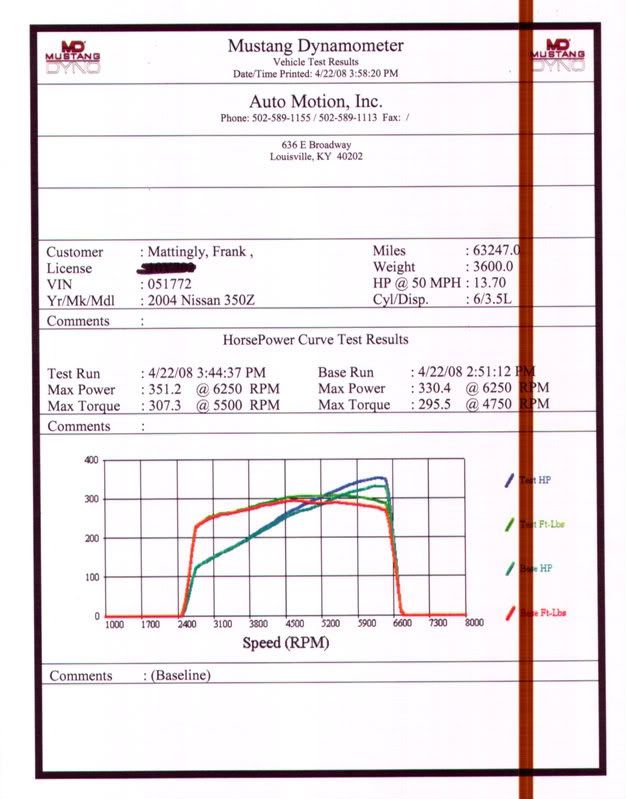 [/IMG]
You can see the gains. Was using a 50/50 mix and had the timing advanced with the meth. I don't see how anyone is getting more hp without advancing the timing a little.
[IMG]
[/IMG]
Last edited by frankie945; Sep 6, 2009 at 07:46 AM.
Hope you get your block back soon!
FYI, the boost pressures obtained using the various liquids is shown at the top of Figure 5(d).
In that test, water allowed about 20% more boost in the AFR range applicable to us. A 70/30 meth-water mixture allowed about 50% more boost.
Those gains are pretty significant.
In that test, water allowed about 20% more boost in the AFR range applicable to us. A 70/30 meth-water mixture allowed about 50% more boost.
Those gains are pretty significant.
Last edited by ttg35fort; Sep 6, 2009 at 09:27 AM.


Here is a vid showing how the AEM recirculation style pump differs from the switch style pump that many of the other kits use. The head tech at Intense showed me this vid today. I was impressed.

<EMBED height=344 type=application/x-shockwave-flash width=425 src=http://www.youtube.com/v/XNIjps6bwqs&color1=0xb1b1b1&color2=0xcfcfcf&hl=en&feature=pl ayer_embedded&fs=1 allowScriptAccess="always" allowfullscreen="true">
Last edited by RudeG_v2.0; Oct 9, 2009 at 10:49 PM.
^^^^
Good information.
Coolingmist also has changed their pumps to the re-circuation type. In fact, I bought the new pump a few months back, and hence have the old pump available for sale if anybody is interested.
Good information.
Coolingmist also has changed their pumps to the re-circuation type. In fact, I bought the new pump a few months back, and hence have the old pump available for sale if anybody is interested.
I have an aquamist pump which appears to be a shurflo 160 psi "bypass" pump. I wonder if that's the same thing? There is a separate electronically controlled flow control valve with the aquamist setup and the pump wiring seems to consist simply of a relay connection to the battery (always on I presume). My set up is not ready to turn it on yet to test... Sam, George, can you put this in perspective for your aquamist customers?
If you currently have a system that pulse width modulates your existing pump, I don't think you can just pop this in, can you? How do you regulate flow otherwise?
EDIT: Never mind - apparently Aquamist has been using these types of pumps for some time now. This is directly from an Aquamist rep post on another forum:
If you currently have a system that pulse width modulates your existing pump, I don't think you can just pop this in, can you? How do you regulate flow otherwise?
EDIT: Never mind - apparently Aquamist has been using these types of pumps for some time now. This is directly from an Aquamist rep post on another forum:
The water pump is normally at idle. It turns fully when the triggering point is reached.
Inside the pump head, there are three by-pass valves. As soon as the preset pressure is reached, the valve opens and allows the water to recirculate internally. This process maintains the water pressure steadily at around 125psi.
Water injection flow is controller by an inline PWM valve. The whole set up is almost identical to the fuel injection system.
Inside the pump head, there are three by-pass valves. As soon as the preset pressure is reached, the valve opens and allows the water to recirculate internally. This process maintains the water pressure steadily at around 125psi.
Water injection flow is controller by an inline PWM valve. The whole set up is almost identical to the fuel injection system.
Last edited by rcdash; Oct 10, 2009 at 01:41 PM.
Thread Starter

Joined: Oct 2002
Posts: 7,303
Likes: 1
From: West suburbs of Chi-town

