


omg building an engine tech!!!!


I am also not sure on the ford guys saying removal of the thermostat is bad. Many people have used it in older iron blocks with no problems, aluminum has better heat transfer property's so it should work even better then on those engines. Every block will be hotter then the coolant, there is no material that can transfer the heat away quick enough. Especially with coolant that engines use, its horrible for transferring heat. That's why Darton recommends a different coolant for sleeves, which still isn't stellar but it doesn't freeze. Straight water is the best coolant on the market PROVIDED you are in a warmer climate, due to it transferring heat the best. I might need to brush up on thermodynamics however heat transfer is not linear. A engine that is 200 degrees with a coolant at 40 degrees will raise the temperature of the coolant to 41 degrees faster, then a engine that is 200 degrees with a coolant at 100 degrees will get its coolant to 101 degrees. So by the coolant staying at a lower temp it will actually cool the block more. Again ill have to brush up to double check, damn i wish i wasn't leaving Monday, hopefully the internet at our cop Isn't too bad.
Thread lower down is also updated with cam info.
Thread lower down is also updated with cam info.
Last edited by jerryd87; Apr 8, 2011 at 11:41 AM.



Hay Jerry nice Thread.
When you get to talking about Valve Train, Heads, Cams, ect, can you talk about the differences between Turbo cams vs N/A cams vs Centrifugal Supercharger Cams Plus what would work best in each application for street, street/strip and pure Drag Racings.
Thanks
When you get to talking about Valve Train, Heads, Cams, ect, can you talk about the differences between Turbo cams vs N/A cams vs Centrifugal Supercharger Cams Plus what would work best in each application for street, street/strip and pure Drag Racings.
Thanks


... Straight water is the best coolant on the market PROVIDED you are in a warmer climate, due to it transferring heat the best. I might need to brush up on thermodynamics however heat transfer is not linear. A engine that is 200 degrees with a coolant at 40 degrees will raise the temperature of the coolant to 41 degrees faster, then a engine that is 200 degrees with a coolant at 100 degrees will get its coolant to 101 degrees. So by the coolant staying at a lower temp it will actually cool the block more. Again ill have to brush up to double check, damn i wish i wasn't leaving Monday, hopefully the internet at our cop Isn't too bad.
A good point on heating thing, one point to note is that removing a thermostat isn't a good idea for ALL cars. However since it seems we have overheating issues on cars that have sleeve's installed that's why i bought it up. A n/a car that stays at 180-200 degrees obviously has no reason to do this. On the other hand a street car with sleeves that driven hard or a road race car that has oil coolers, bigger radiator, pathfinder cooling mod and the owner still has to be careful to not get the temps to 240+ it could be a very real solution. Personally im still not 100% convinced if the sleeves just make the engine harder to cool, or if the heads are lifting and super heating the coolant with combustion gases. The people that have the issues are all high power builds that drive there cars how they where built to be driven, hard. As such its really hard to determine since only a few people are running high hp numbers with stock sleeves.
As far as cams really its going to be different. N/a cams pretty much make higher peak numbers in an engine by increasing duration and lift, and shortening the lobe separation angle. The result is a peak power at a higher rpm but a narrower power band. Nitrous would use the same cams, no big difference between a nitrous and n/a cam. Some are marketed however those cams will work just as good on n/a and the reverse is also true.
Turbo cams would have larger intake duration and lift but not as much as a n/a cam, the major increase in duration and lift would be on the exhaust lobes. The reasoning for this is when the air comes into the combustion chamber it is pressurized and being forced in, so there isn't a need to open them more or for longer. However once they burn the gas has the same amount but is no longer compressed therefor it will take longer to leave the combustion chamber then enter it. On top of this turbo cars will be able to run a wider lobe separation angle, this will increase the power band or "power under the curve", and reduce overlap resulting in a better idle as well. This type of cam is run because you don't want overlap, overlap will allow air/fuel to escape out the exhaust port, and since the air is being forced in then there is no need for scavenging.
I don't have a lot of experience with blowers/supercharger, my Camaro i ran nitrous and my 350 is going to be turbocharged, but ill take a shot at it. Since a supercharger of equal size to a turbo is less efficient i would probably run a slightly larger cam following similar rules to a turbo cam. Maybe just a slightly smaller lobe separation to maximize power where the supercharger is most efficient. However since the supercharger draws more power from the engine then a turbo due to running directly off the crankshaft it would still make less power. For a traditional roots type blower that makes power way down low and quickly runs out up top i would go with a large lift to max how much air i can get in. Shorter duration then n/a but longer then turbo to try and limit overlap while also increasing ramp up and keeping the power curve in the low rpms. Finally i would go with a lobe separation angle in between both as well again to limit overlap but to try and build power as high up as possible before the blower runs out of breath maximizing the potential of the engine.
Its going to vary greatly from engine to engine, for instance a small block Chevy from olden days typically will use a lobe separation angle of 106-108 degrees for n/a applications. However a ls1 with 4 cubic inch's less of displacement commonly have 110-112 degree lobe separation angles to the same effect but with a wider power band. That is due to the ls1's roller cam and cathedral port heads with allow fast ramp up on the cams with larger duration, and fast velocity in the heads despite the rather larger for its displacement heads.
As far as what is best for what, typically the larger the cam the more you move away from street and closer to track. engines like ours with variable valve technology allow much larger cams due to being able to have a larger lobe separation angle at low rpm's, and close it up at higher rpm's. However if you are running insane power levels like some people and cannot keep traction even with large tires, stepping up the cam a little can help to move the power band up higher lowering the power made in the low end. You will have to run the engine higher for your "fun" time and a lot of people end up disappointed due to less "kick in the pants".
Oh yah almost forgot, Rotella did start to pull zinc and phosphorus from there oils about two years ago due to increased emissions requirements on diesels as well. The amount in there oils is still higher then gas motor oils but i cannot remember how much is left in there currently. I would imagine they also still make oils for older diesels, i know what we used at the Cadillac dealership was simple "Rotella T" dint say T6 or anything like that. I haven't looked too much into it i simply run gm EOS in performance engines every oil change with no problems. Beyond 2200ppm iirc no real benefit has been found to zinc it has vastly diminished returns at that point. Your average gas motor oil today is between 700-1200 ppm from the bottle and EOS will add right around 700ppm. Like was said above though, it will fry your cats faster.
As far as cams really its going to be different. N/a cams pretty much make higher peak numbers in an engine by increasing duration and lift, and shortening the lobe separation angle. The result is a peak power at a higher rpm but a narrower power band. Nitrous would use the same cams, no big difference between a nitrous and n/a cam. Some are marketed however those cams will work just as good on n/a and the reverse is also true.
Turbo cams would have larger intake duration and lift but not as much as a n/a cam, the major increase in duration and lift would be on the exhaust lobes. The reasoning for this is when the air comes into the combustion chamber it is pressurized and being forced in, so there isn't a need to open them more or for longer. However once they burn the gas has the same amount but is no longer compressed therefor it will take longer to leave the combustion chamber then enter it. On top of this turbo cars will be able to run a wider lobe separation angle, this will increase the power band or "power under the curve", and reduce overlap resulting in a better idle as well. This type of cam is run because you don't want overlap, overlap will allow air/fuel to escape out the exhaust port, and since the air is being forced in then there is no need for scavenging.
I don't have a lot of experience with blowers/supercharger, my Camaro i ran nitrous and my 350 is going to be turbocharged, but ill take a shot at it. Since a supercharger of equal size to a turbo is less efficient i would probably run a slightly larger cam following similar rules to a turbo cam. Maybe just a slightly smaller lobe separation to maximize power where the supercharger is most efficient. However since the supercharger draws more power from the engine then a turbo due to running directly off the crankshaft it would still make less power. For a traditional roots type blower that makes power way down low and quickly runs out up top i would go with a large lift to max how much air i can get in. Shorter duration then n/a but longer then turbo to try and limit overlap while also increasing ramp up and keeping the power curve in the low rpms. Finally i would go with a lobe separation angle in between both as well again to limit overlap but to try and build power as high up as possible before the blower runs out of breath maximizing the potential of the engine.
Its going to vary greatly from engine to engine, for instance a small block Chevy from olden days typically will use a lobe separation angle of 106-108 degrees for n/a applications. However a ls1 with 4 cubic inch's less of displacement commonly have 110-112 degree lobe separation angles to the same effect but with a wider power band. That is due to the ls1's roller cam and cathedral port heads with allow fast ramp up on the cams with larger duration, and fast velocity in the heads despite the rather larger for its displacement heads.
As far as what is best for what, typically the larger the cam the more you move away from street and closer to track. engines like ours with variable valve technology allow much larger cams due to being able to have a larger lobe separation angle at low rpm's, and close it up at higher rpm's. However if you are running insane power levels like some people and cannot keep traction even with large tires, stepping up the cam a little can help to move the power band up higher lowering the power made in the low end. You will have to run the engine higher for your "fun" time and a lot of people end up disappointed due to less "kick in the pants".
Oh yah almost forgot, Rotella did start to pull zinc and phosphorus from there oils about two years ago due to increased emissions requirements on diesels as well. The amount in there oils is still higher then gas motor oils but i cannot remember how much is left in there currently. I would imagine they also still make oils for older diesels, i know what we used at the Cadillac dealership was simple "Rotella T" dint say T6 or anything like that. I haven't looked too much into it i simply run gm EOS in performance engines every oil change with no problems. Beyond 2200ppm iirc no real benefit has been found to zinc it has vastly diminished returns at that point. Your average gas motor oil today is between 700-1200 ppm from the bottle and EOS will add right around 700ppm. Like was said above though, it will fry your cats faster.
Last edited by jerryd87; Apr 8, 2011 at 02:55 PM.
http://www.shell.com/home/Framework?...on_detail.html
What we used at the dealer ship and as you can see it says optimized to 2007 and newer vehicles.
http://www.shell.com/home/Framework?...t6_detail.html
Shows it is the current reduced phosphorus/zinc content standard API CJ-4 so yah reduced content in that as well, might want to check the jugs CI-4 is the older high content stuff. You might have been putting the lower content stuff in all along, but it still will have more then a normal motor oil.
What we used at the dealer ship and as you can see it says optimized to 2007 and newer vehicles.
http://www.shell.com/home/Framework?...t6_detail.html
Shows it is the current reduced phosphorus/zinc content standard API CJ-4 so yah reduced content in that as well, might want to check the jugs CI-4 is the older high content stuff. You might have been putting the lower content stuff in all along, but it still will have more then a normal motor oil.
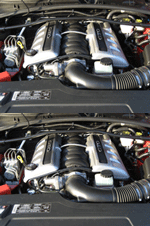
Some interesting oil info here IMO, especially since Forced Performance is one of the most trusted turbo rebuilders on the east coast. The chart at the end is very useful. I know I've posted this before:
http://store.forcedperformance.net/m...otor%20Oil.pdf
http://store.forcedperformance.net/m...otor%20Oil.pdf
im starting to thick this thread might need to be stickied. input like this is good for everyone in this community and is what leads to growth appreciate the post cass havnt seen that before. It might not be the same brand but its the same type of oil i was planning on running. Although it seems the brad penn does seem a little bit cheaper as you can see the diesel is higher but still lower then what it used to be(about 2000ppm iirc) and still not as good as racing oils. hopefully this will continue to grow with posts that have been placed on here already while im gone. going to try and still check in but it will depend on internet condtion =/
Some interesting oil info here IMO, especially since Forced Performance is one of the most trusted turbo rebuilders on the east coast. The chart at the end is very useful. I know I've posted this before:
http://store.forcedperformance.net/m...otor%20Oil.pdf
http://store.forcedperformance.net/m...otor%20Oil.pdf

I was hoping to see how Shell Rotella T6 compared to the others, but alas... it wasn't listed.


Thanks blink thats pretty consistent with what fp got for mobile one turbo diesel oil. I think we can make an estimated guess that other diesel oils will be similar. Probably be a good idea to run diesel oils in moderate builds still using cats and go full blown race oil on the high end builds or if your running a moderate build without cats.
Thanks blinkerfluid! That was helpful. Glad to know how T6 compares.

I noticed that the Mobil 1 racing oils have the highest specified zinc and phosphorus content amongst all of the oils listed. At 1600-1700 zinc and 1700-1850 phosphorus, the content is significantly higher than some of the other brands of racing oils on that list.
That was helpful. Glad to know how T6 compares.Thanks blink thats pretty consistent with what fp got for mobile one turbo diesel oil. I think we can make an estimated guess that other diesel oils will be similar. Probably be a good idea to run diesel oils in moderate builds still using cats and go full blown race oil on the high end builds or if your running a moderate build without cats.
I noticed that the Mobil 1 racing oils have the highest specified zinc and phosphorus content amongst all of the oils listed. At 1600-1700 zinc and 1700-1850 phosphorus, the content is significantly higher than some of the other brands of racing oils on that list.
For sure i see no reason to not use there racing oils just not the standard stuff. would have to find out where to get it too. ive seen the brad penn, pennzoil and royal purple racing oils all for sale before in ohio but never the mobile one. ill have to see what munkey wurks and sonic's sells on island before i decide 100% what ill use.

I've been running Mobile1 Turbo Diesel off and on since being F/I (6 changes so far) and it always wins in terms of wear on every UOEs I've done, even against Motul which the shop used and recommended originally. As of now I am done testing and only using the TD oil.
i just spent an hour and a half typing a section for cylinder heads and my son came over and whacked the keyboard making the browser go back and i lost it all so im just going to reference everyone to this article since vq cylinder heads tend to be very good anyway. Some points i had discussed such as chamber design and port height arn't mentioned but they also are something not easily changed. We can discuss just those if someone desires.
http://www.popularhotrodding.com/eng...ing/index.html
Here re some pics of my old small block heads that i hand ported with a big lots electric die grinder(not a Dremel there's a difference) and a Dremel flex head duct taped on. Not the greatest work but alot better then stock, and cast iron which is alot harder to work with. I DO NOT recommend anyone trying to port there own cylinder vq cylinder heads they just flow too good stock to mess with, unlike some other heads.


Pretty coated with gm anti rust formula(aka renamed wd40) as this was when the engine was wrapped for storage.
http://www.popularhotrodding.com/eng...ing/index.html
Here re some pics of my old small block heads that i hand ported with a big lots electric die grinder(not a Dremel there's a difference) and a Dremel flex head duct taped on. Not the greatest work but alot better then stock, and cast iron which is alot harder to work with. I DO NOT recommend anyone trying to port there own cylinder vq cylinder heads they just flow too good stock to mess with, unlike some other heads.
Pretty coated with gm anti rust formula(aka renamed wd40) as this was when the engine was wrapped for storage.
Last edited by jerryd87; Apr 9, 2011 at 11:07 PM.
 as well as give you saving options.
Yah that would have been the smart idea. =/ Don't worry though i dint kill or abuse any children lol. The article explains how things effect cylinder head flow and velocity imo. Trying to edit previous posts but kinda busy atm packing up last minute things i use every day. Have to be at work in 18 hours for weapons draw and get ready to hop on the plane. Ill see how things are over there and hopefully be able to add to the thread, the rumor is there's a commercial satellite, I'm not liking the idea of spending 100 bucks a month for 56k speed internet.
Last edited by jerryd87; Apr 10, 2011 at 12:06 PM.

National Z Club President
iTrader: (15)
Joined: Sep 2008
Posts: 9,950
Likes: 2
From: the coolest place on earth
SUBBED.
From all the oil talks is there any downside to running a 20-50 race oil on a stock block TT setup?? I only drive the car when I am beating on it but just wondering about said bearing clearances and such.
I NEVER drive the car without letting it get up to temp so im not worried about slow start up times.
From all the oil talks is there any downside to running a 20-50 race oil on a stock block TT setup?? I only drive the car when I am beating on it but just wondering about said bearing clearances and such.
I NEVER drive the car without letting it get up to temp so im not worried about slow start up times.
I'm honestly not sure as i cant find what clearances they use from the factory. At the very least you can use the lighter race oils or as i mentioned general motors EOS. The major difference between racing oils and non racing oils is racing oils are non detergent, so you have to change the oil religiously, and the amount of zinc/phosphorus in the oil. GMs eos is just concentrated zinc and phosphorus adding it to 5 quarts of oil will bring it up to the amounts racing oils have. Adds about 700ppm when added to 5 quarts, the reason gm says it is only for initial oil break in is emissions reason. Old stuff dint have the little disclaimer on it about not adding it every oil change due to adverse effects on emissions so they had to pull it off the shelf, add that little disclaimer, and give it a new part number saying it was different to keep the EPA off there backs.