


I/C Discussion


Registered User
Joined: Aug 2008
Posts: 46
Likes: 0
From: St. Louis


Yes but you aren't breathing 4500 psi so the oxygen for a given mass of air is the same as the atmosphere. The oxygen percentage doesn't go up with compression, however, the amount of oxygen in say 10 pounds of air is more than the oxygen in 1 pound of air. So if I am compressing air into the engine under say 10 psi and that equates to 10 pounds of air than I have more oxygen than at atmospheric pressure. Hence the measure of pounds/minute as a measure used rather than cubic feet per minute.
Pretty cool information though broken down this way. So when f/a mixtures are represented the pump is trying to deliver a ratio of fuel based on air delivered in its compressed state- similar to breathing at depth as oppose to breathing ambient pressure?
Registered User
Joined: Aug 2008
Posts: 46
Likes: 0
From: St. Louis
Okay when you explain it like that I can interpret his question differently- so yes. Instead of all that oxygen being in a space the size of a building it's all mashed into something the size of a cylinder. That would mean more oxygen compressed in the same space.
Pretty cool information though broken down this way. So when f/a mixtures are represented the pump is trying to deliver a ratio of fuel based on air delivered in its compressed state- similar to breathing at depth as oppose to breathing ambient pressure?
Pretty cool information though broken down this way. So when f/a mixtures are represented the pump is trying to deliver a ratio of fuel based on air delivered in its compressed state- similar to breathing at depth as oppose to breathing ambient pressure?
Now things get a little more complicated than that as the main table generally used in engine tuning is the volumetric efficiency table or VE table. Volumetric efficiency is a measure of how much air enters the engine compared to the maximum volume of air that can fit into a cylinder when the piston is at bottom dead center. The ideal would be 100% but that cannot be reached without a pump to force more air into the cylinder (turbocharger or supercharger). When the air is colder and therefore denser the volumetric efficiency is increased because there are more molecules of air per area (it’s compressed). The volumetric efficiency table represents the engine’s intake efficiency under different conditions.
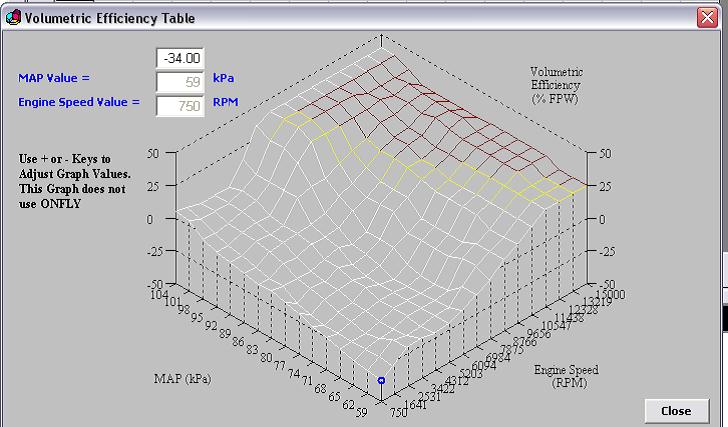
On the graph kPa is metric for pressure which in the imperial system would be psi.

not completely true on the VE portion, you can achieve 100% or greater ve without forced induction. Prostock engines are around 106% volumetric effecient at peak power, the velocity is so great moving through the engine that the air actually compresses itself slightly when it slams into the cylinder, then the intake valve closes before it can fully escape and equalize. iirc the DE is about 102% VE at peak power which is why bolt ons dont do much. dont remember the source for the de engine ve so i can be wrong on that. the source for the pro stock engines is the rediculous number of articles done interviewing pro stock engine builders, i used to have like 6 different ones interviewing different engine builders before i had to throw them out when i moved to hawaii. my wife wouldnt let me bring a file cabnet full of magazines.
also volumetric effeciency is constant regardless of temp, the volume entering the engine is not changing its just the denisty which are both very different things that people often confuse as the same thing. for instance a 1 square inch block of steel and a 1 square block of mallory metal(what they use to add weight to crankshafts during balancing) both have the same volume(one cubic inch) however since the mallory metals molecules are much closer togeather it weighs about twice as much, hence it is twice as dense. density is just a correlation of volume vs mass.
also volumetric effeciency is constant regardless of temp, the volume entering the engine is not changing its just the denisty which are both very different things that people often confuse as the same thing. for instance a 1 square inch block of steel and a 1 square block of mallory metal(what they use to add weight to crankshafts during balancing) both have the same volume(one cubic inch) however since the mallory metals molecules are much closer togeather it weighs about twice as much, hence it is twice as dense. density is just a correlation of volume vs mass.
You are on the right track. What the ECU tries to do is keep a given Air/Fuel ratio (AFR) depending on the load on the engine. For cruise conditions this is generally around 14.7 to 1. Under heavy load/boost that will drop to somewhere around 12 or 11 to 1, so less air more fuel. In order to keep that ratio the ECU looks at the amount of air entering the system in pounds/min. So when it sees heavier (compressed air and/or colder denser air) it adds more fuel to keep the requested AFR.
Now things get a little more complicated than that as the main table generally used in engine tuning is the volumetric efficiency table or VE table. Volumetric efficiency is a measure of how much air enters the engine compared to the maximum volume of air that can fit into a cylinder when the piston is at bottom dead center. The ideal would be 100% but that cannot be reached without a pump to force more air into the cylinder (turbocharger or supercharger). When the air is colder and therefore denser the volumetric efficiency is increased because there are more molecules of air per area (it’s compressed). The volumetric efficiency table represents the engine’s intake efficiency under different conditions.
Attachment 327944
On the graph kPa is metric for pressure which in the imperial system would be psi.
Now things get a little more complicated than that as the main table generally used in engine tuning is the volumetric efficiency table or VE table. Volumetric efficiency is a measure of how much air enters the engine compared to the maximum volume of air that can fit into a cylinder when the piston is at bottom dead center. The ideal would be 100% but that cannot be reached without a pump to force more air into the cylinder (turbocharger or supercharger). When the air is colder and therefore denser the volumetric efficiency is increased because there are more molecules of air per area (it’s compressed). The volumetric efficiency table represents the engine’s intake efficiency under different conditions.
Attachment 327944
On the graph kPa is metric for pressure which in the imperial system would be psi.
You are on the right track. What the ECU tries to do is keep a given Air/Fuel ratio (AFR) depending on the load on the engine. For cruise conditions this is generally around 14.7 to 1. Under heavy load/boost that will drop to somewhere around 12 or 11 to 1, so less air more fuel. In order to keep that ratio the ECU looks at the amount of air entering the system in pounds/min. So when it sees heavier (compressed air and/or colder denser air) it adds more fuel to keep the requested AFR.
Now things get a little more complicated than that as the main table generally used in engine tuning is the volumetric efficiency table or VE table. Volumetric efficiency is a measure of how much air enters the engine compared to the maximum volume of air that can fit into a cylinder when the piston is at bottom dead center. The ideal would be 100% but that cannot be reached without a pump to force more air into the cylinder (turbocharger or supercharger). When the air is colder and therefore denser the volumetric efficiency is increased because there are more molecules of air per area (it’s compressed). The volumetric efficiency table represents the engine’s intake efficiency under different conditions.
Attachment 327944
On the graph kPa is metric for pressure which in the imperial system would be psi.
Now things get a little more complicated than that as the main table generally used in engine tuning is the volumetric efficiency table or VE table. Volumetric efficiency is a measure of how much air enters the engine compared to the maximum volume of air that can fit into a cylinder when the piston is at bottom dead center. The ideal would be 100% but that cannot be reached without a pump to force more air into the cylinder (turbocharger or supercharger). When the air is colder and therefore denser the volumetric efficiency is increased because there are more molecules of air per area (it’s compressed). The volumetric efficiency table represents the engine’s intake efficiency under different conditions.
Attachment 327944
On the graph kPa is metric for pressure which in the imperial system would be psi.
Last edited by jerryd87; Nov 25, 2011 at 11:45 PM.
Registered User
Joined: Aug 2008
Posts: 46
Likes: 0
From: St. Louis
not completely true on the VE portion, you can achieve 100% or greater ve without forced induction. Prostock engines are around 106% volumetric effecient at peak power, the velocity is so great moving through the engine that the air actually compresses itself slightly when it slams into the cylinder, then the intake valve closes before it can fully escape and equalize. iirc the DE is about 102% VE at peak power which is why bolt ons dont do much. .............
also volumetric effeciency is constant regardless of temp, the volume entering the engine is not changing its just the denisty which are both very different things that people often confuse as the same thing. for instance a 1 square inch block of steel and a 1 square block of mallory metal(what they use to add weight to crankshafts during balancing) both have the same volume(one cubic inch) however since the mallory metals molecules are much closer togeather it weighs about twice as much, hence it is twice as dense. density is just a correlation of volume vs mass.
also volumetric effeciency is constant regardless of temp, the volume entering the engine is not changing its just the denisty which are both very different things that people often confuse as the same thing. for instance a 1 square inch block of steel and a 1 square block of mallory metal(what they use to add weight to crankshafts during balancing) both have the same volume(one cubic inch) however since the mallory metals molecules are much closer togeather it weighs about twice as much, hence it is twice as dense. density is just a correlation of volume vs mass.
 Thanks.

Thread Starter
Registered User
Joined: Nov 2003
Posts: 291
Likes: 0
From: columbia md
Really great discussion and appreciate all the good comments as well as education..The reason I started this thread was to understand the benefits of going to a bigger I/C than the puney Vortech unit... Is there a cost benefit/ performance basis for changing?
Performance benefit is elusive since it not easy to calculate it based upon potential delta I/C temp's and at a specific boost level..So what I have done is to calculate the mass delta of O2 for several cases of I/C temp's and at 10 psi..(my systems boost level). Determing how much additional 02 is flowing into the engine as an approximation/ measure of performance increase.
The weight of 02 in air represents approx 23 % of the total weight regardless of temp and pressure.
Looking at the air density chart (at 10 psi) for air at different temp's (representing I/C temp's):
weight of air/density / 02 weight (23%)
150 deg F. / 0.109 lb/ft3 / 0.0250 lb/ft3
140 deg F. / 0.111 lb/ft3 / 0.0255 lb/ft3
120 deg F. / 0.115 lb/ft3 / 0.0265 lb/ft3
100 deg F. / 0.119 lb/ft3 / 0.0274 lb/ft3
So whats the bottom line?
If I buy a larger I/C to get the temp's down from say 150 F to 120 F. the 02 level will increase by 0.0015 lb/ft3 or about a 6% increase..Anyone want to weigh in on how this will effect perf.?? Re tune ? Timing change?
Performance benefit is elusive since it not easy to calculate it based upon potential delta I/C temp's and at a specific boost level..So what I have done is to calculate the mass delta of O2 for several cases of I/C temp's and at 10 psi..(my systems boost level). Determing how much additional 02 is flowing into the engine as an approximation/ measure of performance increase.
The weight of 02 in air represents approx 23 % of the total weight regardless of temp and pressure.
Looking at the air density chart (at 10 psi) for air at different temp's (representing I/C temp's):
weight of air/density / 02 weight (23%)
150 deg F. / 0.109 lb/ft3 / 0.0250 lb/ft3
140 deg F. / 0.111 lb/ft3 / 0.0255 lb/ft3
120 deg F. / 0.115 lb/ft3 / 0.0265 lb/ft3
100 deg F. / 0.119 lb/ft3 / 0.0274 lb/ft3
So whats the bottom line?
If I buy a larger I/C to get the temp's down from say 150 F to 120 F. the 02 level will increase by 0.0015 lb/ft3 or about a 6% increase..Anyone want to weigh in on how this will effect perf.?? Re tune ? Timing change?
Last edited by jpc350; Nov 26, 2011 at 11:43 AM.


^
Totally just thinking out loud, here, so feel free to correct me...
6% isn't much and I doubt that all of that will turn into ponies. Also, I don't know that a bigger intercooler can grab you 30°F lower temp. That sounds like quite a bit of heat to remove when the delta-T isn't that big.
Totally just thinking out loud, here, so feel free to correct me...
6% isn't much and I doubt that all of that will turn into ponies. Also, I don't know that a bigger intercooler can grab you 30°F lower temp. That sounds like quite a bit of heat to remove when the delta-T isn't that big.

So if you have a cheap, small, restrictive FMIC these IAT's may be 40 or 50deg above ambient. Of course it all depends on boost levels, and the overall efficiency of the entire setup. There are a lot of factors to consider here. For example, if your exhuast is restrictive, the IAT's will also go up regardless of how big the FMIC is.
I was going to ask this question in my own thread but this thread has been trending in the right direction with the air cooling issue and the ECU calculating fuel output.
What if the air is ALREADY cold- but the tune was done while air was being cooled to something above ambient. It's not possible to drop the temperature of incoming air past the IC below ambient- save I suppose for WMI or something more exotic I guess-
But if the tune is performed in 15-20C and the car is running in 4-8C in the cooler months will this cause fuel problems? Additionally, will it throw advanced timing off? Will a tune need to be adjusted to accommodate lower temps?
Intec told me that they would make arrangements to come up and do a cold weather / warm weather tune if I wanted them to do that and originally I'd declined the offer. Now as I start to get my head around the bigger picture I'm starting to wonder if it's not a bad idea...
I don't think it's been covered already but I think a lot of the right people are watching this thread to clear up some of the concern.
What if the air is ALREADY cold- but the tune was done while air was being cooled to something above ambient. It's not possible to drop the temperature of incoming air past the IC below ambient- save I suppose for WMI or something more exotic I guess-
But if the tune is performed in 15-20C and the car is running in 4-8C in the cooler months will this cause fuel problems? Additionally, will it throw advanced timing off? Will a tune need to be adjusted to accommodate lower temps?
Intec told me that they would make arrangements to come up and do a cold weather / warm weather tune if I wanted them to do that and originally I'd declined the offer. Now as I start to get my head around the bigger picture I'm starting to wonder if it's not a bad idea...
I don't think it's been covered already but I think a lot of the right people are watching this thread to clear up some of the concern.
Last edited by Eno; Dec 5, 2011 at 09:36 AM.

It all depends on how your tuner setup the temperature compensation tables. Most tunes use coolant temp as the big correction with small tweaks from AIT. Thats how mine is setup.
In the cold, I find that I had to adjust coolant compensation tables at startup/during warm up. So it all depends I guess. This is just my experience, and I am not a pro at this.
your IAT temp correction should go across all range of temps the vehicle could see. the tuning dosnt jump like say you deliver x fuel at 10c and y fuel at 15c then its not going to simply jump from the x to y calculation it will increase in very small amount as the temp changes, it varies on the tuning solution for how small the increments will be. so theres no reason to have a super tune for one temp range and need another for different months, it should be done across the entire range in the same tune.
there are actually alot of ways to lower the IAT below ambient but your gona know about those, theres meth injection, cryogenics on the intercooler, air to water intercooler, the ford lightening even had a/c refrigerant go through the heat exchanger on one of the model years to super cool the the incoming air.
there are actually alot of ways to lower the IAT below ambient but your gona know about those, theres meth injection, cryogenics on the intercooler, air to water intercooler, the ford lightening even had a/c refrigerant go through the heat exchanger on one of the model years to super cool the the incoming air.
I was going to ask this question in my own thread but this thread has been trending in the right direction with the air cooling issue and the ECU calculating fuel output.
What if the air is ALREADY cold- but the tune was done while air was being cooled to something above ambient. It's not possible to drop the temperature of incoming air past the IC below ambient- save I suppose for WMI or something more exotic I guess-
But if the tune is performed in 15-20C and the car is running in 4-8C in the cooler months will this cause fuel problems? Additionally, will it throw advanced timing off? Will a tune need to be adjusted to accommodate lower temps?
Intec told me that they would make arrangements to come up and do a cold weather / warm weather tune if I wanted them to do that and originally I'd declined the offer. Now as I start to get my head around the bigger picture I'm starting to wonder if it's not a bad idea...
I don't think it's been covered already but I think a lot of the right people are watching this thread to clear up some of the concern.
What if the air is ALREADY cold- but the tune was done while air was being cooled to something above ambient. It's not possible to drop the temperature of incoming air past the IC below ambient- save I suppose for WMI or something more exotic I guess-
But if the tune is performed in 15-20C and the car is running in 4-8C in the cooler months will this cause fuel problems? Additionally, will it throw advanced timing off? Will a tune need to be adjusted to accommodate lower temps?
Intec told me that they would make arrangements to come up and do a cold weather / warm weather tune if I wanted them to do that and originally I'd declined the offer. Now as I start to get my head around the bigger picture I'm starting to wonder if it's not a bad idea...
I don't think it's been covered already but I think a lot of the right people are watching this thread to clear up some of the concern.
i've had UTEC, Haltech, and now Proefi. They are all the same in terms of ability to compensate for coolant temp and AIT.
I've never fussed with MAF tuning, but i'd imagine external AIT compensation would be even smaller since AIT is already incorporated into MAF measurements.
I've never fussed with MAF tuning, but i'd imagine external AIT compensation would be even smaller since AIT is already incorporated into MAF measurements.

Thread
Thread Starter
Forum
Replies
Last Post

