


I/C Discussion


Thread Starter
Registered User
Joined: Nov 2003
Posts: 291
Likes: 0
From: columbia md
 I/C Discussion
Lately, several posters have discussed increasing their I/C size for better performance. Thinking about the benefits, it seems to me that increased performance benefits due to lower AIT's can only occur if one uses these lower AIT's to improve the timing map's..( pull some timing).
Lower AIT's will not increase the amount of Air (oxygen) going into the intake, assuming it 's not being limited by the I/C which is unlikely..
A reduced threat to pre ignition or detonation I guess is also a plus.
Am I understanding this correctly?
Lower AIT's will not increase the amount of Air (oxygen) going into the intake, assuming it 's not being limited by the I/C which is unlikely..
A reduced threat to pre ignition or detonation I guess is also a plus.
Am I understanding this correctly?


Lower AIT's will actually result in more oxygen due to the density of the atmospheric air being higher. (Holding pressure and volume constant, etc)
A gallon of 100° air has less oxygen than a gallon of 10° air.
A gallon of 100° air has less oxygen than a gallon of 10° air.

I'm no authority on this but I am interested in the subject. My understanding is simply that cold air lends to better expansion than hot air so while you may not technically be introducing more air into the equation... that amount of air has more "potential." Whoops- DJ beat me to it.
It's like comparing the weight of muscle / fat- a lb of fat weighs the same as a lb of muscle... but while the mass is the same (1lb) it is the size of the object that changes. It looks as if a similar rule applies with air temp / density.
I've been seeing guys going to the vertical style IC versus the horizontals- keeping similar sizes but still gaining efficiency and improving flow through. Most recently was RCDash... at least that I've seen. Not sure where he ended up with it though now that you mention it.
It's like comparing the weight of muscle / fat- a lb of fat weighs the same as a lb of muscle... but while the mass is the same (1lb) it is the size of the object that changes. It looks as if a similar rule applies with air temp / density.
I've been seeing guys going to the vertical style IC versus the horizontals- keeping similar sizes but still gaining efficiency and improving flow through. Most recently was RCDash... at least that I've seen. Not sure where he ended up with it though now that you mention it.
Last edited by Eno; Nov 24, 2011 at 10:14 AM.
Thread Starter
Registered User
Joined: Nov 2003
Posts: 291
Likes: 0
From: columbia md
Colder being denser than warm air contains more partial pressure of oxygen..Where does the additional oxygen come from after entering the compressor and heated? It enters the compressor at ambient, heated , than cooled in the I/C . What oxygen enters at ambient is at the same level throughout the process, no? I guess it boils down to:
Does air (oxygen) at say 130 Deg F deg and 10 psi (post compression) have more O2 than ambient pressure and 70 deg F.?

ok lets see if i can put this in the simplest way i can and not confuse anyone.
air particles are not solid nor are the stationary, they are constantly moving a set speed and a set distance based on there tempature. the hotter they are the more active they are and since they are moving further each particle takes a larger space.
By reducing the temp and slowing these particles down they take less space and as such even though the pressure ratio maintaines the density ratio increases since the particles are moving less before bumping into each other.
so say before an intercooler your air takes up this much space
--------------
after the intercooler it only takes up this much space because it isnt moving as much
-------
so the turbo then has to push more air in to take up the remaining space all while keeping pressure the same, since it is going to try and keep that pressure constant regardless of how much air is required to do that.
there are calculators online that will do the math for you i can access them from this computer, stupid DoD rules. however a rough estimate is at 90 degrees ambient, with a 67% effecient turbo, and a 85% effecient intercooler, and 30 pounds of boost your output temp at the turbo is around 350 degrees and output temp after the intercooler is around 140 degrees. the outlet of the turbo is around a 2.0 density ratio, as in you are actually forcing double the air into the engine then it would normally ingest simply because of how active the air is. however after the intercooler since the air is less excited the density ratio is actually around 2.6ish and the turbo sends more air in and flows more since even though the pressure is the same it needs a larger volume to take up that space. similar to how a gt25 isnt going to flow as much at 15 psi as a gt 35 would, pressure is the same but the flow is much greater.
air particles are not solid nor are the stationary, they are constantly moving a set speed and a set distance based on there tempature. the hotter they are the more active they are and since they are moving further each particle takes a larger space.
By reducing the temp and slowing these particles down they take less space and as such even though the pressure ratio maintaines the density ratio increases since the particles are moving less before bumping into each other.
so say before an intercooler your air takes up this much space
--------------
after the intercooler it only takes up this much space because it isnt moving as much
-------
so the turbo then has to push more air in to take up the remaining space all while keeping pressure the same, since it is going to try and keep that pressure constant regardless of how much air is required to do that.
there are calculators online that will do the math for you i can access them from this computer, stupid DoD rules. however a rough estimate is at 90 degrees ambient, with a 67% effecient turbo, and a 85% effecient intercooler, and 30 pounds of boost your output temp at the turbo is around 350 degrees and output temp after the intercooler is around 140 degrees. the outlet of the turbo is around a 2.0 density ratio, as in you are actually forcing double the air into the engine then it would normally ingest simply because of how active the air is. however after the intercooler since the air is less excited the density ratio is actually around 2.6ish and the turbo sends more air in and flows more since even though the pressure is the same it needs a larger volume to take up that space. similar to how a gt25 isnt going to flow as much at 15 psi as a gt 35 would, pressure is the same but the flow is much greater.
Yea both both pressure and volume are not constant.
Colder being denser than warm air contains more partial pressure of oxygen..Where does the additional oxygen come from after entering the compressor and heated? It enters the compressor at ambient, heated , than cooled in the I/C . What oxygen enters at ambient is at the same level throughout the process, no? I guess it boils down to:
Does air (oxygen) at say 130 Deg F deg and 10 psi (post compression) have more O2 than ambient pressure and 70 deg F.?
Colder being denser than warm air contains more partial pressure of oxygen..Where does the additional oxygen come from after entering the compressor and heated? It enters the compressor at ambient, heated , than cooled in the I/C . What oxygen enters at ambient is at the same level throughout the process, no? I guess it boils down to:
Does air (oxygen) at say 130 Deg F deg and 10 psi (post compression) have more O2 than ambient pressure and 70 deg F.?
I think it makes sense because the volume is fixed by the bore and stroke of the piston. By turbo'ing, you jam more stuff in the same fixed volume by increasing pressure. You can also jam more stuff in by decreasing temperature.
Trending Topics
Thread Starter
Registered User
Joined: Nov 2003
Posts: 291
Likes: 0
From: columbia md
Doesn't it all come down to this question?
Does air (oxygen content) at say 130 Deg F deg (The AIT) and 10 psi (post compression) have more O2 than ambient pressure (14.7 psia) and 70 deg F. the conditions at the intake to the compressor ( blower for S/C'er.).
Intuitively compressing air should pack in more oxygen..
Does air (oxygen content) at say 130 Deg F deg (The AIT) and 10 psi (post compression) have more O2 than ambient pressure (14.7 psia) and 70 deg F. the conditions at the intake to the compressor ( blower for S/C'er.).
Intuitively compressing air should pack in more oxygen..

Registered User
Joined: Aug 2008
Posts: 46
Likes: 0
From: St. Louis
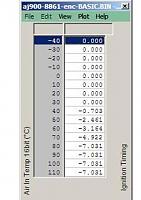
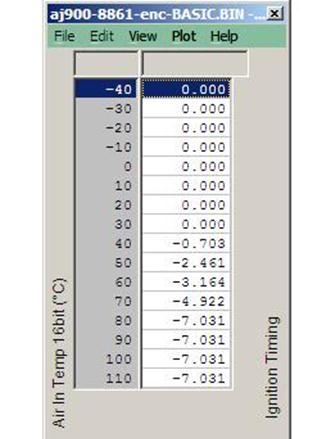
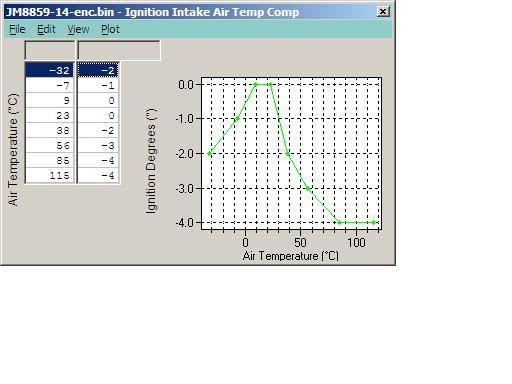
No no. Cubic feet/minute is fine if you are carbureted, however modern vehicles measure Mass Air Flow in pounds/minute. This is especially important for forced induction systems since the turbocharger or supercharger is compressing the air and making it denser (heavier) and fuel must be scheduled based on this mass of air. To measure the weight of the air you also need to know the temperature of the air since colder air is denser (heavier) you need more fuel since this mass of air has more oxygen compressed into it. This also results in more energy being released in the cylinder and hence more power. Most engine computers will schedule fuel and timing based on the mass of air and its temperature. For example below is a timing table based on inlet air temperature. Notice at hotter temperatures timing is reduced and at colder temperatures timing is increased.
Last edited by TurboBob; Nov 24, 2011 at 02:59 PM.
No- it doesn't. Example:
We pack 4500psi into the cylinders in our breathing apparatus but oxygen remains a constant 20.9%. As it is delivered to us it goes through varying stages of decompression from whatever that stored pressure is to a pressure that we can breathe.
So you're not adding or substracting oxygen. But instead you've taken the air from inside a whole building and stored it in a small cylinder. As it is allowed to expand the actual concentration changes but the composition doesn't.
We pack 4500psi into the cylinders in our breathing apparatus but oxygen remains a constant 20.9%. As it is delivered to us it goes through varying stages of decompression from whatever that stored pressure is to a pressure that we can breathe.
So you're not adding or substracting oxygen. But instead you've taken the air from inside a whole building and stored it in a small cylinder. As it is allowed to expand the actual concentration changes but the composition doesn't.

Joined: Mar 2008
Posts: 1,876
Likes: 2
From: Northern NJ / Vacation on MARS
No no. Cubic feet/minute is fine if you are carbureted, however modern vehicles measure Mass Air Flow in pounds/minute. This is especially important for forced induction systems since the turbocharger or supercharger is compressing the air and making it denser (heavier) and fuel must be scheduled based on this mass of air. To measure the weight of the air you also need to know the temperature of the air since colder air is denser (heavier) you need more fuel since this mass of air has more oxygen compressed into it. This also results in more energy being released in the cylinder and hence more power. Most engine computers will schedule fuel and timing based on the mass of air and its temperature. For example below is a timing table based on inlet air temperature. Notice at hotter temperatures timing is reduced and at colder temperatures timing is increased.
Attachment 327896Attachment 327895
Attachment 327896Attachment 327895
Right?
Registered User
Joined: Aug 2008
Posts: 46
Likes: 0
From: St. Louis
No- it doesn't. Example:
We pack 4500psi into the cylinders in our breathing apparatus but oxygen remains a constant 20.9%. As it is delivered to us it goes through varying stages of decompression from whatever that stored pressure is to a pressure that we can breathe.
So you're not adding or subtracting oxygen. But instead you've taken the air from inside a whole building and stored it in a small cylinder. As it is allowed to expand the actual concentration changes but the composition doesn't.
We pack 4500psi into the cylinders in our breathing apparatus but oxygen remains a constant 20.9%. As it is delivered to us it goes through varying stages of decompression from whatever that stored pressure is to a pressure that we can breathe.
So you're not adding or subtracting oxygen. But instead you've taken the air from inside a whole building and stored it in a small cylinder. As it is allowed to expand the actual concentration changes but the composition doesn't.
Last edited by TurboBob; Nov 24, 2011 at 05:59 PM.
Doesn't it all come down to this question?
Does air (oxygen content) at say 130 Deg F deg (The AIT) and 10 psi (post compression) have more O2 than ambient pressure (14.7 psia) and 70 deg F. the conditions at the intake to the compressor ( blower for S/C'er.).
Intuitively compressing air should pack in more oxygen..
Does air (oxygen content) at say 130 Deg F deg (The AIT) and 10 psi (post compression) have more O2 than ambient pressure (14.7 psia) and 70 deg F. the conditions at the intake to the compressor ( blower for S/C'er.).
Intuitively compressing air should pack in more oxygen..
Actually... I was going to answer this but I don't think there is enough information because you haven't specified a volume. This is part of what is tripping you up, here.
I'll try again. Your car takes in about 3.5 L of air on a cycle and that VOLUME is fixed, or constant. If you turbo at about 10 psi, you'll jam about 68% (+10/14.7) more air into that same 3.5L volume. Unfortunately, the compression heats the air up and the intercooler helps to bring the temp down a bit.
If you wanted to jam 68% more air into the same volume by modifying temperature instead of pressure, you'd "just" have to reduce the temp by 68%. Too bad it's measured in Kelvin, otherwise a freezing day (32°F) would give you 68% more air than a hot (100°F) day. Instead, you'd have to go from ~room temp to -289°F.
So, yes, compressing the air is the way to go. Look up ideal gas law for more info: PV=nRT
Just get rid of the R and think of it like a see-saw that must always stay level. n is the amount of molecules and if you...
I'm tired... Let me know if this nerdy **** helps.

i think the op needs to visit turbo mustangs since we appear to be failing to explain this. it is THE source for all things boosted after all(regardless of platform), they have stuff on there that even makes my head spin lol.

hmm, think about a naturally aspirated car then.
on a 100* day there is far less oxygen going into the engine therefore less performance. Take that same tune without changing anything and drive it in 32*. Difference in performance due to more oxygen. This can even been seen with the widebands. The car will run rich in the heat because less oxygen per fuel and it will run lean in the winter due to more oxygen than fuel.
So it's not due to increasing timing with an intercooler.
I experienced this 2 weeks ago on the mustang dyno. I can control my timing tables per air temp. Timing not being pulled (constant) I lost about ~50hp between a 100* intake temp pulls and when they went up to 170* since we didn't have any fans on the car.
on a 100* day there is far less oxygen going into the engine therefore less performance. Take that same tune without changing anything and drive it in 32*. Difference in performance due to more oxygen. This can even been seen with the widebands. The car will run rich in the heat because less oxygen per fuel and it will run lean in the winter due to more oxygen than fuel.
So it's not due to increasing timing with an intercooler.
I experienced this 2 weeks ago on the mustang dyno. I can control my timing tables per air temp. Timing not being pulled (constant) I lost about ~50hp between a 100* intake temp pulls and when they went up to 170* since we didn't have any fans on the car.
@TurboBob:
I think 350zion was talking about cfm in terms of the intercooler becoming a bottleneck in the system. Ie) the compressor was flowing so high that the intercooler would be undersized.
I don't think that's what the OP was talking about, though. And, I don't think that's why some of the guys are going with bigger intercoolers. They are trying to get more cooling without as much of a pressure drop.
(Fill me in if I'm speaking for others incorrectly.)
I think 350zion was talking about cfm in terms of the intercooler becoming a bottleneck in the system. Ie) the compressor was flowing so high that the intercooler would be undersized.
I don't think that's what the OP was talking about, though. And, I don't think that's why some of the guys are going with bigger intercoolers. They are trying to get more cooling without as much of a pressure drop.
(Fill me in if I'm speaking for others incorrectly.)
Joined: Mar 2008
Posts: 1,876
Likes: 2
From: Northern NJ / Vacation on MARS
@TurboBob:
I think 350zion was talking about cfm in terms of the intercooler becoming a bottleneck in the system. Ie) the compressor was flowing so high that the intercooler would be undersized.
I don't think that's what the OP was talking about, though. And, I don't think that's why some of the guys are going with bigger intercoolers. They are trying to get more cooling without as much of a pressure drop.
(Fill me in if I'm speaking for others incorrectly.)
I think 350zion was talking about cfm in terms of the intercooler becoming a bottleneck in the system. Ie) the compressor was flowing so high that the intercooler would be undersized.
I don't think that's what the OP was talking about, though. And, I don't think that's why some of the guys are going with bigger intercoolers. They are trying to get more cooling without as much of a pressure drop.
(Fill me in if I'm speaking for others incorrectly.)
Thanks!


Can you Show the Stock Numbers?
https://my350z.com/forum/attachments...timing-map.jpg
https://my350z.com/forum/attachments...timing-map.jpg
No no. Cubic feet/minute is fine if you are carbureted, however modern vehicles measure Mass Air Flow in pounds/minute. This is especially important for forced induction systems since the turbocharger or supercharger is compressing the air and making it denser (heavier) and fuel must be scheduled based on this mass of air. To measure the weight of the air you also need to know the temperature of the air since colder air is denser (heavier) you need more fuel since this mass of air has more oxygen compressed into it. This also results in more energy being released in the cylinder and hence more power. Most engine computers will schedule fuel and timing based on the mass of air and its temperature. For example below is a timing table based on inlet air temperature. Notice at hotter temperatures timing is reduced and at colder temperatures timing is increased.
Attachment 327896Attachment 327895
Attachment 327896Attachment 327895
Last edited by OldManZ350; Nov 25, 2011 at 09:48 AM.
Registered User
Joined: Aug 2008
Posts: 46
Likes: 0
From: St. Louis
@TurboBob:
I think 350zion was talking about cfm in terms of the intercooler becoming a bottleneck in the system. Ie) the compressor was flowing so high that the intercooler would be undersized.
I don't think that's what the OP was talking about, though. And, I don't think that's why some of the guys are going with bigger intercoolers. They are trying to get more cooling without as much of a pressure drop.
(Fill me in if I'm speaking for others incorrectly.)
I think 350zion was talking about cfm in terms of the intercooler becoming a bottleneck in the system. Ie) the compressor was flowing so high that the intercooler would be undersized.
I don't think that's what the OP was talking about, though. And, I don't think that's why some of the guys are going with bigger intercoolers. They are trying to get more cooling without as much of a pressure drop.
(Fill me in if I'm speaking for others incorrectly.)
