


cam effects on compression


 cam effects on compression
i know its been discussed before but here is an example of how bigger cams effect compression ratio at different static compresson ratios. its for a ford 2.0 duratec but it still is a nice example and give people a rough idea of how it works.
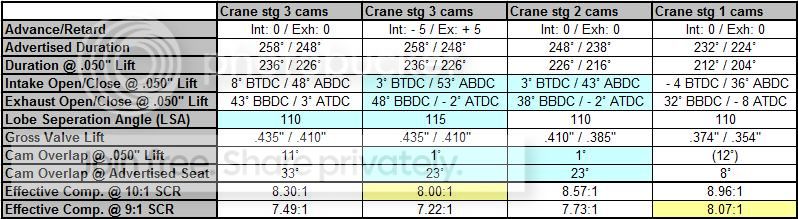

So by running tomei 264/264 I have a lower effective compression than the 9.5:1 pistons?
Cool to know. I never had the chance to sit down and do all this overlap and lobe stuff with cams on engines. Despite loving physics and math it just seems like a headache. lol
Cool to know. I never had the chance to sit down and do all this overlap and lobe stuff with cams on engines. Despite loving physics and math it just seems like a headache. lol
honestly i dont even know how to do it all but our cams between the stock lift and duration would be somewhere between the stage 1 and 2 and its over a point of compression drop. so 264s could be in the 1.5 range and i would suspect the 272 possible as much as a 1.75 drop in effective compression. obviously variable cams comes into play as well and can increase the effective compression down low where its needed.
so advancing the cams raises compression while reducing cam timing reduces compression?
Is that one of the factors that increases spool in the midrange with advanced cam timing?
Is that one of the factors that increases spool in the midrange with advanced cam timing?

I've not seen such data published for VQ cams. Effective compression looks like a time based function (averaged over time). I suspect predisposition to knock would still be based off of peak compression and cam selection would not play a role in this regard (i.e. you would not be able to run a lower octane fuel or run more boost by changing cams or tweaking cam advance).
there isnt a chart because no one has made one but this will reduce peak pressures as well. less pressure to start means more peak. it really isnt much to do with time other then the timing of events. advancing the cams will increase compression because the valves close sooner(to a point of course) so you get complete compression, retarding them results in less so the valve could close while still drawing air in resulting in a smaller volume in the chamber. of course duration then has an effect on overlap and will further effect the effective compression.
all of these will add up affecting peak compressions. how much is it going to effect it? untelling thats a "black magic" area and takes some knowledge which i admit i dont have, and some trial and error. i guarantee the ability of forum members to run 10 psi on a stock block is a example, theres alot of platforms with similar compression ratios which would blow. cam selection is also a way some of the exotics can run 12-13:1 compression ratio with no det, no easy task for sure, but they are also set up to make power in a higher rev range, leading to some much larger cams.
all of these will add up affecting peak compressions. how much is it going to effect it? untelling thats a "black magic" area and takes some knowledge which i admit i dont have, and some trial and error. i guarantee the ability of forum members to run 10 psi on a stock block is a example, theres alot of platforms with similar compression ratios which would blow. cam selection is also a way some of the exotics can run 12-13:1 compression ratio with no det, no easy task for sure, but they are also set up to make power in a higher rev range, leading to some much larger cams.
Trending Topics

http://www.wallaceracing.com/dynamic-cr.php
This is a pretty good calc to use to get dynamic comrpession with different cams. Its not spot on but if wil give you an idea.
This is a pretty good calc to use to get dynamic comrpession with different cams. Its not spot on but if wil give you an idea.
Last edited by meatbag; Jul 31, 2012 at 01:03 PM.
if that was the case it would be impossible to have different power outputs from the same size engine, and lowering compression ratios would not but they obviously do.
tell me if you take a 1 liter bottle and compress it to 1 square inch, and then take a 2 liter bottle(assume both are full and ignore rupturing and other irrelevant things for now.) and compress it to 1 square inch. which has more total compression?
your view point assumes the cylinder is completely full at all times which it is not hence why VE and VE tuning work. altering cam timing gives you a different dynamic compression ratio, because dynamic includes all variables as well as how much will be able to enter the cylinder. and it is quite likely that the piston will be partially on its compression stroke depending on the cams and timing thus further lowering dynamic compression.
great website meatbag, go ahead and look at it rc, you will see our cams actually allow the intake valve to be open during the compression stroke, 32 degrees to be exact thus lowering the dynamic compression, ie what the engine actually sees. bigger cams are more of a effect, stock cams on my engine for example give me a dynamic/effective compression ratio of 6.5
so with my cams and boost pressure obviously varying spark, at 26 psi boost my effective compression ratio in bost is 17.88, nearing the limit of what meth+ pump can see, its likely i can pull timing and hit 30 psi but ill have to compare on the dyno if 26+ spark is better or 30+ a little less is better. my bet is 30 wins especially considering the massive bump in airflow the billet wheels see around that area.
once i put cams in ill be able to add more spark back in, but honestly i see little to no knock from 26 psi, most of mine was 18 psi which i adjusted and pending the next dyno might go back up if i determine its just engine noise at that level.
tell me if you take a 1 liter bottle and compress it to 1 square inch, and then take a 2 liter bottle(assume both are full and ignore rupturing and other irrelevant things for now.) and compress it to 1 square inch. which has more total compression?
your view point assumes the cylinder is completely full at all times which it is not hence why VE and VE tuning work. altering cam timing gives you a different dynamic compression ratio, because dynamic includes all variables as well as how much will be able to enter the cylinder. and it is quite likely that the piston will be partially on its compression stroke depending on the cams and timing thus further lowering dynamic compression.
great website meatbag, go ahead and look at it rc, you will see our cams actually allow the intake valve to be open during the compression stroke, 32 degrees to be exact thus lowering the dynamic compression, ie what the engine actually sees. bigger cams are more of a effect, stock cams on my engine for example give me a dynamic/effective compression ratio of 6.5
so with my cams and boost pressure obviously varying spark, at 26 psi boost my effective compression ratio in bost is 17.88, nearing the limit of what meth+ pump can see, its likely i can pull timing and hit 30 psi but ill have to compare on the dyno if 26+ spark is better or 30+ a little less is better. my bet is 30 wins especially considering the massive bump in airflow the billet wheels see around that area.
once i put cams in ill be able to add more spark back in, but honestly i see little to no knock from 26 psi, most of mine was 18 psi which i adjusted and pending the next dyno might go back up if i determine its just engine noise at that level.
Last edited by jerryd87; Jul 31, 2012 at 07:51 PM.
Yes, I understand dynamic/effective compression is not the same thing as static compression. With a valve open, air is pushed out. Not questioning that, lol. I just don't fully understand what value the data brings to the table when tuning a car. Seems mostly like guesswork - if you find someone with experience actually speaking to how it has helped them, please post up...
Last edited by rcdash; Aug 1, 2012 at 05:35 AM.

@Rcdash, a lot of other communities will cite this idea that cams lower compression and actually help knock/preignition etc. It's weird, I think it's pretty silly but some people think it helps.
I've heard some race engine builders talk about running a fat cam with super high compression can help keep then engine from shitting it's-self and I started asking them more about it. They told me if you rely on that to keep things together you're ****ed and it's a negligible difference.
my bad at the misunderstanding. as far as tuning? i would say little unless like you said someone with far more experience then i would say 99% of this forum has(im thinking mayby 2 people both shop owners). however looking at how it affects things could further give people insight when planning builds
Yes, I understand dynamic/effective compression is not the same thing as static compression. With a valve open, air is pushed out. Not questioning that, lol. I just don't fully understand what value the data brings to the table when tuning a car. Seems mostly like guesswork - if you find someone with experience actually speaking to how it has helped them, please post up...
i hardly think a full point to a point and a half of compression is negligible
Yes.
@Rcdash, a lot of other communities will cite this idea that cams lower compression and actually help knock/preignition etc. It's weird, I think it's pretty silly but some people think it helps.
I've heard some race engine builders talk about running a fat cam with super high compression can help keep then engine from shitting it's-self and I started asking them more about it. They told me if you rely on that to keep things together you're ****ed and it's a negligible difference.
@Rcdash, a lot of other communities will cite this idea that cams lower compression and actually help knock/preignition etc. It's weird, I think it's pretty silly but some people think it helps.
I've heard some race engine builders talk about running a fat cam with super high compression can help keep then engine from shitting it's-self and I started asking them more about it. They told me if you rely on that to keep things together you're ****ed and it's a negligible difference.
You loose very little power.
If you are trying to tell me you can feel the difference and see a difference on the dyno from that compression change on the dynamic compression you're really really stretching it.
This isn't a new thing, and overlap has been known to do things like this for a long time. It's negligible in the grand scheme of things.
for na sure its a minor loss hardly worthwhile however for fi that is actually a HUGE difference. by dropping the dynamic compression 1.5 points with cams you can run another 5 psi boost to get the same dynamic compression ratio. that combined with the increased rpm of the bigger cams is a significant increase in power i would say 50 hp minimum.
Yeah actually it is.
You loose very little power.
If you are trying to tell me you can feel the difference and see a difference on the dyno from that compression change on the dynamic compression you're really really stretching it.
This isn't a new thing, and overlap has been known to do things like this for a long time. It's negligible in the grand scheme of things.
You loose very little power.
If you are trying to tell me you can feel the difference and see a difference on the dyno from that compression change on the dynamic compression you're really really stretching it.
This isn't a new thing, and overlap has been known to do things like this for a long time. It's negligible in the grand scheme of things.


Joined: Aug 2004
Posts: 28,899
Likes: 1,906
From: Twin Cities, MN
Wow, this has gotten way out of hand no thanks to 'jerry.'
You have just been warned and penalized for putting the language filter to the test.
As informative as this thread may have been, it's gotten out of control and is losing the point.
This thread is done.
You have just been warned and penalized for putting the language filter to the test.
As informative as this thread may have been, it's gotten out of control and is losing the point.
This thread is done.


Thread
Thread Starter
Forum
Replies
Last Post
Colombo
Forced Induction
35
Nov 9, 2020 10:27 AM
B Esquire
Autocross/Road
0
Sep 24, 2015 07:52 AM
