


Fuel system setup for E85


 Fuel system setup for E85
I will hopefully be receiving my freshly built motor back from my builder this week. I plan on running my car on E85, since I live just a few minutes from a gas station that sells it. I am also only a few minutes from ProEFI, so it only makes sense for me to use their ems. My goal for the build is to see 550whp, and I would be thrilled if I could make 600whp. I have the powerlab GT35 kit, with the upgraded 1.06 turbine housing. And I just sent my fuel pump basket to Dynosty for a walbro 485 fuel pump and I have a set of pte 1200 injectors.
My question is about my fuel line setup. I have a CJM fuel pump output fitting which has a -6an fitting. My plan is to run a -6 to -8 expander, then run a -8 fuel line from the pump to a Y, where it will split from -8 into two -6 lines. From there, obviously, they will run to the fuel rails. Then I will T them back together and run them into my fuel pressure regulator. After that my return line will go to my flex fuel senor and then back to my tank. Where I have the CJM return fuel correction kit.
So on to my questions, will a -8 line flow enough fuel to hit my goals? Also, will I have any issues with fuel flow going from a -6 fitting to a -8 fitting? Then on the return side, the CJM return fuel correction kit is a -4 fitting will it cause any issues if i used a -6 to -4 reducer fitting? That way I can run a -6 return line from my flex fuel sensor to the tank. I guess I'm wondering if I will have pressure issues going from a -6 fitting to the -8 expander. Any advice will be much appreciated.
My question is about my fuel line setup. I have a CJM fuel pump output fitting which has a -6an fitting. My plan is to run a -6 to -8 expander, then run a -8 fuel line from the pump to a Y, where it will split from -8 into two -6 lines. From there, obviously, they will run to the fuel rails. Then I will T them back together and run them into my fuel pressure regulator. After that my return line will go to my flex fuel senor and then back to my tank. Where I have the CJM return fuel correction kit.
So on to my questions, will a -8 line flow enough fuel to hit my goals? Also, will I have any issues with fuel flow going from a -6 fitting to a -8 fitting? Then on the return side, the CJM return fuel correction kit is a -4 fitting will it cause any issues if i used a -6 to -4 reducer fitting? That way I can run a -6 return line from my flex fuel sensor to the tank. I guess I'm wondering if I will have pressure issues going from a -6 fitting to the -8 expander. Any advice will be much appreciated.


I would be a little concerned about the 4an line on the return side. With the large volumes of e85 going through the fuel system when you are in cruise or idle almost all of it will be returned to the pump. With a 6an line I haven't noticed any pressure backup but the 4an might cause your fuel pressure to run high due to back pressure. You can easily test it by setting your fuel pressure without the flex sensor then installing it and making sure it's the same fuel pressure. if it does you might have to run a Y adapter and run a 4 an line to hte sensor then back to the tank and another 6an line back to the tank so it doesn't restrict flow.
I would run 8an line like you stated. It will be more than enough flow but for that distance I wouldn't chance using a 6an line because you will have to rip it out if you ever decide to run a larger turbo for more power.
I would be a little concerned about the 4an line on the return side. With the large volumes of e85 going through the fuel system when you are in cruise or idle almost all of it will be returned to the pump. With a 6an line I haven't noticed any pressure backup but the 4an might cause your fuel pressure to run high due to back pressure. You can easily test it by setting your fuel pressure without the flex sensor then installing it and making sure it's the same fuel pressure. if it does you might have to run a Y adapter and run a 4 an line to hte sensor then back to the tank and another 6an line back to the tank so it doesn't restrict flow.
I would be a little concerned about the 4an line on the return side. With the large volumes of e85 going through the fuel system when you are in cruise or idle almost all of it will be returned to the pump. With a 6an line I haven't noticed any pressure backup but the 4an might cause your fuel pressure to run high due to back pressure. You can easily test it by setting your fuel pressure without the flex sensor then installing it and making sure it's the same fuel pressure. if it does you might have to run a Y adapter and run a 4 an line to hte sensor then back to the tank and another 6an line back to the tank so it doesn't restrict flow.
Well, I am planning to run a -6an return line. I am concerned with where I will have to go from a -6an line then use a -6 to -4 reducer fitting to fit on the end on the CJM return fuel kit. Since, it is a -4an fitting. Just like you stated, I am concerned that it will be a "bottle neck" for the fuel return. And thanks for the input.
Trending Topics
that or I just thought of another idea. Put T fittings on both fuel rails and then run a 4an line between those rails while leaving the rest of the system alone (so it still returns fuel back to the FPR then tank through 6an). All it needs is to see the fuel passing by to adjust the ethanol content.

Registered User
Joined: Mar 2013
Posts: 329
Likes: 5
From: chicago
you need to keep pressure in your return line for the venturis to work. the less pressure they have, the less your over-tank siphon is working. If you bypass the venturis, you will reduce or eliminate return pressure completely, and that will make your vehicle more or extra prone to fuel starvation. If you add a venturi bypass line, you will need to restrict it in attempt to maintain return pressure during idle and cruising. Its fine if return pressure drops for momentary full throttle bursts (for a street car anyway), but you want those venturis working 90% of the time and venturis work off of pressure. Run at least a -6 return line. Just because the return correction kit is -4, doesnt mean that the entire return line can be -4. You will have to open up the yellow venturi on your fuel canister at least a little bit but I wouldnt be surprised if no amount of opening it up is able to get fuel pressure into spec at idle, as there are more restrictions inside that assembly. Whatever you do, do not make such large flow modifications to your return side that you eliminate return pressure and kill the venturis. Only go as far as you must to get fuel pressure in spec. When youre done, with the car idling, remove the level sensor on the drivers side and stick your hand in the fuel and feel for suction at the steel tube on the floor of tank. no suction or almost no suction means dead venturis and fuel starvation. Perhaps before you make any modifications at all, check the suction so that you can get a feel for what is healthy, and then you will have something to relate to when you check it later after modifications.
Last edited by phunk2; May 14, 2013 at 11:24 AM.

Well, once again I appreciate all the info and advice that has been given to me.
I got my Z back on the road for the first time yesterday. And it seems that I have another fuel issue. I have only put 10 miles on my new motor. When ever I get to 2k rpm I get a huge hesitation or stutter. When this happens my AFR reading, which aren't good to begin with start to lean out. My AFR readings have been in the 8s,9s, and 10s. But, when I get to 2k rpms the AFR readings lean to 12s. Granted, I'm on a base tune. Since, it is just a base tune, I was just hoping to drive it easy to put a few miles on the motor before it goes in for a tune. So, I don't want to try to accelerate through the stutter/hesitation.
My fuel system step up is as follows: walbro 485 fuel pump installed in the basket at Dynosty, pte 1200 injectors, -8 feed line which Ys into two -6 lines to the oem rails with -6 fittings welded on. I ran 180 degree fittings and T back together into a -6 line into the FPR, from there it is a -6 line into my flex fuel sensor and back to the tank. My base fuel pressure is set to 53 psi, and it seems to be holding steady. I'm currently just running 91.
I plan to talk with my tuner on monday about adjusting the base tune to make it more drivable. My question is do you guys think I need to add a fuel damper back to the system? I read another thread which made a brief mention of a marren fuel damper. Or should I just buy the cjm rails with the dampers? Any insight would be much appreciated.
I got my Z back on the road for the first time yesterday. And it seems that I have another fuel issue. I have only put 10 miles on my new motor. When ever I get to 2k rpm I get a huge hesitation or stutter. When this happens my AFR reading, which aren't good to begin with start to lean out. My AFR readings have been in the 8s,9s, and 10s. But, when I get to 2k rpms the AFR readings lean to 12s. Granted, I'm on a base tune. Since, it is just a base tune, I was just hoping to drive it easy to put a few miles on the motor before it goes in for a tune. So, I don't want to try to accelerate through the stutter/hesitation.
My fuel system step up is as follows: walbro 485 fuel pump installed in the basket at Dynosty, pte 1200 injectors, -8 feed line which Ys into two -6 lines to the oem rails with -6 fittings welded on. I ran 180 degree fittings and T back together into a -6 line into the FPR, from there it is a -6 line into my flex fuel sensor and back to the tank. My base fuel pressure is set to 53 psi, and it seems to be holding steady. I'm currently just running 91.
I plan to talk with my tuner on monday about adjusting the base tune to make it more drivable. My question is do you guys think I need to add a fuel damper back to the system? I read another thread which made a brief mention of a marren fuel damper. Or should I just buy the cjm rails with the dampers? Any insight would be much appreciated.
Last edited by WTFMike; Jun 29, 2013 at 09:19 AM.
dont waste too much time until you are tuned. who knows whats going on when you dont have a tune on teh car. if your AFRs are really that rich, you probably fouled up the plugs
Last edited by str8dum1; Jun 29, 2013 at 12:56 PM.
Ok, I put a few more miles on it last night. My AFR readings are definitely hitting the high 8's and low 9's when I hit ~2300 rpms. Then when I let off the throttle it reads 12's. So, you guys are right it needs to be tuned. As for my fuel pressure it is set to 53 psi at idle and by ~2400 rpms it is up to 56psi.
I pulled all the plugs and they all looked like this: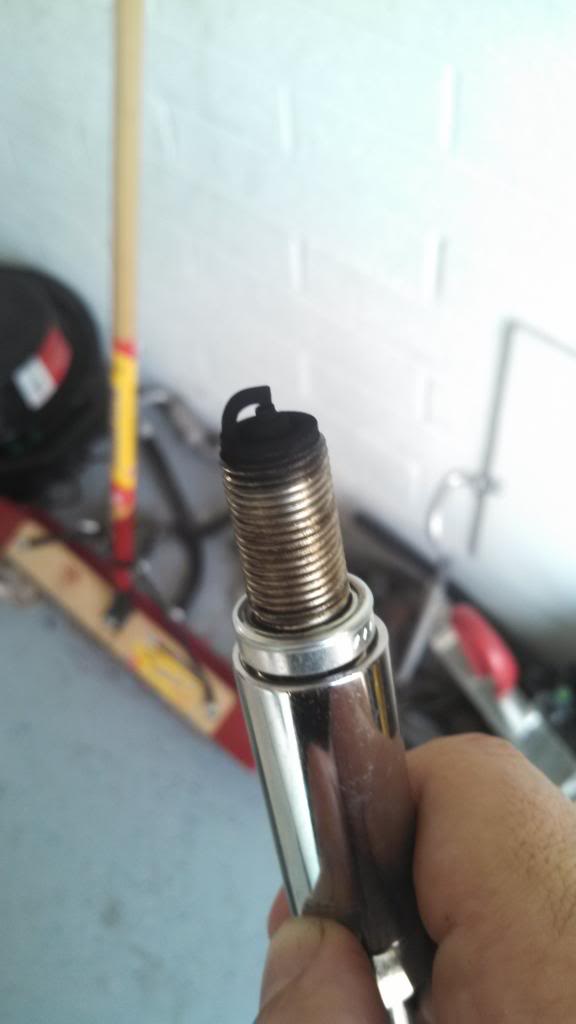
Thanks again guys.
I pulled all the plugs and they all looked like this:

Thanks again guys.
Fuel pressure rises based on how much vacuum or boost there is completely independent of the rpms. Less vac (closer to 0)=more fuel pressure, Positive boost=more fuel pressure
You need to take out a lot of fuel. 8's and 9's will damage that engine by washing the cylinder walls. I bet the plugs are fouled as can be and your o2 sensors are probably getting ruined as well.
You need to take out a lot of fuel. 8's and 9's will damage that engine by washing the cylinder walls. I bet the plugs are fouled as can be and your o2 sensors are probably getting ruined as well.
May I ask what base fuel pressure you guys are running? Most of the build threads that I have read have mentioned 48 psi to 53 psi. I had a guy tell me that mine should be set to 43.5 psi. Which seems kind of low to me. Isn't stock 52 psi?