


Exhaust theory experts needed: quietening the evoTT!


Thread Starter
New Member
iTrader: (18)
Joined: Jul 2005
Posts: 6,474
Likes: 65
From: Chapel Hill, NC
 Exhaust theory experts needed: quietening the evoTT!
I love the sound of the evoTT at WOT but long story short, I want to get rid of the drone from 1800-2500 rpms on the evoTT. I personally think it is worst at 2k rpms, city driving, so that's my primary target.
I was thinking of Tee-ing off a closed-ended 2" round pipe from the H-pipe on the evoTT. The goal here is to have a pressure wave that is exactly phase-shifted 1/2 the wavelength from the resonance that is occurring at 2k rpms.
So by my calculations, 2000 rpms, is 1000 exhaust pulses per minute * 6 cylinders = 6k pulses/min / 60 = 100 firings per second, divided over two banks for a dual exhaust. The wavelength for a 100 Hz audio signal at 400 degC (that's a guess for the temp at the H pipe in the evoTT) is 520 cm according to this link. So to generate a wavelength cancellation pulse, the pulse would travel to the end of the closed pipe and reflect back - so the pipe would have to be 1/4 the wavelength or 130 cm.
That's 4.2 feet! Are these calculations correct?
Tell me this - why doesn't a pulse from one bank cancel out the pulse from the other bank via the H pipe in the evoTT?
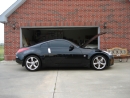
I would post a picture of the evoTT but I can't find a good one on the 'net. If anyone has a complete pic from back to front, can you post?
I was thinking of Tee-ing off a closed-ended 2" round pipe from the H-pipe on the evoTT. The goal here is to have a pressure wave that is exactly phase-shifted 1/2 the wavelength from the resonance that is occurring at 2k rpms.
So by my calculations, 2000 rpms, is 1000 exhaust pulses per minute * 6 cylinders = 6k pulses/min / 60 = 100 firings per second, divided over two banks for a dual exhaust. The wavelength for a 100 Hz audio signal at 400 degC (that's a guess for the temp at the H pipe in the evoTT) is 520 cm according to this link. So to generate a wavelength cancellation pulse, the pulse would travel to the end of the closed pipe and reflect back - so the pipe would have to be 1/4 the wavelength or 130 cm.
That's 4.2 feet! Are these calculations correct?
Tell me this - why doesn't a pulse from one bank cancel out the pulse from the other bank via the H pipe in the evoTT?
I would post a picture of the evoTT but I can't find a good one on the 'net. If anyone has a complete pic from back to front, can you post?



Thread Starter
New Member
iTrader: (18)
Joined: Jul 2005
Posts: 6,474
Likes: 65
From: Chapel Hill, NC

A banana would work, but I'm looking to maintain flow for those twin turbos, 'ya know? 
A resonator is a reasonable suggestion, but you gotta specify which one, and why. The evoTT already has two, one on each pipe, just before the H connection.
I was thinking of adding an X-pipe as a first step, just before the resonators, but I don't understand why the H that is there now doesn't do a better job of acoustic cancellation on our V6. Are the turbos complicating the acoustics here?
A resonator is a reasonable suggestion, but you gotta specify which one, and why. The evoTT already has two, one on each pipe, just before the H connection.
I was thinking of adding an X-pipe as a first step, just before the resonators, but I don't understand why the H that is there now doesn't do a better job of acoustic cancellation on our V6. Are the turbos complicating the acoustics here?

Thread Starter
New Member
iTrader: (18)
Joined: Jul 2005
Posts: 6,474
Likes: 65
From: Chapel Hill, NC
^^ That is helpful and corroborates other reports on the net. Was it a standard X-pipe or the magnaflow perforated X that you have on there now? Did you have both an X and H or did you replace the H with an X?
I have the X pipe muffler on my Borla. It came with the H pipe, which I changed to a regular X pipe, and the sound was terible. I went back to the exhaust shop and replaced it with the X pipe muffler. I can honestly say this is the best exhaust mod I have done on this car.
Trending Topics


Registered User
Joined: Feb 2008
Posts: 268
Likes: 0
From: kuwait
speaking of X-Pipes
Originally Posted by rcdash
Ok, so the H-pipe is gone. X-pipe muffler only?
I'm going to try that as a first step. Thanks.
I'm going to try that as a first step. Thanks.
 ,but since you guys brought X-pipes i`v posted a thread about it but nobody have any idea
  how to use or chose an X-pipe :
https://my350z.com/forum/intake-exha...move-rasp.html
can someone help which X-pipe will work with True Duel exhaust like APS .

Last edited by Darkness75; Jul 25, 2008 at 04:02 AM.
Thread Starter
New Member
iTrader: (18)
Joined: Jul 2005
Posts: 6,474
Likes: 65
From: Chapel Hill, NC
Originally Posted by Darkness75
sorry to hijack the thread with this issue ,but since you guys brought X-pipes i`v posted a thread about it but nobody have any idea how to use or chose an X-pipe :
https://my350z.com/forum/intake-exha...move-rasp.html
can someone help which X-pipe will work with True Duel exhaust like APS .
,but since you guys brought X-pipes i`v posted a thread about it but nobody have any idea how to use or chose an X-pipe :https://my350z.com/forum/intake-exha...move-rasp.html
can someone help which X-pipe will work with True Duel exhaust like APS .

Registered User
Joined: Jul 2008
Posts: 427
Likes: 0
From: NY/NJ/PA/FL
Originally Posted by rcdash
I love the sound of the evoTT at WOT but long story short, I want to get rid of the drone from 1800-2500 rpms on the evoTT. I personally think it is worst at 2k rpms, city driving, so that's my primary target.
I was thinking of Tee-ing off a closed-ended 2" round pipe from the H-pipe on the evoTT. The goal here is to have a pressure wave that is exactly phase-shifted 1/2 the wavelength from the resonance that is occurring at 2k rpms.
So by my calculations, 2000 rpms, is 1000 exhaust pulses per minute * 6 cylinders = 6k pulses/min / 60 = 100 firings per second, divided over two banks for a dual exhaust. The wavelength for a 100 Hz audio signal at 400 degC (that's a guess for the temp at the H pipe in the evoTT) is 520 cm according to this link. So to generate a wavelength cancellation pulse, the pulse would travel to the end of the closed pipe and reflect back - so the pipe would have to be 1/4 the wavelength or 130 cm.
That's 4.2 feet! Are these calculations correct?
Tell me this - why doesn't a pulse from one bank cancel out the pulse from the other bank via the H pipe in the evoTT?
I would post a picture of the evoTT but I can't find a good one on the 'net. If anyone has a complete pic from back to front, can you post?
I was thinking of Tee-ing off a closed-ended 2" round pipe from the H-pipe on the evoTT. The goal here is to have a pressure wave that is exactly phase-shifted 1/2 the wavelength from the resonance that is occurring at 2k rpms.
So by my calculations, 2000 rpms, is 1000 exhaust pulses per minute * 6 cylinders = 6k pulses/min / 60 = 100 firings per second, divided over two banks for a dual exhaust. The wavelength for a 100 Hz audio signal at 400 degC (that's a guess for the temp at the H pipe in the evoTT) is 520 cm according to this link. So to generate a wavelength cancellation pulse, the pulse would travel to the end of the closed pipe and reflect back - so the pipe would have to be 1/4 the wavelength or 130 cm.
That's 4.2 feet! Are these calculations correct?
Tell me this - why doesn't a pulse from one bank cancel out the pulse from the other bank via the H pipe in the evoTT?
I would post a picture of the evoTT but I can't find a good one on the 'net. If anyone has a complete pic from back to front, can you post?
an ideal exhaust creates a perpetuating flow of gas by utilizing each previous discharge as a propellent for the next, thus reducing turbulence in the flow of the escaping gas and allowing the pulses to "help each other along". to clarify this... when a pulse of gas is discharged from a cylinder into the exhaust, the discharge creates a fluctuation in pressure, and leaves behind it a low pressure "system" that aids the next pulse in being pushed through the length of the exhaust efficiently. the use of equal measure tubing headers is essential in this process because it assures that all of the discharge gas is running through the same amount of piping before it enters into the main exhaust system. the vq35de utilizes a firing order in which a cylinder in one given bank fires subsequently to the other reciprocal cylinder of the alternative bank. this allows there to be an equivalent amount of time between the exhaust pulses, thus improving this perpetual flow of gas coming out of your exhaust.
now, an H pipe is designed to equalize the pressure between the two separate exhaust pipes. it is not designed to cancel the other pulse out, it is not a resonator by any means.
the X pipe works in a different manner. i do not understand the intended purpose of the X pipe at all, it seems to me that it would create turbulence in the system and reduce efficiency in both pipes. however, the turbulence that i am assuming is existent would seemingly reduce the amount of natural resonance that is created by the particular frequency of your exhaust. this is speculation because like i said i do not understand the x pipe very well.
i am tired and slightly drunk so i will leave this for tomorrow. if anyone wants to add or correct any information, please feel free to do so.
Thread Starter
New Member
iTrader: (18)
Joined: Jul 2005
Posts: 6,474
Likes: 65
From: Chapel Hill, NC
Originally Posted by R-TuneZ
well those are some pretty nifty calculations and i am impressed, though they are slightly incorrect and irrelevant, but i do not understand your goal... simply to get rid of the rasp correct? or is this an issue of performance?
...
...
 Tell me what you think is incorrect, and better yet, show me the correct calculation.
 The purpose as stated in the first sentence of the post is: "I want to get rid of the drone from 1800-2500 rpms on the evoTT".

Sound pulses will bifurcate at any junction, depending on the diameter of the outlet pipes. If the pulse in one pipe is exactly phase shifted 1/2 wavelength from a parallel pipe, and you H-pipe them together, then I think they should cancel. Two things though: the H pipe on the evoTT is smaller than the main pipe diameter and the turbos are disturbing the acoustics.
I think before I make any changes, making a recording in the cabin with a RT audio spectrum analyzer may be worthwhile. At least I'll have some quantitative data.
That's the really nifty thing about Motordyne's new exhaust products - interchangeable components. I'm going to see if I can make changes to my current setup compatible with the dimensions for his products so that there's a possibility to swap them in.
Last edited by rcdash; Jul 25, 2008 at 04:59 AM.
Registered User
Joined: Jul 2008
Posts: 427
Likes: 0
From: NY/NJ/PA/FL
Originally Posted by rcdash
Well, I asked for feedback, but "slightly incorrect and irrelevant" is not helpful. Tell me what you think is incorrect, and better yet, show me the correct calculation.
The purpose as stated in the first sentence of the post is: "I want to get rid of the drone from 1800-2500 rpms on the evoTT".
Sound pulses will bifurcate at any junction, depending on the diameter of the outlet pipes. If the pulse in one pipe is exactly phase shifted 1/2 wavelength from a parallel pipe, and you H-pipe them together, then I think they should cancel. Two things though: the H pipe on the evoTT is smaller than the main pipe diameter and the turbos are disturbing the acoustics.
I think before I make any changes, making a recording in the cabin with a RT audio spectrum analyzer may be worthwhile. At least I'll have some quantitative data.
That's the really nifty thing about Tony's new exhaust products - interchangeable components. I'm going to see if I can make changes to my current setup compatible with the dimensions for his products so that there's a possibility to swap them in.
Tell me what you think is incorrect, and better yet, show me the correct calculation. The purpose as stated in the first sentence of the post is: "I want to get rid of the drone from 1800-2500 rpms on the evoTT".
Sound pulses will bifurcate at any junction, depending on the diameter of the outlet pipes. If the pulse in one pipe is exactly phase shifted 1/2 wavelength from a parallel pipe, and you H-pipe them together, then I think they should cancel. Two things though: the H pipe on the evoTT is smaller than the main pipe diameter and the turbos are disturbing the acoustics.
I think before I make any changes, making a recording in the cabin with a RT audio spectrum analyzer may be worthwhile. At least I'll have some quantitative data.
That's the really nifty thing about Tony's new exhaust products - interchangeable components. I'm going to see if I can make changes to my current setup compatible with the dimensions for his products so that there's a possibility to swap them in.

cheers.
Thread Starter
New Member
iTrader: (18)
Joined: Jul 2005
Posts: 6,474
Likes: 65
From: Chapel Hill, NC
Originally Posted by R-TuneZ
dont get me wrong, my post was not intended in any way as an insult. im still drunk and i am still browsing this forum, its like an addiction. let me sleep on it and i will try to help tomorrow.
cheers.
cheers.
------
Ok, a little simpler question (for anyone): in a true dual exhaust, are the sound frequencies in one bank exactly 1/2 wavelength phase shifted from the other bank?
Now that I think about it, just because the 6 firings are divided equally between two banks doesn't mean they are phase shifted from bank to bank.

Ok, that would explain why the H-pipe does nothing for acoustic cancellation. Having a T'd pipe as described in the my first post should work though. Probably best to actually do a RTA and work off the peak low freq sound though...
Last edited by rcdash; Jul 25, 2008 at 06:22 AM.
Registered User
Joined: Jul 2008
Posts: 427
Likes: 0
From: NY/NJ/PA/FL
ok a little better, i am actually in cancun right now and it is amazing, as usual .
well here is the issue with your setup. the H pipe, like i said, does not in any way act as a resonator, but rather as a means to equalize the pressure between the two pipes. you are right when you said sound/pressure waves will bifurcate at any junction, though the issue is that the entire pulse is not exposed to the redundant sound waves, preventing the rasp from being completely eliminated. you can be assured though, that the H pipe is doing something because i am sure if you are running straight 3" duals you would be getting some pretty intense rasping throughout most of the cars rpm range.
any efficient exhaust system will have this annoying resonance "rasp" because it is inherent when applying a specific frequency to any structure; the frequency being applied to the metal exhaust parts by the evenly spaced pulses traveling through the pipes. so, your goal is to somehow cancel this noise all together? you are talking about phase shifting and i said this was irrelevant because the fluctuations in pressure are traveling in different time patterns and are not able to cancel each other out with an H pipe because the phase difference is not 180 degrees, and therefore does not create anti-phase. if you were to increase the size of the H pipe you will likely find that you have only shifted the point where the rasp occurs because you are still facing the same timing dilemma. the fact that you are running TT's makes this issue even more complicated because you have to consider the defusing effect the turbine has on the flow of the gas, and also the point in the system where the oscillations are revived.
it is really an issue of how important efficiency is in your eyes. you do have several options. the X pipe will probably sooth your woes but it will also disturb the flow of exhaust causing it to be slightly less efficient. the X pipe likely destroys the timed oscillations that occur within the system and because the pressure waves are being destroyed you will find that the rasp will probably disappear. this however, will yield much better results when compared to adding an entire new resonator in the system. your T-pipe idea may also work, and it does it would be more efficient then a X pipe setup; i would like to see the design if you are planning on going through with it.
.well here is the issue with your setup. the H pipe, like i said, does not in any way act as a resonator, but rather as a means to equalize the pressure between the two pipes. you are right when you said sound/pressure waves will bifurcate at any junction, though the issue is that the entire pulse is not exposed to the redundant sound waves, preventing the rasp from being completely eliminated. you can be assured though, that the H pipe is doing something because i am sure if you are running straight 3" duals you would be getting some pretty intense rasping throughout most of the cars rpm range.
any efficient exhaust system will have this annoying resonance "rasp" because it is inherent when applying a specific frequency to any structure; the frequency being applied to the metal exhaust parts by the evenly spaced pulses traveling through the pipes. so, your goal is to somehow cancel this noise all together? you are talking about phase shifting and i said this was irrelevant because the fluctuations in pressure are traveling in different time patterns and are not able to cancel each other out with an H pipe because the phase difference is not 180 degrees, and therefore does not create anti-phase. if you were to increase the size of the H pipe you will likely find that you have only shifted the point where the rasp occurs because you are still facing the same timing dilemma. the fact that you are running TT's makes this issue even more complicated because you have to consider the defusing effect the turbine has on the flow of the gas, and also the point in the system where the oscillations are revived.
it is really an issue of how important efficiency is in your eyes. you do have several options. the X pipe will probably sooth your woes but it will also disturb the flow of exhaust causing it to be slightly less efficient. the X pipe likely destroys the timed oscillations that occur within the system and because the pressure waves are being destroyed you will find that the rasp will probably disappear. this however, will yield much better results when compared to adding an entire new resonator in the system. your T-pipe idea may also work, and it does it would be more efficient then a X pipe setup; i would like to see the design if you are planning on going through with it.
Originally Posted by rcdash
What prompted you to change from an H to an X with the HKS?
Last edited by gothchick; Jul 27, 2008 at 08:21 AM.
Thread Starter
New Member
iTrader: (18)
Joined: Jul 2005
Posts: 6,474
Likes: 65
From: Chapel Hill, NC
^ gotcha. Heard about that QC issue.
I think I'm going to try the X muffler because it's relatively low cost and easy to implement. I don't think it'll do too much for the drone except make the entire exhaust quieter (I'd prefer only low rpms are quieter). But I'll take what I can get.
To get rid of a specific resonant frequency, I think I'm going to have either get a tuned resonator or muffler or put in a pipe of a specific length. Not much room in there for another 4 ft long pipe, or resonator for that matter...
Maybe I can get 2 of Motordynes VQ mufflers to replace the evoTT's barrells. If it'll fit...
I think I'm going to try the X muffler because it's relatively low cost and easy to implement. I don't think it'll do too much for the drone except make the entire exhaust quieter (I'd prefer only low rpms are quieter). But I'll take what I can get.
To get rid of a specific resonant frequency, I think I'm going to have either get a tuned resonator or muffler or put in a pipe of a specific length. Not much room in there for another 4 ft long pipe, or resonator for that matter...
Maybe I can get 2 of Motordynes VQ mufflers to replace the evoTT's barrells. If it'll fit...