


Crank pulleys



It seems this or just puttung back the oem crank pulley may be the best way to ensure my blower is not overspinning. Changing the SC pulley from the 85mm to the 95mm does not make enough difference on the calculator. What do you think?
The pulley has an inside and an outside shell. Maybe can keep the inside shell and replace the outside shell with a smaller diameter. They said they will get back to me with what they can do and the price...
Last edited by jonnylaw; Apr 27, 2010 at 09:12 AM.

I presume I have the same one everyone else does - my A/C and P/S are still intact and fully functional, nor have I altered the factory idler pullies in any way
Last edited by Z1 Performance; Apr 27, 2010 at 09:23 AM.

Registered User
Joined: Nov 2009
Posts: 133
Likes: 2
From: Redondo Beach
I have the Fluidampr crank pulley - no issues.
I have also researched quite a bit and also came to the conclusion that Fluidampr has a more efficient design.
ATI's design is completely mechanical/rubber and works better at higher RPMs than at lower RPMs. Of course - vibration at lower RPM is not as harsh as at higher RPMs, so this might not be a negative for most people.
Since the Fluidampr uses a fluid damping method - it works better across the RPM range as a whole. But if you compare ATI to Fluidampr, performance is close to the same.
I have never heard of any issues coming from the Fluidampr or the ATI, it's always user/installation error. IMO - you really can't go wrong with either one.
I have also researched quite a bit and also came to the conclusion that Fluidampr has a more efficient design.
ATI's design is completely mechanical/rubber and works better at higher RPMs than at lower RPMs. Of course - vibration at lower RPM is not as harsh as at higher RPMs, so this might not be a negative for most people.
Since the Fluidampr uses a fluid damping method - it works better across the RPM range as a whole. But if you compare ATI to Fluidampr, performance is close to the same.
I have never heard of any issues coming from the Fluidampr or the ATI, it's always user/installation error. IMO - you really can't go wrong with either one.
Ok, so I'm a little confused on how the OD is measured and stated with the ATI/Fuildampr and the stock piece.
Basically, for calculating impellar speed, I need to know the diameter of the pulley where the belt runs, That is, at the top of the belt lands. Not the bottom of the vees, not the outer edges of the pulley where the lips are high to keep the belt from walking off:
http://www.928motorsports.com/servic...our-pulley.jpg
http://www.928motorsports.com/servic...ingpulley.html
So, when people say the Stock diameter is 5.75" and the Fluidampr OD is 6.5" and the ATI is 6.78", is the diameter being measured like above, or is it being measured straight across the face with the higher lip (not the measure I am looking for)?
If someone has a OEM, Fluidampr, or ATI unit handy and can properly measure it, described in the method above, or straight across to see which stated diameter is being referenced I would appreciate it!
Also, I'm sitll confused on the Fluidampr. If it is 3/4" larger than stock, how can you retain the stock belts? This is why I am asking to see how the stated diameter is measured.
thx.
Basically, for calculating impellar speed, I need to know the diameter of the pulley where the belt runs, That is, at the top of the belt lands. Not the bottom of the vees, not the outer edges of the pulley where the lips are high to keep the belt from walking off:
http://www.928motorsports.com/servic...our-pulley.jpg
http://www.928motorsports.com/servic...ingpulley.html
So, when people say the Stock diameter is 5.75" and the Fluidampr OD is 6.5" and the ATI is 6.78", is the diameter being measured like above, or is it being measured straight across the face with the higher lip (not the measure I am looking for)?
If someone has a OEM, Fluidampr, or ATI unit handy and can properly measure it, described in the method above, or straight across to see which stated diameter is being referenced I would appreciate it!
Also, I'm sitll confused on the Fluidampr. If it is 3/4" larger than stock, how can you retain the stock belts? This is why I am asking to see how the stated diameter is measured.
thx.
Last edited by jonnylaw; Apr 27, 2010 at 07:56 PM.
thx.
Last edited by jonnylaw; Apr 27, 2010 at 07:54 PM.
Also, does anyone know how well the oem crank pulley will hold up to ~400/400. I'm not sure which would be better, protecting the crank more, or ensuring that my SC is not overspinning..

I have the Fluidampr crank pulley - no issues.
I have also researched quite a bit and also came to the conclusion that Fluidampr has a more efficient design.
ATI's design is completely mechanical/rubber and works better at higher RPMs than at lower RPMs. Of course - vibration at lower RPM is not as harsh as at higher RPMs, so this might not be a negative for most people.
Since the Fluidampr uses a fluid damping method - it works better across the RPM range as a whole. But if you compare ATI to Fluidampr, performance is close to the same.
I have never heard of any issues coming from the Fluidampr or the ATI, it's always user/installation error. IMO - you really can't go wrong with either one.
I have also researched quite a bit and also came to the conclusion that Fluidampr has a more efficient design.
ATI's design is completely mechanical/rubber and works better at higher RPMs than at lower RPMs. Of course - vibration at lower RPM is not as harsh as at higher RPMs, so this might not be a negative for most people.
Since the Fluidampr uses a fluid damping method - it works better across the RPM range as a whole. But if you compare ATI to Fluidampr, performance is close to the same.
I have never heard of any issues coming from the Fluidampr or the ATI, it's always user/installation error. IMO - you really can't go wrong with either one.

Registered User
Joined: Oct 2009
Posts: 507
Likes: 0
From: Davie
At what horsepower should this be considered a necessity? Im assuming stock blocks won't really see much of a benefit from this but its comforting to know that this'll cause less strain on my crank if i were to get it... FI wise


However, I'm not sure if the added stress/load caused by FI on a stock engine, would truly benefit from a dampened pulley like the ATI/Fluidampr.
Also, it should be noted that the same crank pulley (part nunber) is used on Infiniti G35 coupes/350z from 2003-2007. So that includes both nonrevup engine (6600 redline) and revup engines (7000 rpms).
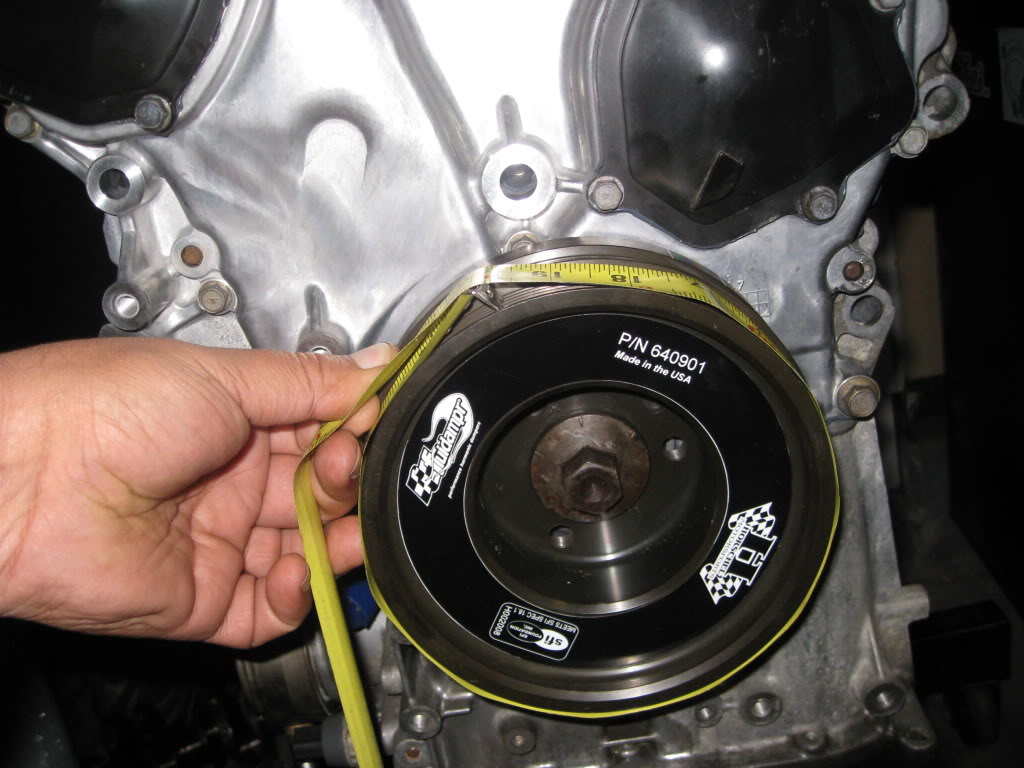
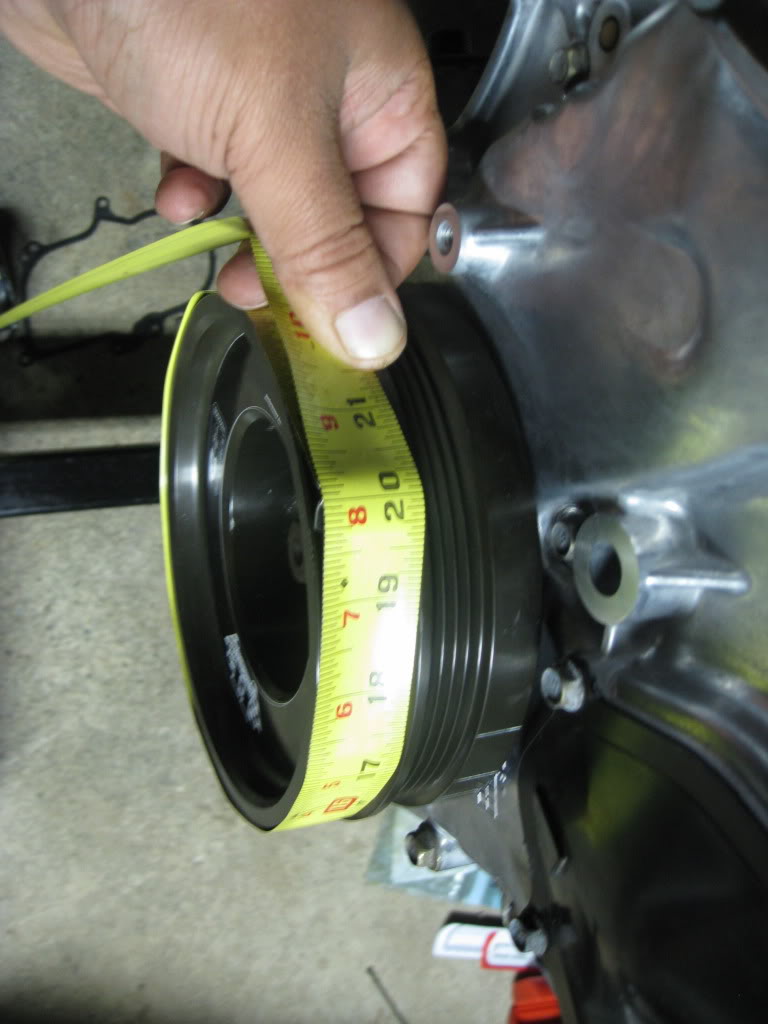
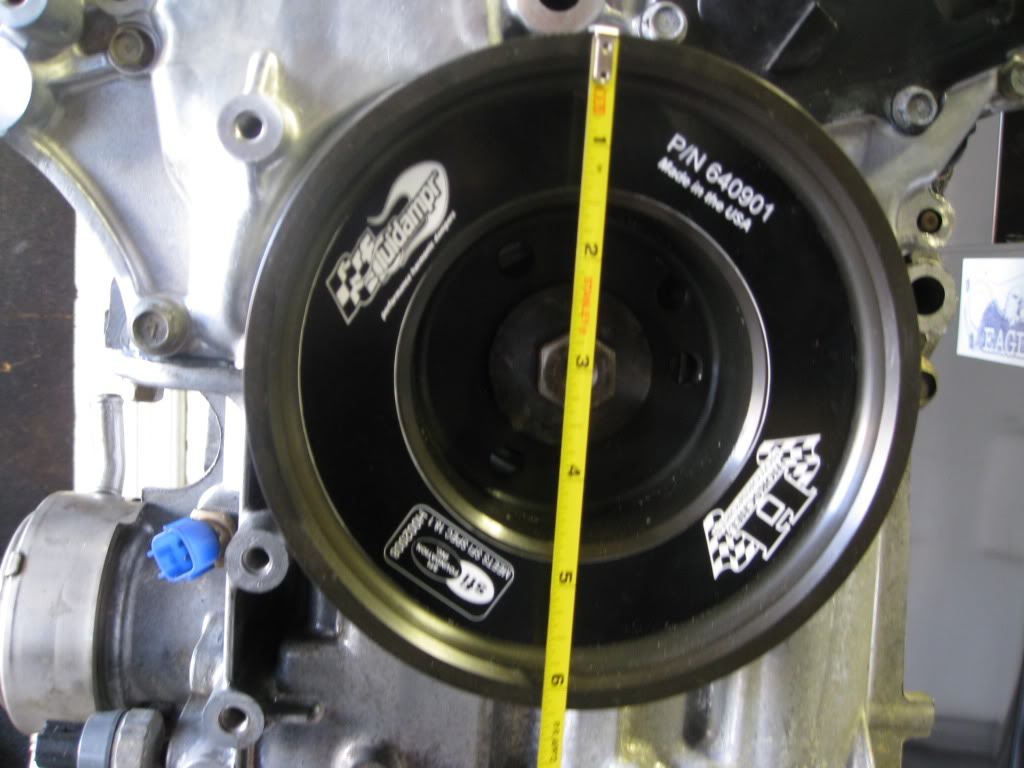
I spoke with ATI and Fluidamper on the actual OD, measured from where the belt sits and they are as follows:
ATI: 6.610"
Fluidampr: 6.125"
Everyone says the stock is 5.745", but I haven't actually measured myself.
If I had originally bought the Fluidampr, instead of the ATI, I might have left it on, and not rev'd past 6500. However, the ATI is just too big for my application...

^^possible, there was some confusion over measurement from where the belt would sit. It's either 6 1/8" or 6 1/4". Measurement by Glex were also ~6.25"
I'm pretty sure this difference in Fluidampr diameter from stock would still require different belt(s). Maybe Glex can verify when he puts on accesory belts.
I'm pretty sure this difference in Fluidampr diameter from stock would still require different belt(s). Maybe Glex can verify when he puts on accesory belts.

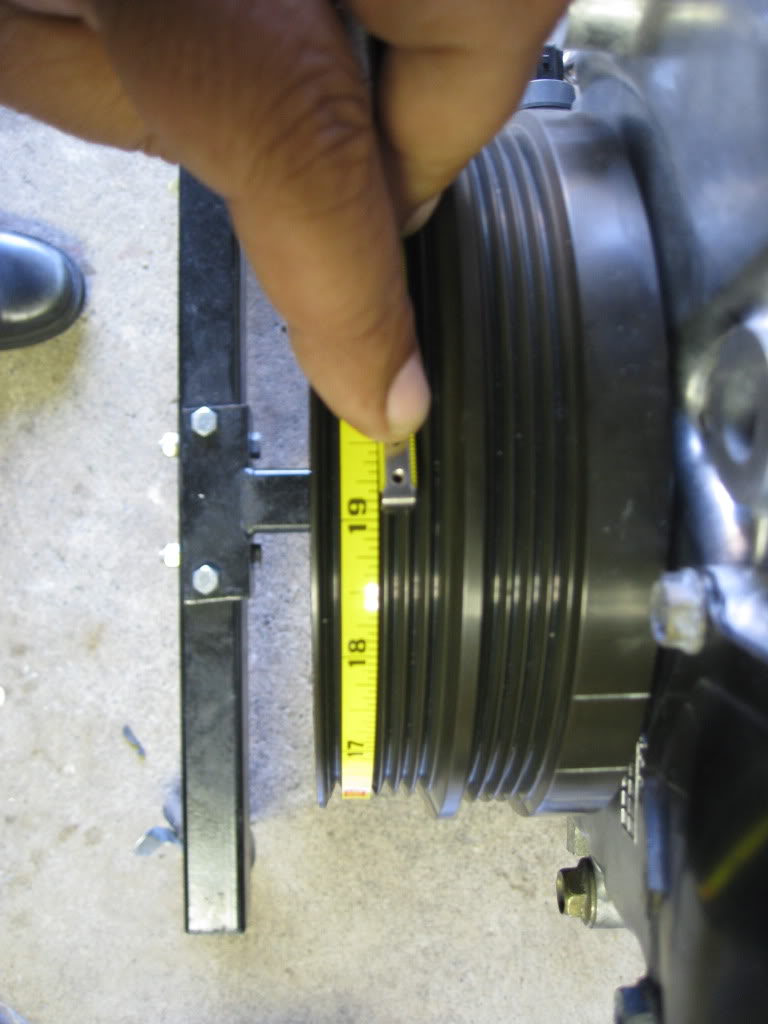
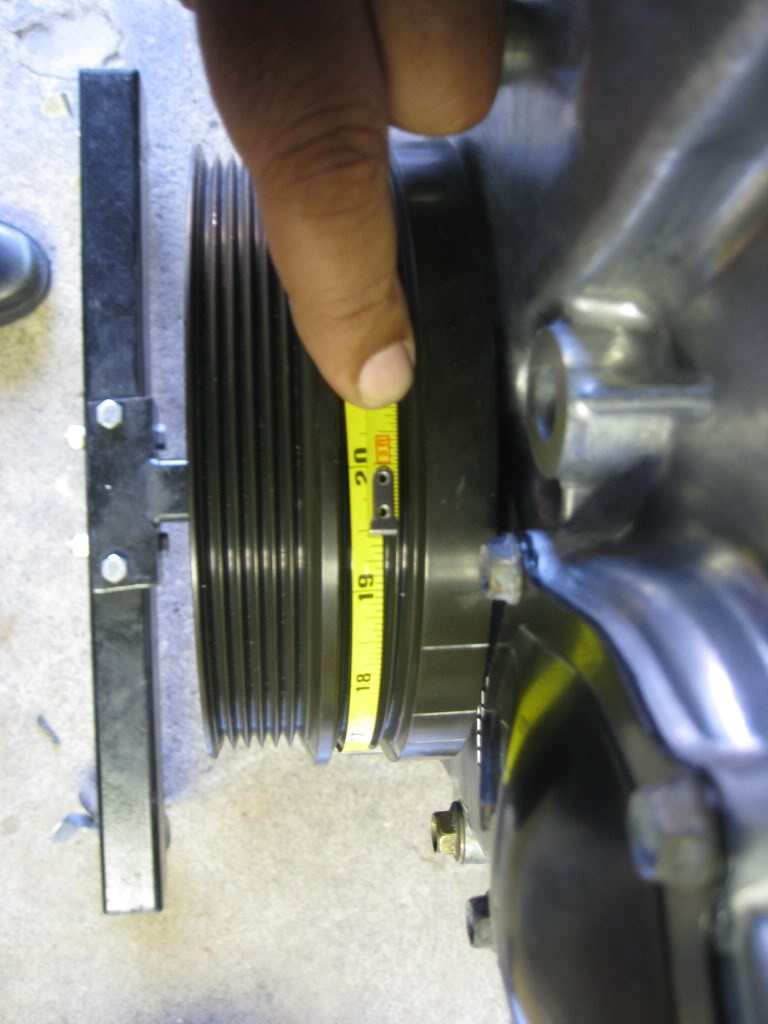
Fluidampr VS OEM
It appears that the pullery that runs the AC is the same diamaeter but the pulley that runs the PS and AL will be overdriven due to the larger pulley diameter.
Also the overall height of the FD is about 2mm over stock ie: it will sit 2mm further away from the enigine.
One other point of concern is the timing markers which do not appear to be the same as OEM. Can anyone comment on this?
Summary:
OEM 165mm and 150mm
FD 165mm and 158mm
NOTE: this is not measured to the top of the teeth so give or take 2mm from edge to teeth. There is a bit of paralax error in the photos


It appears that the pullery that runs the AC is the same diamaeter but the pulley that runs the PS and AL will be overdriven due to the larger pulley diameter.
Also the overall height of the FD is about 2mm over stock ie: it will sit 2mm further away from the enigine.
One other point of concern is the timing markers which do not appear to be the same as OEM. Can anyone comment on this?
Summary:
OEM 165mm and 150mm
FD 165mm and 158mm
NOTE: this is not measured to the top of the teeth so give or take 2mm from edge to teeth. There is a bit of paralax error in the photos
Last edited by MR RIZK; Apr 30, 2010 at 10:04 PM.