


Resonation boxes on factory intakes??


Thread Starter
Registered User
iTrader: (1)
Joined: Dec 2009
Posts: 185
Likes: 0
From: Houston, Texas
 Resonation boxes on factory intakes??
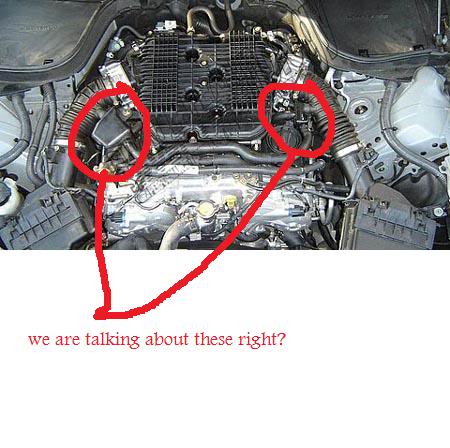
Has anybody removed the three resonation boxes (or whatever they are officially called) that are a part of the factory intake system? There are two incorporated into the vaccum system and the third is a closed box that simply acts as a muffler for the intake.
Do you think by removing them it will cause any positive or negative affects? One thing is for sure, it makes the stock intakes with K&N filters sound great.
I decided that these pieces were completely uneccesary and decided to remove them. I bought 5/8 inch heater hose, 3/4 - 5/8 hose connectors, a 5/8 T junction and a 5/8 x 3/4 rubber stopper for the third box hole.
After removing the strut tower bar and engine cover, I started on the passenger side intake. First I removed the resonation box that fit directly into the intake hose. I replaced it with the 3/4-5/8 hose connector and then used a 3 inch piece of 5/8 hose to fill the gap where the box had been.
On the other side I used the T-junction to replace the small box between the driver side intake, the breather and the hose coming from the passenger side.
Underneath the intake hose there is a third box. This box seems like it was added as an after thought in order to quiet the intake. The reason I believe it was an after thought is because it has foam insulation on the bottom to keep it from rattling on the AC lines below. Why would a good engineer design a system that is supposed to make something quiet, but only causes more noise, unless it was an afterthought?
I plugged the hole for the third box and clamped all the connections down. I then cleaned my throttle bodies and MAFs. After doing all of this I immediately noticed a difference in throttle response and the intakes have a sound that is now close to an intake with a cone filter. I don't know if removing the boxes made the difference or cleaning the TBs and MAFs, but there is a noticeable difference in power delivery and sound.
Do you think by removing them it will cause any positive or negative affects? One thing is for sure, it makes the stock intakes with K&N filters sound great.
I decided that these pieces were completely uneccesary and decided to remove them. I bought 5/8 inch heater hose, 3/4 - 5/8 hose connectors, a 5/8 T junction and a 5/8 x 3/4 rubber stopper for the third box hole.
After removing the strut tower bar and engine cover, I started on the passenger side intake. First I removed the resonation box that fit directly into the intake hose. I replaced it with the 3/4-5/8 hose connector and then used a 3 inch piece of 5/8 hose to fill the gap where the box had been.
On the other side I used the T-junction to replace the small box between the driver side intake, the breather and the hose coming from the passenger side.
Underneath the intake hose there is a third box. This box seems like it was added as an after thought in order to quiet the intake. The reason I believe it was an after thought is because it has foam insulation on the bottom to keep it from rattling on the AC lines below. Why would a good engineer design a system that is supposed to make something quiet, but only causes more noise, unless it was an afterthought?
I plugged the hole for the third box and clamped all the connections down. I then cleaned my throttle bodies and MAFs. After doing all of this I immediately noticed a difference in throttle response and the intakes have a sound that is now close to an intake with a cone filter. I don't know if removing the boxes made the difference or cleaning the TBs and MAFs, but there is a noticeable difference in power delivery and sound.
Last edited by Sooner350; Oct 8, 2010 at 02:26 PM.

those are called Oil catch cans, they are there to keep any oil that blows out of the crank case from going back into the intake system.. i would put them back if i where you. or get the ARC catch can. you are noticing what we call a "placebo effect" the removal of those catch cans is bad in the long run unless replaced by other catch cans.






 and their purpose on the intake system.

Trending Topics
The volumetric efficiency and resonators in an air intake system are two closely related terms for the performance of naturally aspirated internal combustion engines. This article will discuss Helmholtz resonator designs and how intake resonators work.
The intake manifolds of modern naturally aspirated IC engines are integrated with resonators. The purpose of the Helmholtz resonator is to improve the volumetric efficiency of the engine and also to help with engine sound attenuation. This is possible due to the special features of the Helmholtz resonator designs.
What is the Volumetric Efficiency of an IC Engine?
The volumetric efficiency of an IC engine is the ratio of the volume of air fuel mixture (or air) entered into the combustion cylinder to the volume of the cylinder when the piston is at bottom dead center. The volumetric efficiency is directly related to the torque output of the engine. Turbocharged engines can easily achieve a volumetric efficiency over 100%. For naturally aspirated engines, higher volumetric efficiency is achieved by using resonators integrated with the inlet manifold design.
Read more: http://www.brighthub.com/engineering...#ixzz11u2shWvh
The intake manifolds of modern naturally aspirated IC engines are integrated with resonators. The purpose of the Helmholtz resonator is to improve the volumetric efficiency of the engine and also to help with engine sound attenuation. This is possible due to the special features of the Helmholtz resonator designs.
What is the Volumetric Efficiency of an IC Engine?
The volumetric efficiency of an IC engine is the ratio of the volume of air fuel mixture (or air) entered into the combustion cylinder to the volume of the cylinder when the piston is at bottom dead center. The volumetric efficiency is directly related to the torque output of the engine. Turbocharged engines can easily achieve a volumetric efficiency over 100%. For naturally aspirated engines, higher volumetric efficiency is achieved by using resonators integrated with the inlet manifold design.
Read more: http://www.brighthub.com/engineering...#ixzz11u2shWvh
Last edited by Chris@FsP; Oct 9, 2010 at 02:22 PM.


Registered User
Joined: Dec 2005
Posts: 15
Likes: 0
From: Rep the IE
They look like oil separators and when in the intake they pull a vacuum on the crank case and help pull the rings down from the bottom side and seal combustion slightly better and with that you could see a performance increase this is why on turbo cars they will be relocated to the intake side of the turbo and clock them towards the wheel of the turbo also NA would help if there clocked toward the throttle body as well to increase vacuum due to scavenging effects..
Side note "if they where used for resonance to increase VE" as soon as you change the intakes lengths or diameter or type of metal mild steal vs aluminum vs rubber tubes you would also need to study how wave forms are and adjust where your resonators will go..
Me,Jim & Clark @ Jim Wolf Technology one day while tuning my race car on the dyno we ran across some interesting things with intakes I will start with saying my MAF is in front of my tire right at the bumper with the filter. The farther we placed the MAF the more HP we made. Stock location vs a 3' intake to MAF was about 4WHP difference..
Also I have been working/tuning Nissans for about 15 years now and have learned quite a bit of stuff. I know a few will probably say I don't know what I am talking about and thats okay it happens every time and is why I don't do much posting but here you go.


Thread Starter
Registered User
iTrader: (1)
Joined: Dec 2009
Posts: 185
Likes: 0
From: Houston, Texas
Those boxes pictured are the ones I removed. The third is on the under side of the driver side intake.
I was hoping to get a serious answer. Thanks to those that did so. I rarely post on this forum because I do not want to add to the useless garbage that so many contribute for the sake of post counts.
In no way did I believe this increased power by a noticable amount. However, after making this change and cleaning the MAFs and TBs it does run better and is noticably louder.
IMO
The boxes cannot be a catchcan type device because the oil would eventually build up and find its way back into the intake tract. They do not seem to work with the volumetric efficency theory because they are not a closed system. They both have an inlet (or multiple) and an outlet, which will not create the Helmoltz resonation effects.
The volumetric efficiency theory seems like it only works on the third box (unpictured) which is below the driver side intake. That being said, I read the study on planetsoarer.com, and it seems that it is only optimised for a certain RPM. Also, why would the closed system be on just one side?
I simply thought of it as a muffler slowing and quieting airflow, not increasing it. If this box increases efficency or power or makes throttle response better, I have no problem putting it back. So far I have not noticed any adverse effects in MPG, acceleration or drivability.
I was hoping for a definitive answer. Below is what the system looks like now. Shagspeed and Chris@FsP, you both seem knowlegable and willing to help. Is what I have done going to hurt on track performance in any way? Should I just put it back to factory spec. So far I have not noticed any adverse effects in MPG, acceleration or drivability.
I was hoping to get a serious answer. Thanks to those that did so. I rarely post on this forum because I do not want to add to the useless garbage that so many contribute for the sake of post counts.
In no way did I believe this increased power by a noticable amount. However, after making this change and cleaning the MAFs and TBs it does run better and is noticably louder.
IMO
The boxes cannot be a catchcan type device because the oil would eventually build up and find its way back into the intake tract. They do not seem to work with the volumetric efficency theory because they are not a closed system. They both have an inlet (or multiple) and an outlet, which will not create the Helmoltz resonation effects.
The volumetric efficiency theory seems like it only works on the third box (unpictured) which is below the driver side intake. That being said, I read the study on planetsoarer.com, and it seems that it is only optimised for a certain RPM. Also, why would the closed system be on just one side?
I simply thought of it as a muffler slowing and quieting airflow, not increasing it. If this box increases efficency or power or makes throttle response better, I have no problem putting it back. So far I have not noticed any adverse effects in MPG, acceleration or drivability.
I was hoping for a definitive answer. Below is what the system looks like now. Shagspeed and Chris@FsP, you both seem knowlegable and willing to help. Is what I have done going to hurt on track performance in any way? Should I just put it back to factory spec. So far I have not noticed any adverse effects in MPG, acceleration or drivability.
Last edited by Sooner350; Oct 11, 2010 at 01:30 PM.
The only to really tell is back to back dyno, or back to back lap or 1/4mi times.
Thread Starter
Registered User
iTrader: (1)
Joined: Dec 2009
Posts: 185
Likes: 0
From: Houston, Texas
Oh well it filled a Sunday afternoon while the Cowboys had a bye week.

Registered User
Joined: Aug 2006
Posts: 75
Likes: 0
From: Kuwait
My opinion is that they're installed to reduce NVH. The G35 HR sedan for example also comes with 2 large resonator boxes that connect to each intake box. Removing them will slightly increase noise and this is noticeable intake noise. No effect on power at all.

Your right

After reading this and the linked article and it's sources I am going to give this a try. I did a little looking around and from what I can tell (it was hard to find good pictures), the aftermarket intake systems (such as Injen) still attach to and utilize this system. So, is it really ok to ditch it?.. and to what extent can you delete it? I come from a VW and let me tell you, we had some smart guys on that forum and we ditched just about everything possible under the hood. However, it doesn't seem like people are very willing to experiment here on MY350Z.com.
It sounds to me that the 3rd box located under the drivers side intake hose is definitely just a resonator, and pulling it won't affect anything. What's odd to me though is that there is only one on THAT side. However, maybe only one is necessary because the two intakes are interconnected by the hose that runs between them.
Next, I'm trying to figure out exactly what the two boxes (besides the third under the drivers side intake) are actually for. Perhaps they are resonators as well but work even though they have multiple orifices. Is that possible? Or perhaps they are in fact oil catch systems of sort; but as the Sooner pointed out, they would eventually just overflow and be useless. There is no documentation in my service manual about emptying any catch cans. =P
Coming from a turbocharged engine I am familiar with catch cans, PCV valves, and crankcase ventilation. I am going to actually dig around on my car so I can see where that hose is coming from that goes to the bottom of the engine, and if there are any check valves on it. Crank cases need to breath because of blow-by past the rings, but it's debated on whether or not you really need any suction force pulling the gasses out. Some think that it helps seal the rings but I'm not so sure about that.. especially on an N/A application where the suction force is minimal. The blow-by gasses and condensed oil are what would collect in the two boxes, or catch cans, so that they aren't reintroduced into the engine in the intake air. Well actually, modern day emissions calls that these gasses ARE reintroduced so that they can be burned again, reducing final emissions. That's why people will put aftermarket catch cans on their cars, trying to benefit the cars (emissions folks are more concerned with the environment than the HP our cars make...). With that said, the only possible thing I can think those boxes are there for is sound resonation, and that they are only there to make the car quieter. I am interested to see if there is even any baffling inside them (which would be used to "catch" condensed oil), and I highly doubt there is.
That being said, if they are in fact attached to the crank case, there should be some oil residue built up inside them. If that's the case, then introducing a real and effective catch can into the system would perhaps be beneficial. But, these vapors aren't too harmful to the engine I don't think. They do more harm to a turbo charger than a throttle body and valves IMO so I wouldn't bother personally since we're N/A.
Oh and by the way, in case you didn't read all of the articles, intake tuning as far as performance goes only occurs in the intake runners and plenum. So any intake tuning that occurs before the throttle body is for audible sound only, not performance.
SO, I believe that removing all of the boxes is perfectly fine, as long as you don't mind the extra sound (I know that I personally WANT the extra sound 8-) haha).
Now, I just need to find out if they're just there for crankcase ventilation. If so, there are a few options.
1) Keep the system as is, allowing the crankcase to vent, and using the intake forces to pull crankcase gases out of the crank, *possibly* helping the rings seal. This shouldn't have any adverse effect on the engine even without the boxes or an aftermarket catch can.
2) Get rid of the black boxes. Car will be louder and that's it.
3) Get rid of everything and plug the holes in the intakes, and either put a breather valve on the crankcase line or just vent it to atmosphere. Or you can route it to the exhaust if you really want to get fancy. But, I am still unsure if there is another reason the intake hoses are connected...
What I am curious about is why Nissan designed the two intake hoses connecting like that. Is it only for sound resonation purposes? Or is it because they wanted both intake tracts to have pull on the crankcase gases? But most importantly, I'm looking at this from a performance perspective.
That brings me to my main question. I am no expert on engines and this is my first dual throttle body engine to work with, but is it necessary to have the two intake hoses connected like that? What about just plugging all of the holes and ditching it all? I can't tell, but it seems that the two intake tracts are completely separate from each other all the way into the heads (except for this one connecting hose). In other words, the two intake tracts do NOT combine in the upper plenum. Can anyone confirm this? If that's the case, I wonder if the hose is there for any real reason other than crankcase ventilation and/or sound resonation.
Disclaimer: This is all my personal speculation and the result of being a hobbyist and doing a lot of reading. I am definitely not an expert and it's not my profession to work on cars, so do all of this at your own risk!
BTW, great and helpful pictures here: 3 5 0 z - t e c h .com/zwiki/VQ35HR (without spaces of course.. sigh):
It sounds to me that the 3rd box located under the drivers side intake hose is definitely just a resonator, and pulling it won't affect anything. What's odd to me though is that there is only one on THAT side. However, maybe only one is necessary because the two intakes are interconnected by the hose that runs between them.
Next, I'm trying to figure out exactly what the two boxes (besides the third under the drivers side intake) are actually for. Perhaps they are resonators as well but work even though they have multiple orifices. Is that possible? Or perhaps they are in fact oil catch systems of sort; but as the Sooner pointed out, they would eventually just overflow and be useless. There is no documentation in my service manual about emptying any catch cans. =P
Coming from a turbocharged engine I am familiar with catch cans, PCV valves, and crankcase ventilation. I am going to actually dig around on my car so I can see where that hose is coming from that goes to the bottom of the engine, and if there are any check valves on it. Crank cases need to breath because of blow-by past the rings, but it's debated on whether or not you really need any suction force pulling the gasses out. Some think that it helps seal the rings but I'm not so sure about that.. especially on an N/A application where the suction force is minimal. The blow-by gasses and condensed oil are what would collect in the two boxes, or catch cans, so that they aren't reintroduced into the engine in the intake air. Well actually, modern day emissions calls that these gasses ARE reintroduced so that they can be burned again, reducing final emissions. That's why people will put aftermarket catch cans on their cars, trying to benefit the cars (emissions folks are more concerned with the environment than the HP our cars make...). With that said, the only possible thing I can think those boxes are there for is sound resonation, and that they are only there to make the car quieter. I am interested to see if there is even any baffling inside them (which would be used to "catch" condensed oil), and I highly doubt there is.
That being said, if they are in fact attached to the crank case, there should be some oil residue built up inside them. If that's the case, then introducing a real and effective catch can into the system would perhaps be beneficial. But, these vapors aren't too harmful to the engine I don't think. They do more harm to a turbo charger than a throttle body and valves IMO so I wouldn't bother personally since we're N/A.
Oh and by the way, in case you didn't read all of the articles, intake tuning as far as performance goes only occurs in the intake runners and plenum. So any intake tuning that occurs before the throttle body is for audible sound only, not performance.
SO, I believe that removing all of the boxes is perfectly fine, as long as you don't mind the extra sound (I know that I personally WANT the extra sound 8-) haha).
Now, I just need to find out if they're just there for crankcase ventilation. If so, there are a few options.
1) Keep the system as is, allowing the crankcase to vent, and using the intake forces to pull crankcase gases out of the crank, *possibly* helping the rings seal. This shouldn't have any adverse effect on the engine even without the boxes or an aftermarket catch can.
2) Get rid of the black boxes. Car will be louder and that's it.
3) Get rid of everything and plug the holes in the intakes, and either put a breather valve on the crankcase line or just vent it to atmosphere. Or you can route it to the exhaust if you really want to get fancy. But, I am still unsure if there is another reason the intake hoses are connected...
What I am curious about is why Nissan designed the two intake hoses connecting like that. Is it only for sound resonation purposes? Or is it because they wanted both intake tracts to have pull on the crankcase gases? But most importantly, I'm looking at this from a performance perspective.
That brings me to my main question. I am no expert on engines and this is my first dual throttle body engine to work with, but is it necessary to have the two intake hoses connected like that? What about just plugging all of the holes and ditching it all? I can't tell, but it seems that the two intake tracts are completely separate from each other all the way into the heads (except for this one connecting hose). In other words, the two intake tracts do NOT combine in the upper plenum. Can anyone confirm this? If that's the case, I wonder if the hose is there for any real reason other than crankcase ventilation and/or sound resonation.
Disclaimer: This is all my personal speculation and the result of being a hobbyist and doing a lot of reading. I am definitely not an expert and it's not my profession to work on cars, so do all of this at your own risk!
BTW, great and helpful pictures here: 3 5 0 z - t e c h .com/zwiki/VQ35HR (without spaces of course.. sigh):
Last edited by AadosX; Nov 30, 2010 at 08:31 AM.