


Built HR *Broken Cam*


I would like to set the record straight:
There were some issues with Jays build, everything they say is true; however S&R did step to the plate and fixed every issue with this particular build.. S&R came out of pocket for a new ECU because an O2 sensor was rubbing on the exhaust. Bottom line is I will make mistakes and my techs will make mistakes. We do deliver about 80 cars a month out of this shop and tune about 30 cars a month. We stand behind our work 100%
1. I have loan out my truck & trailer
2. I have loan out my computer to use my Osiris software and cable
3. Loan tools
On this build
We removed a twin turbo kit from a totaled out Nismo that Performance Factory converted from a DE to fit a HR. Enough said there.
In the process of build the engine the harness was removed and reinstalled and found tons of problems. We spent tons of hours trying to figure out this problem and never charge a dime of labor. Later we found out that Nissan had released a bunch of bad harnesses (source is local Infinti of Tampa)
During the dyno tuning a rag got sucked up in the trans and wiped out the slave. S&R fault and fixed.
Oil line somehow pulled itself off a barb fitting. S&R got better lines and fittings, no charge to the customer. If im right it wasn’t even a part we supplied.
When the engine came out the second time we had the turbo’s sent out for inspection and tear down to verify there was no damage created by the wrong sized couplers and T-bolt clamps that was supplied in the used turbo kit.
I am sure there are a few little things I left out, we did build this car two years ago and yes it has been a ongoing issue with mostly electrical problems . S&R doesn’t hide from our mistakes we embrace them and learn from them.
Bobby Ralston
President
There were some issues with Jays build, everything they say is true; however S&R did step to the plate and fixed every issue with this particular build.. S&R came out of pocket for a new ECU because an O2 sensor was rubbing on the exhaust. Bottom line is I will make mistakes and my techs will make mistakes. We do deliver about 80 cars a month out of this shop and tune about 30 cars a month. We stand behind our work 100%
1. I have loan out my truck & trailer
2. I have loan out my computer to use my Osiris software and cable
3. Loan tools
On this build
We removed a twin turbo kit from a totaled out Nismo that Performance Factory converted from a DE to fit a HR. Enough said there.
In the process of build the engine the harness was removed and reinstalled and found tons of problems. We spent tons of hours trying to figure out this problem and never charge a dime of labor. Later we found out that Nissan had released a bunch of bad harnesses (source is local Infinti of Tampa)
During the dyno tuning a rag got sucked up in the trans and wiped out the slave. S&R fault and fixed.
Oil line somehow pulled itself off a barb fitting. S&R got better lines and fittings, no charge to the customer. If im right it wasn’t even a part we supplied.
When the engine came out the second time we had the turbo’s sent out for inspection and tear down to verify there was no damage created by the wrong sized couplers and T-bolt clamps that was supplied in the used turbo kit.
I am sure there are a few little things I left out, we did build this car two years ago and yes it has been a ongoing issue with mostly electrical problems . S&R doesn’t hide from our mistakes we embrace them and learn from them.
Bobby Ralston
President
Last edited by S&R Performance; Apr 5, 2011 at 05:02 PM.

Thanks for sharing.
+1: I haven't seen a broken camshaft in the VQ's over the years but I agree oem cams in general are brittle as hell and do not take well to any type of impact. The point about stiffer valve trains is a good one. Many years ago we saw damaged/bent buckets and worn camshafts from using stiff springs without upgrading to billet lifters You don't often see OEM cams used on big builds so perhaps the OE cams are just not sufficiently strong and degraded over time. Every little piece of information will improve the community's knowledge base.
Thanks for sharing.
Thanks for sharing.

something that i do find interested, arnt these cams all billet steel? ive seen lobes break off of sbc cams, or simply worn away coughcoughlate90'sanyonecoughcough, but never broken like this the pin that holds the cam in place should break far before the cam itself, again my experience is in old school v8s but those engines are running cast iron cams in most cases with 500lbs+ spring pressure with no such issue. the issues they did have where solved when people started using high zinc content oils due to extreme forces from high pressure springs and flat tappet cams, which i dont think extreme pressures are whats at work here. it seems very strange for the cam to break in that place. not attacking it just seem curious to me so dont take it that way. im starting to think we need more people in the industry like nelson racing engines =/ manufactures, engine builders, machine shops everyone. 1600hp with a 24 month 24000 mile warranty anyone? and gamer no offense but your arguement dosnt make alot of sense, just because a engine is putting out alot more power dosnt mean theres more stress on a cam. when the engine is making power both valves are closed so there the same amount of force on the cam no matter how much power it is making. as far as power being applied to the cam snout it also dosnt work that way, the amount of power needed to drive the cams dosnt change unless you change springs. if a engine is making 500 hp and it takes 50 hp to spin the cams, when you up it to 1k hp it still only takes 50 hp to spin them if you dont mess with the valvetrain. theres nothing magical that makes the cams take more abuse at higher powers the amount of stress on them is only affected by timing chain tension and spring pressures of the valvetrain it makes. the friction in these two items and the pressure of the springs determine how much power it takes to rotate the cams.
that would be a stretch to cause. that would cause a localized force being presented against the cam, and typically (bearing the actual structural integrity of the cam), you should see the break AT that lobe. this, too, has happened on other cars that i have seen in the past. for a cam to break at the front such as this, it is either portraying a fault in the casting of the cam itself, or an over all force against all the lobes (i.e. all springs too stiff) which then leads to a break in the one weak spot of the cam design.
this is all still conjecture, though. until i see the actual part, we can all play the guessing game. i just tend to look at things from an engineering perspective.
this is all still conjecture, though. until i see the actual part, we can all play the guessing game. i just tend to look at things from an engineering perspective.
Last edited by jerryd87; Apr 5, 2011 at 08:08 PM.
i dont mean to be a *** as some/many people havnt done the work themselves, but there are also several who have. i dont have the big *** machines to install sleeves and bore a engine but i do know how to put togeather an engine for example, with torque specs and clearances, just my experience is on another platform. might even have some pics left of the suspension i built for my camaro but idk i know i have some pics of the engine still. heck only reason im having someone build this engine instead of ordering everything and doing it myself is because i want the engine done when i get back, not have to wait for 3 weeks to get the machine work done then assemble it and break it in =/ like i said above i just think it is a bit "odd" i guess seeing it fail at the point where it appears the bolt threads end. i wont make any comment on the battered bolt since no pic of the bolt was posted but a cam bolt shoulnt have any deformity but it could have been caused when the cam snapped.
Unfortunatly every tech behind the keyboard knows how to build/repair cars thanks to forums.Or at least they read about it so now they are qaulified.I have seen numerous failures like this with oem parts at oem build levels.Once you subject it to greater forces,the weakest link will show it's face.If it wasn't effected by greater force as mentioned then why do you need better head studs,or valve springs,as examples.Until each person here has done this work by themselves,how can you argue a qaulified tech's defense.

i dont mean to be a *** as some/many people havnt done the work themselves, but there are also several who have. i dont have the big *** machines to install sleeves and bore a engine but i do know how to put togeather an engine for example, with torque specs and clearances, just my experience is on another platform. might even have some pics left of the suspension i built for my camaro but idk i know i have some pics of the engine still. heck only reason im having someone build this engine instead of ordering everything and doing it myself is because i want the engine done when i get back, not have to wait for 3 weeks to get the machine work done then assemble it and break it in =/ like i said above i just think it is a bit "odd" i guess seeing it fail at the point where it appears the bolt threads end. i wont make any comment on the battered bolt since no pic of the bolt was posted but a cam bolt shoulnt have any deformity but it could have been caused when the cam snapped.
My thought was that while the amount of power need to turn the cam may stay the same, the inertia created by having more power spinning the cam would be greater. Kind of like if you take a bicycle with the wheels off the ground and you stomp on the pedal really quick. The quick jolt of power I would think could take it's toll on the cam shaft over time.
I also think you brought up a good point about the valve springs. If I remember correctly, stiffer valve springs were put in which means the stocks cams would have been experiencing more resistance than stock which absolutely could have caused this failure.
Hmmmm, if there are bigger springs in that head, I think that may be the culprit.
Last edited by GAMERMODZoCOM; Apr 5, 2011 at 08:41 PM.
if this where something further along in the drive train or the crank a sudden jolt would cause something to break when launching the car. however the engine is already spinning and it gradually accelerates in rpms so theres no real jolt in power. springs could potentially be the issue i just said i have never seen it before, like others have posted and i did as well i would have thought the pin would snap first its what 1/10 the size of the material that broke being conservative? now at higher rpms the cams will see higher stresses due to friction however that will be the same amount on a built engine or a stock one and has no function on the amount of power the car makes, unless something is done to reduce the friction. really im just curious as to the cause of the failure to try and improve the platform similar to how i mentioned h11 head studs and larger oil clearance bearings in the longevity thread. still trying to find what the specs of the stock crank bearings are clearance wise to see what type of clearance the larger ones are. or if shops are already using the bearings but judging how people are running thinner oils in the built blocks im expecting they are not...................... sorry got a little off topic there lol
Last edited by jerryd87; Apr 5, 2011 at 09:01 PM.
if this where something further along in the drive train or the crank a sudden jolt would cause something to break when launching the car. however the engine is already spinning and it gradually accelerates in rpms so theres no real jolt in power. springs could potentially be the issue i just said i have never seen it before, like others have posted and i did as well i would have thought the pin would snap first its what 1/10 the size of the material that broke being conservative? now at higher rpms the cams will see higher stresses due to friction however that will be the same amount on a built engine or a stock one and has no function on the amount of power the car makes, unless something is done to reduce the friction.
I think you were on the money when you mentioned the valve springs.
Fontana Nissan broke a cam after putting double springs in their race 350Z. While there words were "The exact cause of the broken cam is still unknown", the start of their post said "At the first event run with double valve springs we broke a cam".
the drivetrain during launching was just an example, extreme stress i placed on those components because when you gas it they arnt moving and you force them to suddenly move at very high rates of speed. camshafts on the other hand are already moving so theres no sudden from stopping to moving, also they dont just suddenly jump from say 1000 rpms to 5000. also drivetrain parts break under forces of over 6600 ft lbs in first gear on a manual making 500 ft lbs at the engine as the gearing multiplies. the camshafts in gearing are only exposed to half this because of gearing they spin half the speed of the crank. however again since theres no sudden jolt on the cams the hardly experience a large amount of force.
think of it this way a car has more lag in lower gears due to less load. theres less load on the car because the gearing provides more power and thus the engine has less load and has to do less work making less power. since the cams arnt taking any more power to spin then there is no extra demand coming from them to the engine and thus, since there is no extra demand, the engine isnt transferring the energy to them. it would be similar to a a/c compressor if there where more energy transferred to it from a higher power engine then it would do the same thing to the stock a/c compressor and we would have cases of snapped compressor shafts and slipping clutchs(outside normal wear conditions) if you take a 5 hp a/c compressor and put it on a 300 hp engine and a 500 hp engine at the same rpm assuming all atmospheric conditions where the same the dynos would only show 5 hp difference between the compressor on and off with both engines there would be no difference due to no extra load being demanding from the component thus no extra power being delievered to it. this is some pretty advanced stuff and you really need to know about engines to fully understand it hopfully i made it a bit easyer to understand that a higher hp engine isnt going to have more power delivered to the cams.
also what you are talking about with a faster ramp up it dosnt really matter because the metallurgy is already designed to spin at those rpms and above its not the rpms that make a cam not spin to high rpms its the springs not being able to control the valves and fully seat them before the cams open them again. thats why stronger springs are used because otherwise the valves never really close at high rpms. this wont be a case in a stock cam engine with upgraded springs there just isnt enough ramp up, lift and duration to do that.
now on the other hand the engine did have upgraded valvetrain components however i personally dont think that was the issue here, the reason being as i said small block engines run cams made out of the same material or a worse material i thought they where billet but a post mentioned they where cast iron, thought those where done away with i know all roller cams used in ohv engines ive encountered have all been billet from the factory. these engines also run 2-3 times the spring pressures of the bc cam springs and have zero issues in a flat tappet design which exerts more stresses on the cam then what is in ohc engine due to how the valves are actuated. every cam ive seen fail until coming here has been 1)flat tappets not using high zinc oil having lobes snapped off, 2) flat tappets not using high zinc oil having the lobes wore off, and 3) cam bearings not allowing the cam to spin due to contamination and snapping the pin off the cam that locates it in the cam gear. again we are getting into some pretty advanced stuff now that even your average mechanic wont understand, i know back when i was working in a shop i dint understand it until i got into racing and started building stuff.
think of it this way a car has more lag in lower gears due to less load. theres less load on the car because the gearing provides more power and thus the engine has less load and has to do less work making less power. since the cams arnt taking any more power to spin then there is no extra demand coming from them to the engine and thus, since there is no extra demand, the engine isnt transferring the energy to them. it would be similar to a a/c compressor if there where more energy transferred to it from a higher power engine then it would do the same thing to the stock a/c compressor and we would have cases of snapped compressor shafts and slipping clutchs(outside normal wear conditions) if you take a 5 hp a/c compressor and put it on a 300 hp engine and a 500 hp engine at the same rpm assuming all atmospheric conditions where the same the dynos would only show 5 hp difference between the compressor on and off with both engines there would be no difference due to no extra load being demanding from the component thus no extra power being delievered to it. this is some pretty advanced stuff and you really need to know about engines to fully understand it hopfully i made it a bit easyer to understand that a higher hp engine isnt going to have more power delivered to the cams.
also what you are talking about with a faster ramp up it dosnt really matter because the metallurgy is already designed to spin at those rpms and above its not the rpms that make a cam not spin to high rpms its the springs not being able to control the valves and fully seat them before the cams open them again. thats why stronger springs are used because otherwise the valves never really close at high rpms. this wont be a case in a stock cam engine with upgraded springs there just isnt enough ramp up, lift and duration to do that.
now on the other hand the engine did have upgraded valvetrain components however i personally dont think that was the issue here, the reason being as i said small block engines run cams made out of the same material or a worse material i thought they where billet but a post mentioned they where cast iron, thought those where done away with i know all roller cams used in ohv engines ive encountered have all been billet from the factory. these engines also run 2-3 times the spring pressures of the bc cam springs and have zero issues in a flat tappet design which exerts more stresses on the cam then what is in ohc engine due to how the valves are actuated. every cam ive seen fail until coming here has been 1)flat tappets not using high zinc oil having lobes snapped off, 2) flat tappets not using high zinc oil having the lobes wore off, and 3) cam bearings not allowing the cam to spin due to contamination and snapping the pin off the cam that locates it in the cam gear. again we are getting into some pretty advanced stuff now that even your average mechanic wont understand, i know back when i was working in a shop i dint understand it until i got into racing and started building stuff.
Last edited by jerryd87; Apr 5, 2011 at 10:52 PM.

Sorry for the delay with the pictures of the actual cam. Finally got some loaded up. Ill post more tomorrow but i am to tired for now and have to be at work in 4 hours.
For those who were asking. The springs are BC Single spring, titanium retainer.
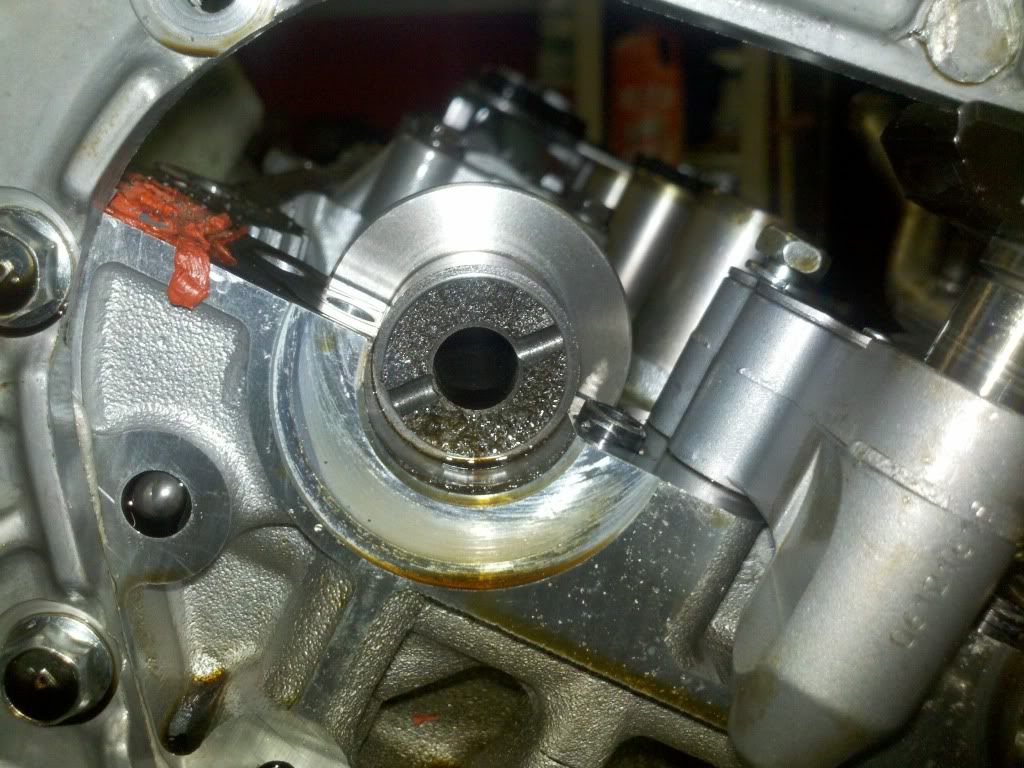
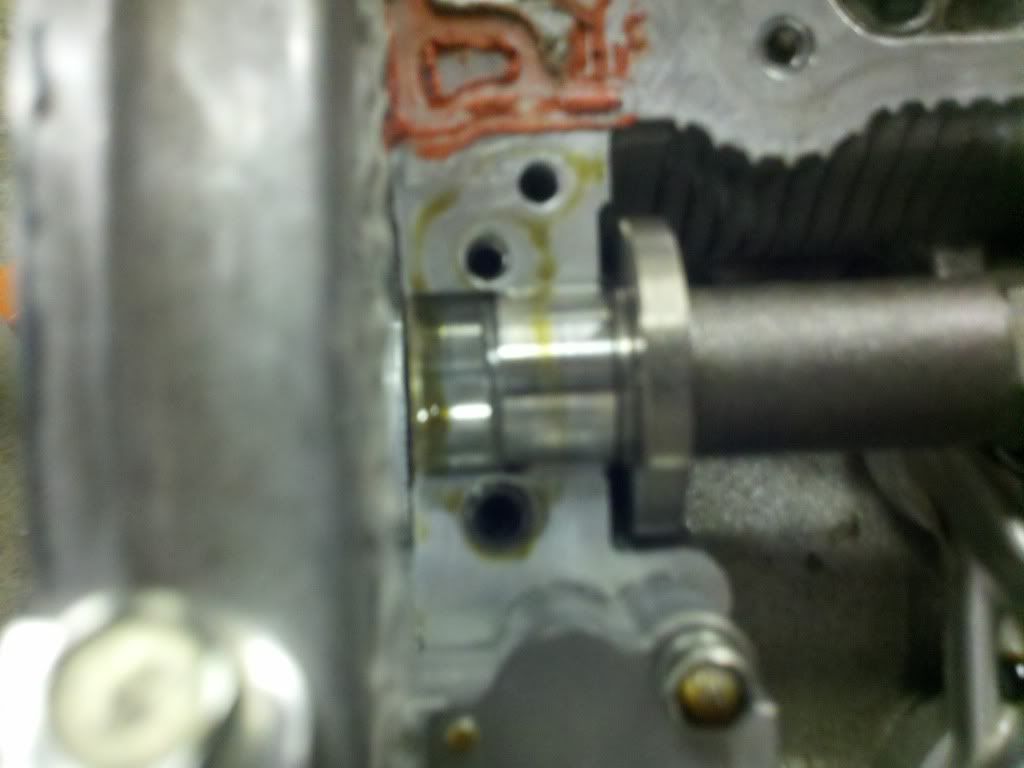
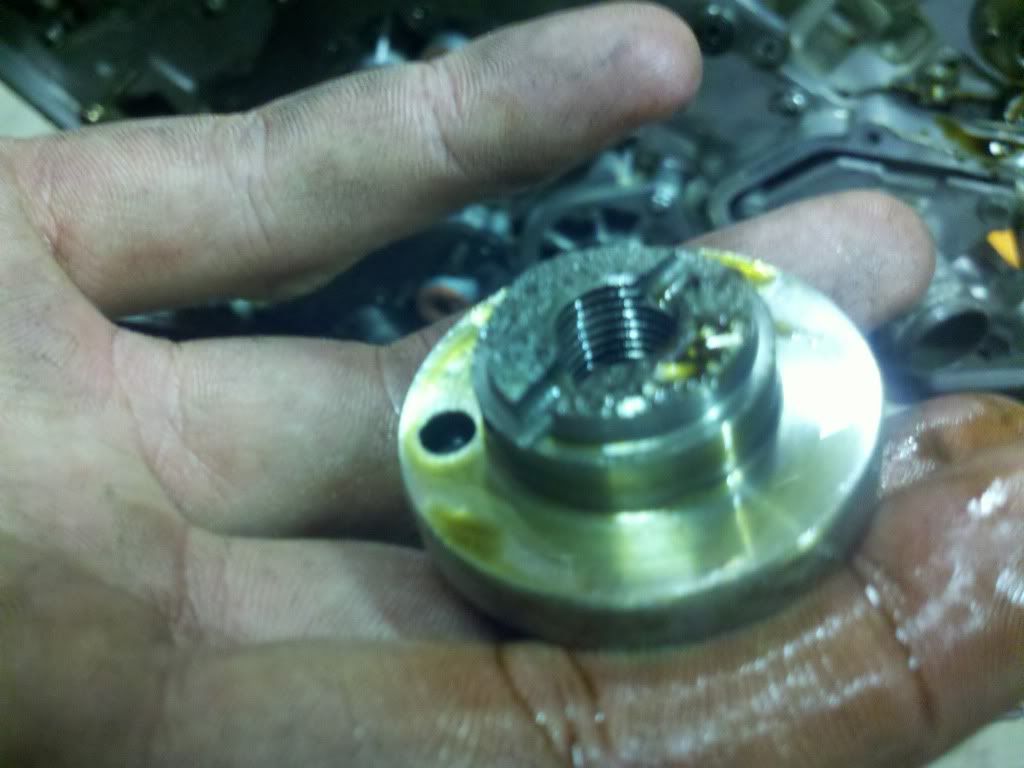
For those who were asking. The springs are BC Single spring, titanium retainer.

I doubt we'll ever know what really happened. I would guess just a weak cam from factory but that's mighty close to the threads, could have been overtorqueing. Anyway the bandwagon **** on this site by the dramaqueens is disgusting. Lulz is cool but this is straight vagina monologue activity.

Registered User
Joined: Aug 2010
Posts: 32
Likes: 0
From: Tampa, FL
you can see that where that break is, the threads stop there and dont appear to go further into the cam. also, the two holes for the oil passages present a clear weak point. i say design flaw. if the threads were to extend all the way through to the other side, and nissan chose to use a longer bolt, it would hold those two sides of the weak fault line together.
Registered User
Joined: Aug 2010
Posts: 32
Likes: 0
From: Tampa, FL
also, you can clearly see that factory cams are made out sand cast iron. while strong, they are subject to cracking easily at weak points.
also, we JUST got a call from someone (ironically enough) looking for an intake cam shaft, gear and bolt and because his broke on his stock motor. i **** you not.
we may find that this sort of thing is going to be the weak point in OEM cams used for high performance applications
also, we JUST got a call from someone (ironically enough) looking for an intake cam shaft, gear and bolt and because his broke on his stock motor. i **** you not.
we may find that this sort of thing is going to be the weak point in OEM cams used for high performance applications
also, you can clearly see that factory cams are made out sand cast iron. while strong, they are subject to cracking easily at weak points.
also, we JUST got a call from someone (ironically enough) looking for an intake cam shaft, gear and bolt and because his broke on his stock motor. i **** you not.
we may find that this sort of thing is going to be the weak point in OEM cams used for high performance applications
also, we JUST got a call from someone (ironically enough) looking for an intake cam shaft, gear and bolt and because his broke on his stock motor. i **** you not.
we may find that this sort of thing is going to be the weak point in OEM cams used for high performance applications

That's a pretty clean break right at the end of the head. If this were a problem from over-tightening there would be some kind of thread damage, there isn't. Looks like the snout just sheared clean off. The cam sprocket wanted to keep turning and the action of the stiffer springs made the rest of the cam say "hell no!"

Im not here to debate of even talk about how this cam broke.
I have to laugh at the stupidity of this situation. Its funny no one pointed a finger yet everyone's crying. If everyone would have calmed down and not blown it out of proportion this wouldnt be happenening. Grow up people stop calling my phone and texting me 1000 times. I have a career where I cant play around on the intrawebnetz playing Uber l33t CyberSmartGuy with Gamermodz, I'd suggest to him he stays out of my thread and business since if he would have shut up a alot of this crazy posting wouldnt have happened. Congrats S&R what a flagship car you got there, too bad the driver is IGNORANT.Guess if he was such a smart guy he wouldnt drive street tires at a track with well over 600whp... Nice what 12.8.....
I have to laugh at the stupidity of this situation. Its funny no one pointed a finger yet everyone's crying. If everyone would have calmed down and not blown it out of proportion this wouldnt be happenening. Grow up people stop calling my phone and texting me 1000 times. I have a career where I cant play around on the intrawebnetz playing Uber l33t CyberSmartGuy with Gamermodz, I'd suggest to him he stays out of my thread and business since if he would have shut up a alot of this crazy posting wouldnt have happened. Congrats S&R what a flagship car you got there, too bad the driver is IGNORANT.Guess if he was such a smart guy he wouldnt drive street tires at a track with well over 600whp... Nice what 12.8.....
Last edited by Jasonvs2146; Apr 6, 2011 at 08:23 AM.
Registered User
Joined: Aug 2010
Posts: 32
Likes: 0
From: Tampa, FL
although this situation overall is discouraging, i am relieved in the fact that it is obviously a part defect and not any one person's doing. this whole series of events is extremely unfortunate.
Last edited by Durdan; Apr 6, 2011 at 08:23 AM.
 no kidding. It's always something caused by people that are unrelated to the situation that just want to fuel a flame. It's a shame but it is what it is.