


Fuel system setup for E85


You can set it to what you can tune to...I set mine as low as possible (40 psi) to maximize fuel pump performance since I have plenty of injector...typically, the higher you set your fuel pressure, the more performance you get out of your injectors at the price of pump performance as boost goes up, and the lower you set your fuel pressure the better your pump performs at the price of fuel injector performance(ie duty cycle)...

On pump when I had plenty of injector I used 50psi base which was 42psi at idle (due to vacuum).

Thanks for the replies, it makes more sense now.
I tried turning my fuel pressure down. However, I couldn't get it to go below 48psi, and hold steady, this was with the vacuum line connected. I also, disconnected and reconnected my vacuum line and I didn't see a difference. The pressure stayed the same. So, when the vacuum line is connected to my FPR the pressure should drop? Is it possible that my flex fuel sensor is causing a restriction that will not allow my fuel pressure to drop?
I tried turning my fuel pressure down. However, I couldn't get it to go below 48psi, and hold steady, this was with the vacuum line connected. I also, disconnected and reconnected my vacuum line and I didn't see a difference. The pressure stayed the same. So, when the vacuum line is connected to my FPR the pressure should drop? Is it possible that my flex fuel sensor is causing a restriction that will not allow my fuel pressure to drop?

Registered User
Joined: Mar 2013
Posts: 329
Likes: 5
From: chicago
You should probably just set your pressure, with hose connected, at 49-50. If you continue to turn the regulator down after the pressure stops lowering, you will have a goofy inconsistent pressure curve where when you first hit the gas the pressure will drop down, and then start climbing up again.
what i believe is happening is that your stock sending units return plumbing is too restrictive and will not allow enough fuel bypass for lower pressure. If you turn it down lower, when the engine starts to consume more fuel and the return volume decreases, pressure will drop to the regulator setting. better to just set your regulator to a place where the fuel pressure curve responds even at idle.
if you want lower, you will have to modify your fuel sending unit to improve return side flow.
then again, your FF sensor probably isnt helping. Bypass the sensor and double check that its not the actual source of the restriction. But my money is on the stock fuel sending unit.
what i believe is happening is that your stock sending units return plumbing is too restrictive and will not allow enough fuel bypass for lower pressure. If you turn it down lower, when the engine starts to consume more fuel and the return volume decreases, pressure will drop to the regulator setting. better to just set your regulator to a place where the fuel pressure curve responds even at idle.
if you want lower, you will have to modify your fuel sending unit to improve return side flow.
then again, your FF sensor probably isnt helping. Bypass the sensor and double check that its not the actual source of the restriction. But my money is on the stock fuel sending unit.
Last edited by phunk2; Jul 3, 2013 at 05:05 PM.
^I agree with charles (anyone who knows him would never disagree with his knowledge)
If you didn't want to make the return less restrictive you could just run a higher base pressure like I am. It won't hurt anything but you will need to tune the car for that new pressure. Just make sure the lowest pressure you can achieve is still above 48psi since that is your low point and it will be fine. So I would choose somewhere around 55-60psi with no vac hooked up.
If you didn't want to make the return less restrictive you could just run a higher base pressure like I am. It won't hurt anything but you will need to tune the car for that new pressure. Just make sure the lowest pressure you can achieve is still above 48psi since that is your low point and it will be fine. So I would choose somewhere around 55-60psi with no vac hooked up.


the sensor is not a restriction as I run at ~37psi vac referenced thru the same sensor with a MUCH bigger pump.
like binder said, you def dont want to set the FPR to a point where referenced and non-referenced are the same. you always want to see a drop in pressure when its referenced, in a properly setup system
like binder said, you def dont want to set the FPR to a point where referenced and non-referenced are the same. you always want to see a drop in pressure when its referenced, in a properly setup system

the sensor is not a restriction as I run at ~37psi vac referenced thru the same sensor with a MUCH bigger pump.
like binder said, you def dont want to set the FPR to a point where referenced and non-referenced are the same. you always want to see a drop in pressure when its referenced, in a properly setup system
like binder said, you def dont want to set the FPR to a point where referenced and non-referenced are the same. you always want to see a drop in pressure when its referenced, in a properly setup system

Here is how mine is set up
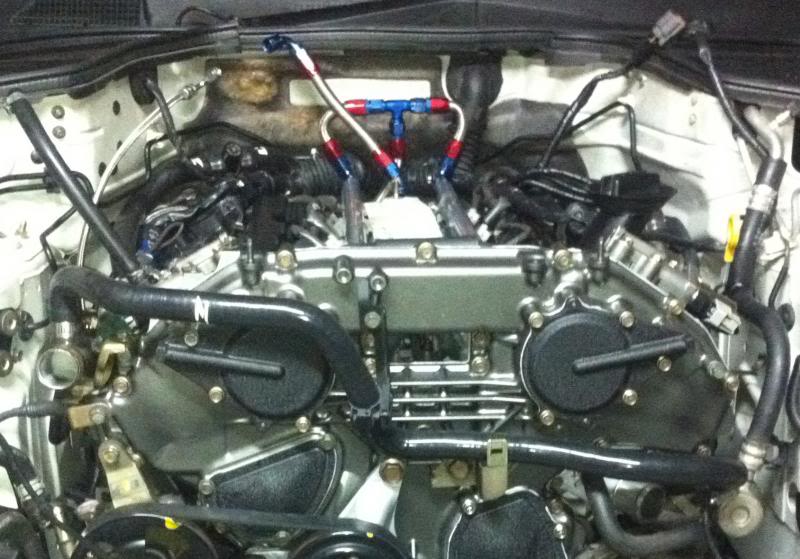
Rails fed by -6AN which leads to both rails to a T and that then has a -6AN go back to the hard line.
The other end of the rails also have a -6AN then go to the regulator
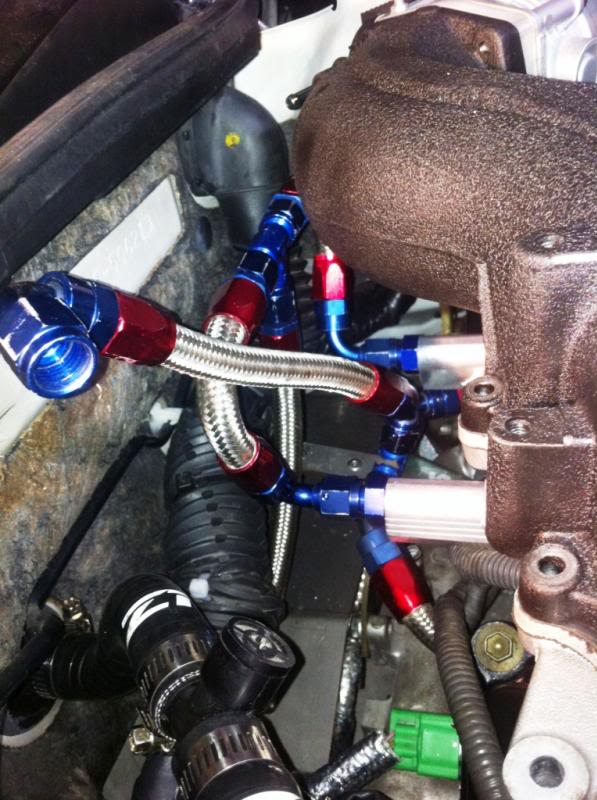
The fuel basket has the return line correction kit that replaces the fuel regulator and a -4AN line comes from the top of the basket to the fuel A1000 regulator.

Rails fed by -6AN which leads to both rails to a T and that then has a -6AN go back to the hard line.
The other end of the rails also have a -6AN then go to the regulator

The fuel basket has the return line correction kit that replaces the fuel regulator and a -4AN line comes from the top of the basket to the fuel A1000 regulator.
setting up the fuel system is very basic and your tuner should have been able to diagnosis it on the spot for you.
you need to log fuel pressure and boost.
if your unreferenced base fuel pressure is 45psi, at 1psi of boost it should be 46psi, at 2psi boost = 47psi, etc etc.
If your fuel pressure rises with boost initially, then the regulator is ok. From there, when you get to 5000 rpms or so and you see your fuel pressure start to drop, that means your fuel pump is too small.
you need to log fuel pressure and boost.
if your unreferenced base fuel pressure is 45psi, at 1psi of boost it should be 46psi, at 2psi boost = 47psi, etc etc.
If your fuel pressure rises with boost initially, then the regulator is ok. From there, when you get to 5000 rpms or so and you see your fuel pressure start to drop, that means your fuel pump is too small.

New Member
Joined: Dec 2010
Posts: 39
Likes: 3
From: Oklahoma City
...or as seen in a fairly recent thread, the vacuum/boost reference point for the FPR is bad or has a leak nearby causing a fault.

Thread
Thread Starter
Forum
Replies
Last Post
Justin100
Intake Exhaust
26
Nov 29, 2015 03:58 PM
