


JIC Ti - 80mm OK for N/A?



Joined: Jan 2009
Posts: 7,287
Likes: 189
From: Eastern NC

If I am understanding your posts correctly (I'm probably not); I can buy test pipes and a XYZ y-pipe with stock mid-pipe and muffler and yield the same results as an aftermarket y-pipe back exhaust?

"yield the same results" I don't think thats whats being said.
What I asked for example is what would happened if one would add or remove a pre-muffler aka resonator past the y-pipe. Say for example you removed the straight through resonator off of the Fujitsubo legalis R or the Welinda Nismo unit. A lot of members here hack off their resonators for great decibel ratings. From the looks of it, Adding or Removing straight through resonators would only change sound and not really change power levels.
Which leads me to my next question, how would a non-straight through resonator effect performance of a large chambered oem style muffler system (fujitsubo /nismo). Also, would it quiet down more than a straight resonators.

thanks for any input.
What I asked for example is what would happened if one would add or remove a pre-muffler aka resonator past the y-pipe. Say for example you removed the straight through resonator off of the Fujitsubo legalis R or the Welinda Nismo unit. A lot of members here hack off their resonators for great decibel ratings. From the looks of it, Adding or Removing straight through resonators would only change sound and not really change power levels.
Which leads me to my next question, how would a non-straight through resonator effect performance of a large chambered oem style muffler system (fujitsubo /nismo). Also, would it quiet down more than a straight resonators.

thanks for any input.

The stock exhaust necks down to a single 2.25 resonator in the mid pipe and then it goes to a multi chambered muffler in the back. The stock exhaust is quite restrictive.



No. What I meant by that is if you have a straight through 3" exhaust from the Y pipe on back, it doesn't matter if you do or don't have a 3" straight through resonator or muffler in the Y back system.
The stock exhaust necks down to a single 2.25 resonator in the mid pipe and then it goes to a multi chambered muffler in the back. The stock exhaust is quite restrictive.
The stock exhaust necks down to a single 2.25 resonator in the mid pipe and then it goes to a multi chambered muffler in the back. The stock exhaust is quite restrictive.

New Member
Joined: Aug 2012
Posts: 14
Likes: 0
From: South Africa , Pretoria
1) this resonator is totally empty (no sound deadening materials/flanges inside), and its just a larger section of pipe. (like the pics show) ?
and
2) the affect it has on the sound- is that it decreases the "rasp" we hear from Rally cars (if i have to describe it to the extreme) ?

1) It's a resonator, not a muffler, it's straight through, the sound deadening is round the outside, this is normal, if it has nothing in it, it's just a pipe, not a resonator.
2) Pretty much.

2) Pretty much.
New Member
Joined: Aug 2012
Posts: 14
Likes: 0
From: South Africa , Pretoria
didnt know what Test pipes look like inside. Here in South Africa there are no rules as to how loud a car can be, what emissions it gives, "CARB Legal" (whatever that means) etc... so usualluy exhaust shops here just build the pipes up under your car as you tell them to. therefore, usually people just "build" a "cat delete" Y pipe in one. - hence, test pipes arent really used....
New Member
Joined: Aug 2012
Posts: 14
Likes: 0
From: South Africa , Pretoria

ok so this i can also see that its the Motordyne resonator module for the XYZ pipe... so my next question is- Do resonated test pipes have that same stuff inside the Chamber part of the test pipe too. (i would assume so) ?

Registered User
Joined: Feb 2010
Posts: 137
Likes: 0
From: South Africa
Question for Motordyne please:
If those results showed that 2.0" test pipes gave the best results, then why are the ART pipes 2.5"?
General question for everyone:
I have a few dollars to spend and can buy either test pipes or exhaust, but possibly not both at the same time right now.
Do I get the ART pipes and run them with my stock exhaust? (will this sound bad?)
Do I get a cat back exhaust system and run them with stock cats? (will this perform badly?)
I like the sound of the Greddy TI-C or the EVo2 system (no offense). Do these exhausts bolt up against the test pipes/art pipes/stock cats, or do I still need another part (XYZ pipe for example) that links up to the exhausts?
Thank in advance.
If those results showed that 2.0" test pipes gave the best results, then why are the ART pipes 2.5"?
General question for everyone:
I have a few dollars to spend and can buy either test pipes or exhaust, but possibly not both at the same time right now.
Do I get the ART pipes and run them with my stock exhaust? (will this sound bad?)
Do I get a cat back exhaust system and run them with stock cats? (will this perform badly?)
I like the sound of the Greddy TI-C or the EVo2 system (no offense). Do these exhausts bolt up against the test pipes/art pipes/stock cats, or do I still need another part (XYZ pipe for example) that links up to the exhausts?
Thank in advance.
Last edited by Doc_Z; Oct 24, 2012 at 12:51 AM.

Joined: Feb 2008
Posts: 13,406
Likes: 130
From: MexiCali dodging potholes
Can't give a technical answer the first question my guess is just more flow, the second two are all preference. Doesn't matter where you free up the exhaust system. You have three/four sections - headers - cats - y-pipe/catback. Replacing one section at a time has its pros and cons. Similar results overall, replacing two is where a noticeable changes can be felt/heard. To the fourth question yes, if it's for your make and model then everything should bolt up.
Without going back to the ART pipe thread (where the technical stuff is) i can't remember what the deal with the diameter is, however, they are optimally tuned.
The ART pipes will give you the most immediate gain Vs just the cat back exhaust.
Art pipes on the stock exhaust, you will get a little bit of rasp around ~3k but nothing like normal test pipes. The construction of the stock y-pipe adds a little to that, but it's also a good gain point. If you add the XYZ pipe, it will reduce the rasp a little and free up the flow, it will also allow you to add the MD resonator module which completely removes all rasp on the stock system with ART pipes.
Just doing the cat back will not free quite as much as replacing the cats, but it can be close with the right system.
The advantage of the XYZ system is that anything that bolts to the stock setup will bolt to that.
The ART pipes will give you the most immediate gain Vs just the cat back exhaust.
Art pipes on the stock exhaust, you will get a little bit of rasp around ~3k but nothing like normal test pipes. The construction of the stock y-pipe adds a little to that, but it's also a good gain point. If you add the XYZ pipe, it will reduce the rasp a little and free up the flow, it will also allow you to add the MD resonator module which completely removes all rasp on the stock system with ART pipes.
Just doing the cat back will not free quite as much as replacing the cats, but it can be close with the right system.
The advantage of the XYZ system is that anything that bolts to the stock setup will bolt to that.
The difference between 2.25" and 2.0 inch is ~1HP but using 2.25" allows significantly more power margin in forced induction applications.
The ART pipes are compatible with just about every known catback on the market and they will fit fine with either Greddy system.
The biggest bang for the buck will probably be with ART pipes only but there will be some rasp when connected to the stock exhaust.
The ART pipes are compatible with just about every known catback on the market and they will fit fine with either Greddy system.
The biggest bang for the buck will probably be with ART pipes only but there will be some rasp when connected to the stock exhaust.
Question for Motordyne please:
If those results showed that 2.0" test pipes gave the best results, then why are the ART pipes 2.5"?
General question for everyone:
I have a few dollars to spend and can buy either test pipes or exhaust, but possibly not both at the same time right now.
Do I get the ART pipes and run them with my stock exhaust? (will this sound bad?)
Do I get a cat back exhaust system and run them with stock cats? (will this perform badly?)
I like the sound of the Greddy TI-C or the EVo2 system (no offense). Do these exhausts bolt up against the test pipes/art pipes/stock cats, or do I still need another part (XYZ pipe for example) that links up to the exhausts?
Thank in advance.
If those results showed that 2.0" test pipes gave the best results, then why are the ART pipes 2.5"?
General question for everyone:
I have a few dollars to spend and can buy either test pipes or exhaust, but possibly not both at the same time right now.
Do I get the ART pipes and run them with my stock exhaust? (will this sound bad?)
Do I get a cat back exhaust system and run them with stock cats? (will this perform badly?)
I like the sound of the Greddy TI-C or the EVo2 system (no offense). Do these exhausts bolt up against the test pipes/art pipes/stock cats, or do I still need another part (XYZ pipe for example) that links up to the exhausts?
Thank in advance.

Registered User
Joined: Sep 2011
Posts: 831
Likes: 0
From: Philadelphia, PA
I've ran the Greddy RS (TI-C updated) with the ART pipes and they fit perfectly. With the silencers in, the noise was fine. Silencers out, unbearable.
I swapped over to the Motordyne TDX2 after this, one of the sweetest and best decisions I've made.
I swapped over to the Motordyne TDX2 after this, one of the sweetest and best decisions I've made.
Registered User
Joined: Feb 2010
Posts: 137
Likes: 0
From: South Africa
Ok Greddy seemingly no longer makes the TI-C or the EVO 2.
Replaced with EVO3 and that silly stock looking exhaust.
At Hydrazine. Do you sell Motordyne parts? If so, please can you pm me a individual shipping estimates on:
a TDXV2 exhaust
art test pipes
both combined
to Johannesburg, South Africa, Postal code 1736?
thanks
I love the sound of the single exhausts, but it would look strange on my otherwise stock Z.
Replaced with EVO3 and that silly stock looking exhaust.
At Hydrazine. Do you sell Motordyne parts? If so, please can you pm me a individual shipping estimates on:
a TDXV2 exhaust
art test pipes
both combined
to Johannesburg, South Africa, Postal code 1736?
thanks
I love the sound of the single exhausts, but it would look strange on my otherwise stock Z.
Doc Z,
Yes. And we ship international all the time.
For a shipping quote to your area please send your full address and the parts you want via email to sales @ motordyneengineering dot com
Yes. And we ship international all the time.
For a shipping quote to your area please send your full address and the parts you want via email to sales @ motordyneengineering dot com


Registered User
Joined: Mar 2015
Posts: 25
Likes: 0
From: bradenton florida
[QUOTE=Hydrazine;7435408]Back pressure (at least on our engine) is NEVER a good thing for NA applications.
It is a widely spread myth that some back pressure is good, but it is 100% FALSE.
There clearly are situations where smaller diameter pipes can outperform larger diameter pipes but this is not because of back pressure. This is because of scavenging. And when tuned properly, scavenging actually reduces back pressure as seen by the engine.
But be careful in the assumption that smaller automatically equals better performance. It is highly dependent on where the smaller diameter pipes are being used.
Small pipes near the engine can be good for scavenging and power, but as the pipes move farther and farther away from the engine the effect of scavenging rapidly diminishes. If scavenging cannot be taken advantage of, then small/restrictive pipes must be completely avoided.
Back pressure can only reduce power. Do not confuse this with scavenging.
Scavenging actually reduces back pressure on a tuned cyclical basis.
With each pulse released during the exhaust stroke of the engine, the pulse travels like a shotgun blast down the exhaust pipes. The high intensity blast creates a shockwave with a large positive pressure at the wave front. This wave front is traveling so fast that even when the piston reaches TDC and all the gas is expelled by the piston, the fast moving slug of exhaust gas doesn't stop and it rarefies the gas and creates a vacuum behind the shockwave.
It is the vacuum behind the shockwave that sucks out any remaining exhaust gas from the cylinder. This vacuum also pulls more fuel/air mixture through the intake valves during the intake/exhaust valve overlap period. And this is how more power is made. This is the scavenging effect. It vacuums exhaust gas out of your engine!
Adding back pressure can only kill off this vacuum that you want.
NOW HERE IS HOW THE MYTH STARTED.
IT WAS A MISINTERPRETATION OF TEST RESULTS.
Sombody a long time ago probably did the same series of dyno tests I did on varying pipe diameters. Like I did, they probably found that smaller diameter pipes can yeild higher HP and TQ. They probably mistook this for back pressure and put it out in the public. Smaller diameter pipes can provide higher performance when used properly. But small diameter pipes are only desirable when they are very close to the engine.
For example:
I did a series of dyno tests on various diameter test pipes ranging from 2.5", 2.25" and 2.0".
Before conducting the tests, my initial guess was that the larger diameter pipes would produce the highest HP with lowest TQ. And the smaller diameter pipes would produce the lowest HP and the highest TQ.
Well... I was 1/2 right...
As expected, the dyno testing showed the 2.5" diameter test pipes made the lowest TQ. And as expected, the dyno testing showed the 2.0" diameter test pipes made the highest TQ.
But here's the kicker. The 2.0" test pipes made 2 more HP than the 2.5" test pipes! ...It left me thinking "COOL. Smaller diameter test pipes make more TQ and more HP. That's a wining combination!"
So sombody a long time ago probably misinterpreted the smaller diameter as adding performance by being more restrictive. But this is not the case. It is because of increased scavenging. Smaller diameter pipes near the engine increase the velocity of the shockwave and thereby increasing the effect of scavenging. It was a misinterpretation of the results.
So I continued down this line of testing at the Y-pipe primaries. Using the 2.0" test pipes, I then tested various Y-pipe primary diameters. 2.0", 2.25" and 2.5".
The expectation was to see similar results... but not quite this time. At least not at the Y-pipe.
The 2.0" Y-pipe primaries did indeed provide the highest TQ, but it brought a good portion of the HP down. 2.25" primaries were better but could still be improved upon. The 2.5" Y-pipe primaries provided the best peak power and the best average power.
So dyno testing proved the best test pipe diameter is 2.0" diameter and the best Y-pipe primary diameter is 2.5".
I then continued further down this line of testing on the mid-pipe and made some more interesting observations. Testing mid-pipe diameters at 2.5", 3.0" and then a fully open Y-pipe.
What I did find was that there was no scavenging effect possible after the Y-pipe. There was nothing to gain from the smaller diameter what so ever. In fact, the only thing that had any effect was simple back pressure.
Using a open Y-pipe as the baseline I found that connecting a 3" single exhaust had no effect on TQ and with only a small 1.5 HP decrease.
The 2.5" midpipe slightly reduced TQ and was ~2.5HP down from than the 3" midpipe.
This series of tests established:
1) There was no scavenging possible after the Y-pipe.
2) A smaller diameter midpipe can only decrease HP&TQ
3) There will be rapidly diminishing returns beyond a 3" midpipe
4) With power to weight ratios taken into consideration a 3" midpipe can be considered optimum. 3" also allows more headroom for medium boost FI applications.
Going from 3" to a 3.5" midpipe may at best provide a 0.5HP increase. So from a weight point of view, going larger than 3.0" would be counter productive for NA applications.
I then conducted another series of tests at the end of the Y-pipe.
1) Attaching a 3" diameter butterfly valve with variable position restriction plate.
2) Attaching a 6" diameter parabolic diffuser to reduces pressure drop below that of a 3" open pipe.
The purpose of the butterfly valve restriction plate was to directly test the effect of raw back pressure on performance. And the results were very clear.
BACK PRESSURE RAPIDLY REDUCES PERFORMANCE.
I dyno tested the valve at various levels of flow restriction. From wide open to almost fully closed as back pressure was increased, performance rapidly decreased.
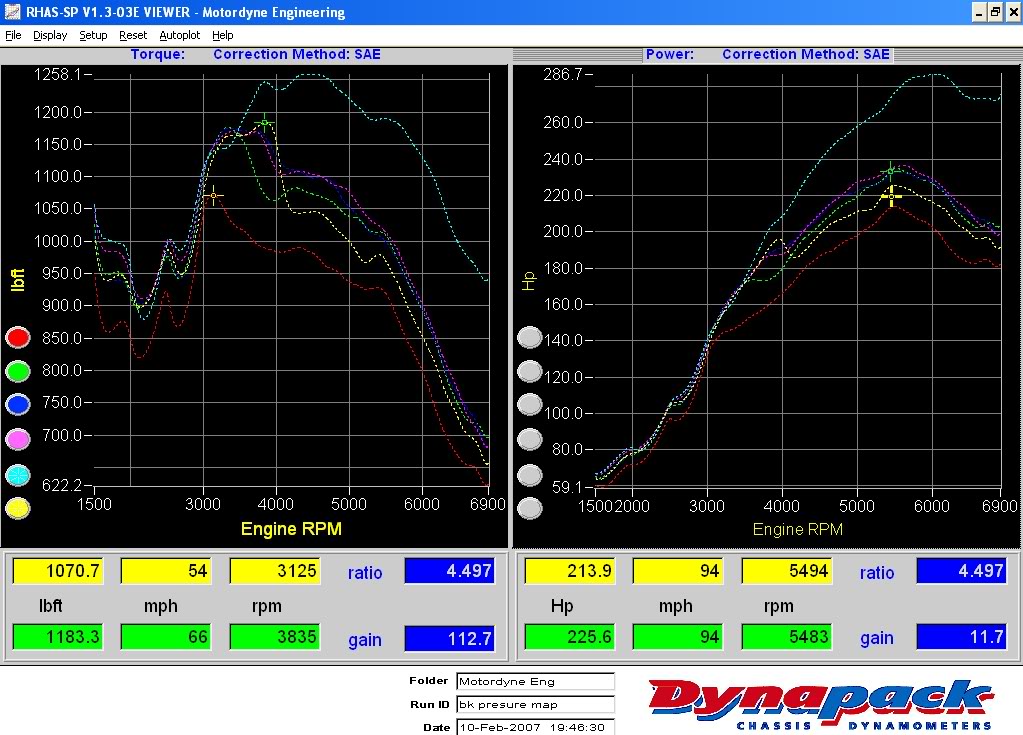
This set of dyno plots is proof positive that back pressure is the enemy of power and torque.
Let the myth of back pressure be permanently dispelled from the vocabulary of this forum!
After that series of tests I started another set of tests that decreased exhaust pressure beyond that of a simple open ended 3" pipe.
A 6" diameter parabolic diffuser was clamped onto the end of the Y-pipe. This was used to decrease flow resistance below that of a open pipe.
Dyno tests of the diffuser showed an instant 4-6HP increase over that of a open Y-pipe!
This picture below is a picture of a 5" linear diffuser. It doesn't perform quite as good as the 6" parabolic diffuser but the 6" diffuser is completely impractical for fitment and production reasons.
6" is too big for fitment under the Z and the parabolic shape also gives it a curvature that makes the production process MUCH more difficult.
This is the diffuser used on the MD ShockWave single exhaust system. It can also be attached directly to the Y-pipe for drag race applications.
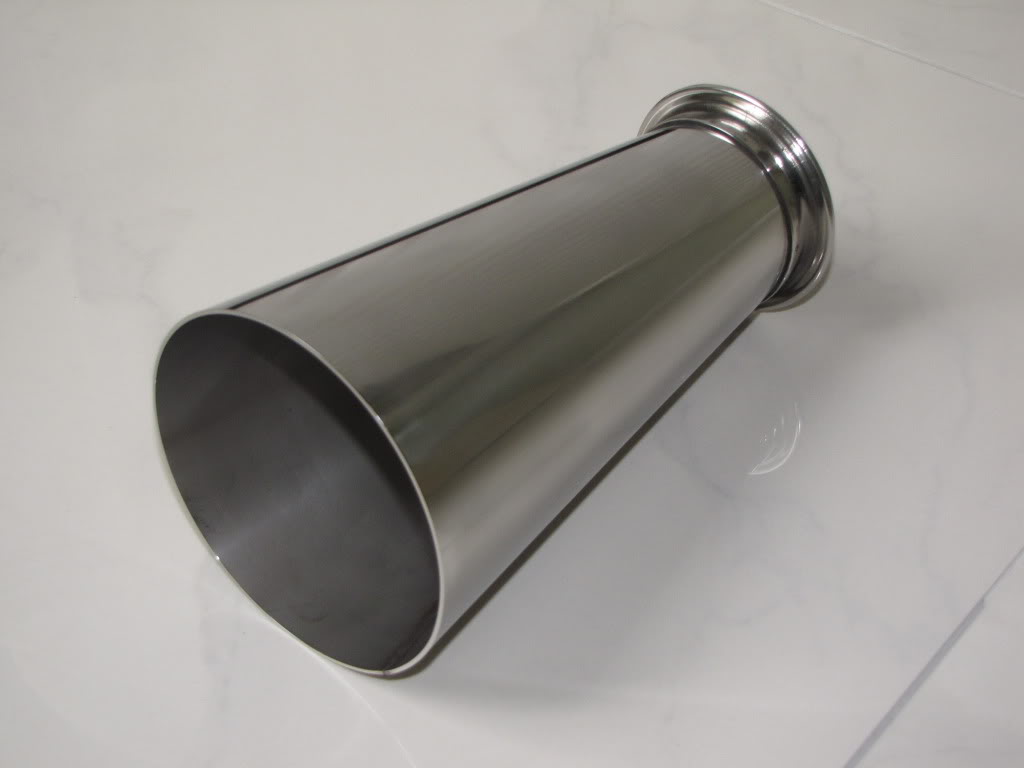
So while there are rapidly diminishing returns with going to larger and larger diameter tubing after the Y-pipe, significant gains can still be made by use of diffusers.
This is a great post!!!
Needs to be stickied at the top of the exhaust thread.
It is a widely spread myth that some back pressure is good, but it is 100% FALSE.
There clearly are situations where smaller diameter pipes can outperform larger diameter pipes but this is not because of back pressure. This is because of scavenging. And when tuned properly, scavenging actually reduces back pressure as seen by the engine.
But be careful in the assumption that smaller automatically equals better performance. It is highly dependent on where the smaller diameter pipes are being used.
Small pipes near the engine can be good for scavenging and power, but as the pipes move farther and farther away from the engine the effect of scavenging rapidly diminishes. If scavenging cannot be taken advantage of, then small/restrictive pipes must be completely avoided.
Back pressure can only reduce power. Do not confuse this with scavenging.
Scavenging actually reduces back pressure on a tuned cyclical basis.
With each pulse released during the exhaust stroke of the engine, the pulse travels like a shotgun blast down the exhaust pipes. The high intensity blast creates a shockwave with a large positive pressure at the wave front. This wave front is traveling so fast that even when the piston reaches TDC and all the gas is expelled by the piston, the fast moving slug of exhaust gas doesn't stop and it rarefies the gas and creates a vacuum behind the shockwave.
It is the vacuum behind the shockwave that sucks out any remaining exhaust gas from the cylinder. This vacuum also pulls more fuel/air mixture through the intake valves during the intake/exhaust valve overlap period. And this is how more power is made. This is the scavenging effect. It vacuums exhaust gas out of your engine!
Adding back pressure can only kill off this vacuum that you want.
NOW HERE IS HOW THE MYTH STARTED.
IT WAS A MISINTERPRETATION OF TEST RESULTS.
Sombody a long time ago probably did the same series of dyno tests I did on varying pipe diameters. Like I did, they probably found that smaller diameter pipes can yeild higher HP and TQ. They probably mistook this for back pressure and put it out in the public. Smaller diameter pipes can provide higher performance when used properly. But small diameter pipes are only desirable when they are very close to the engine.
For example:
I did a series of dyno tests on various diameter test pipes ranging from 2.5", 2.25" and 2.0".
Before conducting the tests, my initial guess was that the larger diameter pipes would produce the highest HP with lowest TQ. And the smaller diameter pipes would produce the lowest HP and the highest TQ.
Well... I was 1/2 right...
As expected, the dyno testing showed the 2.5" diameter test pipes made the lowest TQ. And as expected, the dyno testing showed the 2.0" diameter test pipes made the highest TQ.
But here's the kicker. The 2.0" test pipes made 2 more HP than the 2.5" test pipes! ...It left me thinking "COOL.
Smaller diameter test pipes make more TQ and more HP. That's a wining combination!"So sombody a long time ago probably misinterpreted the smaller diameter as adding performance by being more restrictive. But this is not the case. It is because of increased scavenging. Smaller diameter pipes near the engine increase the velocity of the shockwave and thereby increasing the effect of scavenging. It was a misinterpretation of the results.
So I continued down this line of testing at the Y-pipe primaries. Using the 2.0" test pipes, I then tested various Y-pipe primary diameters. 2.0", 2.25" and 2.5".
The expectation was to see similar results... but not quite this time. At least not at the Y-pipe.
The 2.0" Y-pipe primaries did indeed provide the highest TQ, but it brought a good portion of the HP down. 2.25" primaries were better but could still be improved upon. The 2.5" Y-pipe primaries provided the best peak power and the best average power.
So dyno testing proved the best test pipe diameter is 2.0" diameter and the best Y-pipe primary diameter is 2.5".
I then continued further down this line of testing on the mid-pipe and made some more interesting observations. Testing mid-pipe diameters at 2.5", 3.0" and then a fully open Y-pipe.
What I did find was that there was no scavenging effect possible after the Y-pipe. There was nothing to gain from the smaller diameter what so ever. In fact, the only thing that had any effect was simple back pressure.
Using a open Y-pipe as the baseline I found that connecting a 3" single exhaust had no effect on TQ and with only a small 1.5 HP decrease.
The 2.5" midpipe slightly reduced TQ and was ~2.5HP down from than the 3" midpipe.
This series of tests established:
1) There was no scavenging possible after the Y-pipe.
2) A smaller diameter midpipe can only decrease HP&TQ
3) There will be rapidly diminishing returns beyond a 3" midpipe
4) With power to weight ratios taken into consideration a 3" midpipe can be considered optimum. 3" also allows more headroom for medium boost FI applications.
Going from 3" to a 3.5" midpipe may at best provide a 0.5HP increase. So from a weight point of view, going larger than 3.0" would be counter productive for NA applications.
I then conducted another series of tests at the end of the Y-pipe.
1) Attaching a 3" diameter butterfly valve with variable position restriction plate.
2) Attaching a 6" diameter parabolic diffuser to reduces pressure drop below that of a 3" open pipe.
The purpose of the butterfly valve restriction plate was to directly test the effect of raw back pressure on performance. And the results were very clear.
BACK PRESSURE RAPIDLY REDUCES PERFORMANCE.
I dyno tested the valve at various levels of flow restriction. From wide open to almost fully closed as back pressure was increased, performance rapidly decreased.
This set of dyno plots is proof positive that back pressure is the enemy of power and torque.
Let the myth of back pressure be permanently dispelled from the vocabulary of this forum!
After that series of tests I started another set of tests that decreased exhaust pressure beyond that of a simple open ended 3" pipe.
A 6" diameter parabolic diffuser was clamped onto the end of the Y-pipe. This was used to decrease flow resistance below that of a open pipe.
Dyno tests of the diffuser showed an instant 4-6HP increase over that of a open Y-pipe!
This picture below is a picture of a 5" linear diffuser. It doesn't perform quite as good as the 6" parabolic diffuser but the 6" diffuser is completely impractical for fitment and production reasons.
6" is too big for fitment under the Z and the parabolic shape also gives it a curvature that makes the production process MUCH more difficult.
This is the diffuser used on the MD ShockWave single exhaust system. It can also be attached directly to the Y-pipe for drag race applications.
So while there are rapidly diminishing returns with going to larger and larger diameter tubing after the Y-pipe, significant gains can still be made by use of diffusers.
This is a great post!!!
Needs to be stickied at the top of the exhaust thread.
Last edited by ZaaronZ; Apr 15, 2015 at 01:08 PM.


Thread
Thread Starter
Forum
Replies
Last Post
FromGtoZ
Intake Exhaust
2
Sep 20, 2015 03:41 PM
