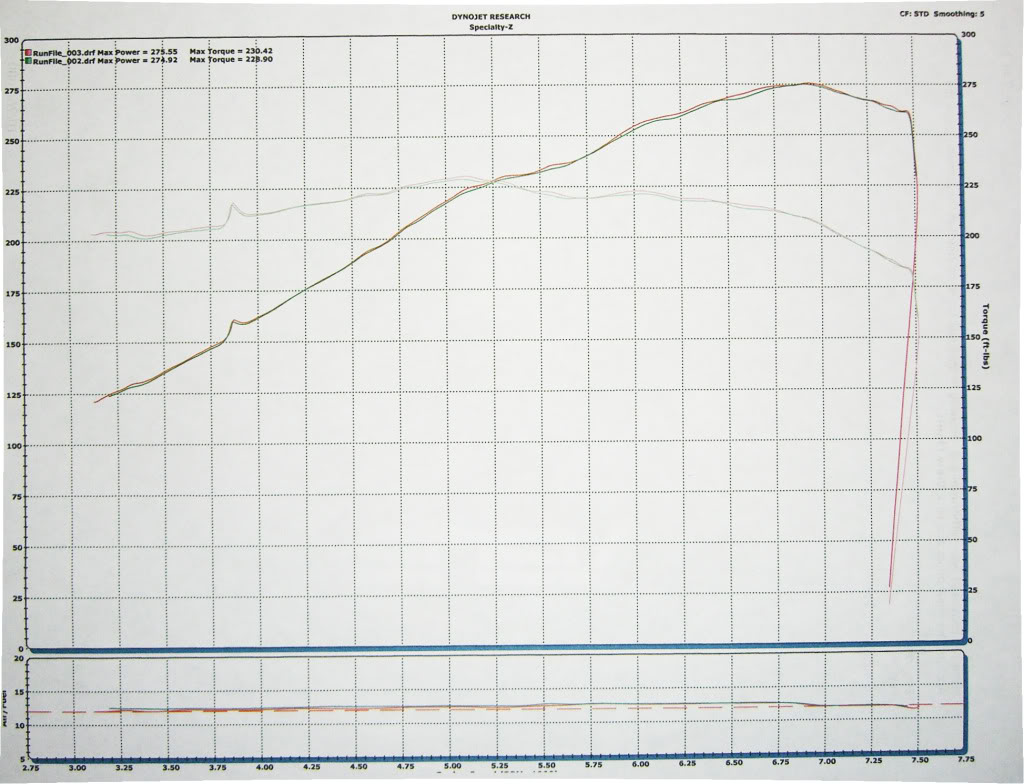
My HR Dyno Numbers...




Huh? SAE are the only results I pay attention too, and I would say most don't post STD.

Do you understand what SAE correction factors do? They may be higher, lower or exactly the same as the standard (raw) power, depends only on the weather conditions at the dyno.

Yes I do, maybe you didn't understand my post. I was comparing Standard to SAE. The correction factors in the "Standard" CF will yield higher hp numbers than will the correction factors in the "SAE" CF. When I dynoed my car the second time, I ran the dyno. I changed between all the correction factors in the computer on the same run and Standard CF give the highest numbers. My run using SAE CF was 257/238, but with Standard CF was 264/246.
Yes I do, maybe you didn't understand my post. I was comparing Standard to SAE. The correction factors in the "Standard" CF will yield higher hp numbers than will the correction factors in the "SAE" CF. When I dynoed my car the second time, I ran the dyno. I changed between all the correction factors in the computer on the same run and Standard CF give the highest numbers. My run using SAE CF was 257/238, but with Standard CF was 264/246.
Standard is the power the car put down to turn the rollers.
SAE CF adjusts that for temperature/baro to give a more "accurate" number. If it's really cold out, the car "should" make more power. Standard will be higher, SAE will adjust to what the power should be at normal conditions, which will be lower. SAE is a way of being fair, trying to equalize the numbers to eliminate changes from the atmospheric conditions, but it is only a math thing, it multiplies the values reported by the dyno (standard numbers) by the percentage of the actual value vs. SAE standard.
If your dyno was done in the same lab that the SAE tests are done in, in the same temperature/pressure/humidity air they consider "standard", both the standard number and the SAE number would be the same, as it would not correct to anything, the values would match.

That is incorrect. The "uncorrected" number is what the car put down to turn the rollers that day, under those weather conditions, at that altitude, with those mods, etc. Standard and SAE are both correction factors. You are confusing standard with uncorrected. If the conditions that day were exactly the same as SAE uses, the uncorrected and SAE numbers would be the same. That has nothing to do with Standard CF.
All CF adjust for different weather conditions, they just use different calculations to do it.
All CF adjust for different weather conditions, they just use different calculations to do it.
No.
Standard is the power the car put down to turn the rollers.
SAE CF adjusts that for temperature/baro to give a more "accurate" number. If it's really cold out, the car "should" make more power. Standard will be higher, SAE will adjust to what the power should be at normal conditions, which will be lower. SAE is a way of being fair, trying to equalize the numbers to eliminate changes from the atmospheric conditions, but it is only a math thing, it multiplies the values reported by the dyno (standard numbers) by the percentage of the actual value vs. SAE standard.
If your dyno was done in the same lab that the SAE tests are done in, in the same temperature/pressure/humidity air they consider "standard", both the standard number and the SAE number would be the same, as it would not correct to anything, the values would match.
Standard is the power the car put down to turn the rollers.
SAE CF adjusts that for temperature/baro to give a more "accurate" number. If it's really cold out, the car "should" make more power. Standard will be higher, SAE will adjust to what the power should be at normal conditions, which will be lower. SAE is a way of being fair, trying to equalize the numbers to eliminate changes from the atmospheric conditions, but it is only a math thing, it multiplies the values reported by the dyno (standard numbers) by the percentage of the actual value vs. SAE standard.
If your dyno was done in the same lab that the SAE tests are done in, in the same temperature/pressure/humidity air they consider "standard", both the standard number and the SAE number would be the same, as it would not correct to anything, the values would match.
Last edited by crg914; Oct 26, 2009 at 04:43 PM.
That is incorrect. The "uncorrected" number is what the car put down to turn the rollers that day, under those weather conditions, at that altitude, with those mods, etc. Standard and SAE are both correction factors. You are confusing standard with uncorrected. If the conditions that day were exactly the same as SAE uses, the uncorrected and SAE numbers would be the same. That has nothing to do with Standard CF.
All CF adjust for different weather conditions, they just use different calculations to do it.
All CF adjust for different weather conditions, they just use different calculations to do it.
What are the values for standard vs. SAE, the actual 'target' it corrects to?
STD is corrected to reference conditions of 29.92 InHg (103.3 kPa) of dry air and 60 F (15.5°C). Because the reference conditions include higher pressure and cooler air than the SAE standard, these corrected power numbers will always be about 4 % higher than the SAE power numbers. Friction torque is handled in the same way as in the SAE standard.
This is a pretty good read on dyno basics for anyone who wants a quick lesson or needs a refresher.
http://www.drdyno.com/AIM_2006-07.html

Heres my dynosheet like i promised. These two were done in 3rd gear. This is an 07 5AT with Greddy Ti-C dual (2.75"), and Injen intakes.
CIMG6576.jpg?t=1256628594
CIMG6576.jpg?t=1256628594

Thread Starter
Registered User
Joined: Oct 2009
Posts: 18
Likes: 0
From: Dallas, TX
Snooping around the net:
STD:
Air Temperature: 60F
Absolute Pressure: 29.92 inches Hg
Relative Humidity: 0%
Relative Horsepower : 104.8%
Air Density: 1.223kg/m3
Relative Air Density: 99.8%
Density Altitude: 67feet
Virtual Temperature: 60F
Vapor Pressure: 0 inches Hg
Dyno Correction Factor: .955
SAE:
Air Temperature: 77F
Absolute Pressure: 29.23 inches Hg
Relative Humidity: 0%
Relative Horsepower : 100%
Air Density: 1.157kg/m3
Relative Air Density: 94.4%
Density Altitude: 1952feet
Virtual Temperature: 77F
Vapor Pressure: 0 inches Hg
Dyno Correction Factor: 1
That would put my 254 rwhp / 222 ft-lbs SAE up to 266 rwhp / 232 ft-lbs STD.
STD:
Air Temperature: 60F
Absolute Pressure: 29.92 inches Hg
Relative Humidity: 0%
Relative Horsepower : 104.8%
Air Density: 1.223kg/m3
Relative Air Density: 99.8%
Density Altitude: 67feet
Virtual Temperature: 60F
Vapor Pressure: 0 inches Hg
Dyno Correction Factor: .955
SAE:
Air Temperature: 77F
Absolute Pressure: 29.23 inches Hg
Relative Humidity: 0%
Relative Horsepower : 100%
Air Density: 1.157kg/m3
Relative Air Density: 94.4%
Density Altitude: 1952feet
Virtual Temperature: 77F
Vapor Pressure: 0 inches Hg
Dyno Correction Factor: 1
That would put my 254 rwhp / 222 ft-lbs SAE up to 266 rwhp / 232 ft-lbs STD.


Thread
Thread Starter
Forum
Replies
Last Post
seagrasser
Zs & Gs For Sale
6
Oct 11, 2015 03:27 PM