


Brake Speedbleeders



 Brake Speedbleeders
Anybody familiar with brake Speedbleeders? I've heard good things about them on a couple of other car sites, but was curious if anybody here had tried them.
Basically, they are bleeder valves for your brakes that have a check valve, so you can bleed your brakes by yourself. Just open them up, pump the brakes a few times until the air is out, then tighten them back down and move on to the next wheel. The check valve keeps air from being sucked back into the system.
They are relatively cheap, too, at $7 a wheel. I was thinking of going to Motul fluid, and these would make the changeover something I wouldn't have to go bug somebody else to help do.
BTW, the 350Z isn't listed, but they tell me that for standard Z brakes, they use pretty much the same as most of the other Nissans they do show on the website, SB1010.
Basically, they are bleeder valves for your brakes that have a check valve, so you can bleed your brakes by yourself. Just open them up, pump the brakes a few times until the air is out, then tighten them back down and move on to the next wheel. The check valve keeps air from being sucked back into the system.
They are relatively cheap, too, at $7 a wheel. I was thinking of going to Motul fluid, and these would make the changeover something I wouldn't have to go bug somebody else to help do.
BTW, the 350Z isn't listed, but they tell me that for standard Z brakes, they use pretty much the same as most of the other Nissans they do show on the website, SB1010.
Cool, those are actually cheaper. I would also get the bleeder bag and hose combo, since it is relatively cheap. I'd bet it is just some clear line into a bag, though, so you could create something yourself to stop the mess.
Post your experience once you get yours.
Post your experience once you get yours.
Registered User
Joined: Dec 2002
Posts: 251
Likes: 0
From: Maplewood, NJ
Re: Brake Speedbleeders
Originally posted by MannishBoy
Anybody familiar with brake Speedbleeders? I've heard good things about them on a couple of other car sites, but was curious if anybody here had tried them.
Anybody familiar with brake Speedbleeders? I've heard good things about them on a couple of other car sites, but was curious if anybody here had tried them.
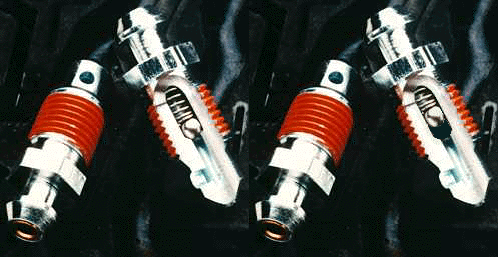
I've installed about 10 sets of these and have found a failure rate of nearly 50 percent. The "1-way" valves too often aren't really 1-way and stuff gets sucked back into the caliper between pumps.
Another reason I don't like them is that, if you are in the car pumping the brake pedal, there's nobody watching the plastic hose between the SpeedBleeder and the catch bottle. You don't know when the air bubbles stop coming out, you can't tell when the old, rusty brake fluid has been flushed and new, clean stuff is coming out. And worse, if the plastic hose pops off the SpeedBleeder, you will be pumping brake fluid all over the inside of your wheel well and possibly onto the side of your car. (Brake fluid eats paint!)
Finally, the SpeedBleeders don't generate enough of a "jolt" on the fluid to knock loose the pesky bubbles clinging inside your calipers. You need a 2nd person cracking open that bleed screw slightly AFTER you push on the brake pedal. And that would totally eliminate the need for SpeedBleeders and you would simply be back to an old fashioned manual bleed.
and like Mr. Zeckenhausen said, when you pump the brakes, you cant see them, so its hard to use them. I still needed another person to help bleed them, and wouldn't use them again just becuase they are unnecesarry.

Registered User
Joined: Jul 2002
Posts: 216
Likes: 0
From: IL
I was thinking of getting this when I get around to bleeding the brakes:
http://www.motiveproducts.com/index.htm

http://www.motiveproducts.com/index.htm
Trending Topics
Registered User
Joined: Dec 2002
Posts: 251
Likes: 0
From: Maplewood, NJ
Originally posted by happypants
I was thinking of getting this when I get around to bleeding the brakes:
I was thinking of getting this when I get around to bleeding the brakes:
Where a pressure bleeder really shines is when you swap brake lines or during a big brake installation. At that point, you have so much air in the system that pumping the brake pedal is virtually useless. I hook up a pressure bleeder and crack open the bleed screws until the the hissing of escaping air stops and what is coming out is mostly fluid. At that point, I refill the reservoir (my pressure bleeder uses air) and repressurize. Then my assistant pushes on the pedal. AFTER the pedal is pushed, I quickly open the bleed screw and then I close it BEFORE the pedal hits the floor. We repeat this until there are at least 3 or 4 pumps with zero air bubbles coming out.
Use the technique above and you will achieve a rock hard pedal. Pressure bleeding alone (or even worse, vacuum bleeding) will move new fluid slowly through the system, but your pedal will still be annoyingly soft.
Dave, thanks for another well written post. I have to agree that nothing beats a hard stomp on the woh(sp) pedal when bleeding.
Another question...Why do I need to bleed my Motul 600 after each track event? Does the fluid loose something after repeated HARD stops? I get no air, and the pedal is no firmer. I'm of the impression that the fluid is designed for high temps, and I find it hard to believe any moisture is added.
Oh yah, LOVE my Stoptech's & Panther +'s.
Another question...Why do I need to bleed my Motul 600 after each track event? Does the fluid loose something after repeated HARD stops? I get no air, and the pedal is no firmer. I'm of the impression that the fluid is designed for high temps, and I find it hard to believe any moisture is added.
Oh yah, LOVE my Stoptech's & Panther +'s.
Registered User
Joined: Dec 2002
Posts: 251
Likes: 0
From: Maplewood, NJ
Originally posted by EnthuZ
Dave, another question
Would it be beneficial to remove my REAR dust shields? It should help cool .....but are there any drawbacks?
Dave, another question
Would it be beneficial to remove my REAR dust shields? It should help cool .....but are there any drawbacks?
Many pads tend to wear at an incredibly accelerated rate when they exceed a certain temperature. For example. the Pagid Orange club race pad will work wonderfully up to about 1200 degrees. But if you exceed that temperature, they start to wear rapidly, often getting consumed in just a single track day. By the way, that's an indication that you need to move up to Pagid Black (or Yellow) if you are using the Pagid family of pads.
Getting back to the rear dust shield: if you remove it, you may only drop the rear rotor temperature by 50 degrees, but if you move the pad temperature down below that magic point where it is vaporizing like crazy, you could potentially double or triple pad life with this simple modification. Given the postage stamp sized rear pad on the non-Track model, you really need all the help you can get back there. All else being equal, the smaller the pad area, the higher the temperature.
Removing a rear shield is tough without pulling the rear hubs. But they can easily be cut off with tin snips. It's a 10 minute job per side.
Registered User
Joined: Dec 2002
Posts: 251
Likes: 0
From: Maplewood, NJ
Originally posted by EnthuZ
Another question...Why do I need to bleed my Motul 600 after each track event? Does the fluid loose something after repeated HARD stops? I get no air, and the pedal is no firmer. I'm of the impression that the fluid is designed for high temps, and I find it hard to believe any moisture is added.
Another question...Why do I need to bleed my Motul 600 after each track event? Does the fluid loose something after repeated HARD stops? I get no air, and the pedal is no firmer. I'm of the impression that the fluid is designed for high temps, and I find it hard to believe any moisture is added.
If you are doing several track events within a week or two of each other, it's not necessary to bleed your brakes between events. However, any softness of the brake pedal is an indication of fluid fade and means that you have air in the system as a result of boiling moisture. If you feel the pedal getting soft, it's time to bleed.
If you go several months between track events, it is probably a good idea to bleed just before the event. The brake fluid steadily lowers its boiling point over time and I wouldn't go to a track event with fluid that was several months old.
The irony is that if you have a StopTech 355mm brake upgrade, you need be LESS concerned about the condition of your brake fluid because the rotor temperatures will be a couple hundred degrees cooler than they would have been had you been using the stock brakes.
Dave, thanks for the answers! I've been running a track event like every other week....another with PCA next Wednesday....2 hours track time.... 
I've got a bunch of tin snips, so it's time to get BUSY!
Thanks for your responses!
I've got a bunch of tin snips, so it's time to get BUSY!
Thanks for your responses!
Registered User
Joined: Dec 2002
Posts: 251
Likes: 0
From: Maplewood, NJ
Originally posted by EnthuZ
Dave, thanks for the answers! I've been running a track event like every other week....another with PCA next Wednesday....2 hours track time....
I've got a bunch of tin snips, so it's time to get BUSY!
Dave, thanks for the answers! I've been running a track event like every other week....another with PCA next Wednesday....2 hours track time....
I've got a bunch of tin snips, so it's time to get BUSY!
PCA lets you run with them? They are more picky on the east coast, I guess. They've even started to exclude X-class from their local autocrosses. We'll see how accomodating they are when you start beating them!


Thread
Thread Starter
Forum
Replies
Last Post