


Hawk Brakes Squealing


 Hawk Brakes Squealing
Ok, I took the car out for about 4 hours of driving around and after the brakes were warmed , they squeaked like crazy from 20 mph and lower when stopping. It was quite annoying.
When I changed the OEM brakes I did not put the anti-squeal clip on the Hawk Brakes.
Should I have put them on?
Love the new brakes, but can't stand the squeaking when the brakes warm up.
Suggestions anyone?
When I changed the OEM brakes I did not put the anti-squeal clip on the Hawk Brakes.
Should I have put them on?
Love the new brakes, but can't stand the squeaking when the brakes warm up.
Suggestions anyone?

New Member
Joined: Apr 2003
Posts: 1,114
Likes: 0
From: In my car, Arkansas
Well, they will squeal a little, especially when it has been dry for a while, I have found. But I don't have the squealing you report. I used some anti-squeal grease I bought from auto-zone. I also bedded the brakes according the instructions given with the brakes. Dr Z has some good bedding instructions also. Those two things should cut down on what you are talking about.

Unfortunately, this tends to be one of the trade-offs of high performance pads. We have some customers complain about squeaks, while others never have any issues. A lot of it has to do with driving style. If you bed the pads in, and then crawl around town for 2 weeks commuting...never getting on the brakes...it starts to scrape off the pad layer that you transferred onto the rotors. In other words, the pads are cold in these conditions, and they are scraping on the surface of the rotor. If you've properly bedded in the pads, the surface of the rotor has a deposited layer of pad on them (an even blueish color around the rotor)...because you heated up your rotors and spread that layer on them when you did your bed-in. Once that pad layer starts to get scraped off however, you have spots where your pads are hitting deposited pad on the rotor, and other spots where your pads are hitting the metal of the rotor itself. Squeaks are usually heard when you are very slowly crawling to a halt, and the pad is slowly scraping across that spot with no pad deposition. If you are hard on your brakes fairly consistently, then you are continually putting a little more pad material on the rotor, since you are heating them up enough. The pad to rotor interface stays consistent, and you don't have any squeaks.
So, you might have to do another bed-in cycle, which could temporarily fix the problem until you scrape that layer off again. The anti-squeak juice helps sometimes as well...although it could get messy if you take the car on the track and heat them up enough.
The pad material itself varies greatly, and is sort of a black art. Batches of the same compounds are not always exactly the same. In other words, if you buy the same pad compound a year apart, chances are, that they exact composition of that pad is not identical to what you got last time. It will probably be close, but maybe not exact. I was pretty surprised when I found that out...pretty weird!
If you have ever run race pads on the street, you'll find that you always get squeaks. They typically have higher metal content, and generally more abrasive materials in them. It takes a lot more heat to get them to the point where you are able to get them to deposit a layer on the rotor. Also, when they're cold, they scrape off the old deposits a lot faster, because they are a more aggressive material.
Hopefully this all makes sense. I always tell my customers...there will always be tradeoffs with brake pads. We have yet to find the perfect compound for all conditions, and I doubt anyone really will. A factory pad is designed to provide adequate friction, but is not meant to make any noise, and to provide less dust in some cases. An aftermarket street pad is designed with a higher coefficient of friction, and has a different temperature threshold and range. It will still bite cold in most cases, although it will tend to squeak a bit more, because of the more agressive compound. Often times, it will dust more as well. It will be able to run a bit hotter than stock, but will still burn up under track use. A full race pad is pretty much useless for cold stops. It will feel like you have a block of wood in calipers if you put it on a fresh rotor without heat in it. Because of the aggressive materials in it (higher coefficient of friction), it will chew up your rotors, and it will make noise in the process. It has poor cold bite. When you heat it up, it has a higher temp. threshold. It will not disintegrate like the street pad. It will 'come in' at a higher temp., and really start to work. It will continue to work until you hit it's max operating temperature. Then it will stop working well.
It's all about tradeoffs with pads. You have to live with these tradeoffs to get the performance you want.
So, you might have to do another bed-in cycle, which could temporarily fix the problem until you scrape that layer off again. The anti-squeak juice helps sometimes as well...although it could get messy if you take the car on the track and heat them up enough.
The pad material itself varies greatly, and is sort of a black art. Batches of the same compounds are not always exactly the same. In other words, if you buy the same pad compound a year apart, chances are, that they exact composition of that pad is not identical to what you got last time. It will probably be close, but maybe not exact. I was pretty surprised when I found that out...pretty weird!
If you have ever run race pads on the street, you'll find that you always get squeaks. They typically have higher metal content, and generally more abrasive materials in them. It takes a lot more heat to get them to the point where you are able to get them to deposit a layer on the rotor. Also, when they're cold, they scrape off the old deposits a lot faster, because they are a more aggressive material.
Hopefully this all makes sense. I always tell my customers...there will always be tradeoffs with brake pads. We have yet to find the perfect compound for all conditions, and I doubt anyone really will. A factory pad is designed to provide adequate friction, but is not meant to make any noise, and to provide less dust in some cases. An aftermarket street pad is designed with a higher coefficient of friction, and has a different temperature threshold and range. It will still bite cold in most cases, although it will tend to squeak a bit more, because of the more agressive compound. Often times, it will dust more as well. It will be able to run a bit hotter than stock, but will still burn up under track use. A full race pad is pretty much useless for cold stops. It will feel like you have a block of wood in calipers if you put it on a fresh rotor without heat in it. Because of the aggressive materials in it (higher coefficient of friction), it will chew up your rotors, and it will make noise in the process. It has poor cold bite. When you heat it up, it has a higher temp. threshold. It will not disintegrate like the street pad. It will 'come in' at a higher temp., and really start to work. It will continue to work until you hit it's max operating temperature. Then it will stop working well.
It's all about tradeoffs with pads. You have to live with these tradeoffs to get the performance you want.
New Member
Joined: Apr 2003
Posts: 1,114
Likes: 0
From: In my car, Arkansas
It actually goes on the back of the brake pads, supposed to stop the vibrations that cause the squealing. Mine was real cheap, just rubbed it on the back of the brake pads with my finger. I did put mine on my car myself, but I don't remember the clips that you are speaking of.
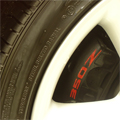
I think the clips they are talking about are the shims that protect the face of the piston from the back of the pad. They also function as a low pad squeal indicator. You need some high temperature grease to go on the back between the pad and the shim, and between the 2 shims (there are 2) as well. I actually got my brakes so hot during the bed-in, that the grease cooked and smoked like a son of a b****. The brakes are silent though. I have the Hawk HPS pads as well and love em. No more dust, no more squealing (my old stock pads actually did squeal).
J Ritt,
Thanks for an excellent reply. You learn something everyday and I sure did today. Thanks again.
Looks like I will bed the brakes again. I guess the first time wasn't quite good enough.
I dont drive the car much, has only 2000 miles, put the pads on at 900 miles.
Thanks again.
Thanks for an excellent reply. You learn something everyday and I sure did today. Thanks again.
Looks like I will bed the brakes again. I guess the first time wasn't quite good enough.
I dont drive the car much, has only 2000 miles, put the pads on at 900 miles.
Thanks again.
Trending Topics

Registered User
Joined: Jan 2003
Posts: 999
Likes: 0
From: IL, U.S.
I also replaced factory brembo ferodo pads with Hawk HPS last October, and they did squel for about 1-2 month, but after that, they don't make any.
You might wanna keep driving and see how it goes.
Now it doesn't squel at all at normal condition, but after some hard spirited driving, they tend to squel just a little at low speed range.
You might wanna keep driving and see how it goes.
Now it doesn't squel at all at normal condition, but after some hard spirited driving, they tend to squel just a little at low speed range.

Registered User
Joined: Aug 2002
Posts: 560
Likes: 0
From: austin
I have HPS pads and just installed them 2 weeks ago. They don't squeal a bit.. but I put the stock shims on all 4 pads, and I also applied anti-squeal "lube" to each pad. I couldn't be happier with the HPS pads on the street -- fantastic performance, almost no dust, and low cost.

how much did you pay for?
(and.. where?)
thank you.
i need new brake pads and my choice is nismo or hawks hps.
but i never heard anyone who HAS nismo (for non-track) pads.
can you guy tell me about nismo pads?
dusty? noisy?
thank you
(and.. where?)
thank you.
i need new brake pads and my choice is nismo or hawks hps.
but i never heard anyone who HAS nismo (for non-track) pads.
can you guy tell me about nismo pads?
dusty? noisy?
thank you
Registered User
Joined: Oct 2003
Posts: 303
Likes: 0
From: Walnut Creek, CA
I read somewhere here that Nismo pads = Hawk HPS pads.?? I got my front pads through www.tirerack.com for $69. They're Discount Tires Direct one one of the vendor/sponsors here on this forum. I've also read there's a cheaper place to buy them, but you'reonly gonna save $5-7 bux.

Registered User
Joined: Dec 2002
Posts: 102
Likes: 0
From: CO
To simplify your problem. If you drive high performance track pads on the street every stop must be last second panic type. Gentle doesn't cut it. I use the Axxis ultimate, which is not a track pad, but a high performance street. Still squeal a little if I crawl up to a stop.
I used to switch pads before going to the track. During the drive I would hit them hard and when I got to the track I had a nice coating on them. A couple of hard braking corners and I was in business
I used to switch pads before going to the track. During the drive I would hit them hard and when I got to the track I had a nice coating on them. A couple of hard braking corners and I was in business
How hard is it to install the Hawks? I've had my Z for 2 months now and the dust is bothering the crap out of me. I've never installed pads before so someone please let me know the range of difficulty. I wouldn't want to install and end up with squeaks or worse not be able to stop!
RNL323-
See this very excellent How-to from Tere @ ZChickz.com...
http://www.zchickz.com/brake1.htm
TB
See this very excellent How-to from Tere @ ZChickz.com...
http://www.zchickz.com/brake1.htm
TB
Registered User
Joined: Oct 2003
Posts: 303
Likes: 0
From: Walnut Creek, CA
HokieZ (our own member here)started this thread too. I found it a little more detailed than the one on zchickz website. But they're both pretty good DIY posts!
https://my350z.com/forum/showthread....threadid=58156
https://my350z.com/forum/showthread....threadid=58156

Thread
Thread Starter
Forum
Replies
Last Post
350Z_Al
Exterior & Interior
133
Oct 29, 2020 07:44 PM
