


The Official LS Swap Info/Questions Thread



Joined: May 2009
Posts: 4,293
Likes: 2
From: Spartanburg(SparkleCity), SC

I dug up some extra info on specific truck motors for the "budget" LS guys like me:
2007 5.3 L33 Silverado/Sierra 310hp
2007 5.3 LS4 Impala SS/MCSS/Grand Prix GXP 303hp
2008 5.3 LS4 Impala SS/GXP 303hp
2007 5.3 LC9 Avalanche/Suburban 310hp
2007 5.3 LC9 Yukon/Silverado/Avalanche 315hp
2007 5.3 LH6 Trailblazer/Envoy Denali/Buick Rainer/Saab 9-7 302hp
2007 5.3 LH6 Silverado/Sierra 315hp
2008 5.3 LH6 Trailblazer/Envoy Denali/Saab 9-7 300hp
2008 5.3 LH6 Silverado/Sierra 315hp
2008 5.3 LH8 Hummer 3 Alpha 300hp
2008 5.3 LMG Avalanche/Suburban/Tahoe/Yukon/Silverado/Sierra 320hp
Even better breakdown -
Gen III & Gen IV Engines
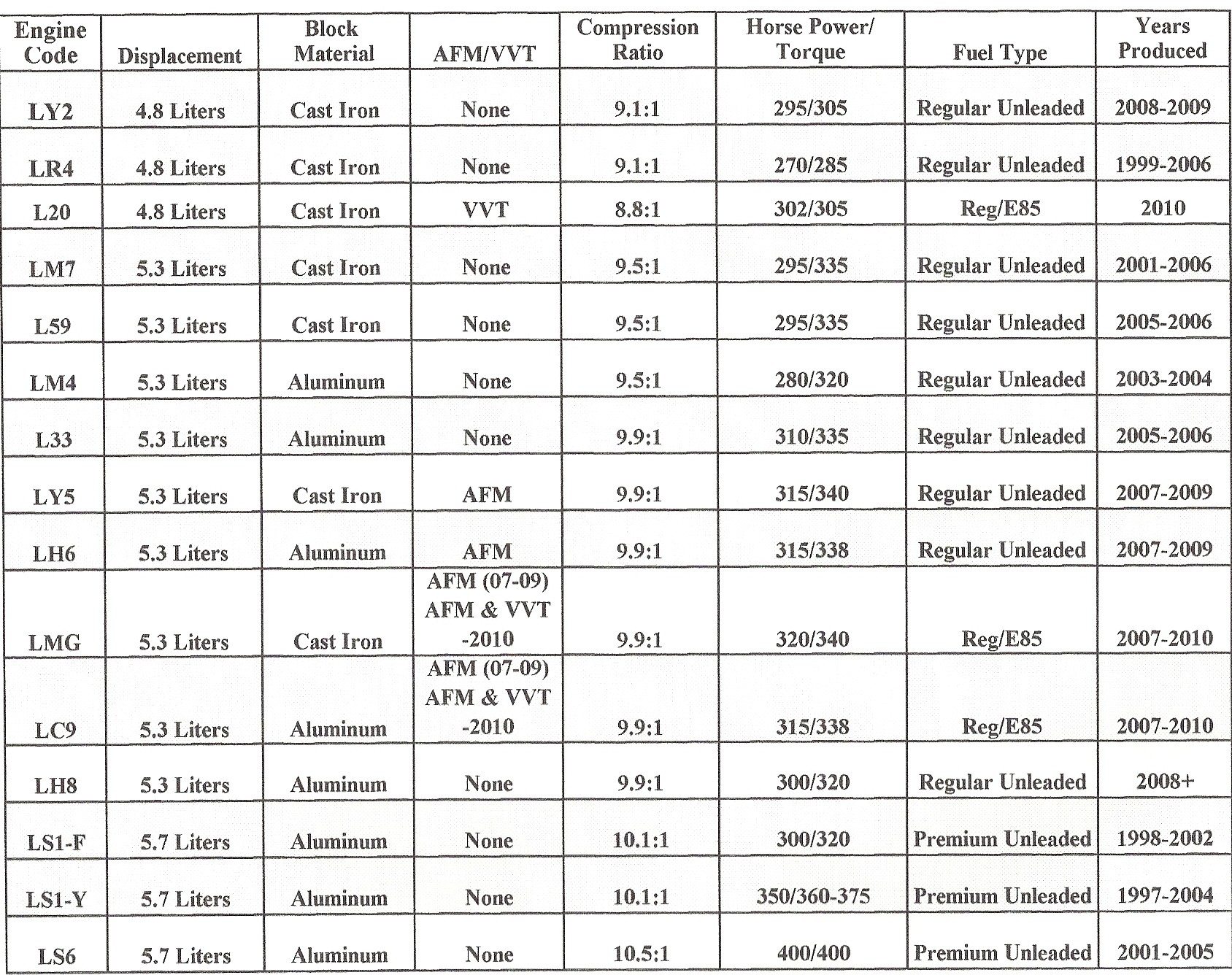

Significant Gen III Engineering Points:
1. All Gen III truck engines use iron blocks. Only the Camaro (F-Car) and Corvette (Y-car)LS1/LS6 engines feature aluminum blocks.
2. All Gen III engines have aluminum heads except for the '99 LQ4 engines that were equipped with iron heads. These engines received aluminum heads for the 2000 model year.
3. All Gen III engines share common main,rod,and cam-bearing journal diameters for ease of interchange. All blocks use a cross-bolted six-bolt main cap.
4. All Gen III engines are completely metric.
5. All valvetrain pieces are completely interchangable. The standard rocker ratio for all Gen III engines is 1.7:1.
6.All Gen III truck engines use cast aluminum oil pans that are deeper than the camaro or corvette pans.
7. All intake manifolds interchange. The truck intakes are roughly 3-4 inches taller than the passenger-car intakes.
8. All Gen III engines employ reusable gaskets for sealing surfaces except for the head gaskets. This makes it much quicker and easier to service the engine.
9. There are only two intake valve sizes for all the Gen III engines. Exhaust valves are all the same diameter.
10. Truck and camaro engines use cable throttle linkage while the corvettes use an electronic throttle. There are also some SUV engines with traction control that use electronic throttle control.
11. Bellhousing patterns are the same for all Gen III engines. The crank flange is basically the same depth as the bellhousing flange.
12. The Gen III firing order has been revised from 1-8-4-3-6-5-7-2 to 1-8-7-2-6-5-4-3. Note that the pairings 1-8, 4-3, 6-5, 7-2 remain the same, but the pairing order is different for reduced vibration.
13. The valve angle on all Gen III engines is 15 degrees versus 23 degrees for the origional and Gen II small-blocks.
14. The Gen III bore spacing is the same as the origional small-block, but each cylinder is ringed with only four head bolts instead of five.
2007 5.3 L33 Silverado/Sierra 310hp
2007 5.3 LS4 Impala SS/MCSS/Grand Prix GXP 303hp
2008 5.3 LS4 Impala SS/GXP 303hp
2007 5.3 LC9 Avalanche/Suburban 310hp
2007 5.3 LC9 Yukon/Silverado/Avalanche 315hp
2007 5.3 LH6 Trailblazer/Envoy Denali/Buick Rainer/Saab 9-7 302hp
2007 5.3 LH6 Silverado/Sierra 315hp
2008 5.3 LH6 Trailblazer/Envoy Denali/Saab 9-7 300hp
2008 5.3 LH6 Silverado/Sierra 315hp
2008 5.3 LH8 Hummer 3 Alpha 300hp
2008 5.3 LMG Avalanche/Suburban/Tahoe/Yukon/Silverado/Sierra 320hp
Even better breakdown -
Gen III & Gen IV Engines
Significant Gen III Engineering Points:
1. All Gen III truck engines use iron blocks. Only the Camaro (F-Car) and Corvette (Y-car)LS1/LS6 engines feature aluminum blocks.
2. All Gen III engines have aluminum heads except for the '99 LQ4 engines that were equipped with iron heads. These engines received aluminum heads for the 2000 model year.
3. All Gen III engines share common main,rod,and cam-bearing journal diameters for ease of interchange. All blocks use a cross-bolted six-bolt main cap.
4. All Gen III engines are completely metric.
5. All valvetrain pieces are completely interchangable. The standard rocker ratio for all Gen III engines is 1.7:1.
6.All Gen III truck engines use cast aluminum oil pans that are deeper than the camaro or corvette pans.
7. All intake manifolds interchange. The truck intakes are roughly 3-4 inches taller than the passenger-car intakes.
8. All Gen III engines employ reusable gaskets for sealing surfaces except for the head gaskets. This makes it much quicker and easier to service the engine.
9. There are only two intake valve sizes for all the Gen III engines. Exhaust valves are all the same diameter.
10. Truck and camaro engines use cable throttle linkage while the corvettes use an electronic throttle. There are also some SUV engines with traction control that use electronic throttle control.
11. Bellhousing patterns are the same for all Gen III engines. The crank flange is basically the same depth as the bellhousing flange.
12. The Gen III firing order has been revised from 1-8-4-3-6-5-7-2 to 1-8-7-2-6-5-4-3. Note that the pairings 1-8, 4-3, 6-5, 7-2 remain the same, but the pairing order is different for reduced vibration.
13. The valve angle on all Gen III engines is 15 degrees versus 23 degrees for the origional and Gen II small-blocks.
14. The Gen III bore spacing is the same as the origional small-block, but each cylinder is ringed with only four head bolts instead of five.
Last edited by SparkleCityHop; Jun 6, 2012 at 06:47 PM.

I dug up some extra info on specific truck motors for the "budget" LS guys like me:
2007 5.3 L33 Silverado/Sierra 310hp
2007 5.3 LS4 Impala SS/MCSS/Grand Prix GXP 303hp
2008 5.3 LS4 Impala SS/GXP 303hp
2007 5.3 LC9 Avalanche/Suburban 310hp
2007 5.3 LC9 Yukon/Silverado/Avalanche 315hp
2007 5.3 LH6 Trailblazer/Envoy Denali/Buick Rainer/Saab 9-7 302hp
2007 5.3 LH6 Silverado/Sierra 315hp
2008 5.3 LH6 Trailblazer/Envoy Denali/Saab 9-7 300hp
2008 5.3 LH6 Silverado/Sierra 315hp
2008 5.3 LH8 Hummer 3 Alpha 300hp
2008 5.3 LMG Avalanche/Suburban/Tahoe/Yukon/Silverado/Sierra 320hp
Even better breakdown -
Gen III & Gen IV Engines

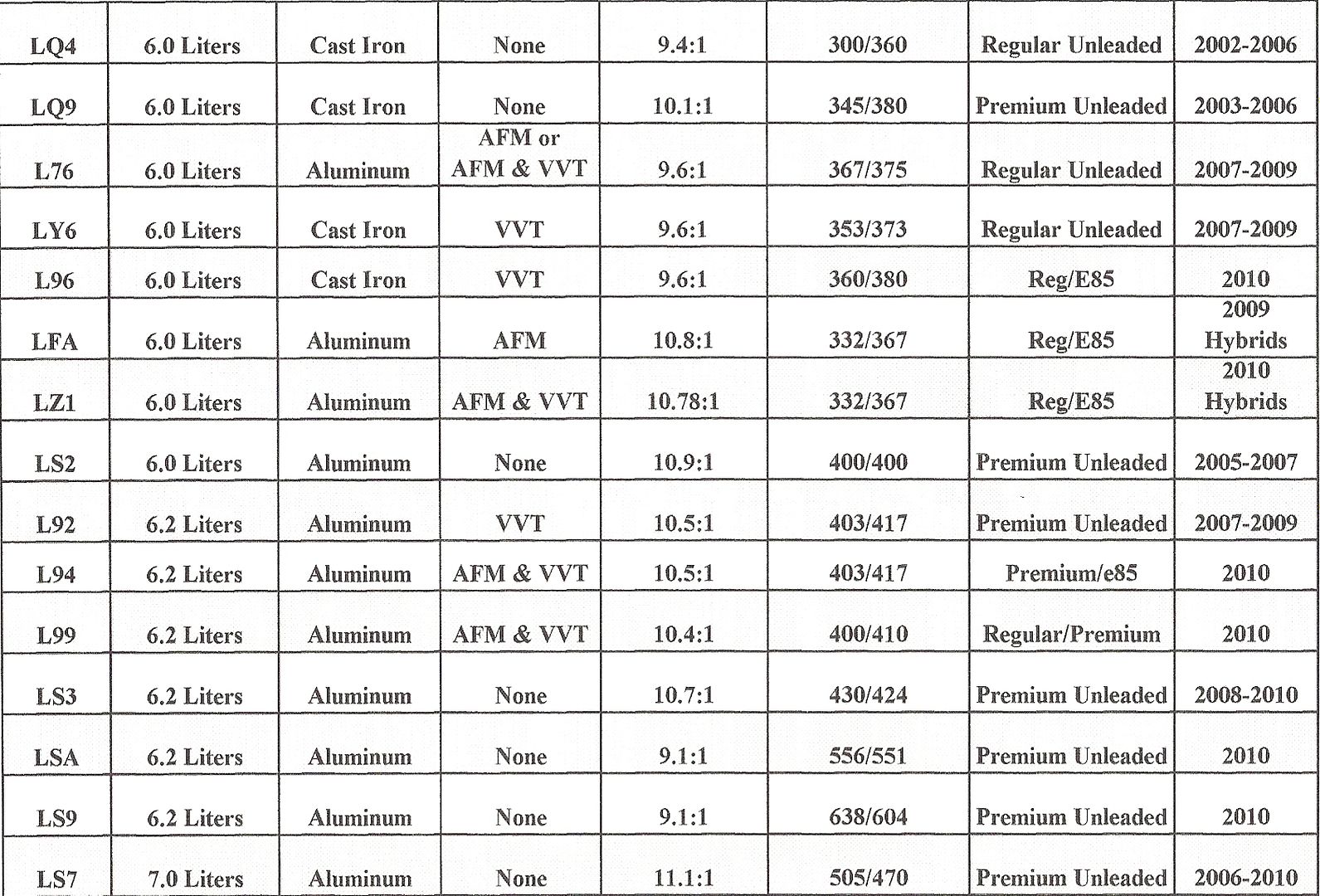
Significant Gen III Engineering Points:
1. All Gen III truck engines use iron blocks. Only the Camaro (F-Car) and Corvette (Y-car)LS1/LS6 engines feature aluminum blocks.
2. All Gen III engines have aluminum heads except for the '99 LQ4 engines that were equipped with iron heads. These engines received aluminum heads for the 2000 model year.
3. All Gen III engines share common main,rod,and cam-bearing journal diameters for ease of interchange. All blocks use a cross-bolted six-bolt main cap.
4. All Gen III engines are completely metric.
5. All valvetrain pieces are completely interchangable. The standard rocker ratio for all Gen III engines is 1.7:1.
6.All Gen III truck engines use cast aluminum oil pans that are deeper than the camaro or corvette pans.
7. All intake manifolds interchange. The truck intakes are roughly 3-4 inches taller than the passenger-car intakes.
8. All Gen III engines employ reusable gaskets for sealing surfaces except for the head gaskets. This makes it much quicker and easier to service the engine.
9. There are only two intake valve sizes for all the Gen III engines. Exhaust valves are all the same diameter.
10. Truck and camaro engines use cable throttle linkage while the corvettes use an electronic throttle. There are also some SUV engines with traction control that use electronic throttle control.
11. Bellhousing patterns are the same for all Gen III engines. The crank flange is basically the same depth as the bellhousing flange.
12. The Gen III firing order has been revised from 1-8-4-3-6-5-7-2 to 1-8-7-2-6-5-4-3. Note that the pairings 1-8, 4-3, 6-5, 7-2 remain the same, but the pairing order is different for reduced vibration.
13. The valve angle on all Gen III engines is 15 degrees versus 23 degrees for the origional and Gen II small-blocks.
14. The Gen III bore spacing is the same as the origional small-block, but each cylinder is ringed with only four head bolts instead of five.
2007 5.3 L33 Silverado/Sierra 310hp
2007 5.3 LS4 Impala SS/MCSS/Grand Prix GXP 303hp
2008 5.3 LS4 Impala SS/GXP 303hp
2007 5.3 LC9 Avalanche/Suburban 310hp
2007 5.3 LC9 Yukon/Silverado/Avalanche 315hp
2007 5.3 LH6 Trailblazer/Envoy Denali/Buick Rainer/Saab 9-7 302hp
2007 5.3 LH6 Silverado/Sierra 315hp
2008 5.3 LH6 Trailblazer/Envoy Denali/Saab 9-7 300hp
2008 5.3 LH6 Silverado/Sierra 315hp
2008 5.3 LH8 Hummer 3 Alpha 300hp
2008 5.3 LMG Avalanche/Suburban/Tahoe/Yukon/Silverado/Sierra 320hp
Even better breakdown -
Gen III & Gen IV Engines
Significant Gen III Engineering Points:
1. All Gen III truck engines use iron blocks. Only the Camaro (F-Car) and Corvette (Y-car)LS1/LS6 engines feature aluminum blocks.
2. All Gen III engines have aluminum heads except for the '99 LQ4 engines that were equipped with iron heads. These engines received aluminum heads for the 2000 model year.
3. All Gen III engines share common main,rod,and cam-bearing journal diameters for ease of interchange. All blocks use a cross-bolted six-bolt main cap.
4. All Gen III engines are completely metric.
5. All valvetrain pieces are completely interchangable. The standard rocker ratio for all Gen III engines is 1.7:1.
6.All Gen III truck engines use cast aluminum oil pans that are deeper than the camaro or corvette pans.
7. All intake manifolds interchange. The truck intakes are roughly 3-4 inches taller than the passenger-car intakes.
8. All Gen III engines employ reusable gaskets for sealing surfaces except for the head gaskets. This makes it much quicker and easier to service the engine.
9. There are only two intake valve sizes for all the Gen III engines. Exhaust valves are all the same diameter.
10. Truck and camaro engines use cable throttle linkage while the corvettes use an electronic throttle. There are also some SUV engines with traction control that use electronic throttle control.
11. Bellhousing patterns are the same for all Gen III engines. The crank flange is basically the same depth as the bellhousing flange.
12. The Gen III firing order has been revised from 1-8-4-3-6-5-7-2 to 1-8-7-2-6-5-4-3. Note that the pairings 1-8, 4-3, 6-5, 7-2 remain the same, but the pairing order is different for reduced vibration.
13. The valve angle on all Gen III engines is 15 degrees versus 23 degrees for the origional and Gen II small-blocks.
14. The Gen III bore spacing is the same as the origional small-block, but each cylinder is ringed with only four head bolts instead of five.
Numbers 1 & 10 are inaccurate, as L33 and lm4's are aluminum blocked engines and a lot of trucks came with DBW TB's. After getting scrwewed out of a 4.8 I purchased an Iron block gen III 5.3 (I don't know the code off the top of my head) for my build out of a 1500 chevy and it had DBW.



everything else...done. minus the one headlight that my brother ran over. still waiting on that thing too. been a solid 3 weeks for that sucker.

Joined: Jan 2004
Posts: 7,175
Likes: 132
From: Florida
Would a Stage 0 CJ-M fuel return system be worth keeping? I see Brew Haha is using a CJ-m fuel conversion? I parting out a turbo build to fund this. Not messing with the VQ now that she is my weekend mistress.
Chris
Chris
Joined: Jan 2004
Posts: 7,175
Likes: 132
From: Florida

Registered User
Joined: May 2012
Posts: 50
Likes: 0
From: Invercargill, New Zealand
Just spent well over 3 hours reading through this thread but damn it was worth it. Some real good info in here to put in the back of my mind.
EDIT: So will the sikky kit work with the TR6060 trans?
EDIT: So will the sikky kit work with the TR6060 trans?
Last edited by S13 S1lvia; Jun 22, 2012 at 05:36 PM.

just doing some fun reading. For you fellas with the ls1 and happen to decide to want to go LS2, here is an easy swap for you maybe?
http://www.ls2.com/forums/showthread.php?t=626014
http://www.ls2.com/forums/showthread.php?t=626014

Went today and checked out this motor a guy in my area posted on craiglist
Says its a LS1 with about 500 miles on it and came out of a 2003 corvette, Im a noob to this **** in case its not obvious but i snapped these pics today and wanted to get input on whether yall believe its worth the 1800 he's asking for it
From what i can see its missing the intake and exhaust manifolds and the belts but other than that im not 100% on what im looking at or looking for
Thanks in advance

Says its a LS1 with about 500 miles on it and came out of a 2003 corvette, Im a noob to this **** in case its not obvious but i snapped these pics today and wanted to get input on whether yall believe its worth the 1800 he's asking for it
From what i can see its missing the intake and exhaust manifolds and the belts but other than that im not 100% on what im looking at or looking for
Thanks in advance
Never came back to state that i did end up purchasing this motor, had it looked at and said that it was from what they can see good to go. Now from the bit of looking around that ive done i think I want to swap over to LS6 heads and IM, Cam the motor, Sikky Kit and get custom piping done for CAI and Exhaust. Dont know what to do has far as the Diff is concerned.
Also my goal for this motor is the 450+ range. How easy/hard would this be? What should do with the new ls6 heads or block while its out of the vehicle?
I will continue to read on my own and look through current build threads and figure some things out but i would love yalls help and answers via this thread, ESPECIALLY when it comes in to the little things that could present problems since this isn't as simple for me as it is for yall
THANKS ALOT IN ADVANCE GUYS
ALEX

What heads are on the motor now? 853's? If go with a cam you will want chromoly pushrods and beehive springs. If you remove heads you can't reuse the head bolts or gaskets so there is some additional expense.
It is also missing the oil pressure sensor and knock sensors. Some of the holes looked gummed up.
Definitely out of a late model c5 vette from what the oil pan looks like. LS6 block based on casting number (1251168), 241 LS1 heads, late model ls6 pcv valley cover.
The engine over all looks very clean. I dont know how you are looking at a 500 mile 9 year old motor, but looks pretty clean. I would go 1500 for the long block complete if you can get him down that low.
Definitely out of a late model c5 vette from what the oil pan looks like. LS6 block based on casting number (1251168), 241 LS1 heads, late model ls6 pcv valley cover.
The engine over all looks very clean. I dont know how you are looking at a 500 mile 9 year old motor, but looks pretty clean. I would go 1500 for the long block complete if you can get him down that low.
And so besides sending the block off to get cleaned all i should do is just start assembly?

Registered User
Joined: Feb 2010
Posts: 290
Likes: 0
From: alabama
Have had some things come up (car getting keyed and other misc money issues) but im close to being ready to get this thing started
Never came back to state that i did end up purchasing this motor, had it looked at and said that it was from what they can see good to go. Now from the bit of looking around that ive done i think I want to swap over to LS6 heads and IM, Cam the motor, Sikky Kit and get custom piping done for CAI and Exhaust. Dont know what to do has far as the Diff is concerned.
Also my goal for this motor is the 450+ range. How easy/hard would this be? What should do with the new ls6 heads or block while its out of the vehicle?
I will continue to read on my own and look through current build threads and figure some things out but i would love yalls help and answers via this thread, ESPECIALLY when it comes in to the little things that could present problems since this isn't as simple for me as it is for yall
THANKS ALOT IN ADVANCE GUYS
ALEX
Never came back to state that i did end up purchasing this motor, had it looked at and said that it was from what they can see good to go. Now from the bit of looking around that ive done i think I want to swap over to LS6 heads and IM, Cam the motor, Sikky Kit and get custom piping done for CAI and Exhaust. Dont know what to do has far as the Diff is concerned.
Also my goal for this motor is the 450+ range. How easy/hard would this be? What should do with the new ls6 heads or block while its out of the vehicle?
I will continue to read on my own and look through current build threads and figure some things out but i would love yalls help and answers via this thread, ESPECIALLY when it comes in to the little things that could present problems since this isn't as simple for me as it is for yall
THANKS ALOT IN ADVANCE GUYS
ALEX
You keep recommending their kit but I don't see any real swaps to support why they are better (?).
Stock diff is fine for that power im at 478 hp 440 tq and havent had a problem. Dont waste your time on welding a custom intake i will post some pics of mine i just used a 45 coupler, 45 pipe and 90 coupler and its perfect. I suggest the fueled racing kit over the sikky but will have my sikky kit up for sale in the next couple of weeks.
^im gonna go on a limb here and say its because the motor sits further back utilizing the oem shifter setup. seems to be their only real problem with that kit, aside form their atrocious wiring skills.
Registered User
Joined: Feb 2010
Posts: 290
Likes: 0
From: alabama
Their oil pans have a different location for the dip stick so it doesnt shoot up when you get on it.
The clutch line kit has the right size banjo bolt that doesnt strip out when you tighten it.
Cheaper and comes with headers with V band clamps.
Better placement of the motor so you have clearance and room up front for boost.
I liked the sikky kit at first but then have just had numerous little problems and 1 or two big problems with the shifter. Ended up making up my own stuff to fix issues that i had with theirs, clutch line, fule line kit, power steering kit, and modified the other things that i didnt have the machines to make new stuff.

They retain the stock shifter location so you can use the nicer short shifters that are out there for them.
Their oil pans have a different location for the dip stick so it doesnt shoot up when you get on it.
The clutch line kit has the right size banjo bolt that doesnt strip out when you tighten it.
Cheaper and comes with headers with V band clamps.
Better placement of the motor so you have clearance and room up front for boost.
I liked the sikky kit at first but then have just had numerous little problems and 1 or two big problems with the shifter. Ended up making up my own stuff to fix issues that i had with theirs, clutch line, fule line kit, power steering kit, and modified the other things that i didnt have the machines to make new stuff.
Their oil pans have a different location for the dip stick so it doesnt shoot up when you get on it.
The clutch line kit has the right size banjo bolt that doesnt strip out when you tighten it.
Cheaper and comes with headers with V band clamps.
Better placement of the motor so you have clearance and room up front for boost.
I liked the sikky kit at first but then have just had numerous little problems and 1 or two big problems with the shifter. Ended up making up my own stuff to fix issues that i had with theirs, clutch line, fule line kit, power steering kit, and modified the other things that i didnt have the machines to make new stuff.
I am curious about the dipstick issue, obviously I'm not running yet. I would think if you're PVC was plumbed to the intake this would go away. How do people having this issue have theirs plumbed?