


300Hp


New Member
Joined: Aug 2005
Posts: 7,175
Likes: 16
From: Here and There

Originally Posted by Nano
actually, so is the 2005 35th edition(automatic included  )... which has the lowest HP/weight ratio of all models.
)... which has the lowest HP/weight ratio of all models. Different magazines have different curb weights for the 35th, but back when it was still on the Nissan website, the factory quote was 3299 lbs (I've seen as high as 3370 lbs, i.e. in R&T).
But the '06's are (per Nissan's site):
Base (MT): 3339
Enth (MT): 3346
Enth (AT): 3344
Tour (MT): 3400
Tour (AT): 3380
Track (MT): 3370
Grand Tour (MT): 3404
Grand Tour (AT): 3391
This would suggest an even lower hp/curb wt. ratio for the '06's, given the same 300hp engine. But we're talking insignificant differences...

New Member
Joined: Aug 2005
Posts: 7,175
Likes: 16
From: Here and There
Originally Posted by NightRida
Wheres the 05 weight list to campare to slacker?
Peace!
Peace!
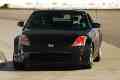
Well, my '05 Z track in "race mode" (17in wheels with 255/40 & 275/40) with 3/4 of a tank of fuel, nothing in the trunk plus me in it (200lb) weight in at 3413lb.
I have a Tanabe Y-back and that's it for mods.
I have a Tanabe Y-back and that's it for mods.

Originally Posted by Kolia
Well, my '05 Z track in "race mode" (17in wheels with 255/40 & 275/40) with 3/4 of a tank of fuel, nothing in the trunk plus me in it (200lb) weight in at 3413lb.
I have a Tanabe Y-back and that's it for mods.
I have a Tanabe Y-back and that's it for mods.
Because honestly and seriously... I don't believe a sinlge one of the published curb weights... from 03 to 06. I believe the 03-05 are a bit underrated(lbs), and the 06 overrated(lbs), there isn't a 200+lbs difference.
Last edited by Nano; May 2, 2006 at 05:53 PM.



Originally Posted by roast
I care, why?

Originally Posted by roast
Did I say the car is heaver BECAUSE they added 13hp? Give me a break. Things tend to get heavier when you keep adding to it.
Originally Posted by roast
Uh. I'm sorry, but you are mistaken. You need to go back to physics and learn the difference between horspower and torque. HP:weight wins races. Take an F1 car for instance, they don't even make 300ft-lbs of torque. Tell me a mustang GT is going to blow it away in a straight line because it has more torque!! 
Horsepower = (Torque x Engine speed) / 5,252
From Wikipedia:
Originally Posted by Wikipedia
Understanding the relationship between torque, power and engine speed is vital in automotive engineering, concerned as it is with transmitting power from the engine through the drive train to the wheels. Typically power is a function of torque and engine speed. The gearing of the drive train must be chosen appropriately to make the most of the motor's torque characteristics.
Things get heavier when you add them

However, there is virtually no difference between 287 hp engines and 300hp engines, which you did originally state.

BTW, nowhere did I say such nonsense.
The way you originally described it, you associated the 287hp cars with being lighter, when you should have associated it with year of production.
Going back to physics shows me horsepower is a function of torque:
Horsepower = (Torque x Engine speed) / 5,252
From Wikipedia:
Horsepower = (Torque x Engine speed) / 5,252
From Wikipedia:
Going back to your erroneous statement "You'd take HP over TQ? HP sells cars, TQ wins races."
You're damn right I would take HP over TQ, assuming I wanted to win a race. HP is what wins races. If I wanted the ability to easily pull a boat up a steep hill, then I would go for torque. If my original question didn't make it clear enough for you (mustang gt vs F1 comparison): How many quarter mile ET calculators can you find that ask for torque, since torque is what wins races??? LOL
Torque is a measurement of rotational force(the rotational ability to do work), that's why it's measured in FOOT POUNDS. Torque does not reflect the RATE at which work can be done, that's why torque itself has no bearing on acceleration! Do you even know what a torque wrench is??? LOL
I wonder why they don't call it a horsepower wrench!!
Horsepower is a measurement of how much WORK can be done in a given amount of TIME. That's why it directly affects acceleration. It is a function of torque because you must first know how much work can be done to begin with. RPM is where TIME gets factored in (revolutions per MINUTE). That's why torque is measured, HP is calculated. Torque by itself is meaningless in regards to acceleration or winning races.
You don't see racers constantly referring to horsepower:weight ratios because torque wins races, do you???? You can have all the torque in the world, but if you can't dish it out fast enough(horsepower), you can't accelerate for sh*t.

On the other hand, you can have sh*t for torque(f1 car for instance), but if you can dish it out at an insane rate(18,000rpms for instance), horsepower will be through the roof.
That was my explanation of torque vs hp entirely off the top of my head. Let's hear your explanation off the top of your head (without relying on wikipedia) backing up your statement why TORQUE wins races. LOL.
You can admit you were wrong or embarrass yourself further. Again, it's your choice.

Last edited by roast; May 3, 2006 at 02:59 AM.
New Member
Joined: Aug 2005
Posts: 7,175
Likes: 16
From: Here and There
Originally Posted by Nano
ahaha, I weight 165lbs!
145 lbs (makes up for the weight diff. b/t my 35th and the other "lighter" models).

Originally Posted by Kolia
And you just lost 5lb according to the mail I just received...
You'll need ALL the help you can get at BAB8... hehe
You'll need ALL the help you can get at BAB8... hehe
Don't forget I have 3 track days at tremblant just before BAB8... and also close to 200 pocket coffees
Originally Posted by roast
No kidding???
Originally Posted by roast
Oh, they are "virtually" the same, besides the fact one produces 13 more hp, 14ft-lbs less torque, and has a 400rpm higher redline. Right??
BTW, nowhere did I say such nonsense.
BTW, nowhere did I say such nonsense.
Originally Posted by roast
The 287hp models have a lot less weight, so just because the '06's have 13 more hp doesn't mean they accelerate faster, or even as fast. Read my above post. Not to mention the heavier the car is, the harder it is to get off the line.
Originally Posted by roast
Do not try to twist my words into an argument that is convenient for your stupidity. If you add weight to a car it gets slower unless you increase horsepower to offset the difference; That's all I was getting at, and it's simple physics, genius.

My point is the 287hp cars DO NOT have a lot less weight, like you initially stated. The weight difference in 2003-2005 models was caused by larger wheels, the addition of TCS/VDC, LSD, and on the Track/35th, the Brembo's. In 2006, all models across the board had a weight increase, which included the 287 and 300hp models. Take the 2006 models for example, taken from Nissanusa.com:
Manual Transmission: 3,339 3,346 3,400 3,370 3,404
Automatic transmission: N/A 3,344 3,380 N/A 3,391
As you can see, the weight difference between the 2006 300hp manual models and the 287hp models is anywhere from 2-20 lbs. Not a whole heck of a lot really, at least in terms of absolute performance.
Also, I completely understand the mechanical differences of the 287hp and 300hp. My point was there wasn't much difference in terms of weight between the two. The differences between the two engines (CVT on the exhaust cams, forged internals, etc) do not make up a noticable difference between a car with the 287hp engine and the 300hp engine.
Originally Posted by ROAST
Wow!! You're good!! You spout off torque and then retort with horsepower. How long did it take you to figure out horsepower was a function of torque? My guess is not very long considering you relied on wikipedia to do it. That was a nice attempt at digging yourself out of the hole you dug, but alas, you failed. I really thought you might do the respectable thing and apologize for taking my comments out of context in an attempt to insult my intelligence, and then admit you were wrong. Instead you force me to bust your *****.
Going back to your erroneous statement "You'd take HP over TQ? HP sells cars, TQ wins races."
You're damn right I would take HP over TQ, assuming I wanted to win a race. HP is what wins races. If I wanted the ability to easily pull a boat up a steep hill, then I would go for torque. If my original question didn't make it clear enough for you (mustang gt vs F1 comparison): How many quarter mile ET calculators can you find that ask for torque, since torque is what wins races??? LOL
Torque is a measurement of rotational force(the rotational ability to do work), that's why it's measured in FOOT POUNDS. Torque does not reflect the RATE at which work can be done, that's why torque itself has no bearing on acceleration! Do you even know what a torque wrench is??? LOL
I wonder why they don't call it a horsepower wrench!!
Horsepower is a measurement of how much WORK can be done in a given amount of TIME. That's why it directly affects acceleration. It is a function of torque because you must first know how much work can be done to begin with. RPM is where TIME gets factored in (revolutions per MINUTE). That's why torque is measured, HP is calculated. Torque by itself is meaningless in regards to acceleration or winning races.
You don't see racers constantly referring to horsepower:weight ratios because torque wins races, do you???? You can have all the torque in the world, but if you can't dish it out fast enough(horsepower), you can't accelerate for sh*t.
On the other hand, you can have sh*t for torque(f1 car for instance), but if you can dish it out at an insane rate(18,000rpms for instance), horsepower will be through the roof.
That was my explanation of torque vs hp entirely off the top of my head. Let's hear your explanation off the top of your head (without relying on wikipedia) backing up your statement why TORQUE wins races. LOL.
You can admit you were wrong or embarrass yourself further. Again, it's your choice.
Going back to your erroneous statement "You'd take HP over TQ? HP sells cars, TQ wins races."
You're damn right I would take HP over TQ, assuming I wanted to win a race. HP is what wins races. If I wanted the ability to easily pull a boat up a steep hill, then I would go for torque. If my original question didn't make it clear enough for you (mustang gt vs F1 comparison): How many quarter mile ET calculators can you find that ask for torque, since torque is what wins races??? LOL
Torque is a measurement of rotational force(the rotational ability to do work), that's why it's measured in FOOT POUNDS. Torque does not reflect the RATE at which work can be done, that's why torque itself has no bearing on acceleration! Do you even know what a torque wrench is??? LOL
I wonder why they don't call it a horsepower wrench!!
Horsepower is a measurement of how much WORK can be done in a given amount of TIME. That's why it directly affects acceleration. It is a function of torque because you must first know how much work can be done to begin with. RPM is where TIME gets factored in (revolutions per MINUTE). That's why torque is measured, HP is calculated. Torque by itself is meaningless in regards to acceleration or winning races.
You don't see racers constantly referring to horsepower:weight ratios because torque wins races, do you???? You can have all the torque in the world, but if you can't dish it out fast enough(horsepower), you can't accelerate for sh*t.
On the other hand, you can have sh*t for torque(f1 car for instance), but if you can dish it out at an insane rate(18,000rpms for instance), horsepower will be through the roof.
That was my explanation of torque vs hp entirely off the top of my head. Let's hear your explanation off the top of your head (without relying on wikipedia) backing up your statement why TORQUE wins races. LOL.
You can admit you were wrong or embarrass yourself further. Again, it's your choice.
Now my question is... since you confirmed HP is basically the amount of work (torque) done is done in a certain period of time, doesn't that mean that the amount of torque you make and how its geared in the transmission determine the actual relative HP? Like you stated, F1 cars have engines built and capable to handle upwards of 15-18k RPM's, but in order for them to get that high, doesn't that require some incredibly high gearing too?
I think I see where your coming from with your argument, I guess the point I'm trying to make is like you said, torque is all about rotational force, which is actually what moves the wheels. HP is simply a caculated number in which the work the engine does over time. I guess my point of view of it was that an engine actually MAKES torque, not HP since HP is just a caculated number, and thats why TQ wins races, not HP.
Or maybe I'm still confused.

Either way, thank you for clarying the whole hp/tq relationship. Obviously my grasp was not as good as I thought it was.
However, there is virtually no difference between 287 hp engines and 300hp engines, which you did originally state.
I'm not twisting anyones words. And I'm not stupid
Your explanation does clarify a few things for me, I will admit that. My understanding of the whole hp/tq relationship has obviously gotten misrepresented over the years... it has been quite a while since I've done anything physics related.
Now my question is... since you confirmed HP is basically the amount of work (torque) done is done in a certain period of time, doesn't that mean that the amount of torque you make and how its geared in the transmission determine the actual relative HP?
Like you stated, F1 cars have engines built and capable to handle upwards of 15-18k RPM's, but in order for them to get that high, doesn't that require some incredibly high gearing too?
I think I see where your coming from with your argument, I guess the point I'm trying to make is like you said, torque is all about rotational force, which is actually what moves the wheels. HP is simply a caculated number in which the work the engine does over time. I guess my point of view of it was that an engine actually MAKES torque, not HP since HP is just a caculated number, and thats why TQ wins races, not HP
Either way, thank you for clarying the whole hp/tq relationship. Obviously my grasp was not as good as I thought it was.

Last edited by roast; Dec 18, 2006 at 12:20 PM.

The rev-up (IMHO) is significantly different...different lower plenum, different cams, different air box, different ECU, higher redline -- that seems like more than a few minor changes. Similar, but by no means a small difference..

Thread
Thread Starter
Forum
Replies
Last Post