


Pre-turbo water injection: has anyone done it?


Thread Starter
New Member
iTrader: (18)
Joined: Jul 2005
Posts: 6,474
Likes: 65
From: Chapel Hill, NC
 Pre-turbo water injection: has anyone done it?
This is a very controversial topic - there are many well-documented benefits (namely making your small turbo have a top-end compressor map like a nice, big, fat one) and some purportedly dire risks (in particular, damage to the compressor blades). I'm looking for real world experience (if there is any) from the the Z/G turbo community.
I had initially rejected this setup because of the spectre of possible turbo damage, but here is a quote from another website indicating factory placement:
If anyone has experience with pre-turbo injection on another vehicle, that would be helpful also.
Please provide some outcome data if you've got it (i.e. how many miles with pre-turbo injection and going strong, or how many miles before a "bad" event occurred)!
Thanks!
I had initially rejected this setup because of the spectre of possible turbo damage, but here is a quote from another website indicating factory placement:
"On pre-turbo water injection, there is NO documentation that it pits the vanes on a turbo or causes any problems, and many people have been running low pressure water injection pre-turbo for years-imagine the cooling effect of water mist through the turbo! The one time I heard of water injection pitting pre-turbo was on a modified car that did not use an air filter!!!!!!! So that doesn't count."
Actually old Saab 99's had a pre-turbo water injection system from the factory. They always came back with pitted compressor wheels, and they certainly ran air-filters! It was a long-term thing though, and I don't mean to make a big deal of it. Most of their turbos were still working fine after 100K miles, and the pitting was mild and didn't seem to affect performance.
Adrian~
Actually old Saab 99's had a pre-turbo water injection system from the factory. They always came back with pitted compressor wheels, and they certainly ran air-filters! It was a long-term thing though, and I don't mean to make a big deal of it. Most of their turbos were still working fine after 100K miles, and the pitting was mild and didn't seem to affect performance.
Adrian~
Please provide some outcome data if you've got it (i.e. how many miles with pre-turbo injection and going strong, or how many miles before a "bad" event occurred)!
Thanks!
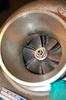

So your talking about adding a nozzle in front of the turbo intake piping? So then it goes through the intercooler already chilled??? Interesting concept. Water/meth droplets hitting the blades is potentially causing damage to the blades? Interesting... looking forward to getting more feedback on this.

Thread Starter
New Member
iTrader: (18)
Joined: Jul 2005
Posts: 6,474
Likes: 65
From: Chapel Hill, NC
Yes, in addition to the traditional benefits of water injection, you can radically change the compressor map for a turbo using water (or W/M) injection, but it is not without risks. Implementing this properly may mitigate these risks, which is why I'm looking for someone that has done this successfully over a long period.

Registered User
Joined: May 2004
Posts: 100
Likes: 0
From: Mesa, Az
Originally Posted by rcdash
If anyone has experience with pre-turbo injection on another vehicle, that would be helpful also.
Please provide some outcome data if you've got it (i.e. how many miles with pre-turbo injection and going strong, or how many miles before a "bad" event occurred)!
Thanks!

Thread Starter
New Member
iTrader: (18)
Joined: Jul 2005
Posts: 6,474
Likes: 65
From: Chapel Hill, NC
Originally Posted by Gary Evans
This is an eroded compressor fan from a Mitsubishi Super 16G used on a bike for about 15000 street miles with occasional boosting. As you can see it didn't fail and ran fine but the leading edge damage was obvious. It was found during maintenance.
At this link I found these images:


Looking at this "damage" begs the question of how relevant it really is in terms of overall longevity of a FI setup?
Last edited by rcdash; Mar 12, 2008 at 11:23 AM.

Trending Topics
Registered User
Joined: May 2004
Posts: 100
Likes: 0
From: Mesa, Az
Originally Posted by rcdash
Thanks for the data point - and image. That is similar to the few other images I have found for water injection with condensed droplets hitting the blades, rather than a fine mist. Do you know any details on the water nozzle setup (nozzle placement [how far upstream], psi, amount of water, trigger for injection, etc)?
At this link I found these images:
Looking at this "damage" begs the question of how relevant it really is in terms of overall longevity of a FI setup?
At this link I found these images:
Looking at this "damage" begs the question of how relevant it really is in terms of overall longevity of a FI setup?

Thread Starter
New Member
iTrader: (18)
Joined: Jul 2005
Posts: 6,474
Likes: 65
From: Chapel Hill, NC
Originally Posted by Gary Evans
I was injecting 275cc/min with a nozzle mounted right in the turbo inlet. The water was held in a tank pressurize by boost through a check valve. The water in control can either be accomplished with another check valve with the correct cracking pressure or through a solenoid valve triggered by an adjustable Hobbs switch. I tried both but settled on the later set to turn on at 7lbs. I believe a compressor fan run under those conditions would last at least 30-50000 miles before performance would degrade much. Should point out that I am not using an intercooler since the water injection accomplishs the same or better detonation protection and intercoolers do not fit very well on street bikes. With an intercooler it isn't recommended to run water mist through the turbo as it may condensate on the intercooler walls. For an intercooler I would suggest injecting at high pressure after the cooler.

Registered User
Joined: May 2004
Posts: 6
Likes: 0
From: S.NH
You could make it work and last longer if you had an appropriate turbo(s). Precision makes a 71mm turbo with a billet impeller wheel. Add an acorn center nut and between the resiliance of the billet and the water distribution of the acorn it might last longer and be slightly more efficient.
Better yet, instead of fluid dynamically changing your pee shooter(s) into a big turbo(s), just get a slightly bigger turbo(s) and use a W/M kit post turbo to gain all the benefits and none of the detrimental side effects.
Legit questions/answers, but for an application such as yours where room is not that big of a concern it's the least desirable way to use a W/M kit. (bikes, snowmobiles, go-carts, Aircraft, etc are examples of extreme space restraint applications)
Better yet, instead of fluid dynamically changing your pee shooter(s) into a big turbo(s), just get a slightly bigger turbo(s) and use a W/M kit post turbo to gain all the benefits and none of the detrimental side effects.
Legit questions/answers, but for an application such as yours where room is not that big of a concern it's the least desirable way to use a W/M kit. (bikes, snowmobiles, go-carts, Aircraft, etc are examples of extreme space restraint applications)
Thread Starter
New Member
iTrader: (18)
Joined: Jul 2005
Posts: 6,474
Likes: 65
From: Chapel Hill, NC
Originally Posted by OVRBST
You could make it work and last longer if you had an appropriate turbo(s). Precision makes a 71mm turbo with a billet impeller wheel. Add an acorn center nut and between the resiliance of the billet and the water distribution of the acorn it might last longer and be slightly more efficient.
Better yet, instead of fluid dynamically changing your pee shooter(s) into a big turbo(s), just get a slightly bigger turbo(s) and use a W/M kit post turbo to gain all the benefits and none of the detrimental side effects.
Legit questions/answers, but for an application such as yours where room is not that big of a concern it's the least desirable way to use a W/M kit. (bikes, snowmobiles, go-carts, Aircraft, etc are examples of extreme space restraint applications)
Better yet, instead of fluid dynamically changing your pee shooter(s) into a big turbo(s), just get a slightly bigger turbo(s) and use a W/M kit post turbo to gain all the benefits and none of the detrimental side effects.
Legit questions/answers, but for an application such as yours where room is not that big of a concern it's the least desirable way to use a W/M kit. (bikes, snowmobiles, go-carts, Aircraft, etc are examples of extreme space restraint applications)
 Again, do not try this at home folks - you've been warned.
That said, most set ups that I've seen described inject right at the compressor inlet and have no intercooler in place (eliminating one source for pressure loss). There are obviously other plausible configurations to consider. Hoping to hear from a few brave souls that ventured into uncharted territory (uncharted for the VQ anyway)...

Last edited by rcdash; Mar 12, 2008 at 08:02 PM.
Registered User
Joined: May 2004
Posts: 100
Likes: 0
From: Mesa, Az
IMO the only advantage on pre-turbo injection is cost since you do not need a high pressure system. Because of the erosion issue I have long since gone to a high pressure system and now inject into the turbo outlet. To do this and get good atomization the injection pressure needs to be at least 50+ lbs above boost and that takes a good pump. I use a AquaMist but would warn you at 275cc/min the pump is max'd out to the point that their largest available jet had to be enlarged to get there. This is for a 1300cc engine injecting something close to 20% so you may not have enough capacity for larger engines with that set up. As you likely already know most automotive applications use variations of the larger FloJet pump for capacity reasons.
Thread Starter
New Member
iTrader: (18)
Joined: Jul 2005
Posts: 6,474
Likes: 65
From: Chapel Hill, NC
Originally Posted by Gary Evans
IMO the only advantage on pre-turbo injection is cost since you do not need a high pressure system. Because of the erosion issue I have long since gone to a high pressure system and now inject into the turbo outlet. To do this and get good atomization the injection pressure needs to be at least 50+ lbs above boost and that takes a good pump. I use a AquaMist but would warn you at 275cc/min the pump is max'd out to the point that their largest available jet had to be enlarged to get there. This is for a 1300cc engine injecting something close to 20% so you may not have enough capacity for larger engines with that set up. As you likely already know most automotive applications use variations of the larger FloJet pump for capacity reasons.
The single largest advantage in pre-turbo injection is the ability to increase turbo efficiency. The fact that we all have intercoolers to do this very same thing begs the question of why even consider this? Simply - to allow more room to grow for those that have maxed out their turbos. Yes, you can change turbos. What's the expense associated with that and which is the more cost-effective option for those considering a turbo-swap for more power? If you're gonna pull the turbo out anyway, why not try pre-turbo WI for a few tens of thousands of miles?
Last edited by rcdash; Mar 13, 2008 at 07:16 AM.
Registered User
Joined: May 2004
Posts: 100
Likes: 0
From: Mesa, Az
With pre-injection the fan atomizes the water but there will be erosion damage regardless of injection pressure unless the water is totally evoporated before it gets to the fan. Unless your running a turbo on the ragged edge of compressor efficency (which you shouldn't be doing) there is likely more to be gained from higher boost than any other change. The main benefit of water or water/alcohol is the prevention of detonation. I know there are a lot of claims about increased HP but I found pretty much zero added from any combination of water and alcohol or at least not enough to be measured on a dyno. If someone claims added power thats fine and I'm not going to argue the point but this has been my experience after a lot of testing. The water mixture cools combustion which is good to prevent detonation but it also displaces air/fuel in the process which cancels part of the gain and even straight alcohol has less power/lb than gasoline. The power increases I have seen (and it can be a lot) came from being able to remove the extra fuel that had been added for cooling purposes and the ability to safety run a higher boost level.
Last edited by Gary Evans; Mar 13, 2008 at 08:27 AM. Reason: Typo
Thread Starter
New Member
iTrader: (18)
Joined: Jul 2005
Posts: 6,474
Likes: 65
From: Chapel Hill, NC
Originally Posted by Gary Evans
With pre-injection the fan atomizes the water but there will be erosion damage regardless of injection pressure unless the water is totally evoporated before it gets to the fan. Unless your running a turbo on the ragged edge of compressor efficency (which you shouldn't be doing) there is likely more to be gained from higher boost than any other change. The main benefit of water or water/alcohol is the prevention of detonation. I know there are a lot of claims about increased HP but I found pretty much zero added from any combination of water and alcohol or at least not enough to be measured on a dyno. If someone claims added power thats fine and I'm not going to argue the point but this has been my experience after a lot of testing. The water mixture cools combustion which is good to prevent detonation but it also displaces air/fuel in the process which cancels part of the gain and even straight alcohol has less power/lb than gasoline. The power increases I have seen (and it can be a lot) came from being able to remove the extra fuel that had been added for cooling purposes and the ability to safety run a higher boost level.
In reference to atomization, the online reported consensus (albeit limited) seems to be that the higher the degree of atomization, the less risk to the compressor wheel. This makes intuitive sense but I have found no hard data to support that. If you have seen or run some experiments to correlate (or demonstrate no correlation to) the degree of atomization with fin damage, I'd love to see it - have been looking for that.
Originally Posted by Gary Evans
...The water mixture cools combustion which is good to prevent detonation but it also displaces air/fuel in the process which cancels part of the gain...
Last edited by rcdash; Mar 13, 2008 at 10:31 AM.

Thread Starter
New Member
iTrader: (18)
Joined: Jul 2005
Posts: 6,474
Likes: 65
From: Chapel Hill, NC
Originally Posted by taurran
I guess I'm still failing to see why you'd bother spraying water before the compressor rather than immediately after the compressor/maf sensor.
Just to take a quick example (all formulas for calculations at this link, with the following assumptions: 3.54L engine, 15.3 psi running at 7000 rpms, VE is 90%):
If the temperature after the turbo is 200 F, calculated theoretical horsepower is 440.
If the temp drops to 140 F, horsepower climbs to 483.
If the temp drops to 100 F, horsepower climbs to 518.
Significant gains are to be had by increasing turbo efficiency. It's why we have intercoolers, but unlike intercoolers the efficiency gained is not associated with a pressure loss (which counteracts the gain as the turbo has to pump more air).
Registered User
Joined: May 2004
Posts: 100
Likes: 0
From: Mesa, Az
Originally Posted by rcdash
In regards to this statement, I don't disagree in principle but keep in mind that Dalton's law of partial pressures for any single gas in a mixture is equal to the pressure it would exert if it occupied the same volume alone at the same temperature. This is because gas molecules are so far apart that they don't interfere with each other ("ideally"). So this actually favors pre-turbo WI because you are converting more of the water to a vapor sooner (so it no longer occupies "space" to displace oxygen), increasing available volume, and decreasing partial pressure, allowing more oxygen to enter the cylinder.