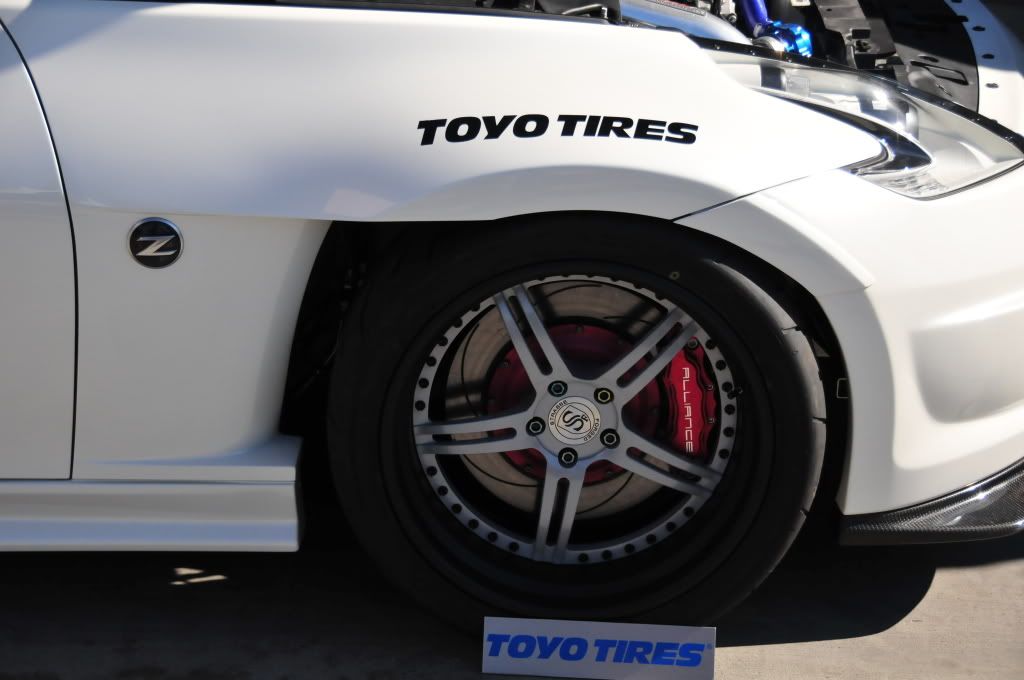
The 2TH PWR Track Car conversion



Thread Starter
New Member
iTrader: (21)
Joined: Sep 2006
Posts: 8,159
Likes: 107
From: London, Ontario, Canada

As far as cooling it hasn't really been a problem. Its warm... but not as hot as the states would get in the middle of summer.

It actually could help. Not only with drag, but with downforce.
Here is a CFD on a rotating wheel

The numbers are Cp, with is co-efficient pressure. Cp=1-(V/Vinf)^2, where V is Volume of air.
So V/Vinf = (1-Cp)^0.5. You can ignore this for now I will make my point at the end.
in the picture, lets take a look at 150deg. At this point the air has gone around the wheel and is trying to exit and is hitting the sideskirt/body of the car, hence the pressure has increased from -19 up to -36
To find our atmospheric pressure here, V/Vinf = (1-(-36))^0.5, or 1.17. This means the air at this spot is 117% of the air outside before it came in.
When air volume is higher than the atmosphere, it is a higher pressure, and thus slower moving air. If this were to enter the bottom of the car, exactly where it would go, it would raise the overall volume of air under the car, raising the pressure, slowing it down, and causing LIFT!!
So if you can exit the air from 150-210deg, the air is a lower pressure when leaving. It is still higher than atmosphere, however it is not exiting under the car and instead into the side of the car, which is already a high pressure area (which above the car, is a good thing).
In practice, you will see a bit of this. More often is hood louvers, which can be less practical as you need pretty wide fenders to begin with, plus it tends to throw rocks at your wind shield. But this throws that high pressure air over the car, and actually creates substantial downforce.
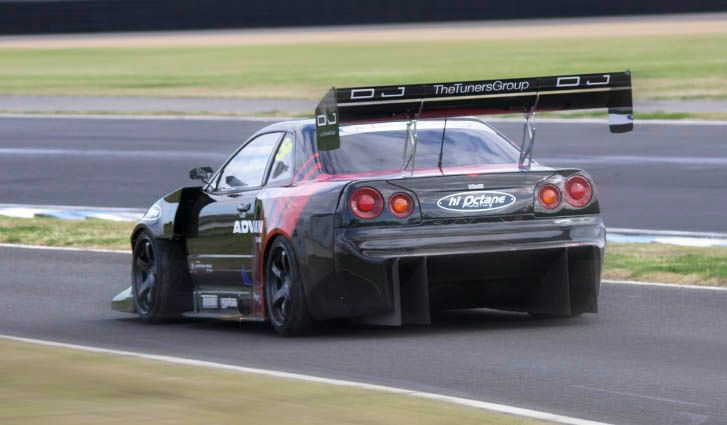
World time attack GTR

Here is a CFD on a rotating wheel
The numbers are Cp, with is co-efficient pressure. Cp=1-(V/Vinf)^2, where V is Volume of air.
So V/Vinf = (1-Cp)^0.5. You can ignore this for now I will make my point at the end.
in the picture, lets take a look at 150deg. At this point the air has gone around the wheel and is trying to exit and is hitting the sideskirt/body of the car, hence the pressure has increased from -19 up to -36
To find our atmospheric pressure here, V/Vinf = (1-(-36))^0.5, or 1.17. This means the air at this spot is 117% of the air outside before it came in.
When air volume is higher than the atmosphere, it is a higher pressure, and thus slower moving air. If this were to enter the bottom of the car, exactly where it would go, it would raise the overall volume of air under the car, raising the pressure, slowing it down, and causing LIFT!!
So if you can exit the air from 150-210deg, the air is a lower pressure when leaving. It is still higher than atmosphere, however it is not exiting under the car and instead into the side of the car, which is already a high pressure area (which above the car, is a good thing).
In practice, you will see a bit of this. More often is hood louvers, which can be less practical as you need pretty wide fenders to begin with, plus it tends to throw rocks at your wind shield. But this throws that high pressure air over the car, and actually creates substantial downforce.
World time attack GTR

Thread Starter
New Member
iTrader: (21)
Joined: Sep 2006
Posts: 8,159
Likes: 107
From: London, Ontario, Canada
It actually could help. Not only with drag, but with downforce.
Here is a CFD on a rotating wheel
The numbers are Cp, with is co-efficient pressure. Cp=1-(V/Vinf)^2, where V is Volume of air.
So V/Vinf = (1-Cp)^0.5. You can ignore this for now I will make my point at the end.
in the picture, lets take a look at 150deg. At this point the air has gone around the wheel and is trying to exit and is hitting the sideskirt/body of the car, hence the pressure has increased from -19 up to -36
To find our atmospheric pressure here, V/Vinf = (1-(-36))^0.5, or 1.17. This means the air at this spot is 117% of the air outside before it came in.
When air volume is higher than the atmosphere, it is a higher pressure, and thus slower moving air. If this were to enter the bottom of the car, exactly where it would go, it would raise the overall volume of air under the car, raising the pressure, slowing it down, and causing LIFT!!
So if you can exit the air from 150-210deg, the air is a lower pressure when leaving. It is still higher than atmosphere, however it is not exiting under the car and instead into the side of the car, which is already a high pressure area (which above the car, is a good thing).
In practice, you will see a bit of this. More often is hood louvers, which can be less practical as you need pretty wide fenders to begin with, plus it tends to throw rocks at your wind shield. But this throws that high pressure air over the car, and actually creates substantial downforce.
World time attack GTR
Here is a CFD on a rotating wheel
The numbers are Cp, with is co-efficient pressure. Cp=1-(V/Vinf)^2, where V is Volume of air.
So V/Vinf = (1-Cp)^0.5. You can ignore this for now I will make my point at the end.
in the picture, lets take a look at 150deg. At this point the air has gone around the wheel and is trying to exit and is hitting the sideskirt/body of the car, hence the pressure has increased from -19 up to -36
To find our atmospheric pressure here, V/Vinf = (1-(-36))^0.5, or 1.17. This means the air at this spot is 117% of the air outside before it came in.
When air volume is higher than the atmosphere, it is a higher pressure, and thus slower moving air. If this were to enter the bottom of the car, exactly where it would go, it would raise the overall volume of air under the car, raising the pressure, slowing it down, and causing LIFT!!
So if you can exit the air from 150-210deg, the air is a lower pressure when leaving. It is still higher than atmosphere, however it is not exiting under the car and instead into the side of the car, which is already a high pressure area (which above the car, is a good thing).
In practice, you will see a bit of this. More often is hood louvers, which can be less practical as you need pretty wide fenders to begin with, plus it tends to throw rocks at your wind shield. But this throws that high pressure air over the car, and actually creates substantial downforce.
World time attack GTR

^ What are the rules/limitations on a world time attack car?



Joined: Feb 2008
Posts: 13,406
Likes: 130
From: MexiCali dodging potholes
Are you planning on putting anything back there! I like the idea but the door is gonna catch air now? I would of at least cut the fender then pull it toward the inner frame?
Like

Replace the asterisks with "the 370z"
In for more
Like
Replace the asterisks with "the 370z"
In for more
Last edited by KingBaby; Dec 12, 2012 at 08:25 AM.

Might as well go all out and do a ground effects car...
Under-body shaped wing w/side skirts to a big *** rear diffuser. Run a smaller rear wing....more downforce...less drag.
Because racecar.
Under-body shaped wing w/side skirts to a big *** rear diffuser. Run a smaller rear wing....more downforce...less drag.
Because racecar.

Thread Starter
New Member
iTrader: (21)
Joined: Sep 2006
Posts: 8,159
Likes: 107
From: London, Ontario, Canada
Thread Starter
New Member
iTrader: (21)
Joined: Sep 2006
Posts: 8,159
Likes: 107
From: London, Ontario, Canada
No it won't catch air. It's got tire and bumper in front of it pulling air forward so I'm sure it's in a vacuum.
Even if it does it will be miniscule. I'm also running with out external side view mirrors so that will more than offset any drag.
I will put a side skirt on. A big one.. I considered bending the sideskirt into the wheel well a bit to help scoop air to the out side of the car.
Last edited by 2TH PWR; Dec 13, 2012 at 07:55 AM.

Thread Starter
New Member
iTrader: (21)
Joined: Sep 2006
Posts: 8,159
Likes: 107
From: London, Ontario, Canada

Thread Starter
New Member
iTrader: (21)
Joined: Sep 2006
Posts: 8,159
Likes: 107
From: London, Ontario, Canada